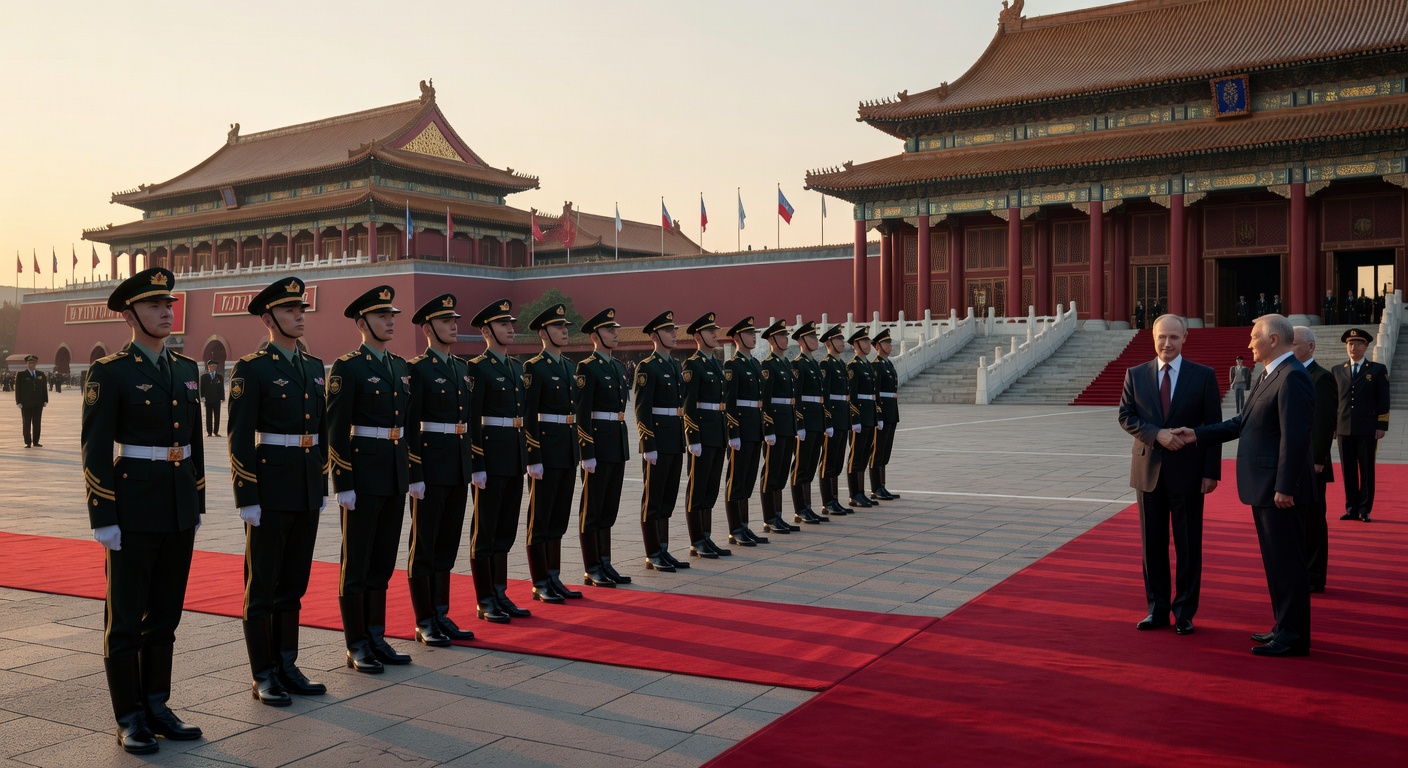
Vladimir Putin travels to Beijing on 19 and 20 May 2026, at the formal invitation of Xi Jinping. A joint declaration and several governmental agreements are expected at the close of the talks. The visit comes less than 72 hours after the departure of Donald Trump, whose trip was the first by a US president to China in nearly a decade. The Trump-Xi summit produced no formal breakthrough, neither on Ukraine nor on the Iranian question.
By receiving the American and Russian leaders within a few days of each other, Beijing underscores its role as a central interlocutor for both of the competing great powers. The China-Russia partnership, formalised in February 2022, has structurally deepened since Russia's entry into Ukraine: in the wake of Western sanctions, China has become Moscow's leading economic partner and absorbs the bulk of its hydrocarbon exports.
The China-US relationship, for its part, is in a phase of relative stabilisation after the 2025 tariff crisis, without any resolution of the underlying disputes over Taiwan, critical technologies or regional files. Negotiations on Ukraine are at a standstill, as Moscow has ruled out any ceasefire unless Kyiv accepts its demands regarding the occupied territories.
The reading of this sequence remains contested. Beijing and Moscow see it as a demonstration of Chinese strategic autonomy and of the strength of their partnership; Kyiv and Paris read it as the consolidation of an axis unfavourable to a fair settlement of the conflict. The extent of Russia's dependence on China, as well as China's role in the war, are likewise assessed in opposing ways by the various actors.