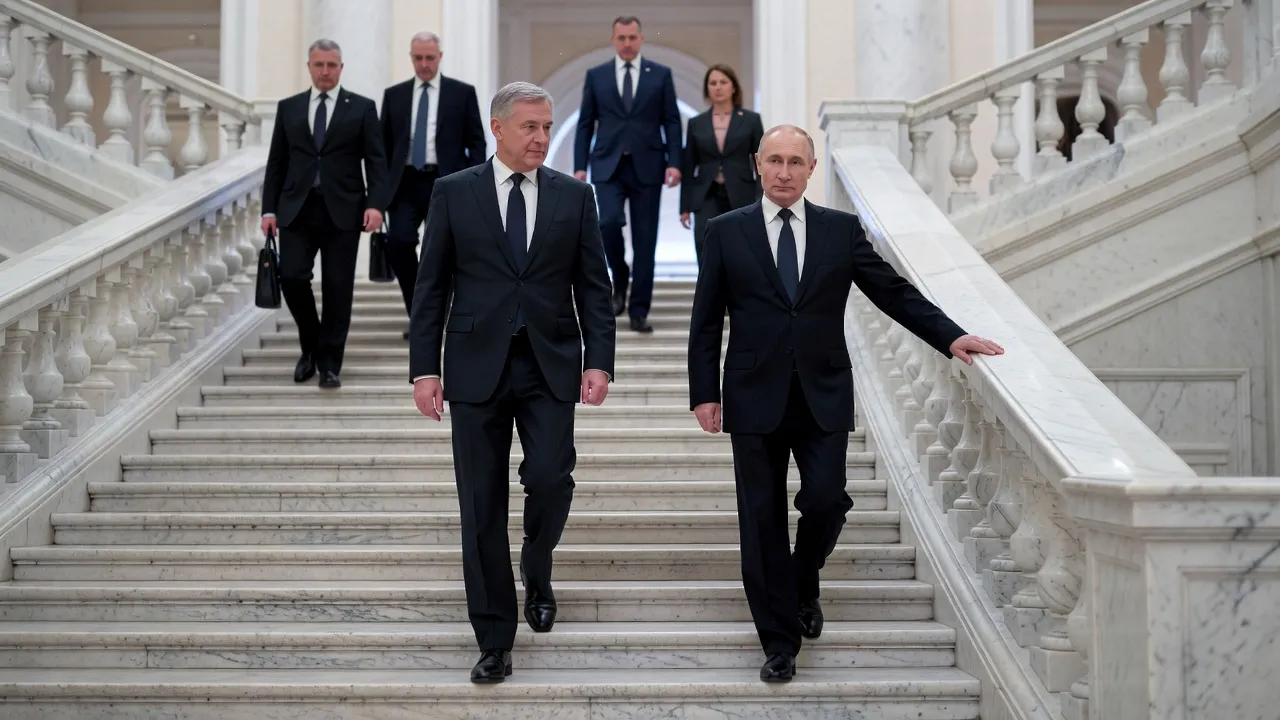
Common ground and differences in coverage across the media analysed.
What the media report in common
1
Steve Witkoff met with Vladimir Putin in St. Petersburg on Wednesday, October 21, a day after his discussions with Volodymyr Zelensky in Oslo.
2
Vladimir Putin announced the release of American Stephen Hubbard, 74, who had been detained since 2022, during the meeting with Steve Witkoff.
Where media coverage diverges
Scope of the Witkoff mission
Does the visit open the way to an agreement? Russian and Qatari media present it as a resumption of dialogue; others highlight the lack of a breakthrough or the Kremlin's judgment on proposals that are 'lacking in substance'.
Is the release without a quid pro quo? Donald Trump says no exchange took place but links it to the suspension of new sanctions; Moscow speaks of a 'gesture of goodwill' and the German press sees it as a gesture towards the American administration.
Canberra is gauging Steve Witkoff's visit to Saint Petersburg by its concrete outcome: one American prisoner released, but no breakthrough in sight in the negotiations on Ukraine.
Budapest is more taken by the flattery than the diplomatic relaunch: the Hungarian press is focusing on the "You're a humanitarian" remark made by Steve Witkoff to Vladimir Putin.
Brasilia sees Hubbard's release as a sign of easing tensions between Trump and Putin, while also recalling that the territories occupied by Russia still block an agreement.
Canberra is gauging Steve Witkoff's visit to Saint Petersburg by its concrete outcome: one American prisoner released, but no breakthrough in sight in the negotiations on Ukraine.
KEY POINTS
Vladimir Putin announced the release of Stephen Hubbard, 74, who has been detained since 2022, during his meeting with Steve Witkoff in Saint Petersburg (ABC News).
Steve Witkoff said he hopes for the resumption of three-way talks between the US, Russia, and Ukraine, on the eve of a meeting in Oslo with Volodymyr Zelensky (PerthNow).
The Trump administration's efforts since early 2025 have produced no significant progress and no imminent breakthrough is mentioned (PerthNow).
ANALYSIS
Canberra, October 21, 2026. The Australian press, led by ABC News and PerthNow, is treating Wednesday's meeting in Saint Petersburg as a diplomatic relaunch episode, whose first tangible fact is a release.
According to ABC, Vladimir Putin announced, while receiving US emissary Steve Witkoff, that Stephen Hubbard, 74, detained in Russia since 2022, was free and at Pulkovo Airport. A former teacher from Michigan, he was serving a sentence of nearly seven years for mercenary activity, after a closed trial. He had been arrested in April 2022 in Izium, where Russian prosecutors claimed he held a post at a Ukrainian army checkpoint. ABC recalls that his American lawyer, Martin De Luca, had told Reuters that Stephen Hubbard considered the accusations false and denied any affiliation with a combat unit. He was, according to the media, the only American prisoner held by Russia that Washington described as "wrongfully detained". ABC describes a "goodwill gesture" that opened discussions, and reports that Steve Witkoff thanked the Russian president.
PerthNow places the visit a day after the meeting in Oslo, where the emissary met with Volodymyr Zelensky and several European leaders. Finnish President Alexander Stubb saw an exchange that "made real progress". At the start of the meeting, Steve Witkoff said he hoped for the resumption of three-way talks between the United States, Russia, and Ukraine, so that technical teams could prepare the next steps towards a settlement. Vladimir Putin thanked Donald Trump and his envoy for their efforts. The media specifies that Donald Trump had mentioned the day before, at the White House, a long conversation with Vladimir Putin on the subject and his request to release the American.
The tone remains cautious on the substance. PerthNow writes that the Trump administration's efforts since early 2025 "have produced no significant progress" and that no imminent breakthrough was mentioned: Moscow and Kiev remain far apart on their conditions, their armies are still clashing, and each is carrying out long-range daily strikes, more than four and a half years after the invasion. ABC reports that Steve Witkoff invited Vladimir Putin to relaunch American mediation and examine new ideas to end the war, during what constitutes, according to the media, his ninth visit.
The overall tone provides a factual reading, focused on the mechanics of negotiation and immediate American interest, without explicit Australian positioning.
Hungary
DOMINANT ANGLE
Budapest is more taken by the flattery than the diplomatic relaunch: the Hungarian press is focusing on the "You're a humanitarian" remark made by Steve Witkoff to Vladimir Putin.
KEY POINTS
Witkoff to Putin: "You're also a humanitarian, sir, I appreciate that," according to a video reported by Politico and picked up by Telex and HVG.
In Oslo on Tuesday, Støre described the discussions with Zelensky as "good and constructive"; a US official speaks of a "strong agreement" on the next steps.
According to the UN, as cited by Telex, 328 civilians died in September in Russian attacks; three people were killed overnight in Kiev and Kharkiv.
ANALYSIS
Budapest, October 21, 2026. For Telex and HVG, the notable scene of the day boils down to one phrase. On Wednesday, in Saint Petersburg, Steve Witkoff, emissary of Donald Trump, told Vladimir Putin: "You talk a lot about my president, Trump, as a humanitarian. You are one too, sir, I appreciate it," adding that it deserved praise. HVG headlines with "You are also a humanitarian" and writes that the emissary "extensively flattered" the Russian president, citing Politico and an excerpt broadcast by Russian state media. Telex recalls in the same article that the total invasion has been going on for four and a half years, that strikes have again hit Kiev and Kharkiv overnight, killing three people, and that the UN counts 328 civilians killed in September.
The day before, on Tuesday in Oslo, Witkoff had met with Volodymyr Zelensky, Norwegian Prime Minister Jonas Gahr Støre, and Finnish President Alexander Stubb, along with European and NATO representatives. Jared Kushner joined via video. Støre spoke of "good and constructive" discussions, necessary "after the events of the past week." A US official cited by AFP via HVG mentions a "strong agreement" between Washington, Kiev, and Europe on the next steps. 444, citing Politico, indicates that Witkoff was to propose to Putin a three-way summit with Trump and Zelensky, which Støre presents as a way to prepare a meeting at the leadership level.
Brazil
DOMINANT ANGLE
Brasilia sees Hubbard's release as a sign of easing tensions between Trump and Putin, while also recalling that the territories occupied by Russia still block an agreement.
KEY POINTS
Stephen Hubbard, 74, detained since 2022, was released on Wednesday, October 21, announced by Steve Witkoff to Vladimir Putin in Saint Petersburg.
Donald Trump claims the US offered nothing in return, after a request made to Putin by phone the previous week.
Witkoff presented proposals to revive Russia-Ukraine-US negotiations after meeting with Zelensky in Norway on Tuesday; occupied territories remain an obstacle.
ANALYSIS
Brasília, October 21, 2026. The Brazilian press reports on the release of Stephen Hubbard, a 74-year-old retired American teacher, announced on Wednesday, October 21, by Steve Witkoff during his meeting with Vladimir Putin in Saint Petersburg. G1 specifies that this man from Michigan, detained since 2022, had been sentenced to nearly seven years in prison after a closed trial in 2024. According to Russian prosecutors, he had signed a contract with the Ukrainian armed forces and fought alongside them until his capture, two months after the start of the invasion.
Veja emphasizes the origin of the decision: a direct request from Donald Trump to Putin, during a phone call the previous week. On Truth Social, the American president stated that Washington had offered nothing in exchange, "an unprecedented situation for Russia." G1 notes, however, that Trump also mentions the current good relations between Washington and Moscow, linked to the lifting of sanctions on Russian oil this month. Witkoff thanked the Russian leader: "Graças a você, ele está voltando para casa, para sua família."
The two media outlets place the episode in a new American diplomatic attempt. Witkoff presented proposals to Moscow to relaunch negotiations between Russia, Ukraine, and the United States, after meeting with Volodymyr Zelensky in Norway on Tuesday. Veja notes that, despite the rapprochement between Trump and Putin, disagreements over the territories occupied by Russia remain one of the main obstacles to a peace agreement.
Germany
DOMINANT ANGLE
Berlin sees the Witkoff mission as an American diplomatic coup where Kiev and Europe are left out, and where the release of Hubbard is less significant than the uncertainty surrounding November.
KEY POINTS
Putin announced the release of Stephen Hubbard to Steve Witkoff in Saint Petersburg on October 21, with Trump stating that no exchange was necessary.
The Kremlin views the US proposals as "lacking substance" but Putin agrees "in principle" to resume talks after November 10.
A potential Putin-Xi-Trump summit is mentioned on the sidelines of APEC, on November 18 and 19 in Shenzhen, with no agreement reached; Zelensky demands to participate.
ANALYSIS
Berlin, October 21, 2026. The German press is covering Steve Witkoff's visit to St. Petersburg as a diplomatic maneuver where Europe and Ukraine carry little weight. Handelsblatt and DW recall that Donald Trump's emissary met with Vladimir Putin on Wednesday, October 21, after "constructive" talks with Volodymyr Zelensky in Oslo on Tuesday, October 20, in the presence of Norwegian and Finnish leaders and representatives of the EU and NATO. According to an American official, Kiev presented new proposals: security guarantees, a post-war economic plan, and an expanded European security architecture. Finnish President Alexander Stubb mentions "significant progress" behind the scenes.
Tagesschau highlights the release of Stephen Hubbard, a retired teacher sentenced in October 2024 to nearly seven years in prison for alleged "mercenary" activities on behalf of Ukraine. Putin announced it in front of Witkoff; Hubbard was already at Pulkovo Airport. Trump claims to have requested this release by phone the previous week and assures that Washington gave nothing in return, "an unprecedented situation for Russia." The channel adds that a German citizen was arrested almost at the same time in Russia.
DW details the follow-up: Witkoff brought "some papers," "ideas" for peace; the Kremlin considers these proposals "lacking substance," but Putin agrees "in principle" to resume talks after November 10. Trump presents the suspension of a new round of sanctions as a necessary concession: without it, negotiations would have been "completely interrupted."
Estonia
DOMINANT ANGLE
Tallinn is scrutinizing Steve Witkoff's tour as a fragile diplomatic relaunch, where the praise addressed to Vladimir Putin and Ukraine's demand for security guarantees carry more weight than the promise of talks in November.
KEY POINTS
Witkoff described Putin as an "humanist" during a meeting in Saint Petersburg lasting over three hours, according to ERR citing Tass.
According to Iouri Ouchakov, Putin said Moscow is "in principle" ready to resume negotiations with the United States and Ukraine in November.
Zelensky claims the document handed over by Witkoff to the Russians contains various security guarantees and that any agreement requires real guarantees (Ohtuleht, ERR).
ANALYSIS
Tallinn, October 21, 2026. For the public radio and television broadcaster ERR, Steve Witkoff's visit to Saint Petersburg is "the latest attempt" by the United States to bring Moscow and Kiev back to the negotiating table, four and a half years after the start of the large-scale invasion. The title first quotes the American envoy, who described Vladimir Putin as an "humanist". Cited from a video by Russian state media broadcast on Wednesday, he says: "You too, sir, are a humanist, and I recognize it, I praise you and thank you again". According to the Tass agency, cited by ERR, the meeting lasted over three hours and ended around 3 pm Estonian time.
ERR recalls that Witkoff had met with Volodymyr Zelensky in Oslo on Tuesday and that it was expected of him to propose to Putin tripartite talks with Donald Trump. This would be the first summit of this type since 2022. The media notes that previous attempts to bring Putin and Zelensky together have failed and that the Kremlin has recently insisted that any meeting take place in Moscow. According to Kremlin advisor Yury Ushakov, Putin told Witkoff that Moscow is "in principle ready" to resume negotiations with the United States and Ukraine next month.
The daily Ohtuleht, in its live coverage on Tuesday, October 20, emphasizes the security aspect. Zelensky affirms that the document Witkoff is to hand over to the Russians contains various security guarantees. He adds, according to ERR, that questions related to Ukrainian territory can only be discussed by heads of state, and that any agreement requires real guarantees and Ukraine's involvement in its drafting.
France
DOMINANT ANGLE
Paris is questioning the diplomatic significance of Steve Witkoff's visit to Saint Petersburg, which it views in the context of a week of high tension between Washington and Kiev.
KEY POINTS
Steve Witkoff met with Vladimir Putin in Saint Petersburg on Wednesday, October 21, for nearly three hours according to the Kremlin, a day after his discussions with Volodymyr Zelensky in Oslo.
Vladimir Putin announced the release of American Stephen Hubbard, who had been detained since April 2022; Donald Trump claims there was no quid pro quo.
Steve Witkoff told Vladimir Putin: "You are a humanist yourself, sir," according to images from Russian public television broadcast by BFMTV.
ANALYSIS
Paris, October 21, 2026. The French press is covering Steve Witkoff's visit to Saint Petersburg as a follow-up to a week of tension between Washington and Kiev. BFMTV recalls that relations have deteriorated since Donald Trump's agreement with Vladimir Putin on the purchase of Russian diesel, and since his criticism of Ukrainian strikes on Russian refineries, which he claims are fueling the surge in fuel prices.
The day before, on Tuesday, October 20, Volodymyr Zelensky received Steve Witkoff and Jared Kushner in Oslo, the latter by video conference due to illness, in the presence of Norwegian and Finnish leaders. The Ukrainian president welcomed the restoration of American intelligence sharing and demanded a place in any negotiations. An American official told AFP of "very productive and constructive" discussions and a "strong alignment" between Americans, Ukrainians, and Europeans. France 24 notes that Marco Rubio, visiting India, mentioned "positive" talks and said Steve Witkoff would share "these ideas" with the Russian side.
The HuffPost France is more reserved: these "diplomatic language elements" do not make us forget the days of high tension. It quotes Donald Trump, who repeats that Volodymyr Zelensky must have the will to end the war, otherwise "it will go very badly", and notes that Moscow has again struck Ukrainian energy sites at night. It counts Steve Witkoff's tenth visit to Russia since 2025.
India
DOMINANT ANGLE
New Delhi sees the Witkoff mission as a cautious diplomatic relaunch: three-way talks to reopen, the release of an American, but no breakthrough announced.
KEY POINTS
Steve Witkoff met with Vladimir Putin in St. Petersburg on Wednesday, a day after meeting with Volodymyr Zelensky in Oslo, to revive trilateral talks.
Russia released Stephen Hubbard, a 74-year-old American retiree from Michigan, accused of fighting as a mercenary for Ukraine.
Marco Rubio, on a two-day visit to India, described the Witkoff-Zelensky meeting in Oslo as "positive", with no surprises.
ANALYSIS
New Delhi, October 21, 2026. The Indian press reports on Wednesday's meeting between US envoy Steve Witkoff and Vladimir Putin in Saint Petersburg as a diplomatic relaunch, without any announced breakthrough. The Deccan Chronicle, which headlines with Donald Trump pushing Kiev towards an agreement, specifies that Witkoff had hoped to discuss the resumption of trilateral talks between the United States, Russia, and Ukraine, so that technical teams could discuss the next steps in a settlement. The newspaper recalls that the Trump administration's efforts since the beginning of last year have not produced significant progress, that nothing suggests an imminent breakthrough, and that Moscow and Kiev remain far apart on terms, while their armies clash daily at long range.
The Times of India details the agenda: the release of Stephen Hubbard, a 74-year-old retired teacher from Michigan, who was tried in camera in 2024 for fighting as a mercenary for Ukraine; renewed US-Russia economic cooperation; Russian diesel exports; and the possibility of a meeting between Putin and Trump in China. According to the Russian agency Interfax, Witkoff handed over documents describing settlement routes and pleaded for the resumption of three-way discussions.
The two dailies relay the previous day's events in Oslo. A US official, quoted by CNN, sees "significant progress" on long-term security guarantees for Ukraine, a post-war economic plan, and a European security architecture. Finnish President Alexander Stubb believes the meeting "made real progress". Volodymyr Zelensky, for his part, judges that a freeze on the conflict is the "minimum" to be obtained from Moscow.
Italy
DOMINANT ANGLE
Rome views Witkoff's mission to Saint-Petersburg as an attempt to revive the diplomatic route after days of chaos between Westerners, while highlighting the vagueness of American proposals.
KEY POINTS
According to Peskov, quoted by Tass via ANSA, the Witkoff-Putin meeting lasted approximately three hours and the Kremlin says it is ready to resume trilateral negotiations in mid-November.
The New York Times, as reported by ANSA, claims that Trump is seeking to get Kiev to accept territorial concessions in the Donbass.
Stephen Hubbard, an American sentenced to six years in prison for fighting alongside Kiev, was released on October 21 on Putin's orders (La Repubblica).
ANALYSIS
Rome, October 21, 2026. For the Italian press, Wednesday, October 21, is part of a sequence: Oslo, then St. Petersburg. La Repubblica recalls that after his Norwegian meeting with Volodymyr Zelensky, the White House envoy was to present Vladimir Putin with "an updated proposal" to end the war. ANSA describes the talks in Oslo as "important and constructive": Zelensky and his European partners are seeking to turn the page on an open confrontation with the United States, and the Ukrainian president announces that the sharing of American intelligence "is working" again. Marco Rubio, from Mumbai, speaks of a "positive meeting, nothing unexpected or surprising".
The Italian agency tempers this relief, however. According to the New York Times, which it cites, Donald Trump is seeking to convince Kiev to accept an agreement including territorial concessions in the Donbass, and the lack of details on the content of the proposals does not help to dispel doubts about the Western plan. Jared Kushner participated in the Oslo discussions remotely.
In St. Petersburg, Witkoff is welcomed at Pulkovo Airport by presidential advisor Kirill Dmitriev. According to Dmitri Peskov, cited by Tass, the meeting with Putin lasted approximately three hours. Witkoff claims to have brought "several documents" describing approaches to a peaceful solution and asks Putin to review them later; Kushner joined by phone. Peskov assures that all proposals will be examined by the president, but "much depends on the Ukrainians". The Kremlin says it is ready to resume trilateral negotiations with Kiev and Washington in mid-November.
Malaysia
DOMINANT ANGLE
Kuala Lumpur is primarily focused on the diplomatic mechanism: a release without an exchange, suspended sanctions, and a US emissary tasked with relaying Oslo's ideas to Saint Petersburg.
KEY POINTS
Marco Rubio, from India, describes the Oslo talks between Steve Witkoff and Volodymyr Zelensky prior to the trip to Saint Petersburg as "positive".
Stephen Hubbard, sentenced in October 2024 to nearly seven years in prison for "mercenary activities", is released; Donald Trump claims no "swap" took place.
Donald Trump links this release to the recent suspension of certain American sanctions and tariffs on Moscow.
ANALYSIS
Kuala Lumpur, October 21, 2026. Malaysia's two pool media outlets, The Sun MY and Malay Mail, are covering the episode through Washington's words, with few direct Russian or Ukrainian voices.
The Sun MY reports on the remarks of Secretary of State Marco Rubio, made from India, according to which the discussions between envoy Steve Witkoff and Volodymyr Zelensky in Oslo were "positive, nothing unexpected, nothing surprising". Armed with these ideas, Steve Witkoff can travel to Saint Petersburg and present them to the Russian side: "let's see if we can make progress". Marco Rubio nonetheless acknowledges the difficulty of ending the war, which has entered its fourth year: "if it were an easy war to resolve, it would have been resolved a long time ago".
The same article devotes a long passage to another issue: the slowdown of the military version of Starlink, Starshield, used by Ukraine on the battlefield. Rubio claims that the White House had no prior knowledge and that the president "has nothing to do" with SpaceX's decisions. Donald Trump denies having ordered a reduction in bandwidth, while Elon Musk had said that the order could only come from the White House; the Wall Street Journal nonetheless claims that Musk gave the order.
Malay Mail, in Washington on October 21, focuses on Stephen Hubbard, an American captured by Russian forces in Ukraine, a retired English teacher in his sixties, sentenced in secret in October 2024 to nearly seven years in prison for "mercenary activities", an accusation he contests. According to Russian agencies, Vladimir Putin announced the release during his meeting with Steve Witkoff, specifying that the man was at Pulkovo Airport; the envoy thanked him.
Norway
DOMINANT ANGLE
Oslo is positioning itself as host and relay for the negotiation: the Norwegian press reports Witkoff's mission to Saint-Petersburg as the direct follow-up to the talks held in the capital.
KEY POINTS
On October 20, Støre, Stubb, Zelensky, and Witkoff met in Oslo; Støre mentioned "good and constructive" conversations and announced Witkoff's departure for Saint-Petersburg.
According to Iouri Ouchakov, quoted by Reuters, Russia is in principle ready to resume peace talks in November, which have been suspended since February.
Trump claims that Stephen Hubbard would not have been released if new sanctions against Russia had been imposed.
ANALYSIS
Oslo, October 21, 2026. Norway's press is telling the story from its own capital: on Tuesday, October 20, the government's representation residence, Parkveien 45, brought together Volodymyr Zelensky, US emissary Steve Witkoff, Finnish President Alexander Stubb, and Prime Minister Jonas Gahr Støre, along with security advisors from the EU, NATO, the United Kingdom, Germany, and Italy. Støre spoke of "good and constructive conversations, necessary after the events of last week," focusing on Ukraine's security, a post-war economic plan, territorial issues, sanctions, and the European security order.
Aftenposten and Dagbladet noted a detail: Witkoff did not participate in the press conference. "This is a press conference for political leaders," Støre replied to a Ukrainian journalist. Dagbladet described a silent Witkoff leaving the dinner, shortly after 9:15 p.m., against a backdrop of an increasingly cold tone between Washington and Kiev.
On Wednesday, October 21, Støre explained to NRK that Witkoff is traveling to Saint Petersburg to exchange Oslo's ideas and "perhaps prepare a meeting at the leadership level" with Putin, Trump, and Zelensky. VG detailed the dossier: security, economic development, and a proposal for a mutual cessation of strikes on energy production, with a corridor for Ukrainian goods in the Black Sea. Støre argued that Europe should be at the table: "We cannot put all the cards in the Americans' hands." Marco Rubio judged the Oslo meeting "positive."
Pakistan
DOMINANT ANGLE
Islamabad views Steve Witkoff's tour as a diplomatic maneuver by Washington: the release of an American and the idea of a Putin-Trump summit in China are overshadowing a Ukraine pressed to conclude.
KEY POINTS
Vladimir Putin proposed meeting Donald Trump in China during his meeting with Steve Witkoff in St. Petersburg, the ninth in-person meeting between the two men (Geo News, according to Russian state television).
Stephen Hubbard, 74, sentenced to six years and ten months in prison in October 2024, was released during the meeting; Steve Witkoff described Vladimir Putin as "humanitarian" (ARY News, AFP).
In Oslo, discussions with Volodymyr Zelensky focused on security guarantees, a post-war economic plan, and European security architecture (Business Recorder).
ANALYSIS
Islamabad, October 21, 2026. Geo News, Business Recorder, and ARY News are following the Saint Petersburg meeting based on Reuters and AFP dispatches. On Wednesday, Vladimir Putin proposed to Donald Trump that they meet in China, hosting emissary Steve Witkoff, according to Russian state television cited by Geo. The Kremlin had already mentioned the possibility of a three-way meeting with Xi Jinping at an Apec summit in China next month. Vladimir Putin also offered to discuss the restoration of economic cooperation between Moscow and Washington. Geo specifies that this is the ninth in-person meeting between Steve Witkoff and the Russian president.
The day before, in Oslo, a US official described discussions with Volodymyr Zelensky, Norwegian and Finnish leaders, and European and NATO representatives as "constructive". Business Recorder reports "significant progress" towards a coordinated approach to Russia, on security guarantees, a post-war economic plan, and European security architecture. Steve Witkoff is to seek to "create a path towards direct trilateral negotiations", according to this official. Donald Trump stated that it was time for Ukraine to end the war, or it would face "a very bad thing".
Poland
DOMINANT ANGLE
Warsaw weighs the implications of Witkoff's mission in terms of its risks for Europe: the release of an American is a gesture by Moscow, but the idea of a Putin-Trump-Xi summit is unsettling.
KEY POINTS
Witkoff and Putin meet in person for the ninth time since the envoy's appointment as chief negotiator (Rzeczpospolita).
Stephen Hubbard, 74, sentenced in October 2024 to six years and ten months in a penal colony, was released by Russia (RMF24, Rzeczpospolita).
Putin proposed discussing a summit with Trump in China; Peskov deemed the comparison with Yalta "totally out of place" (Rzeczpospolita).
ANALYSIS
Warsaw, October 21, 2026. The Polish press is following Steve Witkoff's two-part mission. On Tuesday, in Oslo, Donald Trump's emissary met in person with Volodymyr Zelensky; Jared Kushner participated remotely, as he allegedly - "rzekomo", according to RMF24 - contracted the flu. Norwegian Prime Minister Jonas Gahr Støre and Finnish President Alexander Stubb were present. Stubb stated that the discussions allowed for the development of certain elements of a peace agreement, to be presented on Wednesday in Saint Petersburg. Zelensky expressed gratitude towards Washington for restoring access to intelligence.
Rzeczpospolita specifies that the exchanges in Oslo focused on security guarantees for Ukraine after the war, and a US official cited by Reuters deemed them "constructive". The newspaper recalls that Donald Trump said it was time for Ukraine to end the war, or else it would face "something very bad".
On Wednesday, Rzeczpospolita reported on a gesture from Russia that the US President had requested: the release of Stephen Hubbard. RMF24 recalls that this 74-year-old man was sentenced in October 2024 to six years and ten months in a penal colony for mercenarism; Russian services claim he joined the Ukrainian territorial defense in Izyum in February 2022 and was taken captive in April 2022. According to NYT, cited by RMF24, the mission aimed to show the interest in agreements with Moscow.
Qatar
DOMINANT ANGLE
Doha is gauging the diplomatic mechanics of the day: an updated American proposal being put to Putin, following up on Oslo, to pave the way for direct three-way talks.
KEY POINTS
According to Axios, as cited by Al Jazeera, Steve Witkoff was to present an updated proposal to Vladimir Putin in Saint Petersburg on Wednesday to end the war, with Jared Kushner joining via video conference.
Kiev has requested similar guarantees to NATO's Article 5; the Norwegian Prime Minister deemed the Oslo meeting "good and constructive".
Gulf Times, according to Russian agencies, reports that Putin announced the release of American Stephen Hubbard, who was present at Pulkovo Airport, and that Witkoff thanked him.
ANALYSIS
Doha, October 21, 2026. Qatari coverage, carried by Al Jazeera in Arabic and Gulf Times, focuses on the diplomatic mechanics of the day. On Wednesday, October 21, according to Al Jazeera, citing the Axios website and American sources, Steve Witkoff, Donald Trump's emissary, was to meet Vladimir Putin in Saint Petersburg to present him with an updated proposal aimed at ending the war in Ukraine. Jared Kushner was to join the meeting by video conference.
The channel places this meeting in the continuation of the discussions held in Oslo, attended by Witkoff, Kushner, Ukrainian President Volodymyr Zelensky, and European officials. These discussions, it writes, aimed to contain the tension between Donald Trump and Zelensky, after Kiev's complaints about the diesel agreement with Moscow and the disruption of American military deliveries, including intelligence cooperation, which would have hindered the Ukrainian army's ability to repel Russian attacks.
Norwegian Prime Minister Jonas Gahr Støre judged the Oslo meeting "good and constructive", likely to prepare for another meeting at the leaders' level. Finnish President Alexander Stubb stated that "the peace process is back on track". According to Axios, the exchanges focused on drafting a unified framework agreement proposal, and an American official speaks of tangible progress and strong alignment at the working team level. Kiev, for its part, demands guarantees similar to NATO's Article 5.
Romania
DOMINANT ANGLE
Bucharest is reporting, through news agency dispatches, Witkoff's mission to Saint Petersburg as an uncertain diplomatic step, between tense Western allies and Moscow.
KEY POINTS
Steve Witkoff is heading to Saint Petersburg on Wednesday, according to Tass citing an anonymous source, as reported by Agerpres.
Norwegian Prime Minister Jonas Gahr Stoere says the US-European proposals "could pave the way for a meeting at the leadership level".
Witkoff had met with Zelensky and Finnish President Alexander Stubb in Oslo on Tuesday, amid an escalation of verbal exchanges between Trump and Zelensky.
ANALYSIS
Bucharest, October 21, 2026. The Romanian press is treating Steve Witkoff's visit to Russia as the start of a negotiation, based on agency dispatches reprinted by Agerpres. G4Media and Digi24 report, according to the Russian agency Tass, which cites an anonymous source, that Donald Trump's special envoy is traveling to Russia on Wednesday, October 21. Digi24 writes that the visit is taking place "today", G4Media announces it for Wednesday.
The key point is the announcement by Norwegian Prime Minister Jonas Gahr Stoere, relayed by AFP: Witkoff will go to Saint Petersburg to present to Russian authorities proposals developed by the Americans and Europeans. According to Stoere, they "could pave the way for a meeting at the leadership level". An American official cited by Axios specifies that the envoy is to meet Vladimir Putin and present him with some of the ideas discussed with European allies.
The two articles place the mission after the meeting on Tuesday in Oslo, where Witkoff met with Ukrainian President Volodymyr Zelensky and Finnish President Alexander Stubb, according to Reuters. The sequence is presented as a back-and-forth between Europeans, Kiev, and Moscow, with Washington in an intermediary position.
The context retained is that of tension between allies: the visit is taking place, Digi24 writes, "against a backdrop of verbal escalation between Trump and Zelensky", who have mutually accused each other in recent days of preventing a solution. This tension is not detailed in the articles: neither the exchanged phrases nor their exact authors are cited.
Russia
DOMINANT ANGLE
Moscow presents the Saint Petersburg meeting as a resumption of dialogue on its terms: the release of Hubbard as a gesture of goodwill, three-way negotiations in November, and economic projects with Washington.
KEY POINTS
According to Iouri Ouchakov, Putin said the country is ready to resume trilateral negotiations on Ukraine in the second week of November.
Stephen Hubbard, sentenced to six years and ten months for mercenary activities, has been released; Peskov calls it a "gesture of good will".
Peskov claims that Witkoff's proposals, reported from Oslo, will be studied and evaluated by the president.
ANALYSIS
Moscow, October 21, 2026. On Wednesday, Vladimir Putin received American envoy Steve Witkoff at the Constantin Palace in St. Petersburg. According to Sputnik, he said he was "very happy" to welcome him, thanked Donald Trump for his attention to the settlement efforts, and mentioned a possible meeting with him in China. Kirill Dmitriev greeted the envoy at Pulkovo Airport, and Jared Kushner, who was ill, participated via video conference.
The result that the Russian press retains is that of the conversation, which lasted more than three hours according to Vedomosti. According to adviser Yury Ushakov, Putin said Russia is ready to resume trilateral negotiations with the United States and Ukraine in the second week of November. Witkoff conveyed this proposal, thanked the Russian president for the "diesel agreement," and reported on Oslo. Ushakov believes that the "new approaches" of Ukraine and Europe contain little practical substance. The two parties also discussed major Russian-American economic projects.
The release of Stephen Hubbard opened the meeting. Meduza recalls that he was sentenced by the Moscow court to six years and ten months for mercenarism, after his engagement in the territorial defense of Izium. Dmitry Peskov speaks of a "gesture of good will." Trump claims that Russia did not demand anything in exchange "out of respect for President Trump."
Sweden
DOMINANT ANGLE
Stockholm views Witkoff's mission with skepticism: expectations are deemed low in Europe, and Carl Bildt sees it as yet another diversionary tactic by Putin.
KEY POINTS
Zelensky, in Oslo: "There are other types of guarantees that Steve will share with the Russians" (Dagens Nyheter).
Carl Bildt, former Swedish prime minister, sees the move as "yet another diversionary tactic" by Putin (Aftonbladet, Svenska Dagbladet).
Witkoff returns to Norway after Saint Petersburg to meet with Jonas Gahr Støre, who hopes for more Russian openings (Sveriges Radio).
ANALYSIS
Stockholm, October 21, 2026. In the Swedish press, Steve Witkoff's meeting with Vladimir Putin in Saint Petersburg is first reported as a follow-up to Oslo. On Tuesday, Donald Trump's emissary met with Volodymyr Zelensky, Norwegian Prime Minister Jonas Gahr Støre, and Finnish President Alexander Stubb. Dagens Nyheter quotes Zelensky: "There are other types of guarantees that Steve will share with the Russians." Sveriges Radio deployed its international correspondent Daniel Alling to cover the press conference that followed.
The tone is cautious. Aftonbladet and Svenska Dagbladet, which published the same dispatch, write that expectations in Europe are low. They cite former Swedish Prime Minister Carl Bildt (M), who writes on X that Putin is supposed to sell him "yet another diversionary maneuver" and that "it usually works." Marco Rubio, visiting India, judges the Oslo exchanges positive, "nothing unexpected, nothing surprising," and says that Witkoff arrives "equipped with ideas." The two newspapers recall that the Oslo meeting was hastily convened after a period of high tension between Washington and Kiev, partly due to a controversial agreement providing for Russia to sell diesel to the United States.
This diesel issue also structures Expressen's coverage. According to Russian state media, Witkoff thanked Putin for the diesel agreement and urged Moscow to resume peace talks with Ukraine. The newspaper specifies that Jared Kushner, who is ill, participated remotely, and notes that Putin also made an unusual offer: fertilizer. Earlier, Expressen relayed Reuters and Axios on the emissary's arrival in Russia to discuss a new peace plan.
Ukraine
DOMINANT ANGLE
Kyiv is weighing Witkoff's visit to Putin against the security guarantees agreed upon the day before in Oslo, and is outraged by the compliment paid to the Kremlin leader.
KEY POINTS
Zelensky mentioned at Oslo NATO's Article 5 and an "Article 5 light" option in the document Witkoff was to take to Moscow (Ukrinform).
The Putin-Witkoff meeting lasted about three hours, with Kirill Dmitriev; Kushner joined via video link (Ukrinform, Ukrainska Pravda).
According to the UN, as cited by Kyiv Post, at least 328 civilians were killed and 2,105 injured in September.
ANALYSIS
Kyiv, October 21, 2026. The Ukrainian press is addressing the meeting between Steve Witkoff and Vladimir Putin at the Konstantin Palace near Saint Petersburg, with the security guarantees discussed the day before in Oslo. On Tuesday, October 20, Volodymyr Zelensky received the American envoy in the presence of Norwegian Prime Minister Jonas Gahr Støre and Finnish President Alexander Stubb. According to Ukrinform, he mentioned Article 5 of NATO and a "Article 5 light" variant, included in the document that Witkoff was to hand over to the Russians; Kyiv was hoping for a response within a day. Zelensky recalled that no issue concerning Ukraine could be discussed without it, and referred the territories to the "highest level".
On Wednesday, October 21, the conversation lasted nearly three hours, reports Ukrainska Pravda, citing Interfax. Witkoff said he hoped for the resumption of Russia-US-Ukraine talks to address technical issues, and believed that a basis existed for a ceasefire. Kirill Dmitriev participated; Jared Kushner, who was ill, joined via video link, according to Dmitri Peskov. Ukrainian media also note that Witkoff thanked Putin, on behalf of Donald Trump, for his decision on diesel, and that the latter mentioned more fertilizer deliveries to the United States.
The release of Stephen Hubbard, 74, a teacher from Michigan who has been living in Izioum since 2014, is detailed: he was sentenced to six years and ten months for allegedly joining the Ukrainian territorial defense, according to Russian investigators. His sister claims the accusation is a lie.
United Kingdom
DOMINANT ANGLE
London is deciphering the Saint Petersburg meeting through the release of Stephen Hubbard and the concern of Kiev's allies in the face of a Donald Trump who appears to be turning away from Ukraine to move closer to Moscow.
KEY POINTS
Stephen Hubbard, 74, sentenced in 2024 to nearly seven years in a penal colony for fighting, according to Moscow, for Ukraine, was released during the meeting between Vladimir Putin and Steve Witkoff (BBC).
Donald Trump claims no exchange was necessary and that without the suspension of sanctions, negotiations on Hubbard "would have come to a complete and total halt" (BBC).
Allies are worried about Donald Trump turning away from Kiev while bringing Washington closer to Moscow (The Independent).
ANALYSIS
London, 21 October 2026. For both the BBC and The Independent, Wednesday's meeting between Vladimir Putin and Donald Trump's emissary, Steve Witkoff, in Saint Petersburg, began with a gesture: the release of Stephen Hubbard, a 74-year-old American and former teacher from Michigan.
The BBC recalls that Stephen Hubbard had been sentenced in 2024 to nearly seven years in a penal colony for allegedly fighting for Ukraine, according to Moscow. He had reportedly served in a defense unit in Izyum, in eastern Ukraine, before being captured by Russian forces shortly after the 2022 invasion. The US State Department had classified him as "wrongfully detained". Vladimir Putin indicated during the meeting that Hubbard had been taken to Pulkovo Airport. According to CBS News, the BBC's American partner, Hubbard was in poor health and was to be transported to Texas for treatment.
Donald Trump's account is widely reported. The American president claims that the release was in response to a demand made "directly" to Vladimir Putin the previous week, and that "there was no 'swap' necessary". The BBC notes that other releases of Americans detained in Russia have involved prisoner exchanges. It also points out that Donald Trump appears to be defending his recent decision to suspend sanctions against Russia, two days before they were due to come into effect: new sanctions, he claims, would have stopped the negotiations over Hubbard altogether.
United States
DOMINANT ANGLE
The United States views the episode through the lens of domestic politics: the release of Stephen Hubbard becomes a presidential victory, while the word "humanitarian" addressed to Putin by Steve Witkoff fuels controversy.
KEY POINTS
Stephen Hubbard, 74, detained since 2022 and the last American deemed a "wrongful detainee" by the State Department, was released Wednesday, according to CBS News.
Donald Trump claims the release was made without an exchange, but that it would not have happened without the suspension of new sanctions against Russia (CBS News, The Hill).
Steve Witkoff told Vladimir Putin: "You are a humanitarian also, sir, and I salute that" (CNBC, NBC News, Time).
ANALYSIS
Washington, October 21, 2026. For the American press, Steve Witkoff's visit to Saint Petersburg opens and is summed up first with one face: that of Stephen Hubbard, a 74-year-old retired teacher from Michigan, released on Wednesday after more than four years of detention. CBS News recalls that he was the last American formally qualified as "wrongfully detained" by the State Department. NPR specifies that he was sentenced in 2024, after a closed trial, to nearly seven years in prison for alleged mercenarism.
Donald Trump claims the result on Truth Social: the release was obtained at his request, during a call with Vladimir Putin the previous week, and the United States "had nothing to give in return". He adds that there was "no exchange". Fox News extensively reprints this message, including the phrase "Biden should have done the Hubbard release long ago". The Hill and CBS note, however, that the president himself linked the release to his decision to suspend new sanctions against Moscow, which he says he preserved in order not to interrupt the negotiation.
The sequence that attracts the most attention is the video of the opening of the meeting. Steve Witkoff thanks Putin: "You talk so much about President Trump as a humanitarian; you are one too, sir, and I salute that." CBS emphasizes that the emissary addresses these praises to the leader who ordered the invasion of Ukraine. NBC sees a sign of rapprochement and estimates that the release offers Trump "a victory to claim" after the criticism, in the United States and abroad, of his shift away from Kiev. The Hill recalls that the president has already faced criticism from his own camp over Russian diesel imports and the waiver of sanctions.
South Africa
DOMINANT ANGLE
Pretoria sees Witkoff's visit as a rescue operation for the plummeting Washington-Kiev relationship, with Europeans acting as mediators.
KEY POINTS
Zelensky met with Witkoff in Oslo on Tuesday, October 20, in the presence of Norwegian and Finnish leaders, with Kushner participating remotely (TimesLIVE).
Kiev blames Washington for the lack of early warning on Russian missile strikes, the restriction of Starshield links and undelivered air defenses; Washington denies any deliberate obstruction.
Trump stated on Monday, October 19: "Russia, frankly, has been fine on Ukraine", and that Kiev should find "somebody else to negotiate".
ANALYSIS
Pretoria, October 21, 2026. The South African press consulted here, SABC News and TimesLIVE, focuses on the Oslo stage, not Saint Petersburg: their articles, dated October 20, deal with the meeting between US envoy Steve Witkoff and Volodymyr Zelensky, and present it as an attempt to repair a deteriorating relationship.
TimesLIVE, in a dispatch signed by Nerijus Adomaitis and Lina Golovnya, writes that Zelensky met with Witkoff on Tuesday, October 20, "in a bid to rescue relations that have sunk to new lows". The two men hugged before the discussions, which were hosted in Oslo by the leaders of Norway and Finland. Jared Kushner participated remotely. Zelensky had first met with Norwegian Prime Minister Jonas Gahr Støre and Finnish President Alexander Stubb.
The account highlights Kiev's grievances: Washington allegedly failed to provide early warning of Russian missile strikes, restricted the Starshield satellite links that guide Ukrainian drones, and failed to deliver air defense systems paid for by Europeans. Washington denies any deliberate obstruction. Secretary of State Marco Rubio acknowledged on Tuesday that a batch of missiles purchased by European countries may not have been delivered.
SABC News links the rift to the diesel agreement concluded with Russia, which has weakened sanctions: Zelensky accuses Washington of betrayal and rewarding Vladimir Putin. Donald Trump, for his part, believes that the Ukrainian leader is hindering peace. The channel quotes his statement: "Zelenskiy doesn't know what he's talking about", and his conviction that it's time for "somebody else" to negotiate for Ukraine.
Explore every perspective on this subject across 20 countries.
Russia: Steve Witkoff meets Vladimir Putin, Moscow frees an American and says it is ready to resume talks in November
published on
October 21, 2026
20
countries
59
sources
70
articles
28/100
gap
The content of the proposals brought by Steve Witkoff remains largely undetailed in the articles in the corpus, with mostly the surrounding statements being reported: those of the Kremlin, the Oslo hosts, Kiev, and Washington.
The Kremlin says it is studying the American proposals and declares itself ready, in principle, to resume three-way talks in November; no date has been set.
What the Kremlin takes away from it
Russian reports mainly come from advisor Iouri Ouchakov. According to Vedomosti, he indicates that Vladimir Putin says he is ready to resume trilateral negotiations in the second week of November. Tass, cited by ANSA, reports that Dmitri Peskov promises an examination of all proposals by the president, specifying that much depends on the Ukrainians.
« much depends on the Ukrainians »
Dmitri Peskov, Kremlin spokesperson, quoted by Tass and reported by ANSA, October 21
The judgment on the substance is reported in two ways. In the Russian press, Ouchakov estimates that the "new approaches" from Ukraine and Europe contain little practical substance. DW writes that the Kremlin judges Witkoff's ideas as "lacking substance", while noting that Putin accepts "in principle" to resume talks after November 10. ANSA, for its part, mentions mid-November.
Regarding what Witkoff brought, ANSA notes that he talks about "several documents" describing approaches for a peaceful solution, which he asks Putin to examine later; DW mentions "a few papers". Russian state media, cited by Expressen, say he thanked Putin for the agreement on diesel. CBS reports that Peskov warned that the discussions would be long and that Moscow expects Kiev to make "necessary decisions".
Oslo, a file with little detail
The Norwegian press provides the most detailed account of the meeting on Tuesday, October 20. It was held at Parkveien 45, the government's residence, with security advisors from the EU, NATO, the United Kingdom, Germany, and Italy. Jonas Gahr Støre mentions five topics: Ukraine's security, a post-war economic plan, territorial issues, sanctions, and the European security order. Aftenposten and Dagbladet note that Witkoff did not participate in the press conference.
« This is a press conference for political leaders »
Jonas Gahr Støre, Norwegian Prime Minister, in Oslo on October 20, as reported by Aftenposten
VG adds a proposal for a mutual cessation of strikes on energy production, with a corridor for Ukrainian goods in the Black Sea. Al Jazeera, citing Axios, mentions the drafting of a unified framework agreement proposal. ANSA writes that the lack of details on the content of the proposals does not help dispel doubts about the Western plan, and cites the New York Times: Donald Trump is seeking to have Kiev accept territorial concessions in the Donbass.
Volodymyr Zelensky repeats, according to Ohtuleht and ERR, that territorial issues are the sole responsibility of heads of state. ANSA says he is willing, on Fox News, to freeze the conflict along the current front line before seeking security guarantees; the Times of India reports that he sees this freeze as the "minimum" to be obtained from Moscow.
A week of tension between Washington and Kiev
Several outlets are revisiting the visit after days of tension. TimesLIVE, which published a wire report, lists Kiev's grievances: no early warning of Russian missile strikes, restricted Starshield links, and European-funded air defense systems that were not delivered. Washington denies any deliberate obstruction, and Marco Rubio acknowledged that a batch of missiles purchased by European countries may not have been delivered. According to Telex and HVG, he found the accusation of withheld intelligence "scandalous"; according to Geo News, Zelensky says that strike alerts are working again.
« Russia, frankly, has been fine on Ukraine »
Donald Trump, Monday, October 19, as reported by TimesLIVE
SABC News links the tension to the diesel agreement with Russia: Zelensky accuses Washington of betrayal, and Donald Trump believes that the Ukrainian leader is hindering peace. TimesLIVE reports that Trump says he lifted sanctions to lower fuel prices; Geo News adds that fuel costs are weighing on Republicans ahead of the November legislative elections.
Ukrainska Pravda cites Axios: Jared Kushner allegedly asked Kiev to stop striking Russian refineries. The HuffPost France cites Trump, who says Zelensky must be willing to end the war, or "it will go very badly".
How the media outlets read the episode
Not all coverage in the corpus reports on the same day. The South African texts are dated October 20, the Romanian account announces the visit as upcoming, and the Swedish articles do not report on the release or the November deadline. This observation measures the content of the collected articles, not the attention paid to the subject in these countries.
« another diversionary tactic »
Carl Bildt, former Swedish Prime Minister, on X, quoted by Aftonbladet and Svenska Dagbladet
Witkoff's statement to Putin is reported from several angles. CBS emphasizes that it is addressed to the leader who ordered the invasion of Ukraine. Kyiv Post sets it against the UN's reports on civilians killed in September. HVG writes that the envoy "extensively flattered" the Russian president, ERR makes it their headline, and Aftenposten devotes an article to the "strong reactions".
On Hubbard's release, the BBC notes that other releases of Americans detained in Russia have involved prisoner exchanges, and La Repubblica places it in the history of exchanges between Moscow and Washington. NBC sees it as a victory that Trump can claim. La Tagesschau reports that a German national was arrested almost at the same time in Russia.
Regarding the summit mentioned in China, Rzeczpospolita relays German media reports that it would be "a catastrophe for war-torn Ukraine and all of Europe", and notes that Peskov considers the comparison with Yalta "totally misplaced". Zelensky demands that Ukraine be seated at any table.
Stephen Hubbard
Convicted in October 2024 for "mercenary activities", he was the last American qualified as "wrongfully detained" by the State Department.
Security guarantees
Kiev is requesting similar guarantees to NATO's Article 5, including a "Article 5 light" option, in the document being promoted by Witkoff.
Format of the meeting
Approximately three hours of discussion, with Kirill Dmitriev; Jared Kushner joined via video link.
Summit mentioned
A Poutine-Xi-Trump summit is mentioned on the sidelines of APEC, on November 18 and 19 in Shenzhen, with no agreement concluded.
Key figures
74 years
Age of Stephen Hubbard, a retired Michigan man detained since 2022
Hungarian headlines also emphasize the fragility of the context. Telex and HVG recall that relations between Kiev and Washington have deteriorated: Trump's agreement with Putin on the purchase of Russian diesel, criticism of Ukrainian strikes on refineries, Kiev's suspicions of delays in the delivery of Patriot missiles. Marco Rubio called the accusation that intelligence was being withheld "scandalous"; Zelensky later welcomed their restoration. Telex notes that Trump had stated that it was time for Ukraine to have a new president.
Zelensky has emphasized that territorial issues are the sole responsibility of leaders, that any agreement must include real security guarantees and involve Ukraine. On the Russian side, HVG notes that Sergei Lavrov had warned that Saint Petersburg could produce at most economic agreements. Telex mentions among the topics discussed the case of Stephen Hubbard, a retired American who had joined the Ukrainian forces before being captured, without the provided excerpt specifying the outcome.
The Brazilian perspective is that of an outside observer to the conflict, attentive to the mechanism between the two presidents more than the positions of Kiev or the Europeans. The humanitarian gesture is presented as a signal of bilateral détente, whose impact on the substance of the negotiation remains to be demonstrated. The articles provided do not report the exact date of a resumption of talks or the security guarantees discussed in Oslo.
German media also relay pressure on Kiev: Trump warns that Ukraine must accept an agreement, otherwise it will end "very badly," as American-Ukrainian relations have deteriorated. Zelensky demands that his country be seated at any table, including a potential Putin-Xi-Trump summit on the sidelines of the APEC, on November 18 and 19 in Shenzhen, which has not been agreed upon at this stage; his minister Andriï Sybiha fears that it will "encourage" Putin to continue the war.
In the background, DW reports on the Arctic strategy presented by the European Commission in Strasbourg, which targets underwater cables and Russia's ghost fleet.
The same live coverage recalls the military context: 1,700th day of the war, six deaths, including two children, in a Russian drone strike on a park in the Kharkiv region, two deaths in the Khmelnytskyi region, and over 2,000 attacks on Ukraine's energy infrastructure in three months, according to Prime Minister Serhiy Koretskyi. Ohtuleht also notes that Trump has again criticized Zelensky, estimating that "someone else" could lead the talks on behalf of Ukraine.
The Estonian coverage does not take a clear stance on the outcome: it juxtaposes the courteous gesture of the American envoy, the Kremlin's principled openness, and Kiev's reserve, without presenting a firm calendar.
The gesture that opens the meeting is drawing attention. Vladimir Putin announces the release of Stephen Hubbard, a retired teacher detained since April 2022 and sentenced for "mercenary activities" on behalf of Ukraine, which he denies. BFMTV reports that Donald Trump claims on Truth Social that he was released without "counterpart". Libération presents the same account. Steve Witkoff thanks the Russian president in front of the cameras of Russian public television: "You are a humanist, sir." BFMTV headlines this phrase and the Trump administration's qualification of "humanist".
The meeting lasted nearly three hours, according to the Kremlin cited by Russian agencies. The articles in the corpus do not detail the content of the American proposals; they emphasize the contrast between the cordial tone displayed in Saint Petersburg and the pressure exerted on Kiev.
An angle specific to India emerges in The Hindu Business Line: it was from Bombay, during a two-day visit to India, that Secretary of State Marco Rubio deemed the Witkoff-Zelensky meeting "positive", with nothing "unexpected" or "surprising", adding that the envoy could now share these ideas with the Russian side. The coverage remains factual and aggregated, focused on the mechanics of the talks rather than their implications for New Delhi.
La Repubblica devotes a section to the release of Stephen Hubbard, an American sentenced to six years in prison for fighting alongside Kiev's forces, released that morning on Putin's orders. The newspaper places this event in the history of exchanges between Moscow and Washington, from the spies on the Berlin Bridge during the Cold War to the "diesel agreements".
The military context remains present: Ukrainian attacks on Russian energy infrastructure, two deaths in a drone strike near Kharkiv, and the slowdown of the military version of Starlink, which Rubio says Washington was not aware of. ANSA also notes that Zelensky says he is ready, on Fox News, to freeze the conflict on the current front line before seeking security guarantees.
Donald Trump writes on Truth Social that Stephen Hubbard is "on his way back" and that no "swap" was necessary, "an unprecedented situation for Russia". He nonetheless links this gesture to the recent suspension of certain American sanctions and customs duties: if sanctions had been imposed, negotiations would have ceased "completely and totally". He had said the day before that he had asked Putin for the release.
The Malaysian account thus remains one of transactional diplomacy, reported through statements, without editorial commentary or analysis of Kiev's or Moscow's positions on the substance of an agreement.
The account of the Saint Petersburg meeting relies mainly on Russian sources: approximately three hours at the Konstantinovski Palace, Putin thanking Trump for his efforts and wishing to restore economic ties with the United States. According to Kremlin spokesman Yury Ushakov, cited by Reuters, Russia is "in principle" ready to resume interrupted talks in November, focused on security guarantees for Russia and Ukraine. Aftenposten recalled that Moscow had previously dismissed the idea of a summit.
The newspaper also devoted an article to the "strong reactions" to Witkoff's statement, who told Putin: "You are also a humanist. I congratulate you." Trump linked the release of Stephen Hubbard, sentenced in 2024 to nearly seven years in prison for fighting as a mercenary in Ukraine, to the absence of new sanctions against Russia.
The meeting began with a gesture from Moscow: the release of Stephen Hubbard, a 74-year-old retired American teacher from Big Rapids, Michigan. Geo retraces his story: he settled in Izioum in 2014 and was sentenced to six years and ten months in prison in October 2024. His family and lawyer deny the accusations, and the US had declared him wrongfully detained in January 2025. According to AFP via ARY, Steve Witkoff conveyed the thanks of "the entire nation" and described Vladimir Putin as "humanitarian".
The dispatches place the episode in a climate of distrust. Geo writes that US-Ukrainian relations have clearly deteriorated since the announcement of a Russian diesel export agreement, intended to lower prices in the US, while the cost of fuel weighs on Republicans ahead of the November legislative elections. Business Recorder mentions a bipartisan reaction in Congress and the concern of European capitals, as well as Kiev's complaints about intelligence and military support. Volodymyr Zelensky assured that alerts for Russian strikes were working again: "Now it's working, it's great".
At the beginning of the meeting, Vladimir Putin thanked the Americans for their engagement and expressed interest in restoring economic relations with the United States. He proposed discussing a summit with Donald Trump in China. This is the ninth in-person meeting between Witkoff and Putin since the former's appointment as chief negotiator. Dmitri Peskov deemed the comparison of such a summit to Yalta "totally misplaced".
The newspaper also relays German concerns: a Putin-Trump-Xi summit would, according to German media, be "a catastrophe for Ukraine at war and all of Europe". RMF24, on the other hand, emphasizes that the agenda does not concern only Ukraine, but "perhaps above all US interests".
An American official cited by AFP explains that the meeting with Putin must "build on the progress" of Oslo and prepare for direct three-way talks between Kiev, Moscow, and Washington. Another official hopes that the new proposal will pave the way for direct trilateral negotiations, followed by broader multilateral discussions.
Gulf Times then reports, according to Russian agencies, that Vladimir Putin announced, during the meeting with Witkoff, the release of Stephen Hubbard, an American captured by Russian forces in Ukraine several years ago. Putin specified that he was at Pulkovo Airport in Saint Petersburg, and Witkoff thanked him. The articles provided do not mention a date for the resumption of talks or the Kremlin's reaction to the proposals.
The tone of the two articles remains that of a dispatch: short sentences, systematic attributions (Tass, Reuters, AFP, Axios, Agerpres) and no qualification of the protagonists. G4Media's international section headlines "new negotiations" between the United States and Russia, while Digi24 highlights the proposals intended for Vladimir Putin.
The content of the proposals is not described beyond the mention of ideas "discussed with European allies". Neither of the two articles mentions a calendar, ceasefire, or security guarantees, nor the expected reaction from the Kremlin. The account remains that of a forthcoming event, without a result to report at this stage, and without any commentary from the editorial staff on the chances of success.
Before the meeting, Peskov assured that Trump is "sincere and consistent" in his desire for peace and that Witkoff's proposals would be "studied and evaluated" by the president. He added that the situation in Ukraine is deteriorating "every day" and that Kiev could have obtained better conditions one or two years earlier. RIA Novosti cites Finnish President Alexander Stubb, who mentions after Oslo a "real progress" on security and economy.
The Kremlin announces that the proposals will be examined, without a numerical commitment beyond the November window. Meduza describes a new American attempt to relaunch the process, after months during which, according to Vedomosti, Ushakov had declared the trilateral talks suspended.
After the meeting, Sveriges Radio reports that Witkoff is returning to Norway to meet with Gahr Støre, who tells NRK that he hopes for more Russian openings to end the war through diplomatic means. The Nordic neighborhood is thus at the center of the story: Oslo and Helsinki are actors, while Stockholm comments, through the voice of its media and Carl Bildt, on a negotiation conducted without it. The Swedish articles provided do not report on the release of the detained American or the November deadline.
The point of friction is Witkoff's statement: "You are a humanist too, Mr." Kyiv Post contrasts this with UN reports, which count at least 328 civilians killed and 2,105 injured in September. Ukrainska Pravda recalls that Putin is the subject of an International Criminal Court warrant. The media also cites Axios: Kushner allegedly asked Kyiv to stop striking Russian refineries.
Zelensky states he does not expect to meet Witkoff in Oslo on his return: "We must move forward", with the next steps depending on Russian peace proposals. In Brussels, Commission spokesperson Paula Pinho is awaiting an American report on a possible move to three-way talks.
The BBC quotes Steve Witkoff thanking Vladimir Putin: "You talk so much about my president, President Trump, being a humanitarian - you are a humanitarian also". The Independent adds that the emissary arrived early in the morning to discuss new ideas for ending the war, and that Donald Trump sees this as an unprecedented situation for Russia, without an American counterpart. The newspaper also recalls, in a subtitle, that these discussions are taking place more than two years after Trump's campaign promise to end the war within 24 hours.
The British tone is mainly due to the European angle. The Independent writes that allies are concerned about the American president "turning away from Kyiv while firming up relations with Moscow". The available excerpts do not detail the content of the American proposals or the timeline of the negotiations; the focus is on the release, the suspended sanctions, and Ukraine's place in Washington's approach.
On the substance of the negotiation, Axios reports that Steve Witkoff presented an updated proposal and requested the resumption of trilateral talks between Russia, Ukraine, and the United States, following discussions in Oslo with Volodymyr Zelensky. CBS reports that Kremlin spokesman Dmitri Peskov promised to study the proposals but warned that the discussions would be long, and that Moscow expects Kiev to make "necessary decisions". A meeting between Trump, Putin, and Xi Jinping was deemed "possible" by the Russian side, an idea that Kiev refuses in the absence of Ukraine. CNBC quotes Volodymyr Zelensky: "Nothing about Ukraine without Ukraine".
The security guarantees mentioned in Oslo, including NATO's Article 5 according to CNBC, remain in the background of the American coverage, as well as the strikes on Russian refineries requested by Jared Kushner, mentioned by Axios.
TimesLIVE also reports on Trump's statement from Monday, October 19: "Russia, frankly, has been fine on Ukraine". He added that Zelensky is "not helping matters much". Trump claims to have lifted sanctions to lower American fuel prices.
Both media outlets emphasize the role of Europeans, who see the defense of Ukraine as an existential issue and seek to avoid a deeper rift between Washington and Kiev. SABC speaks of a European effort to steer diplomacy towards a more constructive path. In these articles, the release of an American and the prospect of talks in November are not mentioned.
More divergent than 15% of recent comparable stories (reference: 94 recent stories measured with the same method).