
DOMINANT ANGLE
Berlin sees the Witkoff mission as an American diplomatic coup where Kiev and Europe are left out, and where the release of Hubbard is less significant than the uncertainty surrounding November.
Dominant angle identified — does not reflect unanimity of this country’s media
KEY POINTS
- 01
Putin announced the release of Stephen Hubbard to Steve Witkoff in Saint Petersburg on October 21, with Trump stating that no exchange was necessary.
- 02
The Kremlin views the US proposals as "lacking substance" but Putin agrees "in principle" to resume talks after November 10.
- 03
A potential Putin-Xi-Trump summit is mentioned on the sidelines of APEC, on November 18 and 19 in Shenzhen, with no agreement reached; Zelensky demands to participate.
ANALYSIS
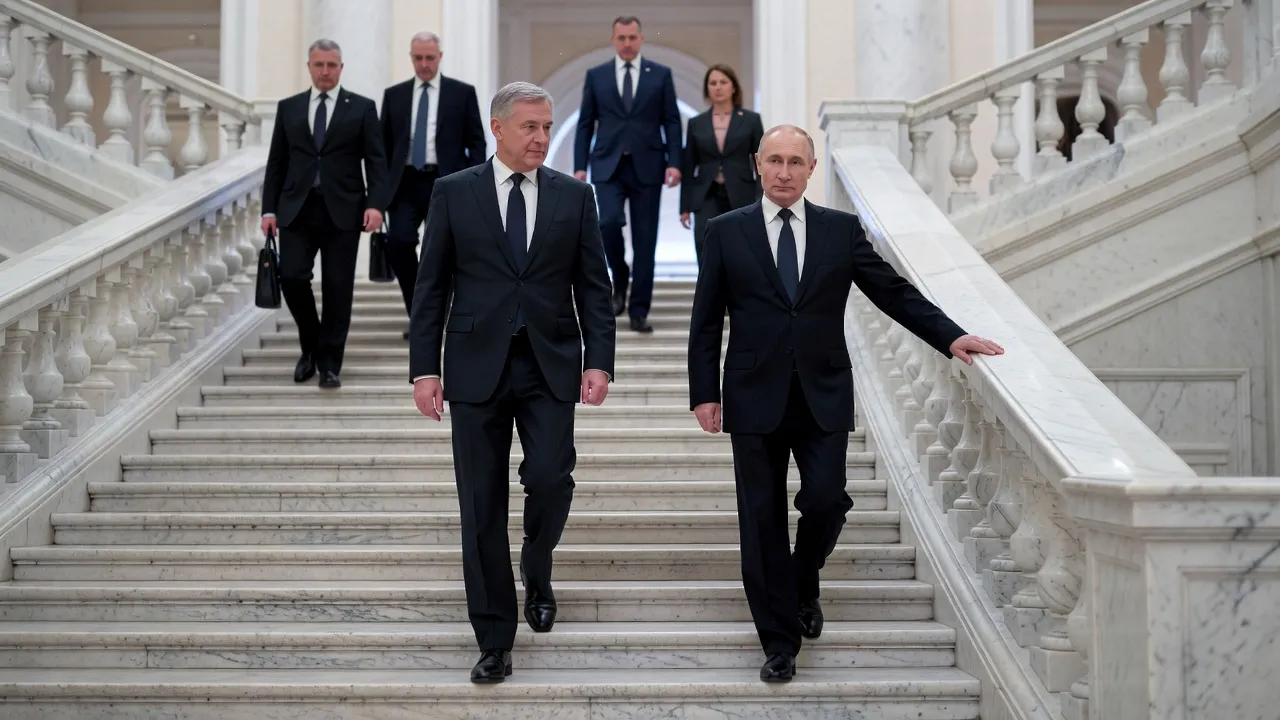
Berlin, October 21, 2026. The German press is covering Steve Witkoff's visit to St. Petersburg as a diplomatic maneuver where Europe and Ukraine carry little weight. Handelsblatt and DW recall that Donald Trump's emissary met with Vladimir Putin on Wednesday, October 21, after "constructive" talks with Volodymyr Zelensky in Oslo on Tuesday, October 20, in the presence of Norwegian and Finnish leaders and representatives of the EU and NATO. According to an American official, Kiev presented new proposals: security guarantees, a post-war economic plan, and an expanded European security architecture. Finnish President Alexander Stubb mentions "significant progress" behind the scenes.
Tagesschau highlights the release of Stephen Hubbard, a retired teacher sentenced in October 2024 to nearly seven years in prison for alleged "mercenary" activities on behalf of Ukraine. Putin announced it in front of Witkoff; Hubbard was already at Pulkovo Airport. Trump claims to have requested this release by phone the previous week and assures that Washington gave nothing in return, "an unprecedented situation for Russia." The channel adds that a German citizen was arrested almost at the same time in Russia.
DW details the follow-up: Witkoff brought "some papers," "ideas" for peace; the Kremlin considers these proposals "lacking substance," but Putin agrees "in principle" to resume talks after November 10. Trump presents the suspension of a new round of sanctions as a necessary concession: without it, negotiations would have been "completely interrupted."
German media also relay pressure on Kiev: Trump warns that Ukraine must accept an agreement, otherwise it will end "very badly," as American-Ukrainian relations have deteriorated. Zelensky demands that his country be seated at any table, including a potential Putin-Xi-Trump summit on the sidelines of the APEC, on November 18 and 19 in Shenzhen, which has not been agreed upon at this stage; his minister Andriï Sybiha fears that it will "encourage" Putin to continue the war.
In the background, DW reports on the Arctic strategy presented by the European Commission in Strasbourg, which targets underwater cables and Russia's ghost fleet.