Common ground and differences in coverage across the media analysed.
What the media report in common
1
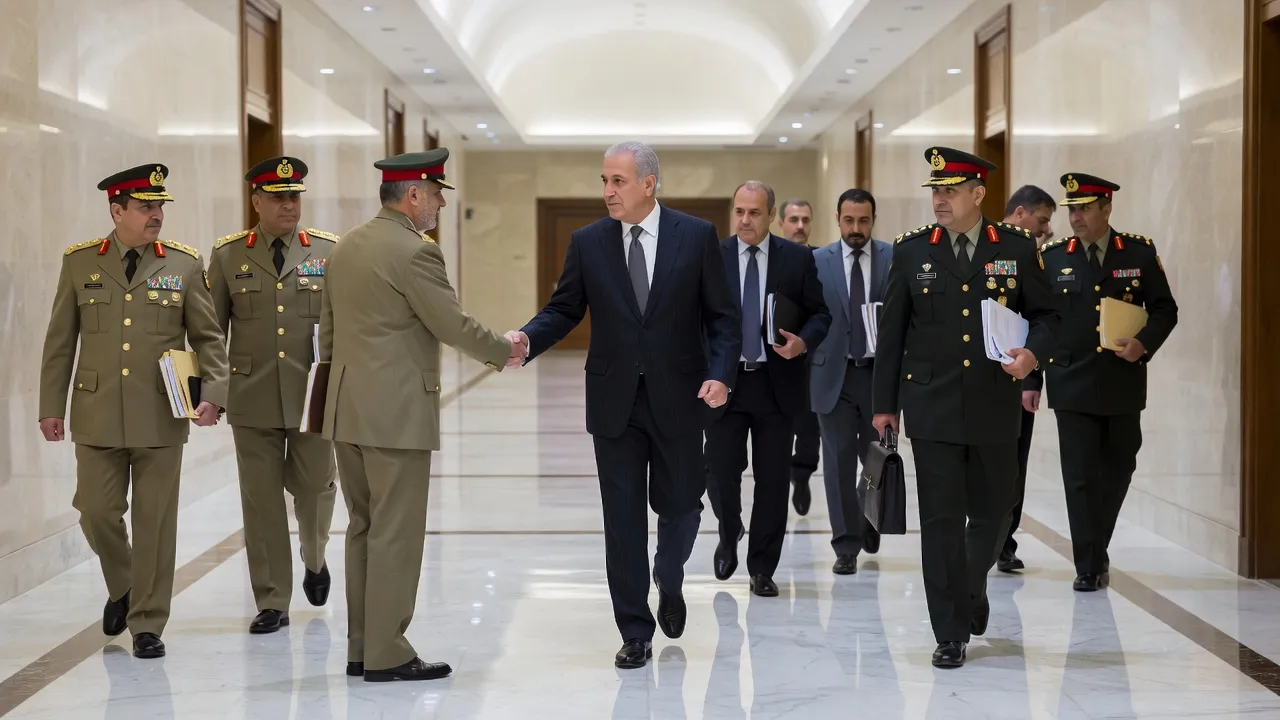
Turkey and Pakistan are to proceed with a 'rapid deployment' of forces to Saudi Arabia, decided during a meeting in Riyadh of the Mecca defense alliance.
2
The meeting was held on Monday, October 5, under the common defense agreement signed in August in Mecca, which considers an attack on one member to be an attack on all.
3
The deployment is part of the Yemeni forces' offensive, backed by the Saudi coalition, against the Houthis around Dhubab and the Bab al-Mandab strait, which the Houthis deny.
Where media coverage diverges
Nature of the activated alliance
How to characterize the activation of the Mecca pact? Saudi press sees it as collective deterrent measures in the face of attacks against the kingdom; Iranian press describes it as a military device entering operational phase and presents Saudi accusations as allegations.
How to treat the reports and qualifications of the coalition and the Yemeni government? TASS reiterates the qualification of Houthi as a terrorist group and French press relays the strike reports of the coalition's spokesperson; Iranian press talks about allegations and relays Sanaa's response, Bangladeshi and Pakistani press place the Houthi denial in contrast.
Dhaka is weighing the Turkish-Pakistani deployment in Saudi Arabia in light of the Yemeni terrain: Bangladeshi media is mainly following the Battle of Bab el-Mandeb and the threat to a vital oil route.
Brasília sees the activation of the Mecca pact as a concrete military test: the Brazilian press is mainly following the armed escalation between Riyadh and the Houthis around Bab el-Mandeb.
Berlin interprets the deployment of Turkish and Pakistani troops to Saudi Arabia as a military escalation of the Iranian conflict, emphasizing above all what the statement leaves unclear: the timeline, mission, and designation of the Houthis.
Dhaka is weighing the Turkish-Pakistani deployment in Saudi Arabia in light of the Yemeni terrain: Bangladeshi media is mainly following the Battle of Bab el-Mandeb and the threat to a vital oil route.
KEY POINTS
Turkey and Pakistan are set to carry out a "rapid deployment" of troops in Saudi Arabia after a meeting of signatories to the Mecca defense pact in Riyadh (The Daily Star).
Yemeni forces backed by Saudi aviation claim to have taken key positions in Dhubab, on Bab el-Mandeb; the Houthis describe the claims as "completely untrue" (The Daily Star, TBS).
The Houthis threaten to attack any flying object in Saudi airspace (The Daily Star).
ANALYSIS
Dhaka, October 6, 2026. Bangladesh's capital is focused on the announcement that Turkey and Pakistan are set to deploy troops to the Kingdom of Saudi Arabia. According to reports, the two countries will proceed with a "rapid deployment" of troops to Saudi Arabia as part of a new mutual defense alliance, as the kingdom faces increasing attacks from Yemen's Houthi rebels.
Following a meeting in Riyadh between signatories to the Mecca defense pact, the three countries agreed, as quoted by the press, "to immediately implement the practical implementation of collective defense commitments" and to provide the agreed-upon forces and capabilities to ensure their rapid deployment in the kingdom. The reports do not specify the exact role of the foreign troops.
However, the bulk of the coverage focuses on the Yemeni front. Yemeni government forces, backed by Riyadh, claim to have taken effective control of the Bab el-Mandeb Strait. They reportedly made rapid progress along the coast, with strong Saudi air support, to seize key positions in the Dhubab area, at the strait's narrowest point. Yemeni Information Minister Moammar al-Eryani told Reuters that the army has taken the Dhubab road and cut off the last Houthi fighters; another government source indicated that fighting is ongoing around a nearby military base.
The Houthis deny any enemy advances, calling them "completely untrue," and threaten to attack any aircraft in Saudi airspace. Reports also suggest that the Houthis have gained control of sections of a mountain road near Taiz, leaving government forces besieged, which another government source denies.
The reports emphasize the energy stakes: the strait is "a vital oil route" whose seizure by the Houthis, backed by Iran, last month caused shockwaves in energy markets. Retaking the coast would complicate disruptions to traffic between the Mediterranean and the Indian Ocean, but the Houthis could still target ships with drones from inland or further up the coast.
The coverage remains factual and dispatch-like, without editorial comment on Islamabad's commitments or the implications for the Bangladeshi diaspora in the Gulf.
Brazil
DOMINANT ANGLE
Brasília sees the activation of the Mecca pact as a concrete military test: the Brazilian press is mainly following the armed escalation between Riyadh and the Houthis around Bab el-Mandeb.
KEY POINTS
According to Folha, Turkey and Pakistan decided on Monday, October 5, to quickly send troops to Saudi Arabia, the first concrete measure of the Mecca agreement signed in August.
Pakistan already has 8,000 soldiers, JF-17 fighters, and anti-aircraft systems at King Abdulaziz base, according to Folha.
G1 reports that the Houthis claim to have struck Riyadh airport and an Aramco refinery in Rabigh, in response to a Yemeni offensive supported by the coalition.
ANALYSIS
São Paulo, October 6, 2026. The Folha and the G1 are treating the announcement as a military turning point. According to the Folha, Turkey and Pakistan agreed on Monday, October 5, to quickly send forces to help Saudi Arabia, "at war" with Yemeni rebels supported by Iran. The newspaper sees this as "the first concrete measure" of the Mecca agreement, a mutual assistance pact signed in August. It describes it as "unprecedented in the Middle East" and writes that it "promises to change the region's security architecture" and will now be put to the test.
The Folha reports that the decision was made during a meeting of foreign ministers in Istanbul. It emphasizes that no details were given about the nature of the support, only that the context of the Houthi threat is being taken into account. The daily recalls that Pakistan already has 8,000 soldiers, JF-17 fighter jets, and anti-aircraft systems at the King Abdulaziz base, under a separate agreement concluded with Riyadh last year. These troops had not been mobilized until now due to the escalation of the war in Yemen.
The situation on the ground is being given significant attention. Since Sunday, October 4, the Saudis have been supporting an offensive by the recognized Yemeni government, which was driven out of Sanaa in 2014, with heavy airstrikes. According to the government, central points in Mocha and Dhubab, opposite Bab el-Mandeb, have been retaken. The Folha explains that the Houthis had taken these points the previous month in an attempt to impose a naval blockade on the port of Yanbu, through which a large part of Saudi oil passes, in order to bypass the closure of the Strait of Hormuz, linked to the stalemate between Iran and the United States. The rebels are contesting this version.
Germany
DOMINANT ANGLE
Berlin interprets the deployment of Turkish and Pakistani troops to Saudi Arabia as a military escalation of the Iranian conflict, emphasizing above all what the statement leaves unclear: the timeline, mission, and designation of the Houthis.
KEY POINTS
Pakistan and Turkey have decided on a rapid deployment of troops to Saudi Arabia, announced on Monday, October 5, in a joint statement released by the Pakistani Ministry of Foreign Affairs (Tagesschau).
The statement does not specify the arrival date of the troops or their missions, and does not mention the Houthis, who are supported by Iran (Tagesschau).
According to the Wall Street Journal, cited by the Handelsblatt, the United States has withdrawn its bombers from the British RAF Fairford base due to fear of an Iranian drone attack.
ANALYSIS
Berlin, October 6, 2026. Germany is focusing on the decision by Pakistan and Turkey to rapidly deploy forces to Saudi Arabia. According to the public broadcaster, the three countries announced this on Monday, October 5, in a joint statement published by the Pakistani Ministry of Foreign Affairs, following an emergency meeting of the so-called Mecca alliance in Riyadh. The "agreed military forces and means" are to be "rapidly stationed in the kingdom".
The German account first highlights the trigger: the attacks by the Houthis, a militia supported by Iran. The public broadcaster reports that AFP journalists heard a series of explosions in Riyadh on Monday evening, after other detonations during the day. The Houthis claim to have targeted the international airport of the capital, a refinery of the public group Aramco, and several other targets. The representatives of the three states, for their part, condemned the attacks against the kingdom, particularly against the holy cities of Mecca and Medina, without naming the Houthis.
The broadcaster emphasizes the gray areas: the joint statement does not indicate the arrival date of the troops or the tasks that will be assigned to them on site. It also recalls the context: this defense pact, called the "Mecca Common Defense Agreement", was concluded at the beginning of August by three Sunni-majority states, against the backdrop of the war in Iran and its consequences, with a mutual defense obligation.
France
DOMINANT ANGLE
Paris sees the deployment of Turkish and Pakistani troops as the first military implementation of the Mecca pact, in an escalation where Houthis and Yemeni forces are clashing on the ground.
KEY POINTS
The joint statement on Monday, October 5, provides for the "rapid deployment in the kingdom" of the agreed-upon military forces, under the agreement signed in August in Mecca.
The Riyadh-led coalition claims to have engaged 100 fighter jets and destroyed 324 targets in the "Dawn of Yemen" operation, according to its spokesman Turki al-Maliki.
The Houthis have claimed attacks on Riyadh's international airport and the Aramco refinery in Rabigh, according to RFI.
ANALYSIS
Paris, October 6, 2026. The French press is treating the announcement as a shift from a written pact to military implementation. Le Monde and RFI report that Turkey and Pakistan, linked to Saudi Arabia by the mutual defense agreement signed in August in Mecca, announced on Monday, October 5, in a joint statement published after a meeting in Riyadh, the deployment of forces in the kingdom. The three countries want to "immediately move to the implementation of the mutual defense agreement" and "quickly deploy in the kingdom" the agreed-upon forces.
Le Monde emphasizes the weight of the alliance: this is the first time this pact has been put into action. It brings together, the daily writes, "the second army of NATO", "the main power of the Gulf", and "the only nuclear power in the Muslim world". The statement does not mention the pro-Iranian Houthists. It "condemns in the strongest terms" the strikes targeting Medina and Mecca, attributed to the Houthists by Saudi Arabia, as well as the attacks on civilian and economic installations. The precise role of the foreign troops is not detailed.
RFI puts the announcement into the context of the escalation of the day. Explosions shook Riyadh on Monday evening. The Houthists, supported by Iran, claimed through Yahya Saree's voice attacks using drones and missiles against Riyadh's international airport and the Aramco refinery in Rabigh.
Iran
DOMINANT ANGLE
Tehran interprets the Mecca pact as a military device that is becoming operational around Saudi Arabia, relaying Yemeni protests against the accusations targeting the Houthis.
KEY POINTS
The defense ministers of Turkey, Pakistan, and Saudi Arabia announce the immediate start of implementing common defense commitments and the rapid deployment of forces and equipment in Saudi Arabia (Asr Iran, YJC).
Pakistani Nauman Mahmood is appointed as the first secretary-general of the coalition for a three-year term (YJC, Khabar Online).
The Mecca agreement, signed on August 7 (16 Mordad), stipulates that an armed attack against one member is equivalent to an attack against all (Khabar Online).
ANALYSIS
Tehran, October 6, 2026. Iranian media are treating Riyadh's announcement as a military turning point. Asr Iran reports that the "Mecca pact" has entered its operational phase, with an "immediate deployment" of forces in Saudi Arabia. The site quotes, via IRNA and Al Jazeera and Al Mayadeen channels, the Turkish Foreign Minister, Hakan Fidan, who stated that the three countries examined ways to provide defensive support to Riyadh and paths for a peaceful settlement of the Yemeni crisis. Fidan claims that Riyadh has adopted a "very constructive" approach; Asr Iran introduces this phrase with the verb "claims".
YJC details the statement. The emergency meeting of the strategic political and defense committee was held in Riyadh. It appointed Pakistani Nauman Mahmood as the first secretary-general of the coalition for three years. The three countries condemn the "alleged" attempts to target Mecca and Medina and the continuation of attacks on Saudi civilian and economic sites. Member states will provide forces and capabilities "according to agreed arrangements and their national laws". Khabar Online recalls that the agreement was signed in Mecca on August 7 (16 Mordad) and that an attack on one member is equivalent to an attack on all.
Tabnak, citing Tasnim, reports that Saudi Defense Minister Khalid bin Salman announced a new military strategy in response to what he calls threats. He mentioned the activation of a "collective deterrence" doctrine. The site writes that Riyadh is acting "by formulating allegations". A reader comments that Turkey and Pakistan "want to milk Saudi Arabia" and that Yemen is challenging it.
Pakistan
DOMINANT ANGLE
Islamabad presents the deployment in Saudi Arabia as the concrete implementation of the Mecca defense agreement, with a Pakistani general at the head of the alliance.
KEY POINTS
The Mecca alliance committee, meeting in Riyadh on Monday, October 5, decided on the "rapid deployment" of agreed-upon military forces and capabilities in Saudi Arabia (The Nation, Geo News).
Retired Lieutenant General Nauman Mahmood has been appointed as the first secretary general of the alliance for three years (Geo News, ARY News).
Yemeni forces backed by the Saudi coalition say they control most of Dhubab, on Bab al-Mandab, which the Houthis deny (Business Recorder, citing Reuters).
ANALYSIS
Islamabad, October 6, 2026. Pakistan's press is treating the emergency meeting in Riyadh as an institutional step forward. According to The Nation, Pakistan, Saudi Arabia, and Turkey decided, during a meeting of the political and strategic defense committee held on Monday, October 5, to "immediately" implement their collective defense commitments, including "the rapid deployment of agreed-upon military forces and capabilities" in the kingdom.
The Pakistani delegation was led by Vice Prime Minister and Foreign Minister Ishaq Dar, accompanied by Defense Minister Khawaja Asif and the Chief of Defense, General Asim Munir, The Express Tribune reports. The newspaper recalls that the Mecca defense agreement was signed on August 7 by the three countries; its supporters describe it as a defensive mechanism aimed at strengthening collective deterrence and regional stability.
Geo News and ARY News are highlighting the appointment of retired Lieutenant General Nauman Mahmood as the first secretary general of the alliance, for three years, presented as an institutional development. The committee condemns, according to ARY, attempts to target Mecca and Medina and attacks on Saudi cities, civilians, and economic installations. Pakistan and Turkey also praise the professionalism of Saudi forces.
Qatar
DOMINANT ANGLE
Doha is gauging the transition of the Mecca alliance from texts to the field: Qatari media is highlighting the Turkish and Pakistani deployment in Saudi Arabia and the Yemeni counter-offensive against the Houthis.
KEY POINTS
Turkey and Pakistan will carry out a "rapid deployment" of forces in Saudi Arabia, decided during an emergency meeting in Riyadh on Monday, October 5, 2026 (Gulf Times, Al Jazeera).
The Mecca joint defence agreement was signed on August 7 by Saudi Arabia, Pakistan, and Turkey; the statement does not specify the role of the troops (Gulf Times, Al Jazeera).
The Yemeni army claims to have retaken Dhubab, near Bab al-Mandeb, and launched an offensive towards Sanaa, according to the Saba agency cited by Al Jazeera.
ANALYSIS
Doha, October 6, 2026. Qatari media is highlighting the decision announced on Monday, October 5, following an emergency meeting in Riyadh of the political and strategic defense committee of the Mecca Alliance. Turkey and Pakistan will carry out a "rapid deployment" of troops to Saudi Arabia, under the common defense agreement signed on August 7 by the three countries.
Gulf Times emphasizes the nature of the pact: it brings together "the second army of NATO", that of Turkey, and the only Islamic state with nuclear weapons, Pakistan, with the Saudi kingdom. The joint statement, cited by the newspaper, says it wants to "immediately move to the practical implementation of collective defense commitments" and "provide the agreed military forces and capabilities". The newspaper notes that the text does not mention the Houthis, supported by Iran, and does not specify the role of the troops once on the ground.
Al Jazeera reports that Saudi Defense Minister Khalid bin Salman spoke of triggering the mechanism in response to "attacks and all those responsible". The channel notes that since the signing in August, questions had persisted about the willingness of Islamabad and Ankara to activate the agreement. It specifies that the commitments will be executed according to "approved arrangements" and within the framework of the laws of the three countries, and links the alliance to regional conflicts, including the war between the United States and Israel against Iran.
Russia
DOMINANT ANGLE
Moscow is relaying without comment the shift of the Mecca alliance towards the military terrain, which it presents as a "Muslim NATO" in response to the Houthi escalation.
KEY POINTS
The Mecca agreement committee, signed on August 7, decided on October 5 in Riyadh to proceed "immediately" with the implementation of collective defense (Interfax, TASS).
The recognized Yemeni authorities launched the "Dawn of Yemen" operation on October 5 to control Sanaa; the Houthis called on companies to avoid Saudi airspace (Vedomosti).
The coalition announced a naval operation in Hodeida, destroying arms depots and shelters for mines and booby-trapped boats, in the name of the security of Bab al-Mandab (TASS).
ANALYSIS
Moscow, October 6, 2026. The Russian press is treating the announcement as a military fact. Interfax, TASS, Vedomosti, and Sputnik are all reporting on the joint statement released on Monday, October 5, in Riyadh, following the emergency meeting of the political and strategic defense committee of the Mecca Agreement, signed on August 7 by Saudi Arabia, Turkey, and Pakistan.
Interfax quotes the text: the committee has decided "to immediately proceed with the implementation of collective defense commitments" and to ensure the "rapid deployment" of forces on Saudi territory. The statement specifies that the security of each country is "an integral part of the collective security" of the three. TASS adds that the deployment will be carried out in accordance with the national laws of the member states, to strengthen combat readiness and military integration. None of the news agencies' reports specify the volume or mission of the contingents.
RT has dubbed the pact the "Muslim NATO" and draws a comparison with Article 5 of the Atlantic Alliance: an attack on one member is equivalent to an attack on all three. The media outlet also published a message from Saudi Defense Minister Khalid bin Salman on the activation of "collective deterrence measures".
Saudi Arabia
DOMINANT ANGLE
Riyadhh presents the activation of the Mecca Alliance as a shift from solidarity to action: a collective deterrent, backed by allied forces deployed in the kingdom.
KEY POINTS
The Mecca Alliance committee, which held an emergency meeting in Riyadh on Monday, October 5, decided on the rapid deployment of agreed-upon forces in the kingdom, in accordance with the national laws of the parties.
Khalid bin Salman: the committee agreed to "activate collective deterrent measures" in response to attacks on the kingdom and the holy sites.
Retired Pakistani Lieutenant General Nauman Mahmood has been appointed as the alliance's first secretary general for a three-year term.
ANALYSIS
Riyadh, October 6, 2026. Saudi media is covering the emergency meeting of the political and strategic defense committee of the Mecca Alliance for Defense, held on Monday, October 5, in the capital. According to Saudi Gazette, Saudi Arabia, Pakistan, and Turkey have decided to "immediately activate the practical implementation" of collective defense commitments and take necessary measures to rapidly deploy the agreed-upon forces and capabilities in the kingdom, in accordance with approved arrangements and national legislation of the parties.
Saudi Defense Minister Prince Khalid bin Salman wrote on X that the committee had agreed to "activate collective deterrence measures" in response to attacks and "all those responsible for them". He sees this as proof of the solidarity of member countries in the face of attacks he describes as heinous against the kingdom and the holy sites. The joint statement condemns "in the strongest terms" the attempt to target Mecca and Medina, as well as ongoing attacks against cities and civilian and economic installations.
Asharq Al-Awsat emphasizes the formula that the security of each party is "an integral part of the collective security" of the three countries, and the credibility that would be given to the agreement by its translation into concrete measures. Pakistan and Turkey praise the vigilance and professionalism of the Saudi armed forces. The committee also appoints retired Pakistani Lieutenant General Nauman Mahmood as the first secretary-general of the alliance, for a three-year term.
Explore every perspective on this subject across 9 countries.
Saudi Arabia: Turkey and Pakistan to deploy troops to the kingdom in the face of the Houthis
published on
October 6, 2026
9
countries
27
sources
33
articles
0/100
gap
The nine countries covered by the corpus report the same announcement from Riyadh, but each press outlet retains a different element: the ambiguity of the mission, the solidarity of the signatories, the Yemeni front, or the framework of the war surrounding Iran.
The troops have not yet been deployed: the arrival date and the role of Turkish and Pakistani forces remain to be specified.
What the statement leaves open
The Tagesschau notes that the joint statement, published by the Pakistani Ministry of Foreign Affairs, does not indicate the arrival date of the troops or their tasks. Saudi Gazette and The Nation specify that the deployment will be carried out according to "approved arrangements" and in accordance with the national legislation of each party.
Al Jazeera recalls that, since the signing in August, questions had persisted about Islamabad and Ankara's willingness to activate the agreement. The Express Tribune details the Pakistani delegation in Riyadh: Vice Prime Minister Ishaq Dar, Defense Minister Khawaja Asif, and Marshal Asim Munir.
Asharq Al-Awsat quotes Turkish Foreign Minister Hakan Fidan: the three countries examined "what support could be provided" to Riyadh and the means of resolving the crisis through dialogue. The Saudi daily also reports the opinion of analysts, who see this as a move to joint action less than two weeks after a first meeting in Istanbul on August 31.
The Brazilian G1 recalls that a similar announcement by France dates back to September 25. It writes, like Folha, that the function of the mobilized military is not specified.
How each press outlet names the alliance
The World highlights the composition of the pact, seeing it, as it writes, as the first implementation of the agreement. RT gives it the nickname "Muslim NATO" and compares it to Article 5 of the Atlantic Alliance. Gulf Times uses the same image of the second army of NATO alongside a nuclear power.
« the second-largest army in NATO (Turkey), the main power in the Gulf (Saudi Arabia), and the only nuclear power in the Muslim world (Pakistan) »
Le Monde, October 5, regarding the three alliance members
The Iranian press focuses elsewhere, with Asr Iran headlining that the "Mecca pact" has entered its operational phase. Tabnak writes that Riyadh is acting "by formulating allegations". Khabar Online cites a Yemeni Awqaf organization, which denounces the inclusion of the Holy Sites in Saudi political and military communications.
These readings do not address the same question, as Saudi and Pakistani press describe the purpose of the alliance: collective deterrence and the appointment of a secretary general. Iranian press comments on how Riyadh presents the attacks, and according to the meta-analysis, Iranian articles in the corpus do not mention Dhubab or the Houthi threat to airspace.
On the Yemeni ground
The territorial updates mainly come from the government camp. According to The Daily Star, Yemeni Information Minister Moammar al-Eryani told Reuters that the army has taken the Dhubab road. Another government source indicates that fighting is ongoing around a nearby military base. Al Jazeera attributes the gains to an anonymous army source, cited by the Saba agency. The Qatari articles do not contain independent confirmation.
« completely untrue »
The Houthis, regarding government gains, as reported by The Daily Star (Dhaka), October 6
The Houthis deny this. TBS News writes that they would have gained control of mountain road sections near Taiz, which a government source denies. RFI reports that Presidential Council Chairman Rachad al-Alimi launched the "Yemen Dawn" operation. Vedomosti specifies that it targets Sanaa and that the Houthi-controlled humanitarian coordination center called on airlines to avoid Saudi airspace.
La Folha explains that the Houthis had seized Dhubab in an attempt to impose a naval blockade on the port of Yanbu, through which a large part of Saudi oil passes. The Daily Star emphasizes the energy stakes of the strait, while noting that the Houthis could still target ships with drones from inland. TASS relayed on October 6, according to coalition spokesman Turki al-Maliki, a naval operation in Hodeida against arms depots and explosive boat shelters.
The framework of the war around Iran
Business Recorder, which reprints Reuters, notes that the Gulf's energy exports are already limited by the closure of the Strait of Hormuz by Iran. It deduces a risk to a second oil route. La Folha links this closure to the stalemate between Iran and the United States. Al Jazeera places the alliance in the context of regional conflicts, including the war between the United States and Israel against Iran.
The Handelsblatt categorizes the episode under the heading "War in Iran". The text it reprints mainly deals with another subject: according to the Wall Street Journal, the United States has withdrawn its long-range bombers from the British RAF Fairford base, for fear of an Iranian drone attack. This aspect does not concern Saudi Arabia. It illustrates the place given to Iran by the German press in its narrative.
RFI dates the resumption of hostilities in Yemen back to July, after years of calm. According to the daily, the Houthis took control of the entire western coast of Yemen on the Red Sea in September.
Alliance Secretariat
Retired Lieutenant General Nauman Mahmood, a Pakistani national, becomes the first Secretary General for a three-year term.
Collective defense clause
The agreement signed on August 7 treats an armed attack against one member as an attack against all.
Houthi claims
The Houthis claim attacks on Riyadh airport and the Aramco refinery in Rabigh, according to RFI.
Key figures
8,000
Pakistani soldiers are already present in Saudi Arabia, according to the Folha
The G1 is emphasizing the response. The Houthis, described as a "Yemeni extremist group supported by Iran", claim to have targeted Riyadh's King Khalid international airport, an Aramco refinery in Rabigh, and military sites in the south of the kingdom, using drones, ballistic missiles, and cruise missiles. Spokesman Yahya Saree presents these strikes as a response to the Yemeni offensive, which he claims included more than 1,000 attacks with the support of 100 planes provided by the coalition. The coalition says it has destroyed arms depots and explosive-laden boats and foiled a plan to attack in the Red Sea.
The G1 notes that Turkey and Pakistan are announcing a "rapid mobilization" of troops without specifying their function, and recalls that a similar announcement by France dates back to September 25. Both media outlets are leaving open the question of the exact role of the foreign contingents.
The Handelsblatt categorizes the episode under the heading "War in Iran" and the title "Turkey and Pakistan want to send troops". However, the text reproduced by the newspaper focuses on another aspect of the crisis: according to the Wall Street Journal, the United States has withdrawn its long-range bombers from the British base at RAF Fairford due to fear of an Iranian drone attack, which was allegedly ordered by the Revolutionary Guards and also targeted personnel, including American pilots.
The German reading is therefore primarily security-related and regional: a pact that moves from words to action, actors who do not name the adversary, and a conflict with Iran whose ramifications already affect European bases. The two media outlets stick to the announced facts and do not comment on the motivations of Ankara and Islamabad or the risks of an escalation.
On the Yemeni ground, the two titles describe a counter-offensive. On Sunday, the Houthists cut off the axis connecting Taiz to Aden and encircled the city. The head of the Presidential Council, Rachad al-Alimi, launched Operation "Dawn of Yemen". The coalition led by Riyadh says it has engaged 100 fighter jets and destroyed 324 targets, according to its spokesman Turki al-Maliki. It also ensures air protection of the Bab el-Mandeb Strait. Government forces announce 1,122 attacks and claim to have taken the airport of Dhoubab, near the strait, which a Houthist military source denies.
The regional context appears in the background. Hostilities resumed in July after years of calm. The Houthists had taken over the entire western coast of Yemen in September, on the Red Sea, and have been regularly targeting Saudi oil and military installations since then.
The Yemeni voice occupies a central place. Khabar Online quotes the Yemeni Awqaf and Guidance organization, which had warned of Riyadh's fabrication of incidents and condemned the entry of the Holy Sites into Saudi political and military communication. This organization sees this as the beginning of a dangerous process of "instrumental use of holy sites in aggression against Yemen".
The articles in the corpus do not mention the Dhubab area, the Houthi threat to airspace, or the closure of Ormuz. They also do not specify the role of foreign troops. Attention is focused on the institutional framework of the alliance, the implementation schedule, and the challenge to the accusations against Sanaa.
Regarding the modalities, the texts remain general: the deployment will be carried out "in accordance with approved arrangements and national legislation" of each party, without specifying the nature or volume of troops. The Foreign Office, the source of the joint statement, emphasizes "a firm commitment to collective defense".
The military context comes mainly from Business Recorder, which quotes Reuters: Yemeni government forces, supported by the Saudi coalition's air force, claim to have taken most of the Dhubab district, opposite Bab al-Mandab, which is denied by media close to the Houthis. The newspaper notes that the Gulf's energy exports are already limited by Iran's closure of Ormuz, which poses a risk to a second oil route.
The Pakistani narrative thus remains focused on trilateral solidarity and official decisions, with the Yemeni conflict appearing in the background.
The Yemeni aspect occupies an important place. Al Jazeera relays the recognized government's army, which claims to have retaken the Dhubab district and positions close to the Bab al-Mandeb strait, with air support, and launched a "strategic offensive" towards Sanaa. Gulf Times describes repeated Houthi attacks on cities, oil infrastructure, and Saudi ships since the resumption of the civil war in July, and then an September offensive that wrested territories from the government. The Arabic version of Al Jazeera mentions "increasing security and humanitarian consequences".
The coverage remains factual and relies on official Saudi, Pakistani, and Yemeni statements. Claims on the ground are attributed to the Yemeni army and the Saba agency, without independent confirmation in the provided articles.
Vedomosti places the announcement in the context of the Yemeni escalation. On the same day, October 5, the recognized Yemeni authorities launched Operation "Dawn of Yemen" to take Sanaa, which is currently under the control of Ansar Allah. The Houthi-controlled humanitarian coordination center called on airlines to avoid Saudi airspace, which "will become a military theater of operations". The newspaper sees this as evidence of "the gravity of the situation".
TASS also reported, on October 6, a naval operation by the coalition in Hodeida, announced by its spokesman Turki al-Maliki: the destruction of arms depots and shelters for booby-trapped boats and mines, in the name of ensuring navigation security in the Bab al-Mandab Strait.
The reports stick to the official Saudi and Pakistani texts, without commentary from the Russian Ministry of Foreign Affairs, and without any explicit link to Tehran or the Strait of Hormuz.
Turkish Foreign Minister Hakan Fidan indicated that the three countries had examined "what support could be provided to Saudi Arabia's defense" and what could be done to resolve the crisis through dialogue. He deemed the Saudi approach "very constructive" and estimated that the establishment of the alliance's institutional structure was nearing its final phase. Ankara had, according to the Anadolu agency cited by Asharq Al-Awsat, planned to express its support for Riyadh in the face of Houthi attacks.
Analysts cited by the newspaper see this as a sign of a shift to joint action, less than two weeks after the first meeting, held in Istanbul on August 31. The articles consulted do not specify the size or mission of the foreign troops.
No story in the recent reference set has a lower score (reference: 90 recent stories measured with the same method).