
DOMINANT ANGLE
Berlin interprets the deployment of Turkish and Pakistani troops to Saudi Arabia as a military escalation of the Iranian conflict, emphasizing above all what the statement leaves unclear: the timeline, mission, and designation of the Houthis.
Dominant angle identified — does not reflect unanimity of this country’s media
KEY POINTS
- 01
Pakistan and Turkey have decided on a rapid deployment of troops to Saudi Arabia, announced on Monday, October 5, in a joint statement released by the Pakistani Ministry of Foreign Affairs (Tagesschau).
- 02
The statement does not specify the arrival date of the troops or their missions, and does not mention the Houthis, who are supported by Iran (Tagesschau).
- 03
According to the Wall Street Journal, cited by the Handelsblatt, the United States has withdrawn its bombers from the British RAF Fairford base due to fear of an Iranian drone attack.
ANALYSIS
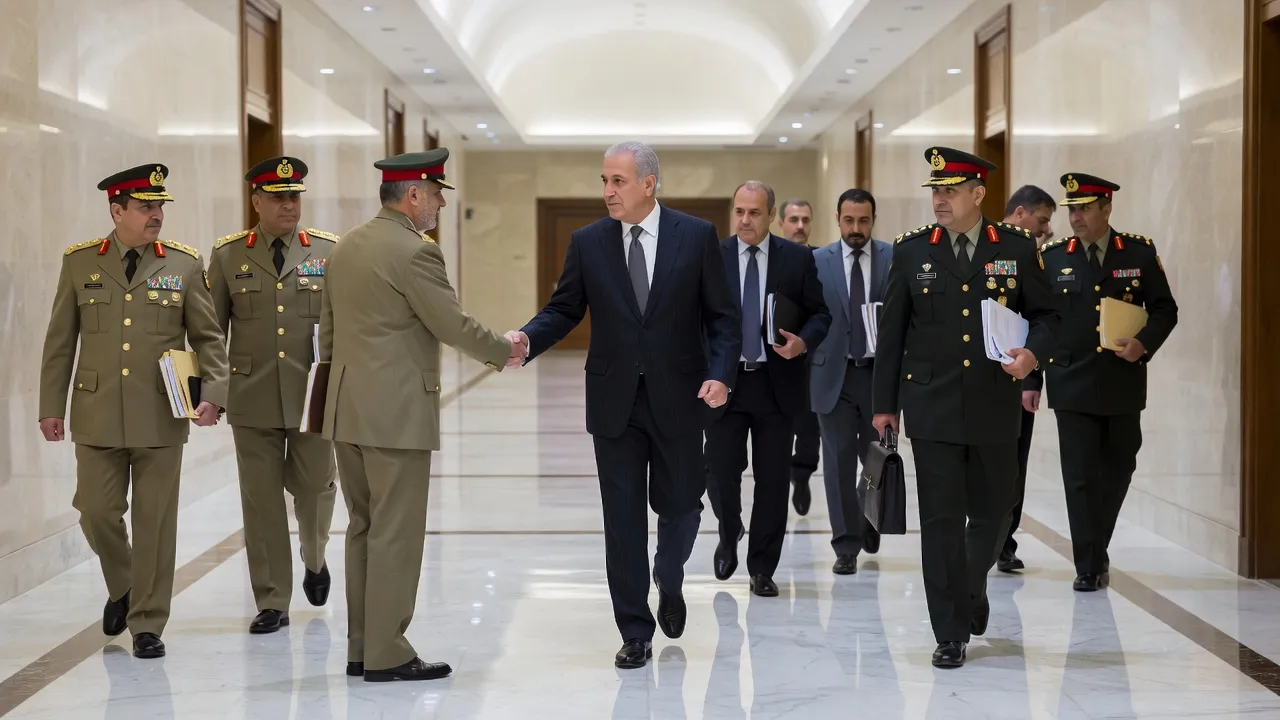
Berlin, October 6, 2026. Germany is focusing on the decision by Pakistan and Turkey to rapidly deploy forces to Saudi Arabia. According to the public broadcaster, the three countries announced this on Monday, October 5, in a joint statement published by the Pakistani Ministry of Foreign Affairs, following an emergency meeting of the so-called Mecca alliance in Riyadh. The "agreed military forces and means" are to be "rapidly stationed in the kingdom".
The German account first highlights the trigger: the attacks by the Houthis, a militia supported by Iran. The public broadcaster reports that AFP journalists heard a series of explosions in Riyadh on Monday evening, after other detonations during the day. The Houthis claim to have targeted the international airport of the capital, a refinery of the public group Aramco, and several other targets. The representatives of the three states, for their part, condemned the attacks against the kingdom, particularly against the holy cities of Mecca and Medina, without naming the Houthis.
The broadcaster emphasizes the gray areas: the joint statement does not indicate the arrival date of the troops or the tasks that will be assigned to them on site. It also recalls the context: this defense pact, called the "Mecca Common Defense Agreement", was concluded at the beginning of August by three Sunni-majority states, against the backdrop of the war in Iran and its consequences, with a mutual defense obligation.
The Handelsblatt categorizes the episode under the heading "War in Iran" and the title "Turkey and Pakistan want to send troops". However, the text reproduced by the newspaper focuses on another aspect of the crisis: according to the Wall Street Journal, the United States has withdrawn its long-range bombers from the British base at RAF Fairford due to fear of an Iranian drone attack, which was allegedly ordered by the Revolutionary Guards and also targeted personnel, including American pilots.
The German reading is therefore primarily security-related and regional: a pact that moves from words to action, actors who do not name the adversary, and a conflict with Iran whose ramifications already affect European bases. The two media outlets stick to the announced facts and do not comment on the motivations of Ankara and Islamabad or the risks of an escalation.