
Common ground and differences in coverage across the media analysed.
The ceasefire has not reopened the Strait of Hormuz: all media outlets document persistent paralysis in maritime traffic
Iran maintains de facto control over the passage, with barely 10 vessels having crossed the strait since the truce
The Islamabad talks are viewed as a pivotal moment whose outcome remains highly uncertain
Anglo-American and Israeli media accuse Iran of not honoring the ceasefire, while Gulf and certain Global South media outlets emphasize U.S. unilateralism and the absence of a multilateral framework.
Coverage aligned with this reading
Israel, Turkey, and Western media stress Iranian incompetence (unlocated mines), while Arab and Asian media either avoid the subject or downplay it.
Coverage aligned with this reading
Coverage that diverges
The Philippines projects the crisis onto the Pacific and the Chinese threat, Russia uses it to illustrate European impotence, Ukraine reads it as a threat to its own U.S. support.
Coverage aligned with this reading
This grouping describes the publications analysed, not the position of these countries’ populations or of their governments.
What the coverage of each country leaves aside, while others put it forward.
United States
China
Australia
Russia
Preview: 3 of 24 media perspectives. Syntheses of the media analysed — not direct quotations. Method & limitations
Canberra views the Hormuz crisis as a test of American naval power in the Indo-Pacific
1 source · View sources
Brasília calculates the Hormuz blockade in billions of reais lost to its trade balance
1 source · View sources
Ottawa documents the gap between ceasefire pledges and persistent maritime paralysis at Hormuz
1 source · View sources
DOMINANT ANGLE
Canberra views the Hormuz crisis as a test of American naval power in the Indo-Pacific
ANALYSIS
Canberra is monitoring the Hormuz crisis through the lens of its indirect energy dependence and military alliance with Washington.
DOMINANT ANGLE
Brasília calculates the Hormuz blockade in billions of reais lost to its trade balance
ANALYSIS
Brasília views the disruption of the Strait of Hormuz as a direct threat to its trade balance.
DOMINANT ANGLE
Ottawa documents the gap between ceasefire pledges and persistent maritime paralysis at Hormuz
ANALYSIS
Ottawa is scrutinising the Hormuz crisis through the dual lens of a NATO ally and an oil producer that could benefit from the disruption.
DOMINANT ANGLE
Beijing frames the Hormuz crisis as an industrial catastrophe for its factories and supply chains
ANALYSIS
Beijing discusses Hormuz through stock markets and factories, not through military capabilities.
DOMINANT ANGLE
Cairo underscores that Washington's Asian allies are turning to its adversaries to survive fuel shortages
ANALYSIS
Cairo is observing the Hormuz crisis as a mirror of its own vulnerability at the Suez Canal.
DOMINANT ANGLE
Paris argues the ceasefire remains hollow as long as the Strait of Hormuz remains paralysed
ANALYSIS
Paris is monitoring the Hormuz file with the precision of a maritime power with vessels in the region.
DOMINANT ANGLE
New Delhi receives Trump's ultimatum on Hormuz with the anxiety of a country dependent on 85% imported oil
ANALYSIS
New Delhi scrutinises every Trump statement on Hormuz with the anxiety of a nation importing 85% of its crude oil, much of which transits through the strait.
DOMINANT ANGLE
Baghdad documents Iranian toll as breaking point in Islamabad negotiations
ANALYSIS
Baghdad covers the Hormuz crisis through the lens of an immediate neighbour whose oil-dependent economy relies on regional stability.
DOMINANT ANGLE
Tehran maintains control of Hormuz as a negotiating lever while signalling restraint to global markets
ANALYSIS
Tehran is playing a dual strategy at Hormuz, reflected across its media landscape.
DOMINANT ANGLE
Rome follows the Islamabad talks with the urgency of a country whose cargo ship has been held hostage in the Strait for over a month
ANALYSIS
Rome is covering the Hormuz negotiations with the tension of a country whose cargo vessel has been blocked in the strait for more than a month.
DOMINANT ANGLE
Tokyo releases 20 days of strategic oil reserves—a signal that the ceasefire won't be enough
ANALYSIS
Tokyo is responding to the Hormuz crisis through action, not rhetoric.
DOMINANT ANGLE
Seoul documents the Strait of Hormuz deadlock with clear-eyed scepticism despite ceasefire announcements
ANALYSIS
Seoul's coverage of the Strait of Hormuz reflects a country that has transformed energy dependency into obsessive documentation.
DOMINANT ANGLE
Abuja turns the Hormuz crisis against its own government's failure to protect Nigerians despite vast oil reserves
ANALYSIS
Abuja is experiencing the Hormuz crisis firsthand: Nigeria, Africa's leading oil producer, should be capitalizing on elevated prices, yet a Vanguard editorialist poses the uncomfortable question — "What is our government doing for us?
DOMINANT ANGLE
Manila sees the Hormuz blockade as a dry run for what China could do in the Pacific
ANALYSIS
Manila is watching Hormuz and seeing the South China Sea.
DOMINANT ANGLE
Islamabad hosts peace talks while facing shipping collapse at its doorstep
ANALYSIS
Islamabad is playing an unprecedented dual role in the Hormuz crisis: peace broker and neighbour to chaos.
DOMINANT ANGLE
Doha pushes for regional agreement to remove Strait of Hormuz from US-Iran standoff
ANALYSIS
Doha is proposing the crisis exit that few others dare to suggest: a regional agreement on the Strait of Hormuz.
DOMINANT ANGLE
Belgrade views the Hormuz crisis as a test that could strengthen the strategic value of Russian oil
ANALYSIS
Belgrade covers Hormuz through the lens of a small landlocked country acutely sensitive to every fluctuation in energy prices.
DOMINANT ANGLE
Singapore maps Hormuz flows and bottlenecks in real-time with the precision of a global port hub
ANALYSIS
Singapore covers Hormuz the way trading floors cover a risk indicator: in real-time, with data.
DOMINANT ANGLE
Ankara notes that Iran has lost track of its mines—a lesson that any strait guardian registers
ANALYSIS
Ankara is amplifying a disclosure first revealed by the Jerusalem Post: Iran has lost track of all the mines it deployed in the Strait of Hormuz.
DOMINANT ANGLE
Kyiv gauges the Hormuz crisis by measuring its impact on American attention being diverted from Ukraine
ANALYSIS
Kyiv covers the Hormuz crisis by assessing what it reveals about American attention.
DOMINANT ANGLE
London covers Hormuz through both nuclear and maritime dimensions, reflecting its dual standing as a naval and nuclear power
ANALYSIS
London covers Hormuz with the scope of a former naval power that maintains interests in the Gulf.
DOMINANT ANGLE
Washington frames the Hormuz crisis through the lens of its impact on American petrol prices at the pump
ANALYSIS
Washington is treating Hormuz as an economic problem requiring resolution, rather than as a geopolitical standoff with an uncertain outcome.
DOMINANT ANGLE
Jerusalem reports Iran has lost track of its own mines in the Strait of Hormuz
ANALYSIS
Jerusalem interprets the Hormuz crisis through the lens of what the ceasefire does NOT resolve.
DOMINANT ANGLE
Moscow highlights a blocked Italian cargo ship to illustrate European powerlessness in the Strait of Hormuz
ANALYSIS
Moscow is observing the Hormuz crisis through a detail that few others are covering: an Italian vessel has been stuck in the strait for over a month.
Explore every perspective on this subject across 24 countries.
Compare viewpoints and see where they diverge.
published on
countries
sources
articles
gap
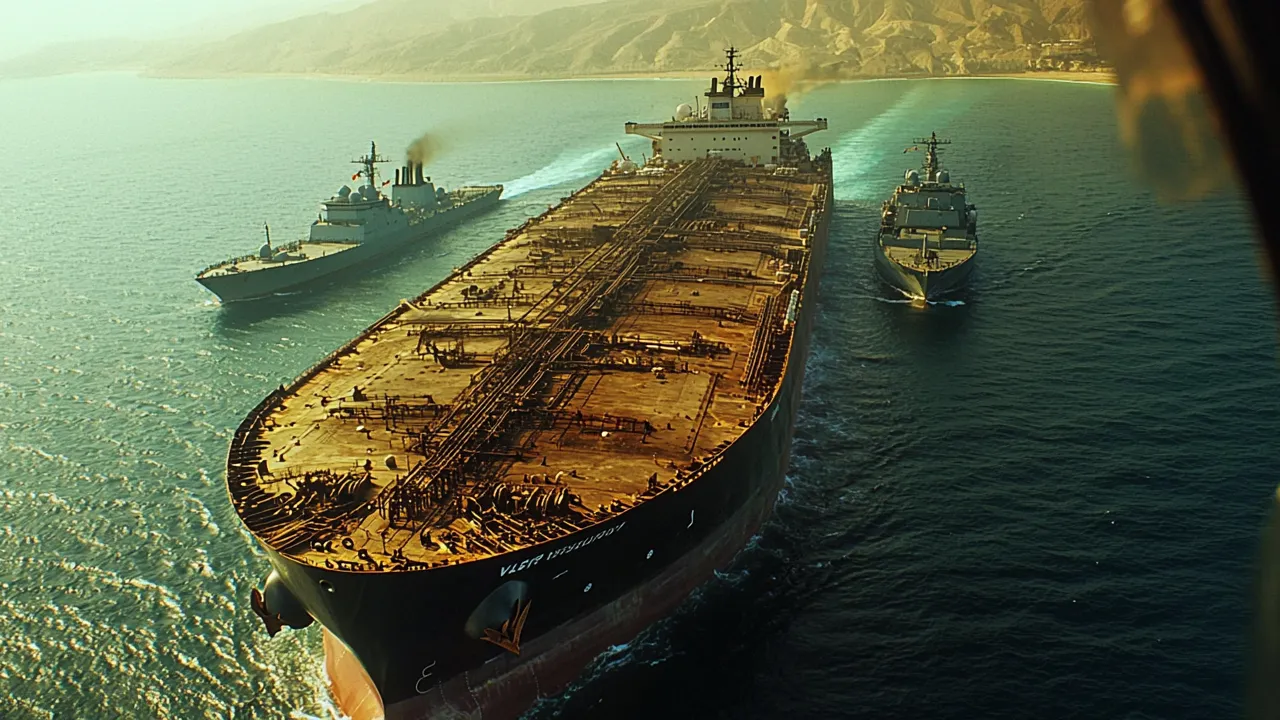
The Strait of Hormuz, through which roughly one fifth of the world's crude oil passes, remains the central chokepoint despite the US-Iran ceasefire reached on 7 April 2026. Of the some 800 ships left stranded, barely 10 have made it through since the truce, and maritime traffic stays largely paralyzed. Iran retains de facto control over the strait.
The first direct talks are being held in Islamabad, with a US delegation led by the vice president. They are seen as a pivotal moment, yet the positions remain far apart: Washington demands a full reopening, while Tehran ties any unblocking to the lifting of sanctions and reaffirms its sovereign claim over the passage. The outcome of the discussions is judged highly uncertain.
Several facts deepen the uncertainty. Mines laid during the conflict have not all been located, complicating efforts to secure the route. At the same time, Chinese supertankers have forced their way through, Japan has drawn on its strategic reserves, and several Asian importing countries have turned to other suppliers to secure their supply.
The actors disagree over responsibility. Some blame Iran for failing to honor the ceasefire, while others point to the lack of a multilateral framework and what they see as a unilateral approach, calling for shared management of the strait. Consumer countries, for their part, focus mainly on supply security rather than on the political dimension of the standoff.
Measured with the previous method (distance between texts), on a different scale.