Common ground and differences in coverage across the media analysed.
What the media report in common
1
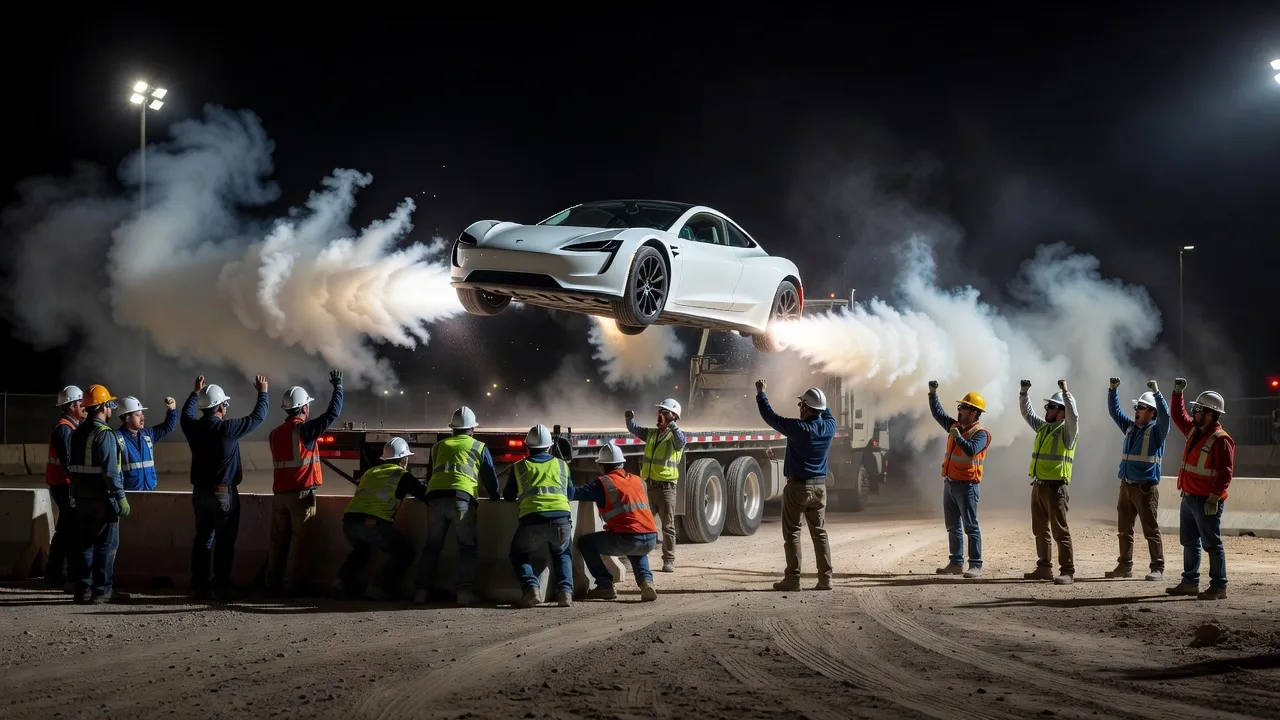
The Roadster was unveiled on Thursday, October 15, 2026, at a SpaceX test site in Texas, with thrusters developed with SpaceX that make it pivot in the air.
2
Tesla announces production starting in 2028.
3
Tesla has not released any official price for the vehicle, according to Argentine, Chilean, Colombian, Hungarian, Nigerian, and Pakistani press.
Where media coverage diverges
Commercial scope of the demonstration
Question asked: does the Roadster have commercial weight for Tesla? The United States, Colombia, Pakistan, Chile, and South Africa cite analysts (Munster, CNBC) who see it as a demonstration without financial effect; South Africa also relays Goldstein, who sees it as Tesla's future 'halo car'.
Question asked: is the delay of the project announced in 2017 recalled? Spain, Hungary, Italy, Russia, and the United States report nine years of waiting; Chile and Nigeria only mention the 2028 deadline.
Buenos Aires is particularly focused on the technical feat of the Roadster "which is flying", relaying Musk's warnings of a success that is not guaranteed rather than the stock market stakes.
Santiago highlights the technical prowess of the Roadster, with cold gas thrusters and suction at the forefront, and puts the stock market and the 2028 calendar on the back burner.
Bogotá is marveling at the "flying car" and wondering about its local price, while the economic press is tempering this by highlighting the lack of commercial value of the demonstration.
Buenos Aires is particularly focused on the technical feat of the Roadster "which is flying", relaying Musk's warnings of a success that is not guaranteed rather than the stock market stakes.
KEY POINTS
The prototype reaches nearly 100 km/h in under one second on a ramp, then maneuvers in the air using integrated cold gas thrusters in the chassis (Ámbito, La Nación).
Musk acknowledged that "success is not guaranteed" and the first test was conducted without a driver (La Nación).
Production is slated for 2028 and Tesla has not released pricing (Ámbito).
ANALYSIS
Buenos Aires, October 16, 2026. The two Argentine media outlets, Ámbito and La Nación, describe the presentation of the new Tesla Roadster as an engineering spectacle, without delving into the financial details. According to La Nación, Elon Musk led the event, held in a SpaceX test hangar in Texas, a company "also owned by the magnate". The daily newspaper misspells the model as "Roadcaster" in its title and describes it as a car with a futuristic look that, according to Musk, "can fly".
The two articles describe the same sequence: the prototype accelerates to nearly 100 kilometers per hour in less than a second on a steep ramp, turns in the air, and then lands back on the ground. Ámbito specifies that it is equipped with cold gas thrusters integrated into the chassis, a technology that is supposed to distinguish it from classic sports cars. Tesla's account on X, cited by La Nación, mentions "active aerodynamics", a "multimode suction system", and these thrusters.
The caution of the leader occupies a central place. La Nación reports that this first test was done without a driver, "to make sure no one gets killed", and that Musk warned that "success is not guaranteed". Ámbito reiterates the warning: the technology is still in development and its final operation is not assured. The daily newspaper adds that there is a gap between what was shown and a vehicle capable of staying in flight for a long time.
On the commercial side, the information remains scarce. Ámbito indicates that production is planned for 2028 and that the company has not announced the price. The articles in the corpus do not mention the reservation deposit, the reaction of Tesla's stock, or the debate among analysts about the commercial scope of the demonstration.
La Nación also quotes Musk's message on X, published with a video of the vehicle in the air: "It turns out that the future has flying cars". The tone is one of curiosity, with little critical distance towards the staging. Ámbito frames the project within the logic of a "new technological bet" by Tesla, which seeks to integrate aerospace engineering solutions into its cars.
On the sidelines, Ámbito provides links to other Tesla-related topics, including a US investigation into robotaxis and speed near schools, but the main text does not establish any connection with these cases.
Chile
DOMINANT ANGLE
Santiago highlights the technical prowess of the Roadster, with cold gas thrusters and suction at the forefront, and puts the stock market and the 2028 calendar on the back burner.
KEY POINTS
The Roadster accelerated from 0 to 60 miles per hour (approximately 97 km/h) in 0.81 seconds during the exhibition (La Tercera, citing The Verge).
The Rocket Roadster is a single-seat configuration by invitation, equipped with cold gas thrusters (La Tercera).
Tesla stock gained 3.21% in pre-market trading at $362.44, and production is announced for 2028 without a price (La Tercera).
ANALYSIS
Santiago, October 16, 2026. The Chilean press initially treats the Tesla Roadster as a technical demonstration. La Tercera writes that Tesla presented a new version of its electric deportivo on Thursday, October 15, "developed with SpaceX technology", capable of rising and performing aerial stunts. The exhibition took place at the aerospace company's test site in McGregor, Texas.
The details of the device occupy a large space. According to La Tercera, the flight capability comes from the Roadster Rocket, a single-seat configuration available only by invitation. Tesla explains that it integrates cold gas thrusters around the body, which produce forward and upward movement as well as lateral rotation. A fan system sucks air under the vehicle and creates suction against the surface, allowing it to remain upside down even when stationary. "Así que sí, puede volar", the brand states on its site. The media cites The Verge for a 0 to 60 miles per hour, or approximately 97 km/h, in 0.81 seconds, and notes that Tesla does not specify the duration of the flight or the maximum altitude.
BioBioChile describes the scene: the car drives up a curved ramp, ends up with its wheels in the air for a few seconds, spins in the air, and then lands on its four wheels. It also jumps over a row of Tesla vehicles, including the Semi truck, with, according to the company, the humanoid robot Optimus at the wheel. The event was broadcast live on X. Elon Musk stated that the presence of the public was important to show that the maneuvers had not been generated by artificial intelligence; La Tercera takes up this theme in a video titled "¡No es IA!".
Colombia
DOMINANT ANGLE
Bogotá is marveling at the "flying car" and wondering about its local price, while the economic press is tempering this by highlighting the lack of commercial value of the demonstration.
KEY POINTS
Tesla unveiled the Roadster on Thursday, October 15, at SpaceX's test site in Texas; production is slated for 2028.
The Roadster drove in reverse up a ramp, flipped in the air, and jumped over vehicles including the Cybertruck, the Model Y, and the Semi.
Gene Munster (Deepwater) calls it a "demonstration of engineering with no commercial value"; Tesla has not confirmed pricing (La República, Semana).
ANALYSIS
Bogotá, October 16, 2026. The Colombian press reports on the presentation of the Roadster by Tesla, on Thursday, October 15, at the SpaceX test site in Texas. Semana dedicates two articles to the spectacle: the car climbed a curved ramp until it was upside down, launched into the air, performed a stunt, and landed. The Roadster also jumped over a line of vehicles from the brand, including the Cybertruck, the Model Y, and the Semi truck. For the media, the event "makes the dream of many people a reality: seeing a car capable of flying".
The mechanism is explained simply. Fans extract air from under the vehicle and, combined with active aerodynamic elements, create a strong suction; Semana specifies that the jump relies on a high-pressure air system. El Colombiano reports Elon Musk's statement, "flying vehicles are real", while citing his admission that "success is not guaranteed" but that the model "will probably work". The Medellín daily indicates that production will begin in 2028 and recalls that technical and regulatory obstacles have so far prevented the takeoff of flying cars. A related link mentions nearly 40,000 electric cars registered in 2026, with Tesla capturing 41.6%.
The question of price occupies the local reader: Semana headlines the cost in Colombia, but notes that Tesla has not confirmed a final price. However, the company has activated reservations in euros on its website for the Performance, Thrust, and Rocket versions.
Spain
DOMINANT ANGLE
Madrid is savoring the technical spectacle of the Roadster: an electric car with SpaceX thrusters that "flies" and accelerates like a rocket, with a backdrop of nine years of delay.
KEY POINTS
Presentation Thursday at SpaceX's rocket testing site in McGregor (Texas): the Roadster is mounted on a curved ramp, ended up inverted, took off, performed a lap in the air and landed thanks to its thrusters.
Announced acceleration from 0 to 100 km/h in under one second (Expansión); three versions, Performance, Thrust and Rocket, according to HuffPost España.
The system relies on highly compressed air, and the development of the Roadster has accumulated nearly nine years of delay; Musk admits that the vehicle is not necessarily "optimized for safety".
ANALYSIS
Madrid, October 16, 2026. The Spanish media are treating the presentation of the new Tesla Roadster as a technological magic show. Expansión opens with a nod to pop culture: "Is it a bird? Is it a plane? Is it Superman?", before summing up the vehicle as an electric sports car that "flies like a plane and accelerates like a rocket".
The two headlines set the scene on Thursday, at SpaceX's rocket testing site in McGregor, Texas, in front of hundreds of people. In one of the demonstrations, according to Expansión, the Roadster climbed a curved ramp until it was upside down, launched itself into the air, performed a complete loop over a line of vehicles, and then landed in a controlled manner using its thrusters. "Bueno, ha funcionado", Elon Musk said, as quoted by the Efe agency.
The Spanish press emphasizes the engineering. Tesla explains on X that SpaceX has been using thrusters "for decades" to position vessels, but making them work in a vehicle, and not in a vacuum, required "completely new hardware and controls". HuffPost España specifies that the system, developed by engineers from both companies, uses compressed air stored at very high pressure rather than a classic rocket fuel.
Hungary
DOMINANT ANGLE
Budapest first praises the Roadster's stunt, then recalls its nine-year delay: the Hungarian press stops at the feat of the Tesla-SpaceX thrusters and the announced performance figures.
KEY POINTS
Telex: unveiled Thursday evening at SpaceX's McGregor test site (Texas), with acceleration from 0 to 97 km/h in under one second and over 370 km/h top speed, according to Musk.
HVG: the Roadster announced in November 2017 for around 2020 will not be delivered until 2028; a 600-litre air tank powers the thrusters developed with SpaceX.
Telex: no official price, but deposits of $50,000 (Performance) and $250,000 (Thrust); the Rocket is by invitation only.
ANALYSIS
Budapest, October 16, 2026. The Hungarian press is treating the Roadster as a technical spectacle and a long-delayed promise. Telex reports that Tesla presented its new electric sports car on Thursday evening, "local time", during a show at SpaceX's test site in McGregor, Texas. Elon Musk stated that the vehicle is reminiscent of science fiction films because it "will be capable of flying". According to Telex, it will go from 0 to 97 km/h in less than one second, with a top speed of over 370 km/h.
The showstopper described by Telex: the two-seater, without a driver, climbs a steep ramp, remains suspended upside down, descends, then pivots in the air and lands using air jets. HVG specifies that the car, developed jointly by Tesla and SpaceX, uses special nozzles and a 600-liter high-pressure air tank to move through the air and, if necessary, "stick" to the asphalt. The site also mentions electronically controlled steering, brakes, and acceleration (steer-by-wire, brake-by-wire, throttle-by-wire).
HVG emphasizes the time that has passed. The first production Roadster (2008-2012) was based on a Lotus platform; its successor, unveiled by Musk in November 2017, was promised with a 0 to 100 km/h time of 1.9 seconds, over 400 km/h, and 1,000 km of range, with a planned release date of around 2020. Nothing has come of it in nine years, and the first deliveries are not announced until 2028, meaning an additional two years of waiting. The site's title, "9 years later, here is the Tesla Roadster, which can also fly", summarizes this double register.
Italy
DOMINANT ANGLE
Rome is primarily focused on the technical spectacle: the Italian press describes a Roadster flying thanks to SpaceX's propellers, while recalling the nine-year wait and the deposits paid.
KEY POINTS
The presentation took place on Thursday, October 15, 2026, at a SpaceX test site in Texas; Tesla announces series production starting in 2028.
The Roadster announces a 0 to 100 km/h in under one second and 370 km/h, with SpaceX thrusters and a vacuum system allowing it to drive upside down.
Panorama recalls the reservations opened in 2017: a $50,000 deposit for the standard model and $250,000 for the Founders Series.
ANALYSIS
Rome, October 16, 2026. The Italian government is taking note of a new development in the automotive industry, as a Italian newspaper, La Repubblica, opens with a play on words: "If time hasn't really flown, it's the car that's taking charge." The daily describes the presentation of the new generation of the Roadster, held on Thursday, October 15, 2026, at a SpaceX test site in Texas, as a launch in the true sense of the word. The electric two-seater announces a 0 to 100 km/h in under one second and 370 km/h at peak speed. It features devices designed with SpaceX: "air rockets" that allow it to take off over short distances and land like a space module, and a suction system that keeps it stuck to the road, even upside down.
The account of the demonstration is detailed. Elon Musk had the car drive up a ramp with its head down, then perform a rotation in the air followed by a landing on its integrated thrusters. In another figure, the Roadster flies over a group of Tesla vehicles, including a Semi truck, while spinning. Panorama mentions five other Tesla vehicles being jumped. After the jump, Musk stated: "Flying cars are a reality." La Repubblica evokes a Batmobile out of Gotham City, a science fiction vehicle like Blade Runner, and notes that Tesla promises mass production starting in 2028.
Panorama emphasizes the length of the wait. After nine years of announcements and deposits paid, some spectators had been waiting for the car since 2017, when Tesla opened reservations for $50,000 for the standard model and $250,000 for the Founders Series. The magazine specifies that the demonstration aimed to combine automotive engineering and aerospace technologies, at a time when Tesla is investing more in autonomous driving and robotics. According to Musk, the Roadster could become "the only manually driven car produced by Tesla." Panorama refers to the Wall Street Journal for still uncertain delivery times.
Mexico
DOMINANT ANGLE
Mexico City is marveling at the demonstration: the Mexican press is mainly focusing on SpaceX's propulsion systems, the spectacular jumps, and the phrase "flying cars exist", before memes take over.
KEY POINTS
The presentation took place on Thursday, October 15, 2026, at SpaceX's rocket testing site in McGregor (Texas), followed by over 200,000 people on X according to El Financiero.
Vanguardia MX: three versions (Performance, Thrust, Rocket) and high-pressure compressed air thrusters instead of rocket fuel.
El Informador: Musk acknowledged that the design does not prioritize safety, hence doubts about certification, and the presentation triggered a wave of memes.
ANALYSIS
Mexico, October 16, 2026. In the Mexican press, Tesla's new Roadster is first and foremost a spectacle. El Financiero headlines "Los autos voladores SÍ existen" and recounts the presentation on Thursday, October 15, in Texas, which was followed live by over 200,000 people on X. Elon Musk affirms that he wanted a live audience to prove that the images are not generated by artificial intelligence: "Lo que van a ver con sus ojos, no van a creerlo". The vehicle drives up a ramp until it is almost suspended upside down, jumps, and then brakes its fall with propellers. Musk exclaims: "Los coches voladores ahora son reales". Later, the car jumps over a row of vehicles while spinning on itself.
Vanguardia MX details the technical specifications. The event was held at SpaceX's rocket testing site in McGregor, and the newspaper notes that the development of the model has accumulated nearly nine years of delay. The propellers, designed by Tesla and SpaceX engineers, use highly compressed air instead of rocket fuel. Three versions are announced: Performance, a two-seater with an underbody suction system; Thrust, with rear propellers; and Rocket, a single-seater capable of taking off. The newspaper quotes Musk's phrase after the maneuver: "Bueno, ha funcionado".
El Informador takes an epic tone: Musk would have "paralyzed the automotive world" and proven that flying cars are no longer science fiction. The Guadalajara daily adds that the jump took place over vehicles of the brand, including a Tesla Semi truck, and that the Optimus robot would have held the wheel, a detail that other titles in the corpus do not repeat. A second article from the same media outlet notes that Musk recognized that the design does not prioritize safety, which raises doubts about road certification.
Nigeria
DOMINANT ANGLE
Abuja recalls from the Texan evening the promise of a "flying car": the Nigerian press focuses on SpaceX's compressed air thrusters and the demonstration presented, while noting that prolonged flight has not been demonstrated.
KEY POINTS
Information Nigeria (AFP dispatch): Musk unveiled on Thursday at a SpaceX test site in Texas a "flying" car with propellers, with production announced for 2028.
Musk states: "Flying cars are real", while acknowledging that "success is not guaranteed" but that "it will probably work".
Vanguard: Tesla claims 0 to 60 mph in around 0.8 seconds, a figure put forward by the company and not independently verified; prolonged flight is not established.
ANALYSIS
Abuja, October 16, 2026. The Nigerian press is treating the unveiling of Tesla's new Roadster as a technical demonstration more than a product. Information Nigeria, which reprints an AFP dispatch, writes that Elon Musk presented a "flying" car equipped with propellers on Thursday, during an event broadcast live on Tesla's X account, at a SpaceX test site in Texas. According to the text, the prototype took off from a very inclined ramp before landing on its wheels.
The newspaper quotes Elon Musk: "Flying cars are real." The leader also conceded that "success is not guaranteed" but that "it will probably work." He explained that the vehicle carries "ultra-high-pressure air tanks" to propel itself, and summarized the project as the result of a collaboration between "the best car brand" and "the best rocket company" in the world. Production is announced for 2028. The article puts the object in history: Glenn Curtiss had presented the first prototype of a flying car in 1917, and technical and regulatory obstacles have so far prevented the sector from taking off.
Vanguard Nigeria publishes a "five things to know" format on its part. The daily newspaper locates the presentation on Thursday, October 15, 2026, in McGregor, Texas, and describes a prototype that climbs an inverted ramp, flips in the air, and lands with the help of propellers. It insists on a reservation: if the demonstration is qualified as a breakthrough in the flying car, the Roadster's ability to stay in the air like a classic aircraft "has not been established."
Pakistan
DOMINANT ANGLE
Islamabad first notes the engineering feat: a SpaceX thruster-powered Roadster spinning in the air, presented with its three versions and quantified performance.
KEY POINTS
Tesla unveiled the Roadster on Thursday, October 15, 2026, near Waco (Texas); it drove upside down on an incline by suction, rotated in mid-air, and jumped over a truck thanks to SpaceX's thrusters.
Production is announced for 2028, price unknown; deposits of $50,000 (Performance) and $250,000 (Thrust), with the Rocket version by invitation only.
Gene Munster (Deepwater) sees it as "an engineering flex with no commercial value" and an argument to bring Tesla and SpaceX closer, just a few days before the third-quarter results.
ANALYSIS
Islamabad, October 16, 2026. The two Pakistani media outlets, Geo News and ARY News, treat the Roadster as a technical spectacle before making it a stock market subject. Geo describes, in a text dated October 16, a white two-seater vehicle, "developed in collaboration" with SpaceX, which drove upside down on a ramp thanks to a suction system, turned in the air, then jumped over a truck and other vehicles while twisting in mid-air. Tesla presented the vehicle on Thursday, October 15, 2026, and announces production in 2028, more than ten years after the first new-generation version.
ARY News, under the pen of Kumail Shah, locates the event near Waco, Texas, and reports Elon Musk's formula: "the best of the last of the human-driven cars". The channel lists the three versions: Performance, approved for the road, Thrust, designed for the track with rear propellers that give a 0 to 60 mph in less than a second, and Rocket, a single-seater with ten cold gas propellers, reserved by invitation. The three announce 300 miles of autonomy and more than 230 miles per hour. Reservations are open, with a $50,000 deposit for the Performance and $250,000 for the Thrust; the final price remains unknown. Vice President Lars Moravy explains that the system uses 600 liters of compressed air stored in the carbon fiber structure.
Russia
DOMINANT ANGLE
Moscow notes the engineering feat of the SpaceX propeller Roadster, while recalling nine years of delays and the blessing of Donald Trump.
KEY POINTS
Vedomosti, citing Bloomberg: the prototype climbed a ramp, performed a controlled flip, and jumped over Tesla vehicles, including the Semi.
The "flying" version only exists in Rocket trim, a single-seater not intended for public roads; production is not expected before 2028.
Interfax: Donald Trump congratulated Elon Musk, "Я очень рад за Илона. Это очень впечатляет".
ANALYSIS
Moscow, October 16, 2026. The Russian press is treating the presentation of the new Roadster as an engineering spectacle, mainly relayed by agency dispatches and reprints from the American Bloomberg. Vedomosti, citing Bloomberg, reports that Tesla unveiled its model at the SpaceX rocket polygon near Waco, Texas. According to the newspaper, the company has "resuscitated and updated" a car whose production had ceased more than ten years earlier.
The account focuses on the details of the demonstration. The prototype, equipped with "air" thrusters developed with SpaceX engineers, climbed a ramp and performed a controlled flip. It then "jumped" and pivoted above Tesla vehicles, including the Tesla Semi truck, before performing other maneuvers using its engines. Vedomosti adds that the car has an aerospace style, two seats, and a control system borrowed from the Cybertruck. Tesla also released a video where it goes from 0 to 96 km/h in less than one second.
The newspaper specifies the limits of the exercise: the "flying" version only exists in the Rocket trim, and this single-seat example is not intended for circulation on public roads. Production is not expected before 2028. It recalls that the first version was presented in 2017, with 1.9 seconds from 0 to 100 km/h, over 400 km/h at peak and 1,000 km of autonomy, and that "the presentation has always been postponed" for years.
Interfax chooses a different angle, a political one: American President Donald Trump congratulated Elon Musk. "I'm very happy for Elon. It's very impressive," he told journalists, adding: "I don't know if you'll see me in this car." The agency describes the scene, a semi-circular ramp, the car held upside down, then its takeoff, its flip in the air, and its landing. It repeats Musk's promise of a car capable of "flying like a rocket," and the same 2028 horizon for its arrival on the roads.
United States
DOMINANT ANGLE
The United States downplays the Roadster demonstration: the financial press sees it as a showcase with no impact on Tesla's accounts and an argument for a merger with SpaceX.
KEY POINTS
Tesla has been taking $50,000 deposits since 2017 and has missed all targeted delivery dates (CNBC).
Tesla has reopened reservations in the US, Canada, and China, with a $50,000 deposit (CNBC).
A Barclays note mentions a potential Tesla-SpaceX merger by the end of the year, according to Bloomberg.
ANALYSIS
Washington, October 16, 2026. The US economic press is addressing the Tesla Roadster through the lens of the stock market and Elon Musk's credibility, long before that of its technical prowess. CNBC recalls that the presentation was scheduled for Thursday evening at a SpaceX test site in McGregor, Texas, near Waco, with a live broadcast at 8:55 p.m. Eastern time.
The story opens with nearly a decade of delays. Elon Musk presented the concept in November 2017, and Tesla began collecting $50,000 deposits the same year. Since then, the network notes that the company "has missed all delivery dates" targeted. Just a year ago, Musk promised a demonstration before the end of 2025, which did not take place. CNBC also cites his June 2018 message about a "SpaceX option package" of about ten small thrusters, which could "even allow a Tesla to fly".
On the commercial front, the tone is reserved. CNBC writes that the car, a high-end model produced in low volume and relying on SpaceX technologies such as cold gas thrusters, should not have a significant financial impact on the manufacturer. The network recalls that Tesla reopened reservations in recent weeks, with a $50,000 deposit in the United States, Canada, and China, and that executives were expected to announce the price, features, and production targets. It also mentions the mockery of Sam Altman, a former ally of Musk and co-founder of OpenAI.
Bloomberg shifts the question to the group's structure. On the show "The Close", investor Ross Gerber comments on the unveiling following a note from Barclays that Tesla and SpaceX could merge before the end of the year, possibly before Tesla's annual general meeting. Gerber estimates that a expensive car produced in small series would not weigh on Tesla's accounts. In this reading, the demonstration is worth mainly as a signal to shareholders and as an argument in favor of a rapprochement between Musk's two companies.
South Africa
DOMINANT ANGLE
Pretoria weighs the Roadster against the backdrop of Wall Street: a technical showcase with no immediate commercial value, in the service of a potential Tesla-SpaceX merger.
KEY POINTS
The Roadster, unveiled Thursday near Waco (Texas), jumped over a truck thanks to cold gas thrusters developed with SpaceX.
Production is announced for 2028, and the car is expected to go from 0 to 100 km/h in under one second and reach a top speed of 370 km/h according to Musk (The Citizen).
Gene Munster (Deepwater) calls it a demonstration with no commercial value; Seth Goldstein (Morningstar) sees it as Tesla's future "halo car".
ANALYSIS
Pretoria, 16 October 2026. The South African press, which largely reproduces international dispatches, treats the Roadster as a stock market event as much as a mechanical one. Moneyweb opens with this formula: Tesla hopes that a demonstration in flight "can give its ground-bound auto business a lift", or give a boost to an automotive business stuck on the ground.
On Thursday, at a SpaceX test site near Waco, Texas, and live on the Internet, the two-seater white car drove upside down on a ramp thanks to a suction system, pivoted in the air, then jumped over a truck and other vehicles thanks to cold gas thrusters. According to The Citizen, Elon Musk launched that "flying cars are real", specified that success "is not guaranteed" but that it "will probably work", and that the vehicle had no driver "to be sure not to kill anyone". He described ten thrusters and high-pressure air tanks, a 0 to 100 km/h in less than one second and a top speed of 370 km/h.
The calendar remains the sensitive point: production is not expected before 2028, more than a decade after the first presentation of a new generation version. TimesLIVE and Business Day, which publish the same text, insist on the financial context: Tesla is turning to autonomous driving and robotics, and its third-quarter results are due in a few days, which matters more to investors according to analysts.
Explore every perspective on this subject across 12 countries.
Tesla unveils a Roadster with SpaceX thrusters that can leap over a truck
published on
October 16, 2026
12
countries
30
sources
33
articles
30/100
gap
Beyond the leap, the corpus covers mainly what Tesla and Elon Musk have said about the limitations of the demonstration: a driverless test, a "not guaranteed" success, and functions whose road use has not been established.
The Roadster remains at the prototype stage: production is announced for 2028, with no price, and Tesla will publish its third-quarter results in a few days.
A trial presented with caution
La Nación reports that this first test was carried out without a driver, "to ensure that no one is killed". The Argentine daily also quotes Elon Musk: "success is not guaranteed". Information Nigeria, which reproduces an AFP dispatch, The Citizen and El Colombiano report the same reservation, accompanied by a "it will probably work".
« Flying cars are real »
Elon Musk, quoted by Information Nigeria (AFP dispatch), after Thursday's presentation
After the maneuver, Expansión quotes the Efe agency: Musk would have said "Bueno, ha funcionado". HuffPost España reports his admission that the vehicle is not necessarily "optimized for safety". El Informador, in Mexico, raises doubts about road certification.
The headlines do not all describe the driving position in the same way. BioBioChile indicates, according to the company, that the Optimus robot was at the wheel during the jump over Tesla vehicles. El Informador reproduces this detail in the conditional, and the other titles in the corpus do not mention it.
What the technique allows and does not allow
According to ARY News, Tesla Vice President Lars Moravy explains that the system uses 600 litres of compressed air stored in the carbon fibre structure. HVG mentions a reservoir of the same volume and nozzles developed with SpaceX. He adds an electronically controlled steering, brakes, and accelerator.
Several titles set boundaries. Vedomosti, citing Bloomberg, writes that the "flying" version only exists in Rocket trim and that this single-seat example is not intended for public roads. La Repubblica notes that it is unknown whether these functions can be used legally on the road. La Tercera notes that Tesla does not specify the duration of the flight or the maximum altitude.
Vanguard Nigeria presents the 0 to 60 mph in 0.8 seconds as a figure put forward by the company, not independently verified for a production vehicle. HVG reports, according to Musk, different figures depending on the trim: 0.59 seconds for the Rocket, 0.9 for the Thrust, 1.6 for the Performance.
The promises of 2017 and the schedule
HVG recalls that the first production Roadster (2008-2012) was based on a Lotus platform. Its successor, unveiled in November 2017, was promised with a 0 to 100 km/h time of 1.9 seconds, over 400 km/h, and 1,000 km of range, with a planned market release around 2020. Vedomosti reports the same 2017 specifications.
CNBC adds that Tesla "has missed all delivery deadlines". The channel notes that Musk promised a demonstration before the end of 2025, which did not take place, and cites his June 2018 message about a "SpaceX option package" of about ten small thrusters. Panorama refers to the Wall Street Journal for still uncertain delivery timelines.
Five national sets in the corpus quantify the wait at nine years: Spain, Hungary, Italy, Russia, and the United States. This count measures what the selected titles chose to recall. It says nothing about the subject's place in each country's opinion. The Chilean coverage in the pool only mentions the 2028 deadline.
Regarding down payments, HVG mentions a payment of "5+45 thousand" dollars for the Performance and Thrust versions. This figure does not match Telex's figure for the Thrust.
Reactions and circulation of the event
According to El Financiero, more than 200,000 people followed the live presentation on X. Musk said he wanted a live audience to show that the images were not generated by artificial intelligence. La Tercera picked up on this theme in a video titled "¡No es IA!".
« I am very happy for Elon. It's very impressive »
Donald Trump, to journalists, as reported by Interfax (translated from Russian)
Interfax reports that US President Donald Trump congratulated Musk in front of journalists. He added: "I don't know if you'll see me in this car".
On the financial side, CNBC writes that the Roadster should not have a significant financial impact on Tesla, and mentions Sam Altman's mockery. On Bloomberg's "The Close" show, investor Ross Gerber believes that an expensive, low-volume car would not weigh on the accounts. Reforma, quoting Bloomberg, summarizes that Tesla wants to "revitalize its automotive business".
In Mexico, El Informador and El Norte report on a wave of memes, including jokes from Monterrey about a traffic-free trip down Gonzalitos street.
Three versions
Performance, Thrust and Rocket ; the Rocket, a single-seat propeller-driven model, is offered by invitation only.
The down payments
50,000 dollars for the Performance and 250,000 dollars for the Thrust, according to the press.
The analysts
Gene Munster (Deepwater) talks about a demonstration with no commercial value; Seth Goldstein (Morningstar) mentions a future "halo car".
Tesla and SpaceX
A note from Barclays mentions a potential Tesla-SpaceX merger by the end of the year, according to Bloomberg.
Key figures
0.81 s
Time announced to go from 0 to 60 mph (approximately 97 km/h) during the demonstration
The financial aspect comes second. La Tercera notes that the stock gained 3.21% in pre-market trading on the Nasdaq, at $362.44, reducing its decline since the beginning of the year to 20.8% according to Tradingview. The newspaper adds that, according to CNBC, it is unlikely that the vehicle will have a significant financial impact. Musk indicated that production will start in 2028; Tesla has not given a price or specifications for the other variants, and has reopened reservations in recent weeks with a deposit of $50,000.
The financial aspect comes from La República. The economic daily sees the demonstration as an emblematic model returned to Tesla after years of delays, while the group focuses on autonomous driving and robotics, just a few days before the third-quarter results, deemed more important by analysts. It quotes Gene Munster, from Deepwater Asset Management, a Tesla investor: "an engineering demonstration with no commercial value beyond embarrassing traditional car manufacturers". It also notes that some observers see this collaboration as an attempt by Musk to spark interest in a merger of his two major companies.
The announced performance figures structure both stories: 0 to 100 km/h in under one second for Expansión, which makes it one of the fastest production cars in the world. HuffPost details three versions, Performance, Thrust, and Rocket. The first, a two-seater, would go from 0 to nearly 100 km/h in less than 1.6 seconds thanks to a suction system under the body. The Thrust, with rear thrusters, would take less than 0.9 seconds.
The delay is mentioned in both texts, almost in passing: the development "has accumulated nearly nine years of delay". HuffPost also reports Musk's admission that the vehicle is not necessarily "optimized for safety". In the available excerpts, neither price, nor production schedule, nor stock market reaction are developed: the focus remains on the demonstration effect, to the detriment of the commercial question.
The figures for the final version vary depending on the model. HVG cites, according to Musk, a single-seat Rocket version that can reach 96 km/h in 0.59 seconds, with a top speed of around 370 km/h and 480 km of range; a two-seat Thrust version that can reach 0 to 100 km/h in 0.9 seconds; and a base Performance version that can reach 0 to 100 km/h in 1.6 seconds. The Rocket is only available by invitation.
As for the price, no tariff has been announced. Telex notes that the pre-order page displays three variants, with a deposit of $50,000 for the Performance and $250,000 for the Thrust. HVG, on the other hand, mentions a payment of "5+45 thousand" dollars for these two versions, which does not quite match Telex's figure. Both media outlets stick to the demonstration and characteristics, without commentary from analysts or market reaction.
The two titles maintain a measured distance. La Repubblica judges the whole thing "spectacular, including from a marketing point of view" and notes that it is unknown whether these functions can be used legally on the road. Panorama presents the spectacle as a means of highlighting Musk's ambitions and putting the automobile back in the spotlight. The Italian coverage remains focused on the feat, the promise, and the calendar; the stock market and price are not the main focus.
The commercial aspect remains thin. Reforma, quoting Bloomberg, summarizes that Tesla wants to "revitalize its automotive business" and recalls the numerous delays since the 2017 announcement. The corpus does not mention a price or production schedule.
The final act is local. El Informador ("Tesla Roadster vuela y los memes aterrizan") and El Norte ("¿Un Tesla volador en México?") report on the wave of memes: drivers stuck in cables, cars against buildings, and jokes from Monterrey about a journey without traffic jams on Gonzalitos street.
The same article specifies that the system works with highly compressed air rather than rocket fuel, and that the demonstration does not prove long-distance flight. It reports Tesla's claim of 0 to 60 mph (approximately 97 km/h) in 0.8 seconds thanks to the propellers, qualifying it as data advanced by the company and not independently verified for a production vehicle. The text finally announces three versions of the model.
The two titles therefore share a framing centered on technology, with a vocabulary of tempered wonder. Neither of them, in the available passages, details the price, reservation deposits, or stock market reaction.
Geo News adds the financial aspect. Gene Munster, from Deepwater Asset Management, judges on X that it was "an engineering flex with no commercial value", and sees it as another argument for merging Tesla and SpaceX, a fusion that some observers imagine is wanted by Musk. The media recalls that he qualified the car in 2023 as a "small potato situation" for the group's finances, while analyst Seth Goldstein, from Morningstar, sees it as Tesla's future "halo car". This comes just a few days before the third-quarter results, which analysts consider more decisive for investors, as the manufacturer turns to autonomous driving and robotics.
ARY concludes on a note of caution: many tech and automotive players are questioning the safety of these devices and the realism of the schedule. Neither of the two texts deals with a Pakistani market or a local issue: the story remains that of an American showcase, read for its figures and mechanics.
Neither of the two texts mentions the price, the reservation deposit, or the stock market reaction: the emphasis remains on technical performance, accumulated delays, and the endorsement provided by the White House.
The two sources thus converge: the Roadster is treated as a showcase for Musk's fans, whose enthusiasm CNBC notes on social networks, and not as a product likely to change Tesla's trajectory. The financial stakes lie elsewhere, in the possible merger with SpaceX.
The quoted voices are those of analysts. Gene Munster, of Deepwater Asset Management, judges on X that it was "an engineering flex with no commercial value beyond embarrassing traditional carmakers" and sees it as another reason why Musk wants to bring Tesla and SpaceX closer together. Seth Goldstein, of Morningstar, recalls that Tesla has no "halo car" and that the Roadster must play this role. Musk himself had qualified the car in 2023 as a "small potato situation" in financial terms.
Moneyweb places the model in a narrow range around two mid-range mass-market models. The articles do not give prices or volumes, and the local dimension, South African market or regulation, is not addressed.
More divergent than 16% of recent comparable stories (reference: 90 recent stories measured with the same method).