
DOMINANT ANGLE
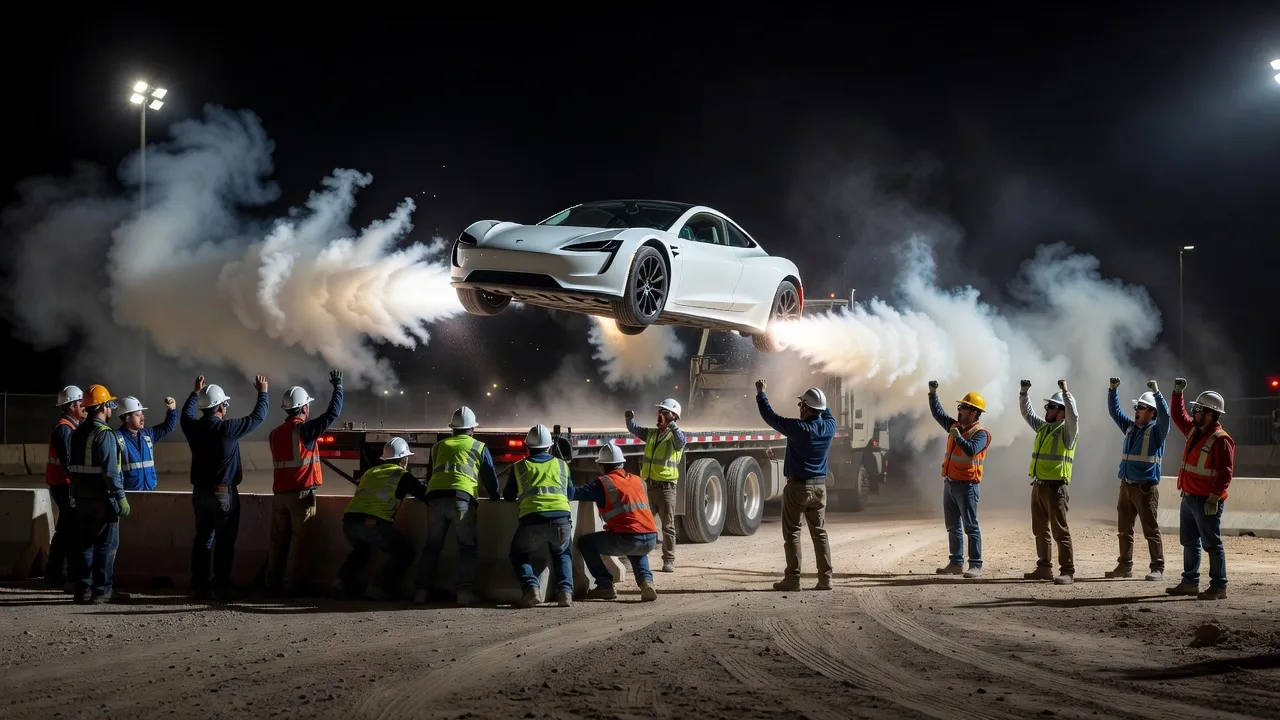
Madrid is savoring the technical spectacle of the Roadster: an electric car with SpaceX thrusters that "flies" and accelerates like a rocket, with a backdrop of nine years of delay.
Dominant angle identified — does not reflect unanimity of this country’s media
KEY POINTS
- 01
Presentation Thursday at SpaceX's rocket testing site in McGregor (Texas): the Roadster is mounted on a curved ramp, ended up inverted, took off, performed a lap in the air and landed thanks to its thrusters.
- 02
Announced acceleration from 0 to 100 km/h in under one second (Expansión); three versions, Performance, Thrust and Rocket, according to HuffPost España.
- 03
The system relies on highly compressed air, and the development of the Roadster has accumulated nearly nine years of delay; Musk admits that the vehicle is not necessarily "optimized for safety".
ANALYSIS
Madrid, October 16, 2026. The Spanish media are treating the presentation of the new Tesla Roadster as a technological magic show. Expansión opens with a nod to pop culture: "Is it a bird? Is it a plane? Is it Superman?", before summing up the vehicle as an electric sports car that "flies like a plane and accelerates like a rocket".
The two headlines set the scene on Thursday, at SpaceX's rocket testing site in McGregor, Texas, in front of hundreds of people. In one of the demonstrations, according to Expansión, the Roadster climbed a curved ramp until it was upside down, launched itself into the air, performed a complete loop over a line of vehicles, and then landed in a controlled manner using its thrusters. "Bueno, ha funcionado", Elon Musk said, as quoted by the Efe agency.
The Spanish press emphasizes the engineering. Tesla explains on X that SpaceX has been using thrusters "for decades" to position vessels, but making them work in a vehicle, and not in a vacuum, required "completely new hardware and controls". HuffPost España specifies that the system, developed by engineers from both companies, uses compressed air stored at very high pressure rather than a classic rocket fuel.
The announced performance figures structure both stories: 0 to 100 km/h in under one second for Expansión, which makes it one of the fastest production cars in the world. HuffPost details three versions, Performance, Thrust, and Rocket. The first, a two-seater, would go from 0 to nearly 100 km/h in less than 1.6 seconds thanks to a suction system under the body. The Thrust, with rear thrusters, would take less than 0.9 seconds.
The delay is mentioned in both texts, almost in passing: the development "has accumulated nearly nine years of delay". HuffPost also reports Musk's admission that the vehicle is not necessarily "optimized for safety". In the available excerpts, neither price, nor production schedule, nor stock market reaction are developed: the focus remains on the demonstration effect, to the detriment of the commercial question.