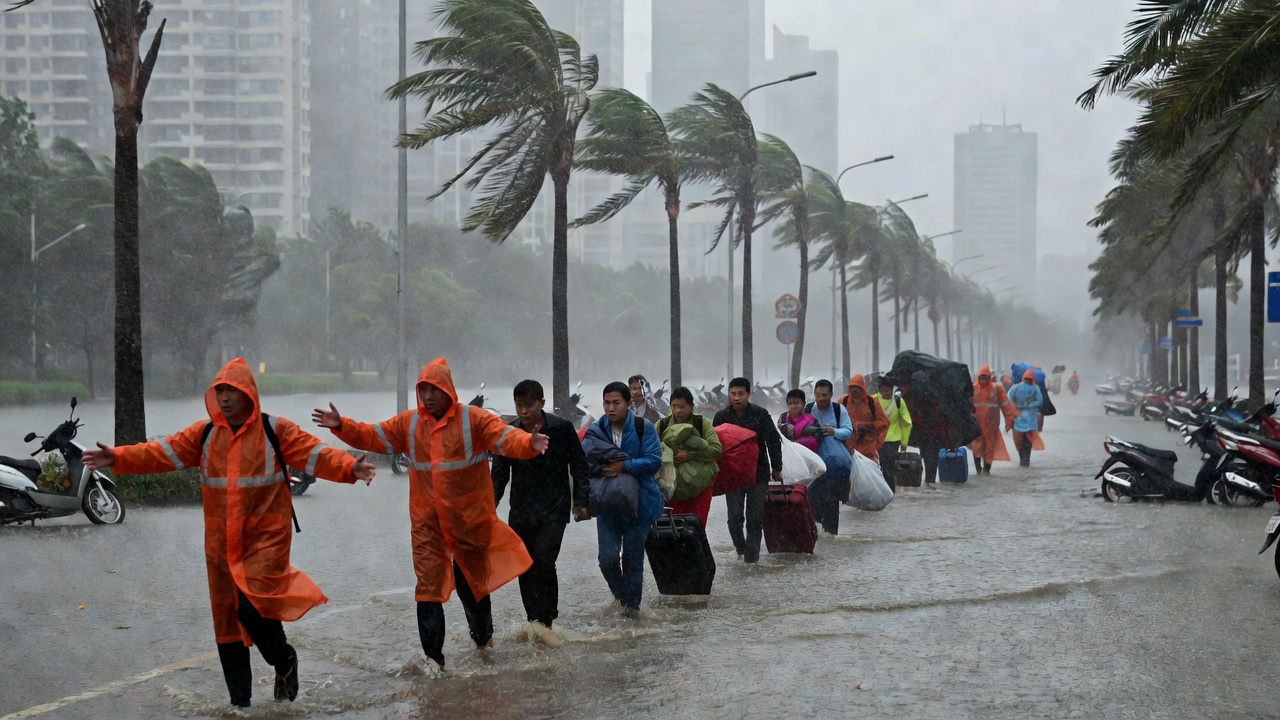
TYPHOON NOUL SLAMS CHINA'S GUANGDONG, FORCING MASS EVACUATIONS
July 27, 2026·11 COUNTRIES
11countries·30sources·35articles
Asia (6)
Americas (2)
Oceania (1)
Europe (1)
Russia & CIS (1)
Asia
Americas
Oceania
Europe
Russia & CIS
EXPLORE THIS STORY
SHARE THIS COMPARISON
Show your friends how the world sees the same news differently.
Typhoon Noul, described as the most powerful of 2026, made landfall on 26-27 July in China's Guangdong province, forcing the evacuation of several hundred thousand people (up to 710,000 by some accounts), grounding flights and halting trains in Shenzhen, Guangzhou and Hong Kong, and bringing torrential rain and flooding. Authorities raised the alert to its highest level.
FRAMING GAP
12/100LOW
Coverages are relatively similar
Here are the main framing differences identified between media coverages.
ANALYSIS BY COUNTRY
 AUSTRALIA
DOMINANT ANGLE
Canberra assesses the scale of the logistics shock hitting its regional neighborhood, with air traffic paralyzed at Hong Kong and an unprecedented red alert in southern China.
Dominant angle identified — does not reflect unanimity of this country’s media
KEY POINTS
- •Over 340,000 people evacuated from Guangdong Saturday afternoon, a figure rising to more than 700,000 after Typhoon Noul's passage according to provincial authorities cited by CCTV.
- •Typhoon Noul made landfall at Huidong around 3:50 a.m. Sunday with sustained winds of 151 to 173 kilometers per hour, the twelfth tropical cyclone this year and third to strike China this month.
- •Hong Kong raised typhoon signal number 9 before lowering it to number 8, with over 150 flights canceled at the international airport and partial scaffolding collapse without injuries.
BIASES
Framing centered on major urban hubs (Hong Kong, Guangzhou, Shenzhen) at the expense of less-covered rural areas of Guangdong Province.Reliance on official Chinese and Hong Kong figures (evacuations, alerts) with limited independent verification of reported numbers.Limited coverage of medium-term economic consequences for regional supply chains on which Australia depends.
 BANGLADESH
DOMINANT ANGLE
Dhaka reads Typhoon Noul through the lens of its own Bay of Bengal cyclones, examining the gap between China's evacuation machinery and Bangladesh's recurring climate vulnerability.
Dominant angle identified — does not reflect unanimity of this country’s media
KEY POINTS
- •Noul made landfall near Pinghai (Guangdong) with winds of 162 km/h, the strongest typhoon to strike China since early 2026 according to CCTV
- •Over 340,000 people evacuated in Guangdong; at least 350 flights cancelled at Hong Kong Airport
- •Hong Kong raised alert signal to T9 before lowering it to T8; over 100 downed trees reported and nine injured confirmed
BIASES
Guangdong/Hong Kong-centered framing: articles focus heavily on evacuation and transport measures in these two zones, with less coverage of inland areas targeted afterward (Jiangxi, Hunan, Hubei)Emphasis on operational metrics (evacuees, cancelled flights): limited coverage of material damage or a broader human toll beyond Hong KongWeak regional context: no article explicitly connects Noul to the cyclones Bangladesh experiences in the Bay of Bengal
 CANADA
DOMINANT ANGLE
Canada relays a single wire agency dispatch on Typhoon Noul without local reporting or independent analysis of southern China.
Dominant angle identified — does not reflect unanimity of this country’s media
KEY POINTS
- •Over 801,000 people were evacuated in Guangdong Province according to Xinhua, cited by the AP dispatch.
- •Hong Kong airport reported approximately 350 canceled flights and nearly 2,000 stranded passengers, with 21 injuries recorded in the city.
- •Beijing released 100 million yuan (14.8 million dollars) for relief; Noul is the third typhoon to strike China in a month following Bavi and Maysak.
BIASES
Wire dispatch framing: all five Canadian outlets reproduce the AP text verbatim without local reporting or distinct editorial analysis.Reliance on official Chinese figures (Xinhua, government ministries) with limited independent verification or direct ground testimony.Minimal coverage of regional spillover effects (Philippines, Taiwan, Gansu flooding): mentioned briefly at the end of the dispatch without development.
 CHINA
CHINADOMINANT ANGLE
Beijing reports China deploys unprecedented emergency mobilization in response to Typhoon Noul, described by national meteorological services as the most powerful storm to strike the country this year.
Dominant angle identified — does not reflect unanimity of this country’s media
KEY POINTS
- •Over 801,000 residents evacuated after Typhoon Noul's landfall in Huizhou, Guangdong (ECNS)
- •Noul is classified by the National Meteorological Center as the most powerful typhoon to strike China in 2026, and the strongest to affect areas east of the Pearl River estuary in a decade
- •Approximately 400 flights canceled in Hong Kong after the city issued its first No. 8 and No. 9 signals of the year, with passengers still stranded at the airport on Monday (South China Morning Post)
BIASES
Institutional-focused framing: emphasis on the efficiency of official mobilization and evacuations rather than on potential criticisms of crisis managementPreference for quantified data (evacuations, canceled flights) over individual testimonies from disaster victims outside the airportLimited coverage of precise material and economic damages in rural areas of Guangdong, which are less documented than Hong Kong and Shenzhen
 FRANCE
DOMINANT ANGLE
Paris examines an unprecedented evacuation operation in southern China, balancing recognition of Beijing's logistical capacity with careful attention to French economic stakes anchored in Hong Kong's role as a regional financial hub.
Dominant angle identified — does not reflect unanimity of this country’s media
KEY POINTS
- •More than 340,000 people evacuated from Guangdong Province as the typhoon's eye made landfall near Pinghai at 3:50 a.m. local time on July 26, according to Xinhua News Agency.
- •Winds reached 162 kilometers per hour at impact, making Noul the strongest tropical system to strike China since the start of 2026, per state broadcaster CCTV.
- •In Hong Kong, the Observatory downgraded its alert from Signal T9 to T8 Sunday morning, with over one hundred trees reported downed, nine people injured, and at least 350 flights canceled.
BIASES
Wire-service dependency: French media largely republished the same AFP dispatch, constraining editorial diversity and independent analytical angles.Institutional data preference: Coverage prioritizes official statistics (CCTV, Xinhua, Hong Kong Observatory) over on-the-ground eyewitness accounts and community impact reporting.Truncated Philippines coverage: Early damage in the Philippines—three deaths and one missing person—received minimal attention, appearing only late in articles.
 INDIA
INDIADOMINANT ANGLE
New Delhi assesses China's mobilization against Typhoon Noul, weighing technical appreciation for Beijing's alert system with broader regional concerns about Asia's shared climate exposure and cyclone frequency.
Dominant angle identified — does not reflect unanimity of this country’s media
KEY POINTS
- •Over 800,000 residents evacuated in Guangdong before Typhoon Noul's landfall, with sustained winds of 162 km/h
- •Ten deaths reported from flash flooding in Gansu Province, according to Xinhua news agency
- •China's national meteorological bureau issued its first red alert of the year; Level IV emergency response activated for Guangdong with 100 million yuan allocated for post-disaster reconstruction
BIASES
China-centric framing: emphasis on Beijing's institutional response and alert system effectiveness rather than direct accounts from affected residents in GuangdongReliance on Chinese state agencies (Xinhua, CCTV) as primary sources with limited independent on-the-ground reporting from affected areasMinimal coverage of regional economic impact, particularly on India-South China trade flows and supply chain disruptions
 MALAYSIA
DOMINANT ANGLE
Malaysian media gauges the regional shockwave of Typhoon Noul, weighing flight cancellations to Hong Kong and Shenzhen against heightened vigilance for its nationals in transit.
Dominant angle identified — does not reflect unanimity of this country’s media
KEY POINTS
- •Typhoon Noul made landfall near Pinghai, Guangdong around 3:50 a.m. with sustained winds of 162 km/h, marking China's strongest typhoon of 2026 according to CCTV.
- •Over 340,000 residents were evacuated ahead of the storm, and at least 350 flights were canceled at Hong Kong airport.
- •Singapore Airlines, Scoot, and Cathay Pacific canceled multiple flights to Shenzhen and Hong Kong on July 25-26.
BIASES
Aviation-centered framing: Malaysian coverage emphasizes impact on regional air traffic rather than damage in mainland China.Preference for institutional sources: articles rely heavily on CCTV, Hong Kong Observatory, and airlines, with minimal direct Chinese accounts.Minimal coverage of Philippine damage: the Philippines toll (three deaths, over 9,300 evacuated) is mentioned only briefly, near article endings.
 PHILIPPINES
DOMINANT ANGLE
Manila traces Kiyapo's path from deadly Philippine typhoon to disaster now striking Guangdong
Dominant angle identified — does not reflect unanimity of this country’s media
KEY POINTS
- •One death in Davao (barangay Talandang) and 127,000 residents affected across Regions IX, XI, XII, and Bangsamoro Autonomous Region per Office of Civil Defense
- •In Iloilo City, 35 of 45 flooded barangays remained submerged Saturday, with 508 residents affected—221 sheltering in four evacuation centers (Situation Report No. 3)
- •Pagasa measured sustained winds of 80 mph and gusts of 100 mph, with the system positioned 350 km west of Itbayat, Batanes, before exiting the Philippine area of responsibility
BIASES
Domestic-centric framing: articles detail damage and evacuations in the Philippines but do not document the typhoon's impact phase in ChinaReliance on Pagasa and Office of Civil Defense bulletins: official local figures take precedence over foreign estimatesLimited Guangdong coverage: the typhoon's trajectory after entering Chinese waters receives minimal treatment in Philippine media sources consulted
 RUSSIASTATE MEDIA
DOMINANT ANGLE
Moscow methodically documents the scale of evacuations and transport paralysis caused by the typhoon, without linking the event to climate change
Dominant angle identified — does not reflect unanimity of this country’s media
KEY POINTS
- •TASS reports over 710,000 people evacuated in Guangdong, including 205,000 in Huizhou and 192,000 in Shanwei
- •RT documents over 1,800 flights canceled in Guangzhou, Shenzhen, and Hong Kong, with over 190 high-speed rail connections suspended
- •Sustained winds of 162 km/h (45 m/s) at landfall near Pinghai (Huidong, Huizhou) around 3:50 a.m. local time Sunday, according to China's National Meteorological Center
BIASES
Factual-numerical framing: emphasis on evacuation statistics and logistical paralysis rather than individual human narratives or longer-term impactsHeavy reliance on official Chinese sources (Nanfang Daily, National Meteorological Center, provincial flood-fighting headquarters) presented without critical perspective or counterpointAbsence of climate context: no discussion of long-term environmental trends or analysis of how this event fits into broader weather pattern changes
 SINGAPORE
DOMINANT ANGLE
Singapore focuses on the direct impact of Typhoon Noul on its own air connections with South China, rather than on the human toll in Guangdong
Dominant angle identified — does not reflect unanimity of this country’s media
KEY POINTS
- •Over 20 flights between Singapore and South China cancelled July 25-26, including 13 Cathay Pacific and Singapore Airlines flights to Hong Kong and 8 to Shenzhen (Changi Airport)
- •Typhoon Noul made landfall near Huidong, Guangdong, early Sunday with sustained winds of 162 km/h—the strongest storm to strike China in 2026 (CCTV)
- •Over 700,000 people evacuated from Guangdong; red alert issued for flash flooding across multiple Chinese provinces
BIASES
Airport-centric framing: strong emphasis on flight cancellations and direct impact on Singapore passengersPreference for official statistics (Changi Airport, CCTV) over on-the-ground accounts from affected residentsLimited coverage of material and human damage within Guangdong outside the Hong Kong-Singapore corridor
 UNITED STATES
DOMINANT ANGLE
Washington assesses the unprecedented scale of Chinese evacuations amid Typhoon Noul, presented as the most powerful to make landfall in China this year, and scrutinizes the logistical cost of a continent-wide alert system.
Dominant angle identified — does not reflect unanimity of this country’s media
KEY POINTS
- •More than 801,000 people were relocated in Guangdong according to Xinhua agency, a figure some media outlets put at over 800,000 evacuated in total.
- •Approximately 350 flights were cancelled at Hong Kong airport, with around 2,000 passengers stranded and at least 21 people injured in the city.
- •Beijing unlocked 100 million yuan (14.8 million dollars) for reconstruction; Noul is characterized as the most powerful typhoon to make landfall in China this year, the third in a single month following Bavi and Maysak.
BIASES
Focus on evacuation and transport statistics with minimal analysis of the structural climate drivers behind the typhoon.Reliance on agency dispatches (AP via ABC News, Worthy News) rather than original on-the-ground reporting from Guangdong.Limited coverage of human and material damage in rural Guangdong areas, with emphasis placed on Hong Kong and major infrastructure.
AUSTRALIADOMINANT ANGLE
Canberra assesses the scale of the logistics shock hitting its regional neighborhood, with air traffic paralyzed at Hong Kong and an unprecedented red alert in southern China.
Dominant angle identified — does not reflect unanimity of this country’s media
KEY POINTS
- •Over 340,000 people evacuated from Guangdong Saturday afternoon, a figure rising to more than 700,000 after Typhoon Noul's passage according to provincial authorities cited by CCTV.
- •Typhoon Noul made landfall at Huidong around 3:50 a.m. Sunday with sustained winds of 151 to 173 kilometers per hour, the twelfth tropical cyclone this year and third to strike China this month.
- •Hong Kong raised typhoon signal number 9 before lowering it to number 8, with over 150 flights canceled at the international airport and partial scaffolding collapse without injuries.
BIASES
Framing centered on major urban hubs (Hong Kong, Guangzhou, Shenzhen) at the expense of less-covered rural areas of Guangdong Province.Reliance on official Chinese and Hong Kong figures (evacuations, alerts) with limited independent verification of reported numbers.Limited coverage of medium-term economic consequences for regional supply chains on which Australia depends.
BANGLADESHDOMINANT ANGLE
Dhaka reads Typhoon Noul through the lens of its own Bay of Bengal cyclones, examining the gap between China's evacuation machinery and Bangladesh's recurring climate vulnerability.
Dominant angle identified — does not reflect unanimity of this country’s media
KEY POINTS
- •Noul made landfall near Pinghai (Guangdong) with winds of 162 km/h, the strongest typhoon to strike China since early 2026 according to CCTV
- •Over 340,000 people evacuated in Guangdong; at least 350 flights cancelled at Hong Kong Airport
- •Hong Kong raised alert signal to T9 before lowering it to T8; over 100 downed trees reported and nine injured confirmed
BIASES
Guangdong/Hong Kong-centered framing: articles focus heavily on evacuation and transport measures in these two zones, with less coverage of inland areas targeted afterward (Jiangxi, Hunan, Hubei)Emphasis on operational metrics (evacuees, cancelled flights): limited coverage of material damage or a broader human toll beyond Hong KongWeak regional context: no article explicitly connects Noul to the cyclones Bangladesh experiences in the Bay of Bengal
CANADADOMINANT ANGLE
Canada relays a single wire agency dispatch on Typhoon Noul without local reporting or independent analysis of southern China.
Dominant angle identified — does not reflect unanimity of this country’s media
KEY POINTS
- •Over 801,000 people were evacuated in Guangdong Province according to Xinhua, cited by the AP dispatch.
- •Hong Kong airport reported approximately 350 canceled flights and nearly 2,000 stranded passengers, with 21 injuries recorded in the city.
- •Beijing released 100 million yuan (14.8 million dollars) for relief; Noul is the third typhoon to strike China in a month following Bavi and Maysak.
BIASES
Wire dispatch framing: all five Canadian outlets reproduce the AP text verbatim without local reporting or distinct editorial analysis.Reliance on official Chinese figures (Xinhua, government ministries) with limited independent verification or direct ground testimony.Minimal coverage of regional spillover effects (Philippines, Taiwan, Gansu flooding): mentioned briefly at the end of the dispatch without development.
CHINADOMINANT ANGLE
Beijing reports China deploys unprecedented emergency mobilization in response to Typhoon Noul, described by national meteorological services as the most powerful storm to strike the country this year.
Dominant angle identified — does not reflect unanimity of this country’s media
KEY POINTS
- •Over 801,000 residents evacuated after Typhoon Noul's landfall in Huizhou, Guangdong (ECNS)
- •Noul is classified by the National Meteorological Center as the most powerful typhoon to strike China in 2026, and the strongest to affect areas east of the Pearl River estuary in a decade
- •Approximately 400 flights canceled in Hong Kong after the city issued its first No. 8 and No. 9 signals of the year, with passengers still stranded at the airport on Monday (South China Morning Post)
BIASES
Institutional-focused framing: emphasis on the efficiency of official mobilization and evacuations rather than on potential criticisms of crisis managementPreference for quantified data (evacuations, canceled flights) over individual testimonies from disaster victims outside the airportLimited coverage of precise material and economic damages in rural areas of Guangdong, which are less documented than Hong Kong and Shenzhen
FRANCEDOMINANT ANGLE
Paris examines an unprecedented evacuation operation in southern China, balancing recognition of Beijing's logistical capacity with careful attention to French economic stakes anchored in Hong Kong's role as a regional financial hub.
Dominant angle identified — does not reflect unanimity of this country’s media
KEY POINTS
- •More than 340,000 people evacuated from Guangdong Province as the typhoon's eye made landfall near Pinghai at 3:50 a.m. local time on July 26, according to Xinhua News Agency.
- •Winds reached 162 kilometers per hour at impact, making Noul the strongest tropical system to strike China since the start of 2026, per state broadcaster CCTV.
- •In Hong Kong, the Observatory downgraded its alert from Signal T9 to T8 Sunday morning, with over one hundred trees reported downed, nine people injured, and at least 350 flights canceled.
BIASES
Wire-service dependency: French media largely republished the same AFP dispatch, constraining editorial diversity and independent analytical angles.Institutional data preference: Coverage prioritizes official statistics (CCTV, Xinhua, Hong Kong Observatory) over on-the-ground eyewitness accounts and community impact reporting.Truncated Philippines coverage: Early damage in the Philippines—three deaths and one missing person—received minimal attention, appearing only late in articles.
INDIADOMINANT ANGLE
New Delhi assesses China's mobilization against Typhoon Noul, weighing technical appreciation for Beijing's alert system with broader regional concerns about Asia's shared climate exposure and cyclone frequency.
Dominant angle identified — does not reflect unanimity of this country’s media
KEY POINTS
- •Over 800,000 residents evacuated in Guangdong before Typhoon Noul's landfall, with sustained winds of 162 km/h
- •Ten deaths reported from flash flooding in Gansu Province, according to Xinhua news agency
- •China's national meteorological bureau issued its first red alert of the year; Level IV emergency response activated for Guangdong with 100 million yuan allocated for post-disaster reconstruction
BIASES
China-centric framing: emphasis on Beijing's institutional response and alert system effectiveness rather than direct accounts from affected residents in GuangdongReliance on Chinese state agencies (Xinhua, CCTV) as primary sources with limited independent on-the-ground reporting from affected areasMinimal coverage of regional economic impact, particularly on India-South China trade flows and supply chain disruptions
MALAYSIADOMINANT ANGLE
Malaysian media gauges the regional shockwave of Typhoon Noul, weighing flight cancellations to Hong Kong and Shenzhen against heightened vigilance for its nationals in transit.
Dominant angle identified — does not reflect unanimity of this country’s media
KEY POINTS
- •Typhoon Noul made landfall near Pinghai, Guangdong around 3:50 a.m. with sustained winds of 162 km/h, marking China's strongest typhoon of 2026 according to CCTV.
- •Over 340,000 residents were evacuated ahead of the storm, and at least 350 flights were canceled at Hong Kong airport.
- •Singapore Airlines, Scoot, and Cathay Pacific canceled multiple flights to Shenzhen and Hong Kong on July 25-26.
BIASES
Aviation-centered framing: Malaysian coverage emphasizes impact on regional air traffic rather than damage in mainland China.Preference for institutional sources: articles rely heavily on CCTV, Hong Kong Observatory, and airlines, with minimal direct Chinese accounts.Minimal coverage of Philippine damage: the Philippines toll (three deaths, over 9,300 evacuated) is mentioned only briefly, near article endings.
PHILIPPINESDOMINANT ANGLE
Manila traces Kiyapo's path from deadly Philippine typhoon to disaster now striking Guangdong
Dominant angle identified — does not reflect unanimity of this country’s media
KEY POINTS
- •One death in Davao (barangay Talandang) and 127,000 residents affected across Regions IX, XI, XII, and Bangsamoro Autonomous Region per Office of Civil Defense
- •In Iloilo City, 35 of 45 flooded barangays remained submerged Saturday, with 508 residents affected—221 sheltering in four evacuation centers (Situation Report No. 3)
- •Pagasa measured sustained winds of 80 mph and gusts of 100 mph, with the system positioned 350 km west of Itbayat, Batanes, before exiting the Philippine area of responsibility
BIASES
Domestic-centric framing: articles detail damage and evacuations in the Philippines but do not document the typhoon's impact phase in ChinaReliance on Pagasa and Office of Civil Defense bulletins: official local figures take precedence over foreign estimatesLimited Guangdong coverage: the typhoon's trajectory after entering Chinese waters receives minimal treatment in Philippine media sources consulted
RUSSIASTATE MEDIADOMINANT ANGLE
Moscow methodically documents the scale of evacuations and transport paralysis caused by the typhoon, without linking the event to climate change
Dominant angle identified — does not reflect unanimity of this country’s media
KEY POINTS
- •TASS reports over 710,000 people evacuated in Guangdong, including 205,000 in Huizhou and 192,000 in Shanwei
- •RT documents over 1,800 flights canceled in Guangzhou, Shenzhen, and Hong Kong, with over 190 high-speed rail connections suspended
- •Sustained winds of 162 km/h (45 m/s) at landfall near Pinghai (Huidong, Huizhou) around 3:50 a.m. local time Sunday, according to China's National Meteorological Center
BIASES
Factual-numerical framing: emphasis on evacuation statistics and logistical paralysis rather than individual human narratives or longer-term impactsHeavy reliance on official Chinese sources (Nanfang Daily, National Meteorological Center, provincial flood-fighting headquarters) presented without critical perspective or counterpointAbsence of climate context: no discussion of long-term environmental trends or analysis of how this event fits into broader weather pattern changes
SINGAPOREDOMINANT ANGLE
Singapore focuses on the direct impact of Typhoon Noul on its own air connections with South China, rather than on the human toll in Guangdong
Dominant angle identified — does not reflect unanimity of this country’s media
KEY POINTS
- •Over 20 flights between Singapore and South China cancelled July 25-26, including 13 Cathay Pacific and Singapore Airlines flights to Hong Kong and 8 to Shenzhen (Changi Airport)
- •Typhoon Noul made landfall near Huidong, Guangdong, early Sunday with sustained winds of 162 km/h—the strongest storm to strike China in 2026 (CCTV)
- •Over 700,000 people evacuated from Guangdong; red alert issued for flash flooding across multiple Chinese provinces
BIASES
Airport-centric framing: strong emphasis on flight cancellations and direct impact on Singapore passengersPreference for official statistics (Changi Airport, CCTV) over on-the-ground accounts from affected residentsLimited coverage of material and human damage within Guangdong outside the Hong Kong-Singapore corridor
UNITED STATESDOMINANT ANGLE
Washington assesses the unprecedented scale of Chinese evacuations amid Typhoon Noul, presented as the most powerful to make landfall in China this year, and scrutinizes the logistical cost of a continent-wide alert system.
Dominant angle identified — does not reflect unanimity of this country’s media
KEY POINTS
- •More than 801,000 people were relocated in Guangdong according to Xinhua agency, a figure some media outlets put at over 800,000 evacuated in total.
- •Approximately 350 flights were cancelled at Hong Kong airport, with around 2,000 passengers stranded and at least 21 people injured in the city.
- •Beijing unlocked 100 million yuan (14.8 million dollars) for reconstruction; Noul is characterized as the most powerful typhoon to make landfall in China this year, the third in a single month following Bavi and Maysak.
BIASES
Focus on evacuation and transport statistics with minimal analysis of the structural climate drivers behind the typhoon.Reliance on agency dispatches (AP via ABC News, Worthy News) rather than original on-the-ground reporting from Guangdong.Limited coverage of human and material damage in rural Guangdong areas, with emphasis placed on Hong Kong and major infrastructure.
CROSS-PERSPECTIVE ANALYSIS
CROSS-ANALYSIS
CONSENSUS POINTS
- 1Noul is unanimously presented as the most powerful typhoon to have struck China in 2026, with sustained winds of approximately 162 km/h at its landfall near Pinghai/Huidong (Guangdong) at around 3:50 AM.
- 2All perspectives report massive evacuations in Guangdong, with counts ranging from several hundred thousand to more than 700,000-800,000 people depending on when the figure was updated.
- 3All perspectives report significant disruptions to air traffic in Hong Kong (several hundred flights cancelled) and the shift in typhoon alert level from T9 to T8.
- 4Perspectives rely heavily on the same institutional sources for figures (CCTV, Xinhua agency, Chinese provincial authorities, Hong Kong Observatory).
FRAMING DIFFERENCES
Origin and identity of the system
Philippine press traces the typhoon from its initial phase under the name Kiyapo, with its own human and material toll in the Philippines, while most other coverage reports only the Chinese phase under the name Noul, at best mentioning the Philippines briefly at the end of the article.
Frame this way
Frame the opposite
Nature of the dominant source
Some coverage relies almost exclusively on a single wire agency dispatch (AP/AFP) repeated in nearly identical form, while others draw on their own regional or national sources (local news agencies, airport authorities, state media).
Frame this way
Frame the opposite
Climate perspective framing
Part of the coverage implicitly connects the event to Asia's shared regional climate vulnerability, while another sticks to an operational account of figures without evoking climate dimensions or crisis management critique.
Frame this way
Frame the opposite
GEOPOLITICAL CLUSTERS
Western wire agency relays
Shared narrative
Rely almost exclusively on a wire agency dispatch (AP or AFP) repeating Chinese official figures, without distinct local reporting or independent editorial analysis.
Relayed Chinese official sources
Shared narrative
Highlight the effectiveness of China's emergency mobilization based on official figures (Xinhua, CCTV, provincial authorities), with an abundance of numerical detail but without critical counterpoint.
Direct regional air impact
Shared narrative
Focus on the direct impact of the typhoon on their own air traffic and nationals transiting through Hong Kong and Shenzhen.
Regional mirror and shared climate exposure
Shared narrative
Connect the event to their own exposure to climate disasters in Asia, between implicit comparison with their own cyclones and detailed account of the system's initial phase before entering the China Sea.
OMISSIONS ANALYSIS
AustraliaOmitted topics
human toll from the Philippine phase (Kiyapo)city-by-city breakdown of evacuations in Guangdong
Highlighted by
BangladeshOmitted topics
toll from deadly Gansu flooding (ten deaths)Philippine phase of the system before entering the China Sea
Highlighted by
CanadaOmitted topics
Philippine phase (Kiyapo) and its human tollcity-by-city breakdown of evacuations in Guangdong
Highlighted by
ChinaOmitted topics
Philippine phase of the system under the name Kiyapotoll from Gansu flooding
Highlighted by
FranceOmitted topics
development of the Philippine toll (three deaths, one missing) beyond a final mentiondetail on Gansu flooding
Highlighted by
IndiaOmitted topics
economic impact on regional tradedetail on flight cancellations in Hong Kong by airline
Highlighted by
MalaysiaOmitted topics
full human toll in the Philippines beyond a brief mentionGansu flooding
Highlighted by
PhilippinesOmitted topics
Chinese phase of the storm once the system entered Guangdong watersmassive evacuation figures announced by Chinese authorities
Highlighted by
RussiaOmitted topics
climate perspective or crisis management critiquePhilippine phase of the system
Highlighted by
SingaporeOmitted topics
material and human damage in Guangdong outside the airport zonetoll from Gansu flooding
Highlighted by
United StatesOmitted topics
Philippine phase (Kiyapo) and its human tollcity-by-city detail of evacuations in Guangdong
Highlighted by
GEOPOLITICAL CONTEXT
Typhoon Noul illustrates the centrality of South China and Hong Kong as a regional logistics hub: its passage immediately paralyzed air connections to Australia, Malaysia, and Singapore, revealing Asia-Pacific's interdependence with this hub. Western coverage (Canada, France, United States), heavily dependent on wire agency dispatches repeating Chinese official figures, contrasts with the firsthand reporting of directly exposed countries (China, Philippines, Singapore), which document either internal institutional mobilization or the system's regional origin under the name Kiyapo. This episode is part of a rapid series of three typhoons striking China in one month, without most coverage explicitly linking this sequence to longer-term climate dynamics.
AI-powered analysis