Common ground and differences in coverage across the media analysed.
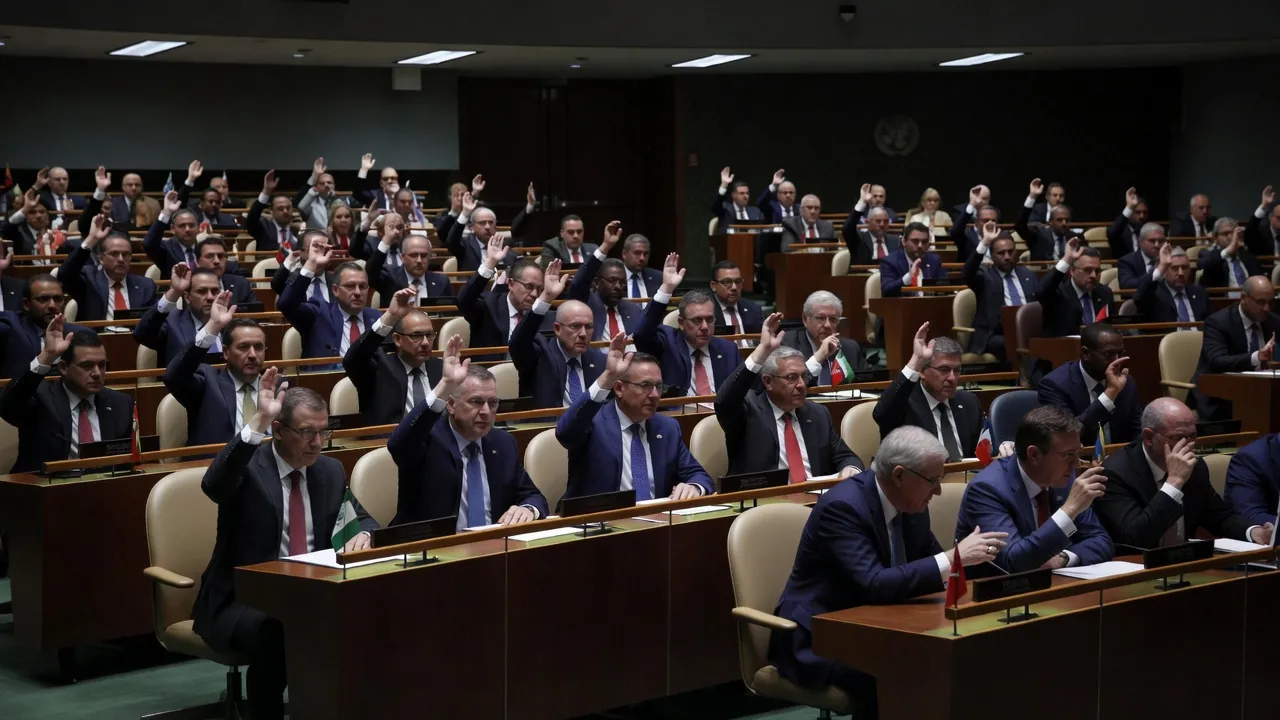
The 'Correct the Map' resolution was adopted at the UN General Assembly on September 4, 2026, by a vote of 164 in favor, with the United States as the sole opposing country.
The Equal Earth projection enlarges Africa, Latin America, South Asia, and Oceania, and reduces Europe and North America compared to the Mercator projection, on which Greenland appears almost as large as Africa, when it is actually about fourteen times smaller.
The initiative was led by Togo on behalf of the African Union, with Foreign Minister Robert Dussey as the main diplomatic voice behind the text.
Most perspectives present the resolution as a legitimate scientific and symbolic correction of a historical distortion, while the United States frames it as an ideological agenda diverting the UN from real issues.
Coverage aligned with this reading
Coverage that diverges
Canada and Australia, backed by a collective statement led by New Zealand, emphasize the lack of legal effect of the resolution on borders, sovereignty, or navigation, while other perspectives stress its historical and political significance.
Some Zimbabwean media outlets celebrate the cartographic correction as a pan-African victory, while others see it as a diversion that cannot erase very real internal political crises like the Gukurahundi or corruption.
This grouping describes the publications analysed, not the position of these countries’ populations or of their governments.
What the coverage of each country leaves aside, while others put it forward.
Australia
Canada
Preview: 3 of 13 media perspectives. Syntheses of the media analysed — not direct quotations. Method & limitations
Nairobi hails a diplomatic victory driven by the South and takes the solitary US vote as proof that the world map remains a power play.
2 sources · View sources
Nigeria views this UN vote as part of a continuum of assertive African diplomacy led by Togo and the African Union, just a few months after the resolution on slavery reparations.
4 sources · View sources
Accra welcomes a massive vote at the UN (164 votes to 1) and particularly notes the diplomatic isolation of the United States, the only country to have rejected a world map more faithful to the actual size of Africa.
2 sources · View sources
DOMINANT ANGLE
Nairobi hails a diplomatic victory driven by the South and takes the solitary US vote as proof that the world map remains a power play.
ANALYSIS
Nairobi, September 5, 2026.
DOMINANT ANGLE
Nigeria views this UN vote as part of a continuum of assertive African diplomacy led by Togo and the African Union, just a few months after the resolution on slavery reparations.
ANALYSIS
Abuja, September 5, 2026.
DOMINANT ANGLE
Accra welcomes a massive vote at the UN (164 votes to 1) and particularly notes the diplomatic isolation of the United States, the only country to have rejected a world map more faithful to the actual size of Africa.
ANALYSIS
Accra, September 5, 2026.
DOMINANT ANGLE
The United States government denounces the UN's ideological agenda and remains the only country in the world to vote against the symbolic abandonment of Mercator.
ANALYSIS
Washington, Friday, September 4, 2026.
DOMINANT ANGLE
London views the vote as a diplomatic shift where the United Kingdom has chosen to side with the majority of the South rather than with Washington, which remained the sole opponent to the Togolese resolution.
ANALYSIS
London, September 4, 2026.
DOMINANT ANGLE
Paris sees this UN vote as a diplomatic lever towards Africa, claiming a gesture of cartographic truth while tightening ties strained by its colonial past.
ANALYSIS
Paris, September 5, 2026.
DOMINANT ANGLE
New Delhi sees this vote as proof that an Africa-led coalition can garner 164 votes against a single opposing vote, that of the United States, in the most universal UN setting.
ANALYSIS
New Delhi, September 5, 2026.
DOMINANT ANGLE
Canberra is first taking note of the diplomatic maneuvering led by Togo and the unusual isolation of the United States, while also pointing out that Australia itself is expanding on the new map adopted at the UN.
ANALYSIS
Canberra, September 5, 2026.
DOMINANT ANGLE
Buenos Aires is taking stock of how Argentina itself is changing shape on the new map, gaining in apparent width but losing relative weight compared to territories closer to the equator.
ANALYSIS
Buenos Aires, September 5, 2026.
DOMINANT ANGLE
Dhaka takes away from this cartographic shift a long-awaited correction: South Asia, like Africa, is no longer downplayed on school maps inherited from Mercator.
ANALYSIS
Dhaka, September 5, 2026.
DOMINANT ANGLE
Ottawa supports the resolution on Equal Earth, but qualifies its vote with a safeguard clause that does not affect borders, sovereignty, or navigation.
ANALYSIS
Ottawa, September 5, 2026.
DOMINANT ANGLE
Stockholm outlines the cartographic mechanics of the shift to Equal Earth, noting the quantifiable disparity between Greenland and Africa and the lone US vote against 164 countries in favor.
ANALYSIS
Stockholm, September 4, 2026.
DOMINANT ANGLE
Harare is separating the pan-African pride surrounding the new map from the very real dramas that are plaguing the country, judging the cartographic symbol to be powerless in the face of internal corruption and repression.
ANALYSIS
Harare, September 5, 2026.
Explore every perspective on this subject across 13 countries.
Compare viewpoints and see where they diverge.
published on
countries
sources
articles
gap
On Friday, September 4, 2026, the United Nations General Assembly adopted, with 164 votes in favor, one vote against, and six abstentions, a resolution inviting member states to abandon the Mercator projection, used since 1569, in favor of the Equal Earth projection. The text was introduced by Togo on behalf of the African Union, which denounces the distortion of Mercator that enlarges areas near the poles at the expense of the equator: on this map, Greenland appears almost as large as Africa, while the continent is approximately fourteen times larger. The United States was the only country to vote against the text.
The resolution is non-binding: it invites states to use Equal Earth without requiring them to do so, nor does it challenge Mercator for maritime navigation.
Led by its minister Robert Dussey, it plans to revise its geography textbooks by the end of the year.
Six countries abstained: Serbia, Estonia, Georgia, Lithuania, Moldova, and Ukraine.
Designed in 2018, it also enlarges Latin America, South Asia, and Oceania compared to Mercator.
Their representative denounced an "ideological agenda" that she believes undermines the credibility of the UN.
More divergent than 87% of recent comparable stories (reference: 91 recent stories measured with the same method).