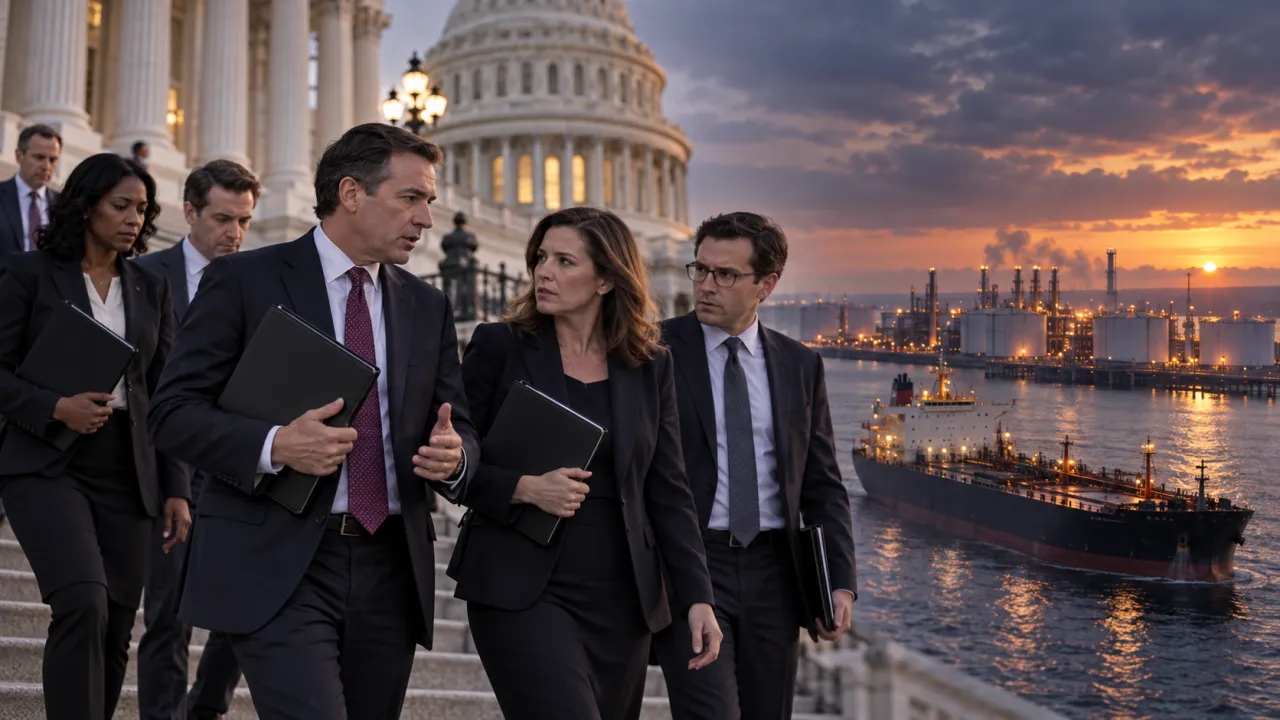
US Congress passes a Russia sanctions law allowing 100% tariffs on countries that buy its oil and gas
published on
countries
sources
articles
The Congressional vote is not the end of the story, but rather its beginning: in the following days, capitals and financial centers are wondering who, between China, India, or Gulf producers, will bear the real weight of the Graham law — and whether Donald Trump will go as far as to apply it.
The text awaits Trump's signature; analysts anticipate that he will keep this tariff authority in reserve rather than exercising it immediately against China and India.
Eighteen months for a vote
The text came to a vote after more than a year and a half of negotiations in Congress, according to ABC News. It bears the name of Lindsey Graham, a Republican senator who died suddenly in July, shortly after a trip to Kyiv where he had announced, according to NBC News, an agreement with the White House to move it forward.
The vote blurred party lines, notes NBC News: Democratic leadership opposed it, fearing an extension of the president's tariff powers. Democratic representatives Gregory Meeks, Don Beyer, and Richard Neal estimated that the text would "do more harm than good".
House Speaker Mike Johnson hailed "a powerful message of American unity", reports NBC News. Sputnik notes, for its part, that Russia has added Lindsey Graham to its list of "terrorists and extremists".
What the text conceals
According to The Atlantic, "the text is not what it seems to be": the magazine argues that it does not impose any significant new sanctions, and that it allows Donald Trump to lift the measures already planned, in the name of national interest.
The Atlantic adds that the text restores to the president some of the tariff power that the Supreme Court had taken away from him in February, without detailing the decision in question.
The Center for Strategic and International Studies, cited by the American press, notes that the device replaces the uniform 500% customs duty provided for by the 2025 version of the text with "a more measured instrument".
Deutsche Welle details a little-commented-on aspect elsewhere: beyond the customs duties targeting buyers of Russian energy, Trump could also impose taxes of up to 500% on direct imports from Russia.
New Delhi and Doha calculate
According to the Global Trade Research Initiative (GTRI), cited by the BBC, Russian oil is only part of India's energy landscape: in July 2026, it accounted for more than half of the country's imports, far ahead of the United Arab Emirates (10.8%), Saudi Arabia (9.6%), Venezuela (6.3%), Brazil (5.5%), Oman (5.3%), and the United States (2.9%) combined.
The Centre for Research on Energy and Clean Air (CREA) calculates, also according to the BBC, that India absorbed 37% of Russian crude oil exports between December 2022 and August 2026 — behind China, which took half, but ahead of Turkey and the European Union, each at 5%.
The Indian Ministry of Foreign Affairs specifies, according to Gulf Times, that the issue has already been "discussed at a high level" with American interlocutors, and that its implications for the bilateral relationship as well as the international energy market have been "very clearly exposed" from the Indian side.
For the Qatari press, cited by Gulf Times and Al Jazeera, the issue goes beyond just pressure on Moscow: if Asian buyers must reduce their Russian purchases, alternative suppliers of liquefied natural gas and oil, starting with the Gulf, could derive a commercial benefit — provided they themselves escape the sanctions mechanism.
Kyiv links law and strikes
In Kyiv, the vote is seen as part of the war dossier rather than a commercial text. On Telegram, Volodymyr Zelensky judged it "symbolic" that the adoption occurred on the night of a Russian attack involving ballistic missiles, other missiles, and drones, reports the Kyiv Post.
« We are of course following the progress of this text. It falls under the category of unfriendly actions, and the imposition of additional sanctions by the United States would certainly complicate the search for a peace settlement in Ukraine »
The Ukrainian president reported damage to civilian infrastructure in eight regions, including energy facilities in Sumy and Odessa and residential buildings in Kyiv and Odessa: 20 injured in Kyiv, 7 in Odessa, including young children, according to the same source.
A few hours before the vote, after a drone strike killed five people near Nikopol, Zelensky had called on his partners to support the Graham text and to tighten European sanctions, reports Ukrinform.
The text is named after Republican Senator Lindsey Graham, who died in July 2026.
203 Republicans and 58 Democrats voted in favor; seven Republicans and 152 Democrats against.
The Hoover Institution anticipates that Trump will keep tariff authority "in reserve" as a lever.
China rejects the text, denouncing "extraterritorial jurisdiction" without a UN mandate.
How each country reads it
6 perspectives, each in the voice of that country's press.
 Germany
Berlin is mainly gauging the extent of the tariff powers granted to Donald Trump by Congress, of up to 500 % on Russian imports and up to 100 % on countries buying Russian energy, before the diplomatic consequences for China and India.
2 sources
 India
IndiaNew Delhi weighs the tariff risk in dollars and market share, highlighting the $40.8 billion of Russian crude imported in 2026 rather than an abstract principle of energy sovereignty.
3 sources
 Qatar
QatarDoha views the US sanctions law as a potential reshaping of the global energy market, where tariffs targeting buyers of Russian oil and gas could redraw the map in favor of Gulf producers.
2 sources
 Russia
Moscow denounces a text that it views as less of a commercial pressure tool and more of an attempt to deprive Russia of the funds necessary to continue its offensive in Ukraine.
4 sources
 Ukraine
Kyiv welcomes the sanctions bill passed by Congress as a means of pressure on Russian energy revenues, but views it in light of the ongoing strikes on its cities.
3 sources
 United States
The United States government hands Trump a tariff weapon held in reserve: Congress validates customs duties of up to 100% on buyers of Russian oil to exert pressure on Beijing and New Delhi, more so than it immediately sanctions Moscow.
7 sources
What the comparison reveals
Common ground and differences in coverage across the media analysed.
What the media report in common
The House of Representatives adopted the text by 262 votes to 159 on Wednesday, September 16, 2026, after a favorable vote by the Senate, before its transmission to Donald Trump for signature.
The law authorizes the president to impose customs duties of up to 100% on countries that continue to buy Russian oil and gas, targeting China and India among the five largest buyers.
The text is named after Republican Senator Lindsey Graham, the main sponsor of the project before his death in July 2026.
Where media coverage diverges
Impact of the vote on peace prospects
The vote is interpreted by some as a tool to accelerate a settlement of the conflict in Ukraine, and by others as an additional obstacle to any negotiation, with Russia describing the move as a 'hostile' gesture.
Immediate application of tariff power
Part of the coverage presents the tariff power granted to the president as an authority being held in reserve rather than applied immediately against China and India, while another part analyzes it as a factor that can redistribute the global energy market now.
Coverage aligned with this reading
Coverage that diverges
This grouping describes the publications analysed, not the position of these countries’ populations or of their governments.
The full text, country by country
Germany
DOMINANT ANGLE
Berlin is mainly gauging the extent of the tariff powers granted to Donald Trump by Congress, of up to 500 % on Russian imports and up to 100 % on countries buying Russian energy, before the diplomatic consequences for China and India.
KEY POINTS
- The House of Representatives adopted the text by 262 votes to 159, after a favourable vote by the Senate the previous month, before transmission to Donald Trump for signature (Handelsblatt, DW German).
- The law authorises customs duties of up to 500% on direct imports from Russia, and up to 100% on the five largest buyers of Russian energy, as well as the five countries that most help to circumvent sanctions, with China and India potentially being affected (DW German, Handelsblatt).
- The text, named after Republican Senator Lindsey Graham who died in July, provides for entry bans and asset freezes targeting Vladimir Putin, military officials, and Russian banks, as well as targeting the "ghost fleet" of oil tankers (DW German).
ANALYSIS
Berlin, September 18, 2026. The German press first notes the scope of tariff powers that the US Congress has just granted to Donald Trump. On Wednesday, the House of Representatives approved a package of sanctions against Russia by 262 votes to 159, after a favorable vote by the Senate the previous month with a "clear majority", according to Handelsblatt. The text now goes to the desk of the American president, who had already "indicated his agreement", the economic daily specifies. Deutsche Welle describes this package as the "first new sanctions text against Russia" of Trump's second term.
The two titles describe the same declared objective: to reduce the revenue from Russian energy exports, which finance the war against Ukraine. But the mechanism highlighted by the German press remains primarily tariff-based. According to DW, Trump will be able to impose taxes of up to 500% on direct imports from Russia, and customs duties of up to 100% on the five largest buyers of Russian energy, as well as the five countries that help Moscow the most to circumvent existing sanctions.
Handelsblatt recalls that China and India are among the largest buyers of Russian oil and that the law "could therefore further strain American trade relations" with these two countries. The daily also emphasizes that the text bears the name of Republican Senator Lindsey Graham, who died in July, presented as the man who "decisively advanced" it in Congress.
On the repressive side, DW details entry bans targeting Vladimir Putin and several military officials deemed responsible for the war, the freezing of their assets in the United States, that of Russian banks, as well as an explicit targeting of the "ghost fleet" of oil tankers used by Moscow to circumvent existing oil sanctions.
Neither of the two articles mentions at this stage any reaction from the Kremlin, India, or Ukraine: the German coverage remains focused on the legislative process in Washington and the tariff mechanisms it opens, rather than on its immediate diplomatic repercussions for New Delhi or Beijing. It remains to be seen, once the presidential signature is obtained, with what scope these new duties will actually be applied.
India
DOMINANT ANGLE
New Delhi weighs the tariff risk in dollars and market share, highlighting the $40.8 billion of Russian crude imported in 2026 rather than an abstract principle of energy sovereignty.
KEY POINTS
- The foreign ministry stated that India remains "firmly committed" to ensuring the energy security of its 1.4 billion inhabitants and will take "all necessary measures" to protect its trade interests (spokesperson Randhir Jaiswal, September 17).
- Russia supplied 30.3% of India's crude oil imports in fiscal year 2026, totaling $40.8 billion out of a total bill of $134.7 billion, according to the Global Trade Research Initiative (GTRI).
- The Lindsey O. Graham bill, passed 262-159 in the House after an 86-11 vote in the Senate, targets the top five buyers of Russian oil and gas but does not automatically impose 100% tariffs.
ANALYSIS
New Delhi, September 18, 2026. The US House of Representatives adopted the Lindsey O. Graham bill on sanctions against Russia and Iran on Wednesday, September 16, by 262 votes to 159, which was already voted on by the Senate by 86 votes to 11. The text, named after the Republican senator who died in July, now heads to Donald Trump's desk and authorizes the president to impose customs duties of up to 100% on imports from countries that continue to buy Russian oil and gas — without triggering them automatically. An exemption is provided for countries that import less than 15% of their gas from Russia and reduce these purchases.
For New Delhi, the stakes are measured in dollars. According to the think tank Global Trade Research Initiative (GTRI), Russia supplied 30.3% of India's crude oil imports in the 2026 fiscal year, totaling $40.8 billion out of a total bill of $134.7 billion. In July, Russian crude accounted for more than half of the country's imports, far ahead of the United Arab Emirates (10.8%), Saudi Arabia (9.6%), Venezuela (6.3%), Brazil (5.5%), Oman (5.3%), and the United States (2.9%) combined. According to the Centre for Research on Energy and Clean Air (CREA), India absorbed 37% of Russia's crude oil exports between December 2022 and August 2026, behind China (half) and ahead of Turkey and the EU (5% each).
On Thursday, September 17, the Indian Ministry of Foreign Affairs responded through its spokesperson Randhir Jaiswal: India remains "firmly committed" to ensuring the energy security of its 1.4 billion inhabitants and will take "all necessary measures" to protect its trade interests. The ministry specifies that the subject has already been "discussed at a high level" with American interlocutors, and that its implications for the bilateral relationship as well as the international energy market have been "very clearly exposed" from the Indian side.
The Indian press emphasizes that the measure is not automatic: Trump will have to decide, country by country, whether or not to activate the customs duties. An earlier version of the text, in July, envisioned tariffs of up to 500% targeting India, China, Turkey, and Singapore, among ten countries. Beijing, also exposed, has rejected the text, denouncing "extraterritorial jurisdiction" without a mandate from the UN Security Council.
Qatar
DOMINANT ANGLE
Doha views the US sanctions law as a potential reshaping of the global energy market, where tariffs targeting buyers of Russian oil and gas could redraw the map in favor of Gulf producers.
KEY POINTS
- The House of Representatives passed the bill by 262 votes to 159 on Wednesday, September 16, after its adoption in the Senate, sending the text to Donald Trump's desk.
- The text authorizes customs duties of up to 100% on countries, including China and India, that continue to import Russian oil and gas.
- The Indian Ministry of Foreign Affairs stated on Thursday, September 17, that New Delhi remained "firmly committed" to ensuring the energy security of its 1.4 billion inhabitants and would take "all necessary measures" to protect its trade interests.
ANALYSIS
Doha, Friday, September 18, 2026. As the world's leading exporter of liquefied natural gas, Qatar is closely following the US Congress vote that paves the way for customs duties of up to 100% against countries that continue to buy Russian oil and gas. On Wednesday, September 16, the House of Representatives adopted the text introduced by Republican Senator Lindsey Graham by 262 votes to 159, after its adoption in the Senate; it is now headed to Donald Trump's desk. The law specifically targets China and India, two major customers of Russian oil, and also targets officials, banks, and the ghost fleet of tankers used by Moscow to circumvent Western sanctions.
For the Qatari press, the issue goes beyond simply punishing Moscow: it is a possible redistribution of the global energy market that is taking shape. If Asian buyers must reduce their Russian imports under penalty of tariff reprisals, alternative suppliers of LNG and oil, led by the Gulf, could benefit commercially, provided they avoid being caught up in the sanctions machinery themselves.
On Thursday, September 17, the Indian Ministry of Foreign Affairs responded that New Delhi remained "firmly committed" to ensuring the energy security of its 1.4 billion inhabitants through "diversified supply", and that it would take "all necessary measures" to protect its commercial interests. A position that, from Doha's perspective, illustrates the difficulty of converting the US law into a real lever: the exemption clause for countries importing less than 15% of their gas from Russia leaves room for negotiation, and nothing obliges Trump to actually apply the tariffs.
The text also extends the Iran Sanctions Act until 2031, a point closely followed in the Gulf, where the regional balance depends in part on American pressure on Tehran. For Qatari observers, the law confirms above all the willingness of Congress, reunited on this issue after more than a year of deadlock, to transform access to Russian energy into a variable of war diplomacy in Ukraine — a logic that could, in the long term, redistribute market shares to Gulf producers.
Russia
DOMINANT ANGLE
Moscow denounces a text that it views as less of a commercial pressure tool and more of an attempt to deprive Russia of the funds necessary to continue its offensive in Ukraine.
KEY POINTS
- The House of Representatives adopted the text by 262 votes to 159 on Wednesday, September 16, after a procedural vote of 214 to 211, according to TASS and RT.
- The text authorizes customs duties of up to 100% on countries buying or reselling Russian oil and gas, targeting China and India in priority, according to RT.
- The Kremlin, through Dmitry Peskov, described the vote as a hostile gesture that would complicate the search for a peace settlement in Ukraine, according to the Moscow Times and Sputnik.
ANALYSIS
Moscow, September 18, 2026. The US House of Representatives approved on Wednesday, September 16, by 262 votes to 159, the text now called the "Lindsey O. Graham Sanctioning Russia and Iran Act of 2026", named after the Republican senator who died in August, reports Sputnik. The Senate had already validated it the previous month; the document is now heading to Donald Trump's desk. According to RT, 203 Republicans and 58 Democrats voted in favor, compared to seven Republicans and 152 Democrats.
The text authorizes the president to impose customs duties of up to 100% on countries that buy or resell Russian oil and gas. It primarily targets, RT specifies, "the five main countries facilitating the circumvention of Russian oil sanctions", with China and India expected to be among the targets. The mechanism also affects the "ghost fleet" of tankers, the Russian energy and defense sectors, as well as officials and banks, with the aim, according to the Moscow Times, of depriving Moscow of the funds used to finance its war against Ukraine.
Kremlin spokesman Dmitry Peskov described the vote as a hostile gesture. "We are of course following the progress of this text. It falls into the category of hostile actions, and the imposition of additional sanctions by the United States would certainly complicate the search for a peace settlement in Ukraine," he said, quoted by Sputnik and the Moscow Times.
Beijing reacted as early as Thursday through the voice of Foreign Ministry spokesman Guo Jiakun: "China's cooperation with other countries should not be subject to the interference of third parties," he stated, adding that these exchanges are based on "equality and mutual benefit" and do not tolerate "either interference or coercion".
TASS recalls that a procedural vote had first allowed, by 214 votes to 211, the final vote to take place, and emphasizes that the text also imposes secondary sanctions on Russia's trading partners, in addition to restrictions targeting high-ranking political and military officials. Sputnik notes, meanwhile, that Lindsey Graham is listed by Russia as a "terrorist and extremist".
Ukraine
DOMINANT ANGLE
Kyiv welcomes the sanctions bill passed by Congress as a means of pressure on Russian energy revenues, but views it in light of the ongoing strikes on its cities.
KEY POINTS
- The House of Representatives adopted the text by 262 votes to 159 on Wednesday, September 16, after a Senate approval of 86 votes to 11 in August; it is now headed to Trump's desk.
- The law authorizes customs duties of up to 100% on the five largest importers of Russian oil and gas, with an exemption for countries with less than 15% of Russian purchases in reduction.
- Volodymyr Zelensky described the law as an "incredibly powerful tool" to force Russia to peace, following a strike that injured 20 people in Kyiv and 7 in Odessa.
ANALYSIS
Kyiv, September 18, 2026. The House of Representatives adopted on Wednesday, September 16, by 262 votes to 159, the sanctions bill introduced by the late Senator Lindsey Graham, which was already voted on by the Senate in August with 86 votes to 11. The text now heads to Donald Trump's desk. It authorizes the US President to impose customs duties of up to 100% on the five largest importers of Russian oil and gas, with an exemption for countries that buy less than 15% of their gas from Russia and reduce their volumes. It also targets Russian officials, banks, and the ghost fleet of oil tankers, and extends sanctions against Iran until 2031.
In Kyiv, the vote is seen as part of the war effort rather than a commercial text. On Telegram, Volodymyr Zelensky judged it "symbolic" that the adoption came "on the night of a new Russian attack involving ballistic missiles, other missiles, and drones". According to him, civilian infrastructure was damaged in eight regions, including energy facilities in Sumy and Odessa, and residential buildings in Kyiv and Odessa: 20 injured in Kyiv, 7 in Odessa, including young children. He described the Graham bill as "an incredibly powerful tool capable of putting an end to this terrorist war and forcing Russia to establish peace".
This reading extends a call made a few hours before the vote: on Wednesday, September 16, after a drone strike that killed five people near Nikopol and damaged a locomotive in the Mykolaiv region, the Ukrainian President urged his partners to support the Graham bill and tighten European sanctions, judging that no concessions to the aggressor in the form of eased sanctions would lead to peace.
On the Russian side, Kremlin spokesman Dmitri Peskov described the vote on Thursday, September 17, as a "hostile gesture" that "will undoubtedly complicate" any peaceful settlement of the conflict. The Wall Street Journal, cited by the Ukrainian press, indicates that Trump plans to sign the text. For Kyiv, the measure directly targets the energy revenues that finance the Russian war effort, particularly through China and India, the main buyers of Russian crude.
United States
DOMINANT ANGLE
The United States government hands Trump a tariff weapon held in reserve: Congress validates customs duties of up to 100% on buyers of Russian oil to exert pressure on Beijing and New Delhi, more so than it immediately sanctions Moscow.
KEY POINTS
- The Chamber adopted the text by 262 votes to 159 on September 16, after a Senate vote of 86 to 11 in August.
- The law authorizes customs duties of up to 100% on the top five buyers of Russian oil or gas, with an exemption for countries importing less than 15% of their gas from Russia and reducing these purchases.
- Ronak D. Desai, of the Hoover Institution, estimates that Trump "will sign this law and keep his tariff authority in reserve as leverage" rather than immediately taxing China and India.
ANALYSIS
Washington, September 18, 2026. After more than a year and a half of negotiations, the House of Representatives adopted on Wednesday, by 262 votes to 159, the Lindsey O. Graham Sanctioning Russia and Iran Act of 2026, already validated by the Senate in August by 86 votes to 11. The text bears the name of the Republican senator who died suddenly in July, shortly after a trip to Kyiv where he had announced an agreement with the White House to move it forward. It is now headed to Donald Trump's desk, who has already supported it.
The law authorizes the president to impose customs duties of up to 100% on the top five buyers of Russian oil or gas, led by China and India, with an exemption for countries importing less than 15% of their gas from Russia and reducing these purchases in a "significant" way. It also sanctions Russian officials, banks, the "ghost fleet" of oil tankers, and extends the Iran Sanctions Act until 2031.
The vote blurred party lines: the Democratic leadership opposed it, fearing an extension of the president's tariff powers, while 58 Democratic lawmakers voted for it and seven Republicans against. Representatives Gregory Meeks, Don Beyer, and Richard Neal warned that the text "would do more harm than good". House Speaker Mike Johnson hailed "a powerful message of American unity".
For several analysts cited by the American press, the issue is not immediate application. Ronak D. Desai, of the Hoover Institution, anticipates that Trump "will sign this law and keep his tariff authority in reserve as a lever". The Center for Strategic and International Studies notes that the text replaces the uniform 500% customs duty of the 2025 version with "a more measured instrument". The Atlantic goes further, judging that "the text is not what it seems to be": according to the magazine, it imposes no new significant sanctions and allows Trump to lift the measures himself in the name of national interest, while restoring some of his tariff power that the Supreme Court had taken away from him in February.
China and India, which have shown no signs of wanting to reduce their purchases of Russian crude, may therefore first face diplomatic pressure held in reserve rather than immediate taxation.
Explore every perspective on this subject across 6 countries.
Compare viewpoints and see where they diverge.