N°27
The week power changed tables while the ground kept shaking
2,600dead under the rubble in Venezuela
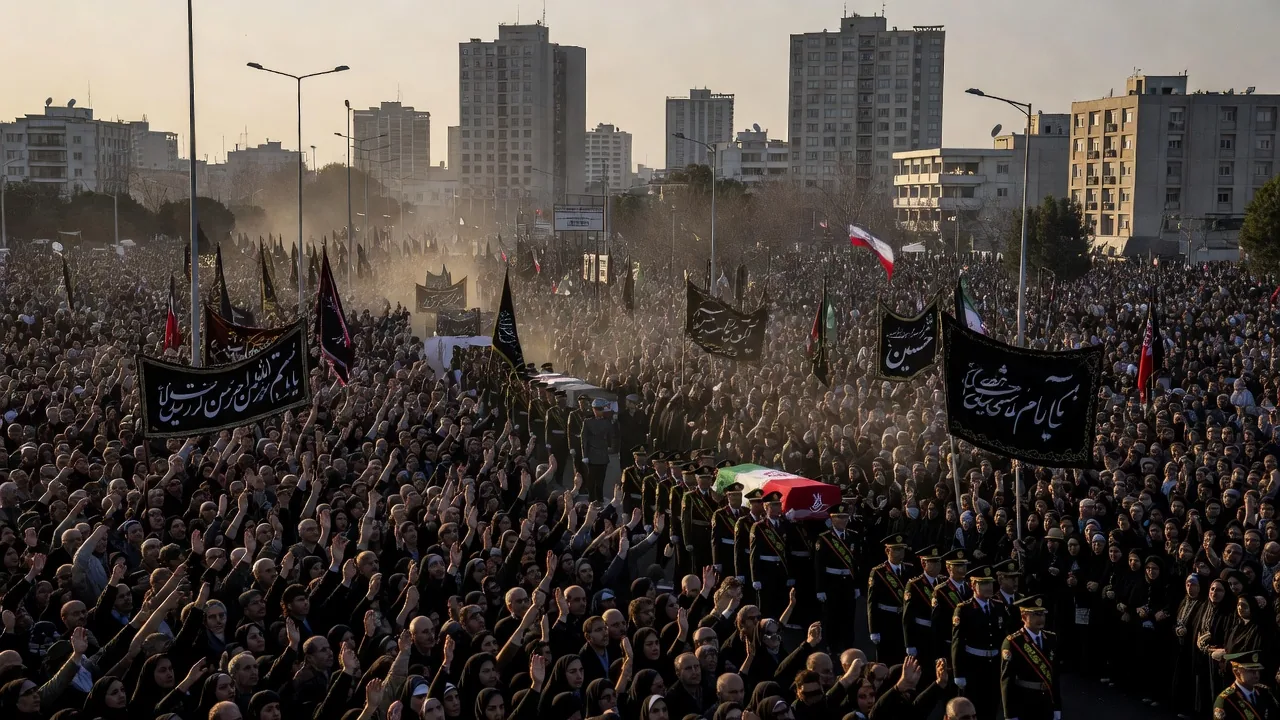
More than 2,600 bodies have been pulled from the debris after the sequence of earthquakes that struck Venezuela, a still-provisional toll as anger mounts over the handling of the rescue effort. The figure is staggering, and yet it circulated this week beneath the noise of a New York wedding and a state funeral in Tehran. It embodies the gap of the week: three transfers of power are being negotiated and announced under the spotlight, while a disaster with no negotiating table counts its dead far from the cameras.Sources — Reuters · AFP · EFE
23
Subjects analysed
41
Countries compared
21%
Owned track-record
The week's three acts
01What divides — free02Under the radar — weak signals03What we bet — predictionsAct 1Free · open access
What divides
The divergence score measures the framing gap between the world’s newsrooms on the same event. The higher the score, the more the narrative fractures along borders.
↑ Most divergent
36/100
Frappes russes massives sur l'Ukraine
33/100
Le Pakistan annonce avoir tué 29 militants à la frontière afghane
32/100
Marches des fiertés à Budapest et Istanbul
↓ Least divergent
4/100
Frappe russe massive sur Kyiv : au moins 11 morts
5/100
Un avion s'écrase sur le plus haut gratte-ciel de Pékin
5/100
Crash d'un hélicoptère d'Aramco en Arabie saoudite : 14 morts
Convergences — what every newsroom tells without connecting
Doha reopens the channel while the strikes go on
June 28: Iranian drones over Bahrain revive fears of a Gulf flare-up; the monarchies condemn with one voice.July 3: Washington and Tehran announce "progress" in Doha on the Strait of Hormuz, with no timetable and no signed text.July 3: the strait stays open to traffic and the risk premium on crude eases without collapsing.July 4: Khamenei's state funeral is held the same day, and the negotiating delegation stays in place in Doha.
The announcement of "progress" in Doha reads the same way on both shores of the Gulf and as far as Asia: a de-escalation channel reopened, but no text to seal it. Riyadh and Abu Dhabi greet the signal with measured relief, because an open Hormuz is worth more to them than a diplomatic victory for anyone. New Delhi and Seoul, first exposed to a closure of the strait, count their cargoes and their prices before anything else. The common thread across half a dozen capitals: no one takes the announcement for an agreement, and everyone takes the reopened channel for a reprieve. The talks happen under a bell jar, in Doha, while the June 28 drones are a reminder that the ground itself does not wait for the communiqué.
Confidence 80% · US · IR · QA · SA · IN · KR
Act 2◆ Signals & shifts locked
Under the radar
Weak signals and narrative shifts are the Prism’s deep analysis: what newsrooms have not yet named. Subscribers only. The blind spots stay free.
Weak signals ◆ Locked
The attention economy arbitrates between a wedding and 400 deaths
Australia turns child protection into leverage over the platforms
The return of a Fujimori to power slips under the global radar
Narrative shifts ◆ Locked
The summit of the Iranian state
North American trade
How the seismic disaster is read
Blind spots Free · open access
DR Congo
The Ebola outbreak nearing 400 deaths
Nearly 400 deaths and reported gatherings in Kinshasa mobilized only a handful of African capitals and health newsrooms, while most of the world's attention went to a New York wedding and the transitions in the Gulf and North America. The epidemic ticks every box of a cross-border emergency, but its media invisibility keeps it off the diplomatic agenda, even as the underfunding of the response flows directly from that lack of attention.
Covered: CD · NG · ZAIgnored: US · FR · CN · RU
Venezuela
Anger at the rescue effort after more than 2,600 deaths
The passing of 2,600 deaths and the rising anger at how the rescue was organized were followed closely mainly by Venezuela and its immediate neighbors, while the major powers treated the disaster as a distant humanitarian matter. The political dimension — a natural disaster becoming a test of the state apparatus — remains largely in the blind spot of capitals absorbed by Hormuz and the USMCA.
Covered: VE · CO · BRIgnored: US · CN · RU · IN
Pakistan
The disputed 29 deaths at the Afghan border
The announcement of 29 "militants" killed and its rejection by Kabul open one of the most divergent files of the week, yet stay confined to South Asia and a few neighbors. The factual disagreement over who was killed and why — militants or civilians, on whose soil — is precisely the kind of gray zone Western capitals dig into only in case of open escalation, leaving the Afghan-Pakistani border in a recurring blind spot.
Covered: PK · IN · IRIgnored: US · FR · DE · BR
Act 3◆ Reasoning locked
What we bet
Dated, falsifiable predictions, judged publicly. The statement and deadline are free — the reasoning behind them is for subscribers. We settle them later, won and lost alike.
15
Jul 2026
No formal, signed agreement on the Strait of Hormuz between the United States and Iran will be announced before July 15, 2026.
Reasoning: The Doha "progress" was announced with no text, no timetable, and during an Iranian interregnum that complicates any formal commitment.
🔒 Full reasoning for subscribers
72%
Confidence
15
Jul 2026
Iran will not publicly announce a named successor to Ali Khamenei before July 15, 2026.
Reasoning: The funeral was held with no designated successor and the Assembly of Experts keeps control of a historically slow timetable.
🔒 Full reasoning for subscribers
70%
Confidence
16
Jul 2026
No North American trade treaty replacing the USMCA will be signed by the three countries before July 16, 2026.
Reasoning: The non-renewal was announced with no replacement text, and both Ottawa and Mexico City are still demanding clarity.
🔒 Full reasoning for subscribers
80%
Confidence
14
Jul 2026
The official death toll from the Venezuela earthquakes will exceed 2,800 before July 14, 2026.
Reasoning: Post-quake tolls of this magnitude almost always rise as debris is cleared and isolated areas are reached.
🔒 Full reasoning for subscribers
70%
Confidence
Our track-record — free, owned, verifiable
21%
of predictions confirmed across all settled editions. We publish everything: bets won and bets lost. Transparency is the contract — not infallibility.
04
ConfirmedPredictions that landed
15
DeniedOwned publicly
19
Settled totali.e. 21% success — won and lost
Unlock
edition N°27
The statement is free. Reading the world, less so. Access the weak signals, the narrative shifts and the full reasoning behind every prediction.
- 4 weak signals decrypted in full
- 3 narrative shifts with their evidence
- The reasoning of each of the 5 predictions
- Full access to the 23 subjects of the week
- All archives, from the start to today
Subscribe to the Prism
Secure payment · Cancel anytime
— The newsroom that bets on the future
Complete weak signals, narrative shifts with evidence, and the reasoning behind every prediction.
$4.99/month$39.99 /year · save 33%
The Prism is published every Saturday. The in-depth analysis is for subscribers.
SHARE THIS RECAP
SHARE THIS COMPARISON
Show your friends how the world sees the same news differently.
Subscribe to the newsletter
Get the Weekly every Saturday morning. Free.