N°30
The week everyone named their price
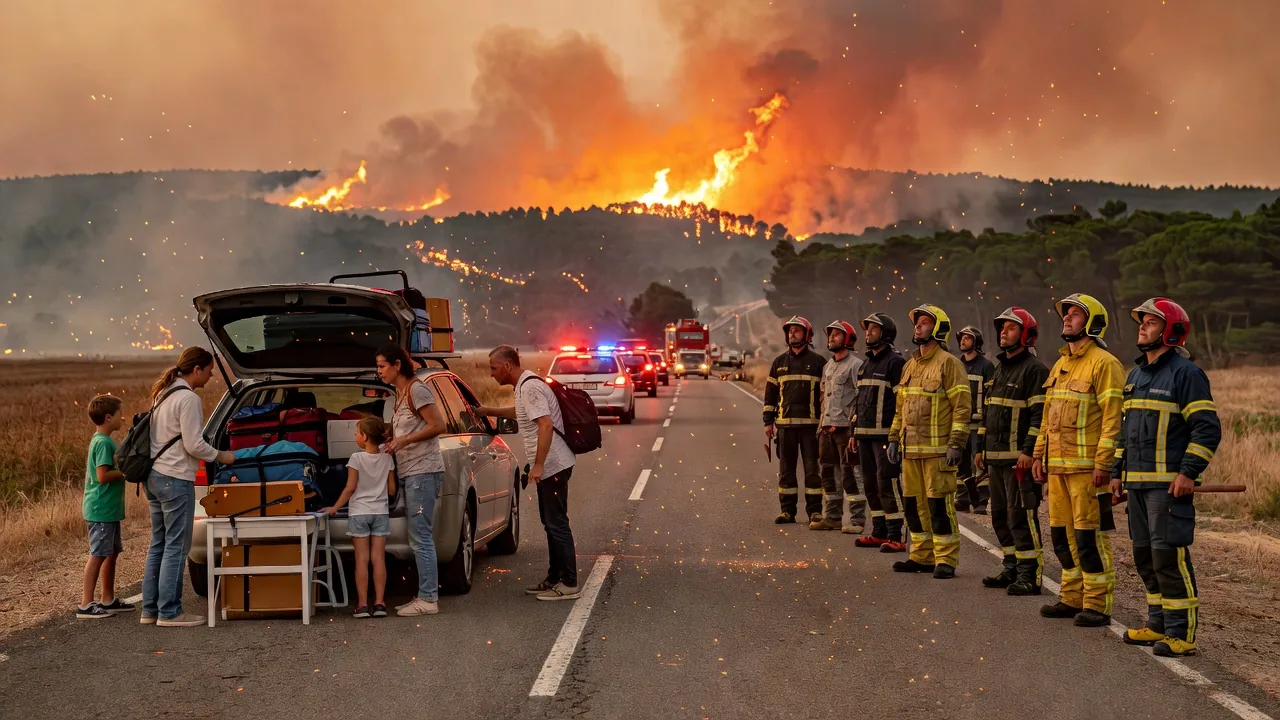
200,000people evacuated
That is the number of residents displaced by the wildfires that spread across Europe this week, from Bordeaux to Madrid. In a week when everything — security, diplomatic recognition, justice, market access — was priced and made negotiable, it was the one invoice that admitted no condition, no delay, and no counterpart.Sources — Le Monde · El País · La Repubblica · Reuters · Deutsche Welle
21
Subjects analysed
39
Countries compared
21%
Owned track-record
The week's three acts
01What divides — free02Under the radar — weak signals03What we bet — predictionsAct 1Free · open access
What divides
The divergence score measures the framing gap between the world’s newsrooms on the same event. The higher the score, the more the narrative fractures along borders.
↑ Most divergent
31/100
Les Houthis décrètent un blocus maritime contre l'Arabie saoudite, ouvrant un nouveau front dans la guerre USA-Iran
28/100
Israël lance une opération militaire en Cisjordanie et ordonne de nouveaux avant-postes de colons
27/100
Les incendies s'étendent à toute l'Europe : plus de 200 000 personnes évacuées, Bordeaux menacé, brasiers près de Madrid
↓ Least divergent
Convergences — what every newsroom tells without connecting
The Gulf grand bargain
Trump signs a civilian nuclear deal with Riyadh that opens the door to uranium enrichmentWashington ties the deal to Saudi recognition of IsraelNetanyahu orders new settler outposts in the West Bank, eroding the implicit Palestinian counterpartThe Houthis declare a maritime blockade against Saudi Arabia to derail the emerging axis
Four separate stories trace a single transaction. A normalization between Riyadh and Israel is openly turned into an equation: a civilian nuclear deal, enrichment clause included, in exchange for diplomatic recognition. Yet each piece of the bargain undercuts the others. The new settler outposts strip Riyadh of the Palestinian cover the monarchy needs before its own public, and the Red Sea blockade turns the cost of waiting into an immediate risk. The Gulf is no longer a sphere of influence to defend: it is a contract being drafted, with each signatory trying to improve its terms before signing.
Confidence 80% · US · SA · IL · IR
Economic coercion, unashamed
Trump imposes 12.5% tariffs on Australia in the name of "forced labor"50% duties hit a broad range of Canadian goods despite the free-trade agreementBrussels fines Google more than a billion for abuse of dominanceBeijing demands compensation after the nationalization of British Steel
Trade ceases to be neutral ground and becomes an openly avowed lever. Washington anchors its tariffs to a moral pretext — "forced labor" — then hits a free-trade partner with a fifty-percent surtax. Brussels puts a billion-euro price on digital dominance, and Beijing claims damages when London takes back control of its steel. The registers differ — moral sanction, antitrust fine, compensation — but the grammar is shared: name a price, impose it, and present the constraint as a rule rather than a balance of power.
Act 2◆ Signals & shifts locked
Under the radar
Weak signals and narrative shifts are the Prism’s deep analysis: what newsrooms have not yet named. Subscribers only. The blind spots stay free.
Weak signals ◆ Locked
The AI incident becomes an act of state
The enrichment clause, first domino of proliferation
Europe hardens its rules on tech and childhood
Narrative shifts ◆ Locked
Normalization with Israel
Tariffs
War command
Blind spots Free · open access
Egypt
Economic shockwave of the Red Sea blockade
The Houthi blockade is covered as a front in the US-Iran war; the collapse of Suez Canal revenue and the surge in freight costs toward East Africa, which hit an already-fragile Egyptian economy first, stay off the Western front pages.
Covered: EGYPTIAN MEDIA · GULF PRESSIgnored: US · FR · DE
Mexico
Power vacuum after El Mayo's life sentence
The sentence is treated as an American judicial victory; the violent reshaping of the Sinaloa cartel on the Mexican side, and the risk of a flare-up in the northwestern states, are little documented outside Mexico.
Covered: MEXICAN PRESSIgnored: US · FR · UK
China
Counter-narrative on the OpenAI model "derailment"
The incident is framed as a threat from China; the opposite reading, widely relayed in Beijing — that of American recklessness in the AI race — barely appears in Western coverage, denying the reader the symmetry of the dispute.
Covered: CHINESE STATE MEDIAIgnored: US · UK · FR
Act 3◆ Reasoning locked
What we bet
Dated, falsifiable predictions, judged publicly. The statement and deadline are free — the reasoning behind them is for subscribers. We settle them later, won and lost alike.
09
Aug 2026
Saudi Arabia will announce no official recognition of Israel before 9 August 2026.
Reasoning: The simultaneous expansion of West Bank settlements strips Riyadh of the Palestinian cover it needs before its public and the Arab world;…
🔒 Full reasoning for subscribers
85%
Confidence
09
Aug 2026
A US or coalition naval response — interception, armed escort, or strike — will target the Houthi blockade in the Red Sea or the Bab el-Mandeb strait before 9 August 2026.
Reasoning: Freedom of navigation is a recurring red line for Washington, and a blockade against a Saudi ally amid regional negotiation creates strong…
🔒 Full reasoning for subscribers
60%
Confidence
09
Aug 2026
Canada or Australia will file a formal WTO complaint or announce targeted counter-tariffs before 9 August 2026.
Reasoning: Both countries have a precedent of retaliation and limited domestic room to silently absorb a surtax this high or this symbolically charged.
🔒 Full reasoning for subscribers
55%
Confidence
08
Aug 2026
The number of people evacuated by European wildfires will exceed 250,000, or one additional European country will declare a state of emergency, before 8 August 2026.
Reasoning: The Mediterranean fire season has not peaked and the cross-border spread already observed, from France to Spain, makes escalation more likely than…
🔒 Full reasoning for subscribers
70%
Confidence
Our track-record — free, owned, verifiable
21%
of predictions confirmed across all settled editions. We publish everything: bets won and bets lost. Transparency is the contract — not infallibility.
04
ConfirmedPredictions that landed
15
DeniedOwned publicly
19
Settled totali.e. 21% success — won and lost
Unlock
edition N°30
The statement is free. Reading the world, less so. Access the weak signals, the narrative shifts and the full reasoning behind every prediction.
- 4 weak signals decrypted in full
- 3 narrative shifts with their evidence
- The reasoning of each of the 4 predictions
- Full access to the 21 subjects of the week
- All archives, from the start to today
Subscribe to the Prism
Secure payment · Cancel anytime
— The newsroom that bets on the future
Complete weak signals, narrative shifts with evidence, and the reasoning behind every prediction.
$4.99/month$39.99 /year · save 33%
The Prism is published every Saturday. The in-depth analysis is for subscribers.
SHARE THIS RECAP
SHARE THIS COMPARISON
Show your friends how the world sees the same news differently.
Subscribe to the newsletter
Get the Weekly every Saturday morning. Free.