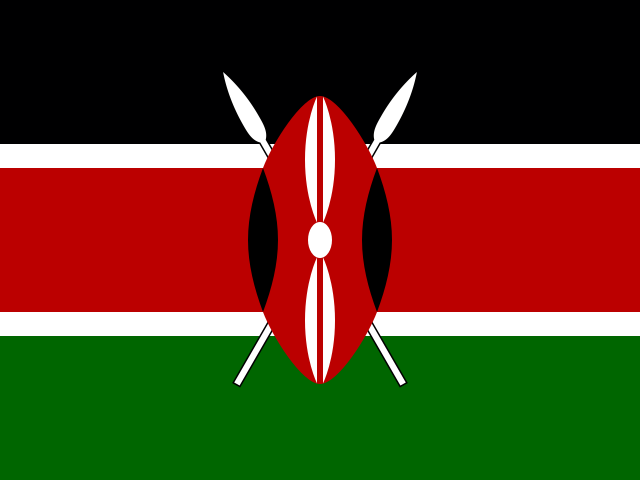
SOUTH AFRICA PERSPECTIVE
EBOLA IN DRC: OVER 1,100 SUSPECTED CASES, SUSPECTED CASES RULED OUT IN BRAZIL AND ITALY, TEDROS WRAPS UP KINSHASA VISIT
Single source
DOMINANT ANGLE
Pretoria sees the Ebola crisis spilling over into Kenya and accuses the US military of defying Nairobi's judicial order: African sovereignty is at play in Laikipia
Dominant angle identified — does not reflect unanimity of this country’s media
ANALYSIS
Cape Town views Nairobi from the southern continent and chooses a framing that few other media dare to take: News24 headlines 'Protests erupt in Kenya as US military defies court order over Ebola quarantine base.' The accusation lies in the verb: 'defies,' defies. The US military, according to the South African newspaper, defies the interim order of the Kenyan High Court by continuing preparations for the Laikipia quarantine center despite the legal blockade. This is a sovereignist angle, assumed and inscribing the health crisis into a longer story: that of American military bases in Africa and their extraterritoriality.
South African coverage is restrained — 296 characters at News24, repeated from Reuters — but the choice of words is decisive. Where the BBC speaks of 'contested plans' and Al Jazeera mentions a 'planned installation,' News24 uses 'defies.' The distinction is not trivial: it says that for Cape Town, it's not just the Kenyan executive authorities who are playing, it's the African judicial institution itself that is being challenged by a foreign power. This is a reading inherited from the post-apartheid South African experience, where the independence of the courts has become the shield of the democratic transition.
The South African angle also inscribes itself in a tradition of pan-African observation. South Africa has no case, is not neighboring the epicenter, but it feels responsible for a certain continental voice. News24 does not write 'Kenyans protest' in the sense of a local fact, but signals that protests have erupted in a file where Washington spends $13.5 million to install a medical infrastructure in a country without cases. The subtext is clear: if the United States really wanted to fight Ebola, they would fund the hospitals of Bunia and Beni in Ituri, not a luxury center in Nanyuki. This is an implicit but clear criticism, formulated with the typical restraint of South Africa's reference media.
KEY POINTS
- News24 uses the verb 'defies' to qualify the American attitude towards the Kenyan High Court's interim order
- The South African angle inscribes the crisis in a sovereignist reading: the African judicial institution is being challenged by a foreign power
- The coverage suggests implicitly that the $13.5 million Americans should fund Bunia and Beni rather than an infrastructure in Nanyuki
COGNITIVE BIASES IDENTIFIED
Judicial sovereignty: South African media systematically values the independence of African courts from foreign powers
Implicit criticism of Washington: the vocabulary ('defies') takes a position without openly claiming it
Assumed pan-African voice: Cape Town speaks on behalf of a certain continental consciousness without citing Congolese or Ugandan sources
SOURCES (1)
Does this analysis seem accurate?