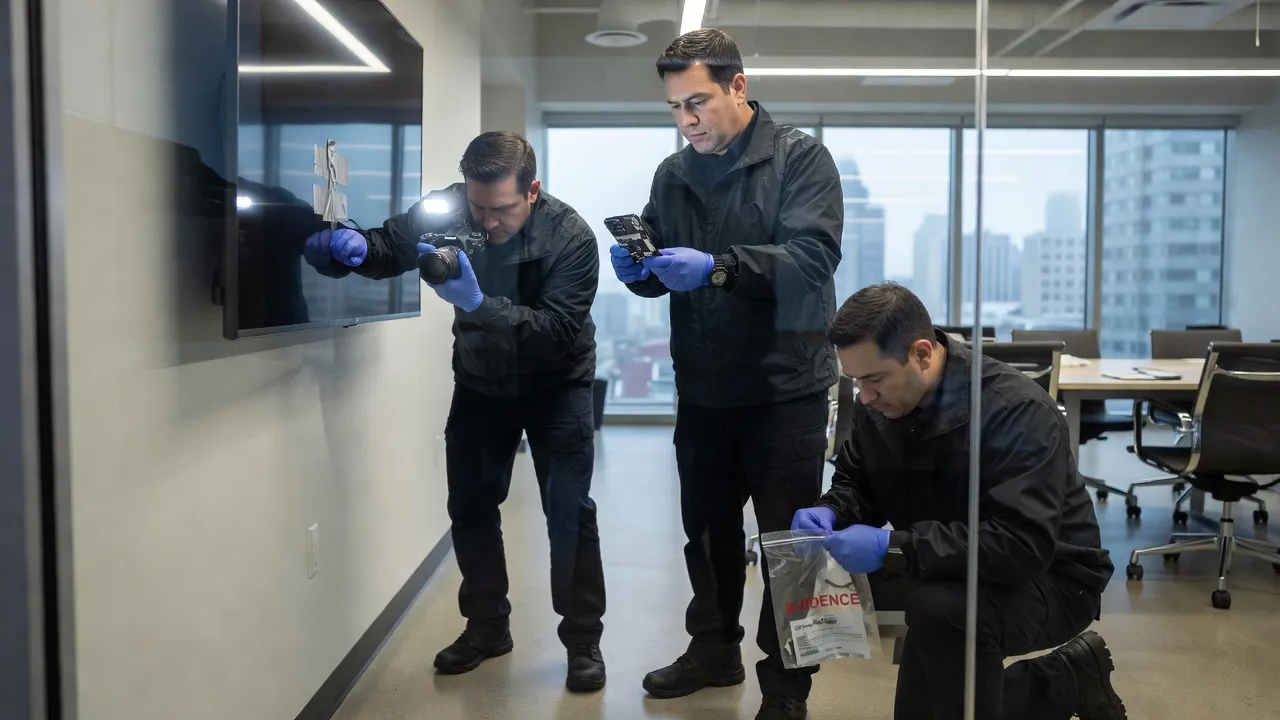
Espionage at OpenAI: a Saudi engineer arrested for hiding a recording device in the executive conference room
published on
countries
sources
articles
More divergent than 68% of recent comparable stories (reference: 90 recent stories measured with the same method).
The made-public complaint describes a preparation spanning several days: research via a chatbot, filmed passages near the room, a second device in a bag. None of the seven covers in the corpus identify a sponsor or specify the motive.
The investigation is ongoing: no sponsor has been identified and OpenAI says it has no indication of access to models, source code, or customer data.
What the complaint describes
VRT provides the most accurate timeline. According to the Flemish channel, the device had been placed two days before its discovery. The room was used for discussions on research, produced plans, business relationships, and contacts with authorities. TASS mentions "highly confidential" information and adds that the engineer also faces a $250,000 fine.
Cameras allegedly filmed him several times near the room, report VRT and France 24. Between September 24 and 30, a chatbot account linked to his wife allegedly received questions about remote recording and memory card encryption, according to VRT. France 24 also mentions a "productivity tool" used to search for information on buildings, rooms, and schedules.
Le Monde writes that, according to the complaint, he allegedly wanted to install other devices in sensitive areas. The US press, according to the Justice Department, places one of the engineer's entries into the room on October 5. A hearing on his detention is scheduled for October 19, according to VRT.
OpenAI's version
The Globe and Mail and CBC indicate that OpenAI says it used its own models to understand the device and identify the employee, before contacting the FBI. The AFP, picked up in Brazil by the Jornal de Brasília and UOL, attributes the discovery to the company's surveillance team.
On the risks, the company sticks to a formula taken up by six of the seven coverages: it has "no indication" of inappropriate access to the model weights, source code, or customer data. According to CNBC, it adds that it protects its technology "as a matter of national importance".
Washington's words
The World notes that Jay Clayton has just been put in charge of the White House's AI task force, the "Super Intelligence Force". He promises to protect American intellectual property "against foreign threats", without naming anyone.
« This serious matter shows why winning the global race to super-intelligence is a national security imperative »
DR is the only Danish media outlet to report on Kash Patel's statement. The FBI director links the protection of American innovation in superintelligence to the country's economic strength and national security.
What the sources leave open
The Globe and Mail notes that the complaint does not say what the engineer wanted to do with the captured conversations. According to CBC, the Saudi embassy in the United States had not responded to Reuters' request for comment. DR notes that its position on the allegations is not known.
Two media outlets place the case in a broader competition. CBC sees growing security concerns around AI research, as companies and governments compete for talent and technology. RT mentions the technological rivalry between the United States and China, which the complaint does not mention.
The finding of no sponsor relates to the corpus: it measures what the articles report, not the state of the investigation, which the Canadian text describes as ongoing.
Wrapped in toilet paper and plugged into a TV's USB port, its recorded content was encrypted.
Employed by OpenAI since July 2025, without access to this room, fired on October 9.
Kash Patel, FBI director, mentions sensitive communications about the company's super-intelligence technology.
Key figures
What the comparison reveals
Common ground and differences in coverage across the media analysed.
What the media report in common
The Saudi engineer at OpenAI, Abdulrahman Alfozan, was arrested on October 9 following the discovery of a hidden recording device in a meeting room of the management in San Francisco.
OpenAI claims to have 'no indication' of inappropriate access to the model weights, source code, or customer data.
No sponsor is designated at this stage in the sources cited by the perspectives.
Where media coverage diverges
Expanded technological rivalry
Question: is the case placed in a broader technological competition? Russian (RT) and Canadian media link it to the rivalry over AI talent and technology, the complaint not mentioning China; American, Danish, and Brazilian coverage sticks to the court case.
Coverage that diverges
This grouping describes the publications analysed, not the position of these countries’ populations or of their governments.
Blind spots
What the coverage of each country leaves aside, while others put it forward.
 Belgium
- no response from the Saudi embassy to Reuters
 Brazil
- Jay Clayton's formula on the super-intelligence race
- second device found in a bag
 Canada
- Jay Clayton's formula on national security
- five-year prison sentence
 Denmark
- second device found in a bag
Understand the context
- SEP 30, 2026OpenAI's security team discovers the device in the meeting room
- OCT 9, 2026Arrest of Abdulrahman Alfozan, who was fired the same day
- OCT 13, 2026Announcement of the arrest by the Department of Justice and first court appearance
How each country reads it
Preview: 3 of 7 media perspectives. Syntheses of the media analysed — not direct quotations. Method & limitations
- Belgium
Brussels is dissecting the American complaint piece by piece: a device hidden in toilet paper, a Saudi suspect, but no designated sponsor.
3 sources · View sources
- Brazil
Brasília is taking away from the OpenAI case the question of protecting the secrets of an AI lab, through an AFP dispatch focused on the company's announcement and what the employee allegedly failed to achieve.
2 sources · View sources
- Canada
Ottawa is gauging the OpenAI case in terms of protecting research secrets in artificial intelligence, where the Canadian press notes that the file does not identify any sponsor.
2 sources · View sources
The full text, country by country
Belgium
DOMINANT ANGLE
Brussels is dissecting the American complaint piece by piece: a device hidden in toilet paper, a Saudi suspect, but no designated sponsor.
KEY POINTS
- Abdulrahman Alfozan, 35 years old, arrested on October 9, appeared on Tuesday, October 13, for intercepting communications, punishable by five years in prison.
- According to the complaint cited by VRT, the device discovered on September 30 was plugged into a TV's USB port, hidden in toilet paper, with encrypted content; a second one was found in a bag.
- OpenAI claims to have "no indication" of access to model weights, source code, or customer data; Jay Clayton has not identified any sponsor.
ANALYSIS
Brussels, October 14, 2026. The Belgian press, including La Libre Belgique, La Dernière Heure, and VRT, reports the arrest on Friday, October 9, of Abdulrahman Alfozan, a 35-year-old Saudi engineer at OpenAI, accused of hiding a "clandestine recording device" in a meeting room at the company's headquarters in San Francisco. He appeared before a federal judge on Tuesday, October 13, for "interception of communications," a crime punishable by up to five years in prison, the US Department of Justice announced.
The Belgian coverage relies heavily on the complaint. VRT provides the most detailed account: the device, discovered on September 30, was plugged into a USB port on the back of a television and hidden in toilet paper; it had been placed two days earlier and its contents were encrypted. A second similar device was found in a bag left by the engineer at the office. The room was used for confidential discussions on research, product plans, business relationships, and contacts with authorities.
The Flemish channel adds that the engineer was not authorized to enter the room, but that cameras had filmed him near the area on several occasions. Between September 24 and 30, a chatbot linked to his wife had received questions about manufacturing a device capable of continuous recording, live listening, and encrypting a memory card. A new hearing, focused on his detention, is scheduled for October 19.
The Francophone titles emphasize the political aspect. They quote Jay Clayton, director of American intelligence, recently appointed to head the White House's AI task force, the "Super Intelligence Force": the case "shows why winning the global super-intelligence race is a national security imperative." He added that American intelligence remains mobilized against "foreign threats," without identifying a sponsor.
On the corporate side, OpenAI, which reported the employee to the FBI, indicated that it had "no indication" of inappropriate access to model weights, source code, or customer data. The engineer, who joined the product team in July 2025, was fired on the day of his arrest.
In the Belgian articles, the case remains a judicial file with unknown motivations: neither motive nor potential sponsor appears, and the Saudi dimension is not commented on beyond the suspect's nationality.
Brazil
DOMINANT ANGLE
Brasília is taking away from the OpenAI case the question of protecting the secrets of an AI lab, through an AFP dispatch focused on the company's announcement and what the employee allegedly failed to achieve.
KEY POINTS
- OpenAI announced on Tuesday, October 13, the arrest of an employee reported to the FBI, accused of hiding a "sophisticated recording device" in a meeting room.
- The device, equipped with complex encryption, was discovered on September 30 by OpenAI's surveillance team; the employee, who joined in July 2025, was fired on October 9, the day of their arrest.
- A spokesperson claims to have "no indication" of inappropriate access to model weights, source code, or customer data.
ANALYSIS
Brasília, October 14, 2026. The Brazilian coverage of the OpenAI case consists of an Agence France-Presse dispatch, reproduced verbatim by the Jornal de Brasília and UOL Notícias, under the title "OpenAI announces arrest of employee suspected of placing bug in the company".
The account opens with the company itself: OpenAI, "creator of ChatGPT", announced on Tuesday, October 13, the arrest of an employee who had been reported to the FBI. The employee is accused of hiding a " sophisticated recording device" in a meeting room and attempting to install others in different locations. The text thus highlights the internal espionage gesture, before any judicial or political consideration.
Technical details take center stage. According to the company, the device was designed to go unnoticed and equipped with complex encryption. It was OpenAI's surveillance team that discovered it on September 30. The employee, who joined the company in July 2025, was identified and fired on October 9, the same day as their arrest. The chronology is therefore presented as a success of the internal detection system.
The phrase retained as the conclusion of the information is a statement by an OpenAI spokesperson: "At this moment, we have no indication that this person has accessed the weights (calibration parameters) of the models, the source code, or customer data in an inappropriate manner". The dispatch explains the "weights" in parentheses for the non-specialist reader, which situates the issue in the protection of the model parameters and source code, i.e., the most sensitive assets of an artificial intelligence laboratory.
The two articles stick to what the company says. The UOL version is a simple header, while the Jornal de Brasília version reproduces the detail of the encryption, dates, and the spokesperson's statement. Neither of the two texts names the arrested person, specifies their nationality, mentions a sponsor, or quotes a reaction from an American authority. They also do not report the charge against the employee.
For the Brazilian reader, the case appears first and foremost as an internal security incident at one of the most visible players in generative AI, which reassures about the absence of a proven leak. Questions of motivation, funding, or geopolitical rivalry remain absent from these two texts.
Canada
DOMINANT ANGLE
Ottawa is gauging the OpenAI case in terms of protecting research secrets in artificial intelligence, where the Canadian press notes that the file does not identify any sponsor.
KEY POINTS
- Abdulrahman Alfozan, 35 years old, a Saudi engineer at OpenAI since July 2025, is accused of having installed a recorder in a conference room of the management in San Francisco (CBC News).
- The device, hidden in toilet paper and plugged into the USB port of a TV, was discovered on September 30; OpenAI says it has "no indication" of access to model weights, source code, or customer data (CBC News, Globe and Mail).
- The complaint does not specify what the engineer intended to do with the recordings and the Saudi embassy had not responded to Reuters (Globe and Mail, CBC News).
ANALYSIS
Ottawa, October 14, 2026. The Globe and Mail and CBC News are covering the arrest of an OpenAI engineer accused of installing a recorder in a conference room, two articles that pick up the agency's thread and American official statements.
According to The Globe and Mail, the employee, Abdulrahman Alfozan, 35, a Saudi national, was arrested on Friday, a week after the discovery of a hidden audio recording device in the room, according to a criminal complaint filed in a federal court in San Francisco. He appeared in court on Tuesday for allegedly using or attempting to use a device to intercept oral communications. The newspaper specifies that it was not known at the time if he had a lawyer.
CBC News provides the material details: the device, plugged into the USB port on the back of a television in the conference room of the management, was hidden in toilet paper. It was discovered on September 30 and is believed to have been installed around September 28, according to the complaint. The US Department of Justice indicates that the engineer had been working at OpenAI since July 2025. FBI Director Kash Patel mentions sensitive communications about the company's "super-intelligence" technology.
Both media outlets emphasize OpenAI's version: the company says it used its own models to understand the device and identify the employee, and then contacted the FBI. It claims to have "no indication" of inappropriate access or extraction of model weights, source code, or customer data. The employee was fired.
The Canadian reading is less about the judicial dimension than about what the case says about the vulnerability of laboratories. CBC writes that the case illustrates growing security concerns around sensitive AI research, as companies and governments compete for talent and technology. The Globe also recalls, in an internal link, the recent firing of three OpenAI security researchers after a disagreement over AI risks.
The gray areas are stated outright. The Globe notes that the complaint does not say what Alfozan wanted to do with the captured conversations. CBC indicates that the Saudi embassy in the United States had not immediately responded to Reuters' request for comment. The FBI investigation is ongoing.
Denmark
DOMINANT ANGLE
Copenhagen recounts the case in a judicial report, based on dispatches from Ritzau, Reuters, and AFP: a Saudi employee of OpenAI is arrested and charged, with no sponsor designated or geopolitical analysis.
KEY POINTS
- The Saudi OpenAI employee was arrested on October 9 and made their first appearance in a US federal court, according to a Justice Department statement cited by DR.
- OpenAI says it has "no indication" of unauthorized access or copying of model weights, source code, or customer data; the employee was fired.
- Kash Patel, FBI director, links the case to the protection of American innovation in superintelligence, economic power, and national security (DR).
ANALYSIS
Copenhagen, October 14, 2026. The Danish press treats the case as an agency dispatch relayed almost verbatim: Berlingske and Politiken reproduce the text from Ritzau, which cites Reuters and AFP, while DR relies on the statement from the US Department of Justice. The common headline announces an OpenAI employee "anholdt for at plante aflytningsudstyr", arrested for having installed a listening device.
The retained facts are sober. According to the ministry, a Saudi national employee was arrested on October 9, suspected of having used or attempted to use a device to intercept oral conversations, described as an "electronic, mechanical or other" device. DR specifies that he appeared for the first time before a federal court on Tuesday, October 13. Berlingske writes that OpenAI's security service found the device "last month" in a San Francisco office, and that the company then forwarded the case to the FBI.
OpenAI's voice occupies a central place. Cited by AFP, the company says it discovered a "sophisticated recording device" hidden in one of its offices. On X, it claims to have "no indication" that the person obtained unauthorized access to model weights, source code, or customer data, or that they copied them. The employee was fired. The three media outlets recall that OpenAI is the company behind ChatGPT, a reference point for the Danish reader.
Only DR reports the American security reading: FBI Director Kash Patel says in the statement that the case shows that "protecting American superintelligence innovation is essential to the country's economic strength and national security". The Danish articles do not develop this aspect, do not designate any sponsor, and do not speculate on a link with the Saudi state.
The register remains that of a judicial report. DR notes that it is unknown how the individual positions himself in relation to the accusations, and Berlingske indicates that neither the sex nor the age was communicated initially. A second version of Berlingske, published on Wednesday, October 14, reproduces the statement by talking about "advanced surveillance equipment" at the San Francisco headquarters, without notable additions. None of the pool's articles cite a Danish expert or comment on the consequences for the security of AI labs or for relations between Riyadh and Washington.
 France
DOMINANT ANGLE
Paris is particularly focused on Washington's security reading: a wiretapping case in an AI laboratory, framed as a national security issue, with no designated sponsor.
KEY POINTS
- Abdulrahman Alfozan, 35, a Saudi engineer at OpenAI since July 2025, was arrested on Friday, October 9, and appeared in court on Tuesday, October 13, for intercepting communications, punishable by up to five years in prison.
- The device, plugged into a TV's USB port and wrapped in toilet paper, was discovered on September 30 in the executive meeting room.
- OpenAI claims to have "no indication" of inappropriate access to model weights, source code, or customer data.
ANALYSIS
Paris, October 14, 2026. The French press has been covering the case since the American announcement on Tuesday, October 13. The Ministry of Justice announced that Abdulrahman Alfozan, a 35-year-old Saudi engineer who joined OpenAI in July 2025, was arrested on Friday, October 9. He is accused of hiding a " sophisticated recording device" in a meeting room of the management, in San Francisco.
Le Monde details the complaint. The device, plugged into the USB port of a television and hidden in toilet paper, was discovered on September 30. It is described as designed to evade detection and equipped with complex encryption. The engineer, who did not have access to this room, appeared before a federal judge on Tuesday for "interception of communications", a crime punishable by five years in prison. OpenAI fired him on the day of his arrest. The newspaper adds that, according to the complaint, he had planned to install others in sensitive areas.
France 24 adds elements from the investigation. The employee was reportedly filmed several times near the room. He allegedly used a "productivity tool" to search for information on buildings, rooms, schedules, and the location of people. A chatbot account linked to his wife allegedly contained queries about remote audio recording and memory card encryption.
The two media outlets give central attention to Washington's political reading. Jay Clayton, director of American intelligence, believes the case "shows why winning the global super-intelligence race is a national security imperative". Le Monde specifies that he has just been appointed to head the White House's AI task force, called "Super Intelligence Force". He promises to protect American intellectual property "against foreign threats", without naming a sponsor.
On the corporate side, caution prevails. OpenAI says it has "no indication" that the employee inappropriately accessed the model weights, source code, or customer data. It claims to have reported the device to the FBI itself. The French articles do not mention the motive or a possible link to Riyadh: the investigation remains open on this point.
 Russia
DOMINANT ANGLE
Moscow is relaying the American judicial case with almost no commentary: TASS is reusing the statement from the Department of Justice, RT is adding the complaint and Jay Clayton's formula on national security.
KEY POINTS
- Abdulrahman Alfozan, 35 years old, a Saudi national and OpenAI engineer since July 2025, was arrested on October 9 and faces five years in prison and a $250,000 fine (TASS, RT).
- According to the complaint cited by RT, an encrypted recorder "hidden in toilet paper" was plugged into a TV's USB port, and a second device was found in a bag.
- RT quotes Jay Clayton: "winning the global race to super-intelligence is a national security imperative".
ANALYSIS
Moscow, October 14, 2026. Russian media are treating the OpenAI case as a US judicial matter, closely reported and without their own commentary. TASS, from New York, is re-releasing the statement from the US Department of Justice: an OpenAI employee was arrested and charged with using or attempting to use a device to intercept oral communications. Abdulrahman Alfozan, 35, a citizen of the Kingdom of Saudi Arabia, was arrested on October 9 and appeared in federal court on Tuesday. An engineer at OpenAI since July 2025, he faces five years in prison and a $250,000 fine.
TASS is detailing the nature of the meetings held in the boardroom, which, according to the ministry, concerned "highly confidential" information: proprietary research, product plans, business prospects, technical advancements, and relations with governments.
RT in English is adding elements from the complaint made public. FBI Director Kash Patel identified the suspect. Around September 30, OpenAI staff discovered an audio recorder plugged into a USB port on the back of a TV, "hidden in toilet paper," with encrypted content. Surveillance footage allegedly shows Alfozan entering the room and looking behind the screen. A second device was found in a bag left in another room. According to the complaint, he queried a productivity tool about the location of management meetings without being authorized to attend, and a chatbot account linked to his wife contained queries about hidden recording devices.
RT is also quoting National Intelligence Director Jay Clayton: this case shows why "winning the global race to super-intelligence is a national security imperative." The media outlet is placing the incident in the context of the growing technological rivalry between the United States and China. In the provided texts, neither TASS nor RT is identifying a sponsor, commenting on a potential role for Riyadh, or specifying what the device may have recorded: both are sticking to what the US procedure says.
 United States
DOMINANT ANGLE
The United States is examining the Justice Department's complaint against a Saudi engineer at OpenAI, sticking to the facts established by the federal case rather than the issue of who is behind it.
KEY POINTS
- Abdulrahman Alfozan, 35 years old, a Saudi national and engineer at OpenAI since July 2025, was arrested on October 9, according to the DOJ.
- A second similar recording device was found in a bag belonging to him, along with his wallet and ID.
- OpenAI states it has "no indication" of inappropriate access or exfiltration of model weights, source code, or customer data.
ANALYSIS
Washington, October 14, 2026. The American account of the affair is based first on the statement from the Department of Justice (DOJ), released on Tuesday, October 13, and on a message from OpenAI. According to CNBC, an OpenAI employee was arrested after the discovery of a " sophisticated recording device" in the conference room of the management.
The man, Abdulrahman Alfozan, 35 years old, is a national of the Kingdom of Saudi Arabia. He was arrested on October 9. The Hill specifies that he worked as an engineer at OpenAI since July 2025 and that he is being prosecuted for using or attempting to use a communications interception device. The company indicates that an employee placed the device a few days before its discovery, that the FBI "acted quickly to make an arrest" and that the individual was fired.
The director of the FBI, Kash Patel, asserts that Mr. Alfozan "concealed a clandestine recording device in his employer's conference room in order to secretly capture sensitive exchanges about the company's super-intelligence technology". The DOJ emphasizes that the engineer was not authorized to enter this room. Images show him near the room on several occasions before the discovery, and he entered it on October 5.
On the same day, a bag belonging to him was found in the OpenAI building. Security discovered his wallet, his ID, and a second recording device similar to the first. The DOJ also mentions a chatbot account associated with the engineer's wife, which shared "several identifiers and attributes" with his.
Regarding the risk to the company, OpenAI is measured: "We currently have no indication that this person inappropriately accessed the model weights, source code, or customer data, or exfiltrated them." It adds that it protects its technology "as a matter of national importance".
The two articles stick to the procedure: criminal qualification, chronology, material elements. They do not designate any sponsor and do not draw any consequence for relations with Riyadh. The coverage remains that of an internal security case of an AI laboratory, treated through the federal channel.
Explore every perspective on this subject across 7 countries.
Compare viewpoints and see where they diverge.