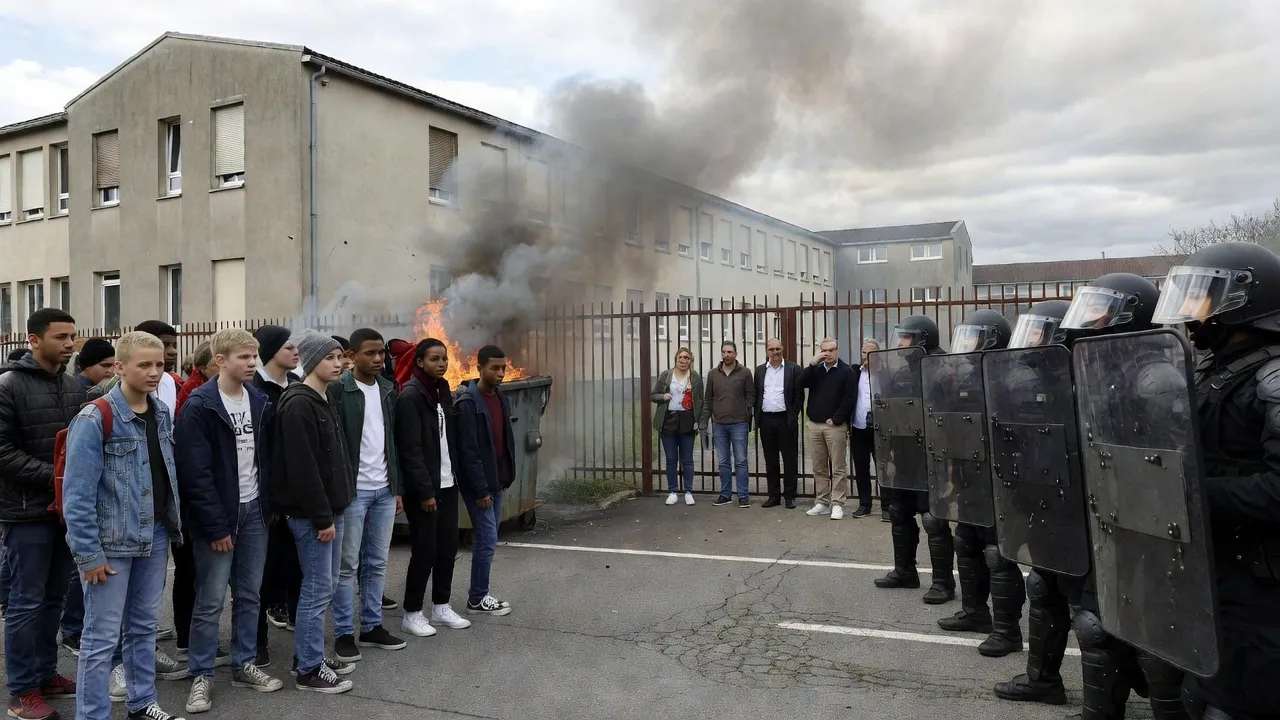
France: high school protests turn violent, nearly 2,000 arrests and more than 400 schools closed
published on
countries
sources
articles
More divergent than 14% of recent comparable stories (reference: 87 recent stories measured with the same method).
Behind the numerical toll, Thursday, October 1st, played out in specific locations, including Marseille, Nantes, Auchel, Saint-Denis, and in a dispute over the origin of the movement, with the initial demands stemming from very concrete local situations.
More than 400 schools closed on Friday, October 2, and the Minister of National Education is to meet with the Union syndicale lycéenne.
The scenes described on location
In Marseille, the Straits Times, citing official sources, and 444, which cites Reuters and the MTI agency, report that several hundred young people surrounded a fire truck that came to the Saint-Exupéry high school. The firefighters had to flee and the vehicle was set on fire, according to the police cited by Veja. According to La Libre, which relays the AFP, the RTM interrupted bus, tram, and metro services after attacks on drivers.
At the Victor Hugo high school, the administration was splashed with gasoline, according to the prosecutor cited by Veja. Veja adds that the authorities do not specify their state of health.
In Nantes, the accounts do not describe the damage in the same way. La Libre, relaying the AFP, writes that the hall of the Nelson-Mandela high school was destroyed by a fire presented as voluntary by the deputy principal. The BBC talks about a damaged hall, after two fires started from a burning trash can. Reuters, cited by Blic, indicates that the establishment was evacuated without injury, according to a deputy mayor.
In Auchel, the principal was injured in the ear. The BBC mentions a firework, La Repubblica a mortar shot. In Saint-Denis, Veja writes that protesters accuse the police of having used tear gas, while the authorities attribute the clashes to groups seeking to extend the blockages.
The dispute over the origin
On the movement's attribution, the most cited source is Matignon. According to BFMTV, which relies on unnamed participants in the crisis cell, the Prime Minister's services see it as a "maneuver organized by LFI and its ultra-left proxies." ANSA cites Matignon sources stating that intelligence believes the movement is orchestrated by La France insoumise. The Straits Times notes that Sébastien Lecornu's office invokes intelligence, without detailing the elements.
« to sink into conspiracy theories and the infantilization of high school students »
La France insoumise rejects the thesis. Manuel Bompard speaks of a "conspiratorial thought," reports Channel News Asia, and Jean-Luc Mélenchon asks which service advanced it. Politika writes that he denied Emmanuel Macron's accusations. Marine Le Pen speaks of "orchestrated riots," according to ANSA; Jordan Bardella proposes that the bill for the damage be shared between the families and the party.
Other statements concern the violence itself. Laurent Nuñez tells Reuters that "agitators" move from one high school to another, according to the American press. The Daily Mail and HVG report the phrase of Saint-Denis Mayor Bally Bagayoko, who believes violence can be "justified" or "legitimate" in response to rubber bullets. Marseille Mayor Benoît Payan condemns the violence but believes the young people are justified in being worried, according to YLE.
The claims and the budget
According to 444, the movement was born on September 21 at the Saint-Exupéry high school in Créteil. Three teachers were appointed there on Wednesday, September 30, which put an end to the protest on site.
« They don't listen to us, we are forced to take to the streets »
Student testimonies discuss the material conditions. A 17-year-old high school student, quoted by Reuters and picked up by Deutsche Welle, talks about cockroaches and rats. G1 quotes Lola, a first-year student, who mentions 8am-6pm days and classes without a reference teacher.
The Tagesschau links the protest to the 2027 budget project and its 43 billion euros in savings. This includes the freeze on public sector salaries and most pensions. Civil servants went on strike on Tuesday, September 29, and some high school student marches partially joined them, the media writes. Universities constitute a second front: the Student Union, quoted by G1, describes their membership as "historic" and talks about an "act two".
What each press outlet retains
The cited figures do not all pertain to the same day. Hungary, Serbia, and Greece report the 625 arrests from Wednesday, September 30, while Germany, Italy, Singapore, and the United Kingdom give the 1,949 from Thursday. The 119 injuries in Geffray cover students and staff since the start of the movement, and the 305 injuries concern police and gendarmes from Thursday, according to the Ministry of the Interior.
The presses do not open with the same elements. In the Hungarian and British coverage of the corpus, the school demands do not appear; the Belgian press does not mention the crisis unit; the German excerpts leave out the debate on LFI. This describes what these articles contain, not the entirety of the press in these countries.
The Greek press reads the movement through the 2027 presidential election: To Vima cites a poll placing Marine Le Pen and Jean-Luc Mélenchon on a trajectory for the second round. ANSA situates the crisis seven months before the election.
Unreplaced teachers, buildings to be renovated; the CGT criticizes the tuition fees for BTS and prep schools provided for in the budget.
119 students and staff injured, according to Minister Édouard Geffray, in addition to the police officers.
About 30 universities joined the blockade on Thursday, October 1.
In Belgium, Liège's secondary schools are closing on Friday, October 2; six arrests on Thursday.
Key figures
- 305Police and gendarmes injured, according to the Ministry of the Interior1 source · Channel News Asia
- 1,027High schools affected out of approximately 3,700, including 222 blocked, according to the Ministry of the Interior1 source · Channel News Asia
What the comparison reveals
Common ground and differences in coverage across the media analysed.
What the media report in common
All coverage describes a high school movement that was accompanied by fires in establishments, clashes with law enforcement, arrests, and injured police officers.
Eleven out of twelve perspectives quantify the arrests based on the Ministry of the Interior or Laurent Nuñez, with counts ranging from 625 to 1,949 depending on the date used.
Where media coverage diverges
Role attributed to LFI
When asked if the movement was orchestrated by La France insoumise, some coverage relays the thesis of Matignon and political officials, while others highlight LFI's denial and the term 'conspiratorial' used by Manuel Bompard.
Coverage aligned with this reading
Origin of the movement highlighted
When asked what explains the mobilization, some coverage first cites the budget cuts and degraded schools, while others first describe the violence and address the school demands after the clashes.
Coverage that diverges
This grouping describes the publications analysed, not the position of these countries’ populations or of their governments.
Understand the context
- SEP 21, 2026Start of the mobilization at the Saint-Exupéry high school in Créteil
- SEP 29, 2026Around 440 arrests, according to Interior Minister Laurent Nuñez
- SEP 30, 2026625 arrests and 83 police and gendarmes injured
- OCT 1, 20261,949 arrests; crisis unit at Matignon
How each country reads it
Preview: 3 of 12 media perspectives. Syntheses of the media analysed — not direct quotations. Method & limitations
 Serbia
Belgrade is primarily concerned with the escalation of violence: the Serbian press details fires, assaults, and clashes with police around French high schools, more than the students' demands.
2 sources · View sources
 Belgium
Brussels is gauging the crisis of French high schools in terms of contagion: on Thursday, October 1, the blockages spread to Liège, where secondary schools will close on Friday, October 2.
2 sources · View sources
 Brazil
Brasília is deciphering a high school revolt born out of a shortage of teachers and resources, whose episodes of fires and assaults hide from the Brazilian press very concrete school demands.
2 sources · View sources
The full text, country by country
Serbia
DOMINANT ANGLE
Belgrade is primarily concerned with the escalation of violence: the Serbian press details fires, assaults, and clashes with police around French high schools, more than the students' demands.
KEY POINTS
- According to Laurent Nuñez, as quoted by Politika, 625 people were arrested and 199 injured, including 83 police officers.
- Blic, citing Reuters, reports fires in at least two high schools, including Nelson Mandela in Nantes, and the assault of a principal in Marseille.
- Mélenchon rejects Macron's accusation that LFI is fanning the unrest, while Philippe Baptiste accuses the party of encouraging violence.
ANALYSIS
Belgrade, October 2, 2026. Serbian dailies Politika and Blic are covering the French high school mobilization from the angle of the deterioration of public order, relying on dispatches from Tanjug and Reuters.
Politika, from Paris, reports on the statements of Interior Minister Laurent Nuñez: more than 600 people were arrested during the blockages of high schools, precisely 625 arrests, and 199 injured, including 83 police officers. The minister condemns the "targeting of police, throwing of projectiles and violence", as well as "urban violence", while ensuring that the police intervened with "a great deal of restraint" and used proportionate weapons such as tear gas. The newspaper specifies that investigations have been opened into injured students.
The newspaper also relays the political quarrel. Citing Le Figaro, it writes that the movement is fueled by members of La France insoumise and supported by students. Jean-Luc Mélenchon denied Emmanuel Macron's accusations that his party is fanning the troubles. Higher Education Minister Philippe Baptiste accuses LFI of encouraging violence, and Macron claims that political leaders should not join the protesters to "spread fear". Politika also notes a strike by civil servants against budget cuts, around ten percent of Parisian high schools blocked, especially in Saint-Denis, and containers set on fire in Lille.
Blic adopts a more dramatic tone, headlining with "horrific details". According to Reuters, the situation "dramatically escalated" on Thursday: fires were set in at least two high schools, including the Nelson Mandela high school in Nantes, which was evacuated without any injuries, according to a deputy mayor. In Marseille, hundreds of young people allegedly surrounded a fire truck and set it on fire, and, according to the prosecutor's office, a principal was splashed with gasoline and beaten. Their health status is unknown.
The causes of the anger, lack of teachers and dilapidated buildings, are only briefly mentioned in the introduction to Blic's article. Neither of the two texts mentions the closure of more than 400 establishments, nor the emergency meeting of the Prime Minister.
Belgium
DOMINANT ANGLE
Brussels is gauging the crisis of French high schools in terms of contagion: on Thursday, October 1, the blockages spread to Liège, where secondary schools will close on Friday, October 2.
KEY POINTS
- Thursday, October 1, students blocked about ten schools in the province of Liège; the Liège police reported one administrative arrest and five judicial arrests.
- The City of Liège closed all secondary schools in its network on Friday, October 2, after a similar decision by the free network, for security reasons.
- In Nantes, the hall of Nelson Mandela High School was destroyed by an arson fire, according to the deputy principal quoted by AFP; in Marseille, public transportation was interrupted.
ANALYSIS
Brussels, October 2, 2026. For La Libre Belgique and La DH, the movement of French high school students is no longer just a foreign issue: on Thursday, October 1, it affected the province of Liège. "For over a week, French high school students have been blocking hundreds of schools in the Hexagon," La Libre recalls, the movement having spread to universities before "now affecting Belgium".
On the French side, La Libre relays the AFP: the hall of the Nelson Mandela high school in Nantes was destroyed by a fire presented as intentional, and the circulation of buses, trams, and subways was interrupted in Marseille after attacks on drivers, according to the RTM. A fire truck was completely burned out.
However, the main focus is on Liège. A call launched on social media gathered hundreds of students in front of five establishments, including the Athénée de Fragnée and the Marie-Thérèse school, around 8 am. The Liège police reported egg-throwing, apple-throwing, barrier-throwing, and firecracker-throwing, as well as burned trash cans and scooters, physical violence including one incident against a school administrator, and projectiles thrown at police officers. The reported toll is one administrative arrest and five judicial arrests. One student regretted "the image we're giving to the movement"; another said some wanted "to do like in France, but we didn't believe it".
The management is very concrete: the police asked the Notre-Dame de Jupille Institute to confine its students at noon, fearing encounters with vandals, according to its director Jean-François Fabry. Faced with the announced amplification, the free network and then the City of Liège closed the secondary schools on Friday, October 2, "above all" for the safety of students, staff, and buildings, according to Alderwoman Julie Fernandez-Fernandez.
The editorial of La DH, titled "Bordelization of School: will the French virus contaminate Belgium?", delivers the most scathing judgment. It speaks of a crisis "instrumentalized by LFI", judges the reading of a simple civic conscience as "very angelic", and reproaches the Insoumis for taking "heavy responsibility". It adds that, for 14- or 15-year-old protesters, force must remain "the last resort". The students' demands, which concern school resources, are echoed in the demands of Belgian teachers.
Brazil
DOMINANT ANGLE
Brasília is deciphering a high school revolt born out of a shortage of teachers and resources, whose episodes of fires and assaults hide from the Brazilian press very concrete school demands.
KEY POINTS
- According to the Interior Ministry cited by G1, 356 establishments were affected on Wednesday, September 30, compared to 338 the day before, with 625 arrests and 83 police and gendarmes injured.
- Around 30 universities joined the blockade on Thursday, October 1, which the Student Union considers "historic".
- In Marseille, the director of Victor Hugo High School was splashed with gasoline and a fire truck was set on fire near Saint-Exupéry School (Veja).
ANALYSIS
Brasília, October 2, 2026. Brazilian media is treating the French high school mobilization as a "new wave of protests and strikes," according to Veja, which links it to the anger over budget cuts. The story begins with the violence of Thursday, October 1: in Marseille, the director of Victor Hugo High School was splashed with gasoline and injured, according to the prosecutor's office, without the authorities specifying her health status. In the same city, hundreds of young people surrounded a fire truck that came to put out a fire at the Saint-Exupéry school; the firefighters had to abandon the vehicle, which was later set on fire, according to the police. In Nantes, a fire at Nelson Mandela High School was brought under control without injury, the establishment evacuated, according to a collaborator of the mayor quoted by Franceinfo.
In Saint-Denis, near Paris, students clashed with the police. The protesters accuse the officers of using tear gas; the authorities attribute the clashes to groups seeking to extend the blockages.
G1 Globo shifts the focus to the causes and scope. About 30 universities joined the blockage movement on Thursday, which the Student Union describes as "historic" and presents as "act two" of the mobilization. The high school students are demanding mainly the replacement of absent teachers and more resources for education. The site quotes Lola, a first-year student, who tells AFP: "They don't listen to us, we're forced to take to the streets," referring to days from 8 am to 6 pm and classes without a reference teacher.
The official figures are reported with precision: 356 establishments affected on Wednesday, September 30, compared to 338 on Tuesday, September 29, according to the Ministry of the Interior; on that Wednesday, 625 people were arrested and 83 police officers and gendarmes were injured. Education Minister Édouard Geffray reports 119 students and staff injured since the start of the blockages. The blockages continue in Paris, Marseille, Strasbourg, and Rennes, where high school students dressed in black have notably stopped the circulation of trams.
The two titles do not take up the French political debate on the responsibility of La France insoumise, nor the announced closure measures: the Brazilian reading remains focused on the school and the street.
 Germany
DOMINANT ANGLE
Berlin sees the revolt of French high school students as a symptom of a worsening educational malaise exacerbated by the austerity budget cuts, rather than just a simple flare-up of violence.
KEY POINTS
- According to Tagesschau, 1,949 people were arrested during the high school protests, according to the Ministry of the Interior, and 305 police officers and gendarmes were injured.
- DW reports that 83 police officers and gendarmes and 32 teachers and students were injured on Wednesday, September 30; 356 institutions were affected, according to Laurent Nuñez.
- Tagesschau links the protests to the 2027 budget plan, which provides for 43 billion euros in savings, and announces the closure of more than 400 schools on Friday, October 2.
ANALYSIS
Berlin, October 2, 2026. The German media is treating the mobilization of French high school students as a social movement that is getting out of hand, and is placing it in the context of budget austerity.
Deutsche Welle reported on the events of Wednesday, September 30: more than 600 people were arrested, 83 police officers and gendarmes were injured, as well as 32 teachers and students. The Minister of the Interior, Laurent Nuñez, denounced an "escalation of violence" and spoke of "urban violence". According to him, 356 schools were affected. DW identified the most affected cities: Paris, Bordeaux, Lyon, and Lille, where the police again used tear gas.
The media also explained why students have been blocking their schools since the previous week: overcrowded classes, too much work, poor-quality equipment, and a lack of teachers. It quoted a 17-year-old high school student cited by Reuters: "There are cockroaches and rats everywhere in the school." Emmanuel Macron considered these concerns legitimate, but believed they could not justify the violence against police officers and teachers.
The Tagesschau, in a report dated Thursday, October 1, broadened the context. It presented the protest as a reaction to the 2027 budget plan, which provides for 43 billion euros in savings: a freeze on public sector salaries and most retirement benefits, a reduction in funding for municipalities and health spending, and a reduction in tax benefits for businesses. Civil servants went on strike on Tuesday, September 29, and the high school student marches partly joined them.
The public media outlet reported that, according to the Ministry of the Interior, 1,949 people were arrested, most for violence against law enforcement, and 305 police officers and gendarmes were injured. It noted that a little over 400 schools had to close on Friday, October 2. In addition to material grievances (dilapidated buildings, teacher shortages, and long school days), the Tagesschau added a "general malaise" and a weariness with politics.
The two German sources set aside the debate over the responsibility of La France insoumise or the far left, which is dominating the French political scene. The focus is on the students' grievances and the gap between the announced austerity measures to reassure financial markets and the state of the schools.
 Finland
DOMINANT ANGLE
Helsinki is first and foremost concerned with public order: thousands of arrests, injured police officers, and schools in flames, before the political dispute between the government and the radical left.
KEY POINTS
- According to the Interior Ministry cited by YLE, nearly 2,000 people were arrested on Thursday and more than 300 police officers were injured.
- Students blocked access to 30 campuses, according to a student organization, and the ministry estimates that around 1,000 high schools were affected.
- Lecornu, citing intelligence, accuses the left of fueling the unrest; La France insoumise denies it (YLE).
ANALYSIS
Helsinki, October 2, 2026. The Finnish press initially treats the mobilization of French high school students as a public order flare-up. YLE, citing AFP and Reuters, reports that the authorities arrested nearly 2,000 students and pupils on Thursday during demonstrations that turned into confrontations, according to the Ministry of the Interior. More than 300 police officers were injured. The ministry estimates that around 1,000 high schools were affected in their operations.
Iltalehti, which relies on the BBC, headlines about "rage" and schools on fire. The newspaper reports fires in several establishments, 625 arrests on Wednesday and more than 600 additional ones on Thursday, according to French media. YLE specifies that protesters set fire to a fire truck near Marseille, in the south, and a fire was lit at the entrance of an establishment in Nantes, in the west.
The demands are stated without dwelling on them: overcrowded classes, teacher shortages, outdated and sweltering buildings in summer. University students joined the movement on Thursday; according to a student organization cited by YLE, they blocked access to 30 campuses. The protests, which started in the Parisian suburbs, spread throughout the country after beginning the previous week.
The political aspect comes next. Prime Minister Sébastien Lecornu convened a crisis unit on Thursday; the government describes a movement that has become "urban violence". YLE writes that Lecornu, referring to intelligence, accuses the left of fueling the troubles, which La France insoumise denies. Iltalehti notes that the government and the right are targeting the radical left, while left-wing elected officials respond that these accusations do not solve the problems at the root of the anger. Marine Le Pen is calling for a new law on riots. The left-wing mayor of Marseille, Benoît Payan, condemns the violence but believes the young people are justified in worrying about their future and public services.
Education Minister Édouard Geffray is to meet with representatives of staff unions, parent associations, and high school organizations on Friday.
 France
DOMINANT ANGLE
Paris takes a firm stance on public order: the tally of arrests and injuries, high school fires, and the slide into "urban violence" overshadow, in the accounts, the students' demands.
KEY POINTS
- 1,949 people arrested on Thursday, October 1, and 305 police officers and gendarmes injured, according to the Ministry of the Interior (Sud Ouest)
- Matignon believes the movement has turned into "urban violence" after an interministerial crisis unit
- Gérald Darmanin has met with the 36 general prosecutors; Édouard Geffray announces more than 400 establishments closed on Friday and receives the Union syndicale lycéenne
ANALYSIS
Paris, October 2, 2026. The high school mobilization, which began at the Saint-Exupéry high school in Créteil about ten days ago, reached a "tipping point" on Thursday, October 1, according to Le Monde: more than 1,020 high schools were affected, including 222 blockages, according to the Ministry of National Education, and about thirty university campuses were blocked.
The security situation dominates the reports. The Ministry of the Interior announced 1,949 arrests during the day, mainly for attacks on persons holding public authority, violence, and gatherings, and 305 police officers and gendarmes were injured; Laurent Nuñez condemned "unbridled violence". In Nantes, the hall of the Nelson-Mandela high school was destroyed by a "voluntary" fire, according to the deputy principal; in Auchel, a principal was injured by a projectile; in Marseille, the prefecture reported about a hundred trash can fires and the RTM interrupted bus, tram, and metro services.
After an interministerial crisis cell, Matignon estimates that the movement has turned into "urban violence". According to BFMTV, participants report that the Prime Minister's services see this as an "organized maneuver by LFI and its ultra-left proxies". Manuel Bompard asked the government not to "sink into conspiracy theories and infantilization of high school students". Gérald Darmanin held a video conference with the 36 general prosecutors on the firmness of the penal response; Sébastien Lecornu asked his ministers to cancel their trips.
The demands remain in the narrative: replacement of absent teachers, renovation of buildings, pressure from Parcoursup. 20 Minutes writes that they are "gradually fading" behind the damage; Sud Ouest titles its editorial "a real distress". The SNPDEN-UNSA union of school principals shares these demands but believes that the movement gives "the impression of being out of control". Sophie Binet (CGT) wonders if Sébastien Lecornu is "an arsonist", given the planned registration fees for BTS and preparatory classes in the budget.
Édouard Geffray believes the movement is "being held hostage by ultra-violent groups", has requested distance learning where blockages prevent access, announced the closure of a little over 400 establishments on Friday, and is set to meet with the Lycée Union.
 Greece
DOMINANT ANGLE
Athens sees the high school surge as a symptom of France's permanent political crisis, eighteen months from the 2027 presidential election, while detailing the balance of violence.
KEY POINTS
- According to Laurent Nuñez, 625 people were arrested and 83 police officers and gendarmes injured; Édouard Geffray puts the number of injured students and staff at 119, including 34 education employees (Protothema EN, October 1).
- 356 institutions were affected on Wednesday, September 30, including 75 high schools in the Paris region, 36 of which were the scene of violence or vandalism.
- To Vima links the mobilization to the 2027 presidential election: a poll puts Marine Le Pen and Jean-Luc Mélenchon on a path to the second round.
ANALYSIS
Athens, October 2, 2026. The Greek press is following the mobilization of French high school students on two levels: the numerical toll of the clashes and the political reading of a country deemed to be durably unstable.
Protothema, in its English version, published an official count on October 1: 625 arrests and 119 injuries since the beginning of the troubles. Interior Minister Laurent Nuñez reported 625 people detained and 83 police officers and gendarmes injured. Education Minister Édouard Geffray estimated the total number of students and staff injured at 119, including 34 education employees. This figure exceeds previous counts, including one of 76 injuries. According to Nuñez, around 440 people, mostly minors, were arrested on Tuesday, September 29 alone.
The movement, which originated in the Île-de-France region, now affects the entire country: 356 establishments were affected on Wednesday, September 30. In the Paris region, 75 high schools were disrupted, including 36 scenes of violence, clashes, or vandalism, according to regional authorities. The newspaper mentions Lille, Lyon, Marseille, Bordeaux, Nantes, and Rennes. In Lille, masked students set fire to trash cans; in Rennes, around 100 students threw projectiles at the city's largest high school. In a Parisian suburb, teachers formed a line around the protesters to protect them from the police. The article also quotes messages published on X describing fires in Bordeaux and a fire at the Nelson-Mandela high school in Nantes.
To Vima, on the same day, headlined "Γαλλία σε αναβρασμό" (France in turmoil). The daily described hundreds of blockages, fires, clashes with the police, and attacks on principals and teachers. Students and professors have joined the movement, while the government is trying to separate educational demands from the violence. The newspaper traces the crisis back to a high school in the Yvelines, around ten days earlier, over a lack of teachers.
Its analysis goes beyond the educational framework. It sees a country where the political crisis has become "permanent", against a backdrop of economic pressure, high cost of living, and distrust of institutions. The 2027 presidential election is already at the center of the debate: a recent poll puts Marine Le Pen and Jean-Luc Mélenchon on a trajectory for the second round. The youth, it writes, will be a stake in the campaign.
 Hungary
DOMINANT ANGLE
Budapest describes a high school movement that is tipping into fires and clashes, mainly drawing on AFP and Reuters reports on public order.
KEY POINTS
- 625 people were placed in police custody on Wednesday, September 30, mostly high school students, and 38 police officers were injured (HVG, citing AFP).
- In Marseille, hundreds of young people surrounded a fire truck that came to put out a fire at the Saint-Exupéry high school, then set it on fire (444, citing Reuters).
- Laurent Nuñez reported actions in about 10% of the 3,700 public high schools; the toll is 119 students and staff and 83 police officers injured (444).
ANALYSIS
Budapest, October 2, 2026. Hungarian media initially present the French high school mobilization as a surge in violence. HVG reports on protests that have "turned into riots" across France, according to AFP: starting in the Paris region, they have become national. The site reports 625 people in custody on Wednesday, September 30, mostly high school students, and 38 injured police officers. The unrest affects several hundred schools, with several dozen barricaded. The most serious situations are in Bordeaux, Lyon, and Lille, while Marseille and Strasbourg suspended public transportation on Thursday, October 1.
444 chooses a sensational title: "They set fire to the fire truck that came to put out the fire at the high school." Citing Reuters and the MTI agency, the site tells the story of how several hundred young people surrounded a fire truck at the Saint-Exupéry high school in Marseille, forced the firefighters to flee, and then burned the vehicle. According to the authorities, a principal was splashed with gasoline and at least two schools were set on fire. Interior Minister Laurent Nuñez estimates that around ten percent of the 3,700 public high schools have experienced actions. The toll since the beginning is 119 students and staff and 83 injured police officers, with 440 young people arrested on Tuesday, September 29.
444 also recalls the demands: lack of teachers, buildings to be renovated, better study conditions. The movement was born on September 21 at the Saint-Exupéry high school in Créteil, where three teachers were appointed on Wednesday, September 30, which put an end to the protest on site. On Thursday, universities joined in, with around thirty campuses closed according to the student union and universities switching to distance learning. HVG adds overloaded schedules, class sizes, and summer heat in classrooms.
On the political level, both sites report that Prime Minister Sébastien Lecornu has convened a crisis cell. HVG notes that government members and President Emmanuel Macron have criticized La France insoumise officials who support the protesters. It highlights the controversy sparked by Bally Bagayoko, the mayor of Saint-Denis, who said that violence can be "justified" in response to rubber bullets, according to the BBC. 444 writes that the radical left openly supports these actions in suburban high schools.
 Italy
Italy
DOMINANT ANGLE
Rome above all retains the image of a France in flames: high schools set on fire, nearly 2,000 arrests, and a political confrontation over LFI's responsibility seven months ahead of the presidential election.
KEY POINTS
- The Interior Ministry reported 1,949 arrests on October 1, after nearly a thousand the preceding days (ANSA).
- In Marseille, the principal of Victor Hugo High School and their staff were allegedly splashed with gasoline; the Mandela High School in Nantes is on fire (ANSA).
- According to Matignon, the intelligence services see an "orchestrated maneuver" by LFI; Le Pen talks about orchestrated riots, the Insoumis reject the accusation (ANSA).
ANALYSIS
Rome, October 2, 2026. The Italian press opens on the outbreak: ANSA headlines, on October 1, "Students set France on fire, schools set ablaze and two thousand arrested." The agency talks about protests that "lacerate the Republic" and reports that the Ministry of the Interior counted 1,949 arrests during the day, after nearly a thousand the previous days. It puts the crisis "seven months from the 2027 presidential elections" into perspective.
The account of violence dominates. In Marseille, according to ANSA, the principal of Victor Hugo High School and his collaborators were allegedly attacked and splashed with gasoline; the Mandela High School in Nantes is burning; in Rouen, two principals are injured. La Repubblica, through the pen of its correspondent Anaïs Ginori, reports another school administrator hospitalized in Pas-de-Calais, hit in the ear by a mortar shot. Libero, via askanews, describes exchanges of firecrackers and tear gas between high school students and law enforcement in Talence, Gironde.
On the political level, Italian sources follow the battle of attribution. Sébastien Lecornu's government has set up a crisis unit and canceled ministerial trips until Monday. According to Matignon, the intelligence services judge the movement a "manovra orchestrata" by La France insoumise and "its references from the far left," which the Insoumis sharply reject. Marine Le Pen denounces "orchestrated riots" by LFI; Jordan Bardella proposes that the bill for the damage be shared between the families of the arsonists and the party.
The social register exists, but in second place. La Repubblica recalls that the mobilization started, a little over a week earlier, in the Parisian suburbs to denounce the lack of teachers and resources, overcrowded classes, and degraded buildings. Askanews cites the demand for replacement of absent teachers and "decent" learning conditions. Education Minister Édouard Geffray will receive the high school associations and calls for distance learning in case of occupation or serious damage.
 Singapore
DOMINANT ANGLE
Singapore gauges the unrest in French high schools in light of the public order situation: arrests, fires, and assaults on staff, through reports from Channel News Asia and the Straits Times.
KEY POINTS
- The Ministry of the Interior announced 1,949 arrests and 305 police or gendarmes injured on Thursday, October 1; 1,027 high schools out of 3,700 were reportedly affected, including 222 blocked (CNA).
- In Marseille, hundreds of young people surrounded a fire truck in front of the Saint-Exupéry high school, then set it on fire; a school principal was injured at the Victor Hugo high school (Straits Times).
- Sébastien Lecornu's office cited intelligence to attribute the organization to the radical left; Manuel Bompard responded that the government was "descending into conspiratorial thinking" (CNA).
ANALYSIS
Singapour, 2 October 2026. Channel News Asia and the Straits Times are treating the mobilization of French high school students as a public order crisis, relying on official figures and dispatches from Paris. The CNA headline talks about protests that "are spreading" while "fires and blockages" are aggravating the troubles.
According to CNA, the Ministry of the Interior recorded 1,949 arrests on Thursday, 1 October, and 305 police officers or gendarmes were injured. Out of approximately 3,700 high schools, 1,027 are said to have been affected by the movement, including 222 by blockages. The authorities in the Paris region are citing around fifty establishments as "the scene of violence, clashes, and vandalism". Interior Minister Laurent Nunez denounced "unbridled violence".
The Straits Times, citing official sources, details the most serious incidents: a school principal splashed with gasoline, fires in at least two schools, and in Marseille, in front of the Saint-Exupéry high school, a fire truck surrounded by hundreds of young people, from which the firefighters had to flee before the vehicle was set on fire. A principal of the Victor Hugo high school was injured, according to the prosecutor's office. Another fire hit an establishment in Nantes.
Both titles emphasize the political dimension. The office of Prime Minister Sébastien Lecornu held a crisis cell, estimating that the movement had become "urban violence" and invoking intelligence to claim that it had been organized by the radical left. Manuel Bompard (LFI) responded that the government was "sinking into conspiracy thinking", and Jean-Luc Mélenchon asked which service had put forward this thesis.
The budget context is presented as a backdrop: the government announced very unpopular spending cuts in the 2027 budget on Thursday, at a sensitive time. The Straits Times also reports the version of the high school students, who accuse the police of using tear gas; a student was holding a sign that read: "Can we explain ourselves without being gassed?". The initial demands (overcrowded classes, teacher shortages, dilapidated buildings) are mentioned but remain secondary compared to the count of clashes.
 United Kingdom
DOMINANT ANGLE
London describes a France plagued by school riots: the British press highlights the fires, the injured and the arrests rather than the demands of the high school students.
KEY POINTS
- According to the Interior Ministry cited by the BBC, 1,949 people were arrested on Thursday, October 1, and 305 police officers were injured.
- The government of Sébastien Lecornu held a crisis meeting and estimated that the student-led protests had turned into "urban violence".
- The Daily Mail attributes the escalation to comments by the mayor of Saint-Denis, Bally Bagayoko, who said "violence can be legitimate".
ANALYSIS
London, 2 October 2026. The BBC and the Daily Mail are treating the French high school mobilization as an outbreak of disorder, but with different intensities. For the BBC, fires "broke out" in several establishments as students block schools across the country to denounce the lack of teachers and staff, overcrowded classes, and dilapidated buildings. University students joined the movement on Thursday, 1 October, with similar demands.
The numerical toll comes from the Ministry of the Interior, cited by the BBC: 1,949 people arrested on Thursday and 305 police officers injured. According to the same source, 1,027 high schools were affected by protests, including 222 blocked, and at least 30 universities were reportedly blocked, notably in Rennes and Paris. Prime Minister Sébastien Lecornu held a crisis meeting on Thursday; the government then judged that the movement had tipped into "urban violence".
The two publications detail the same scenes: in Nantes, two fires started from a burning trash can, including one at the Nelson Mandela high school, whose entrance hall was damaged; in Marseille, staff at the Victor Hugo high school were splashed with gasoline; in Auchel, a principal was injured in the ear by a firework, according to the BBC. The channel takes care to explain to its readers what a high school is, equivalent to British "sixth forms".
The Daily Mail adopts a distinctly more alarmed tone. Its headline talks of rioters setting fire to schools and splashing teachers with gasoline, and its text evokes "riots" after a "largely peaceful" start. It estimates around 600 arrests and 85 injured police officers as of Tuesday, and attributes the escalation to a statement by the left-wing mayor of Saint-Denis, Bally Bagayoko, who said "violence can be legitimate", comments that "sparked fury" in France. It also reports that a firefighter was injured in Marseille after a truck was set on fire.
The political explanations occupy little space in this account: the attribution of the movement to La France insoumise, the announced closure of over 400 establishments, or the protest against BTS enrollment fees do not appear in the available excerpts. The British framing remains that of public order: the French street, its flames, and the state's response.
 United States
DOMINANT ANGLE
The United States assesses the French high school wave in terms of violence: arrests, main casualties and a weakened government, seven months from a presidential election without Macron.
KEY POINTS
- Fox News: over 625 people, mostly students, arrested in two days; over 350 high schools and about 30 campuses affected on Thursday.
- Fox News citing RFI: 83 police officers and gendarmes injured on Thursday, 119 students and staff injured since the start of the unrest; Reuters: the principal of Victor Hugo High School in Marseille doused with gasoline.
- ABC News: Lecornu has called a crisis meeting and cancelled ministerial trips; the issue is becoming a stake in the presidential campaign next May.
ANALYSIS
Washington, October 2, 2026. From the United States' perspective, the French high school movement is first and foremost a public order story. Fox News headlines with a France "rocked by student riots" and reports over 625 people, mostly students, arrested in two days of violent protests near schools and universities. According to the media, over 350 high schools and about 30 campuses were affected on Thursday, October 1, alone.
The human toll is detailed. Fox cites RFI: 83 police officers and gendarmes were injured on Thursday, 119 students and staff were injured since the beginning of the troubles the previous week. Reuters, as reported by Fox, states that the principal of the Victor Hugo high school in Marseille was splashed with gasoline and injured, and two other school administrators were assaulted in Rouen and Petit-Quevilly. Tear gas was used in several cities, and students denounce muscular police methods.
The grievances of the young people are presented briefly: lack of staff, dilapidated buildings, overcrowded classes, budget cuts, and long days. ABC News (agency dispatch) talks about high school students protesting against "under-resourced" schools. Fox links the protest to the announced budget cuts in the 2027 budget, two weeks earlier, which makes it a point of political tension at a sensitive time for the executive.
The government aspect occupies the other half of the story. Prime Minister Sébastien Lecornu held a crisis meeting on Thursday and canceled his ministers' trips. Interior Minister Laurent Nuñez told Reuters that, in some places, "agitators" were going from one high school to another to incite violence, and the authorities are talking about "urban violence" and attempted arson. Education Minister Édouard Geffray is quoted without further details.
ABC News emphasizes the electoral dimension: the issue is becoming hot in the campaign to succeed Emmanuel Macron, who cannot run again, next May, while the government is also facing financial difficulties. Jean-Luc Mélenchon judges the government's response to be repressive; his critics accuse his party of trying to capitalize on the troubles and incite violence.
The two dispatches remain factual and brief, without an editorial on the French school system. The figure of 625 arrests and the toll of injured people dominate, while the students' demands and union positions are not developed.
Explore every perspective on this subject across 12 countries.
Compare viewpoints and see where they diverge.