
DOMINANT ANGLE
London describes a France plagued by school riots: the British press highlights the fires, the injured and the arrests rather than the demands of the high school students.
Dominant angle identified — does not reflect unanimity of this country’s media
KEY POINTS
- 01
According to the Interior Ministry cited by the BBC, 1,949 people were arrested on Thursday, October 1, and 305 police officers were injured.
- 02
The government of Sébastien Lecornu held a crisis meeting and estimated that the student-led protests had turned into "urban violence".
- 03
The Daily Mail attributes the escalation to comments by the mayor of Saint-Denis, Bally Bagayoko, who said "violence can be legitimate".
ANALYSIS
London, 2 October 2026. The BBC and the Daily Mail are treating the French high school mobilization as an outbreak of disorder, but with different intensities. For the BBC, fires "broke out" in several establishments as students block schools across the country to denounce the lack of teachers and staff, overcrowded classes, and dilapidated buildings. University students joined the movement on Thursday, 1 October, with similar demands.
The numerical toll comes from the Ministry of the Interior, cited by the BBC: 1,949 people arrested on Thursday and 305 police officers injured. According to the same source, 1,027 high schools were affected by protests, including 222 blocked, and at least 30 universities were reportedly blocked, notably in Rennes and Paris. Prime Minister Sébastien Lecornu held a crisis meeting on Thursday; the government then judged that the movement had tipped into "urban violence".
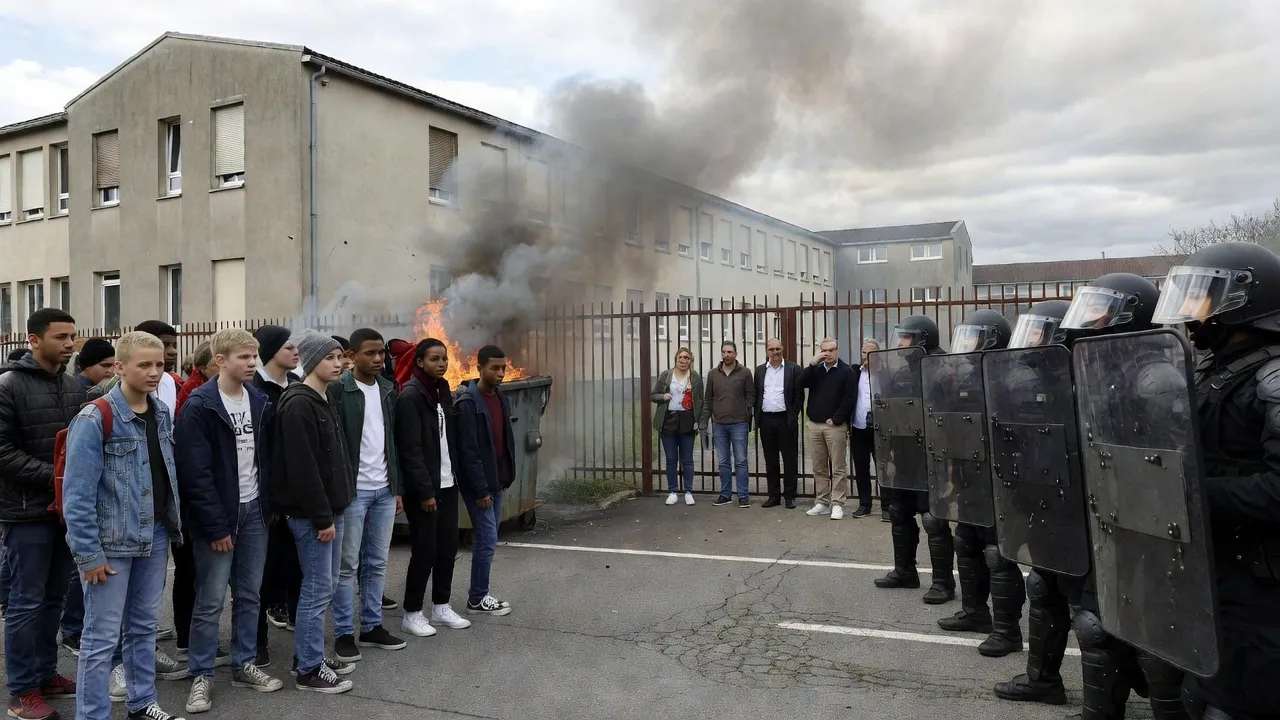
The two publications detail the same scenes: in Nantes, two fires started from a burning trash can, including one at the Nelson Mandela high school, whose entrance hall was damaged; in Marseille, staff at the Victor Hugo high school were splashed with gasoline; in Auchel, a principal was injured in the ear by a firework, according to the BBC. The channel takes care to explain to its readers what a high school is, equivalent to British "sixth forms".
The Daily Mail adopts a distinctly more alarmed tone. Its headline talks of rioters setting fire to schools and splashing teachers with gasoline, and its text evokes "riots" after a "largely peaceful" start. It estimates around 600 arrests and 85 injured police officers as of Tuesday, and attributes the escalation to a statement by the left-wing mayor of Saint-Denis, Bally Bagayoko, who said "violence can be legitimate", comments that "sparked fury" in France. It also reports that a firefighter was injured in Marseille after a truck was set on fire.
The political explanations occupy little space in this account: the attribution of the movement to La France insoumise, the announced closure of over 400 establishments, or the protest against BTS enrollment fees do not appear in the available excerpts. The British framing remains that of public order: the French street, its flames, and the state's response.