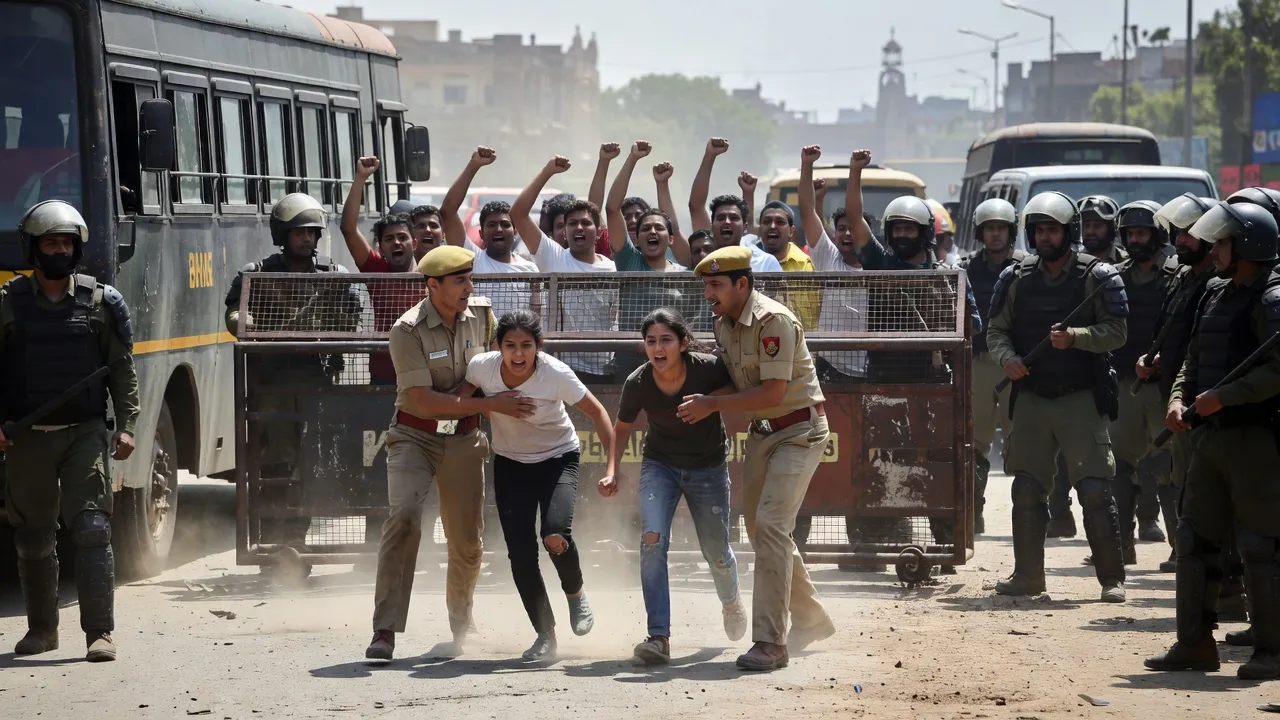
Common ground and differences in coverage across the media analysed.
What the media report in common
1
The founder of the Cockroach Janta Party, Abhijeet Dipke, and leaders Saurav Das and Ashutosh Ranka were detained upon their arrival at Delhi airport.
2
New Delhi was placed under a significant police and paramilitary presence on Saturday, October 10, with protester arrests, suspended mobile internet, and closed transportation.
3
The protest aimed at the revision of electoral rolls, including the removal of around 130 million names cited by several sources, and the head of the electoral commission.
Where media coverage diverges
Nombre d'interpellés le 10 octobre
Combien de personnes ont été interpellées à Delhi le samedi 10 octobre : le corpus bangladais rapporte plus de 4 000, des médias indiens cités par la BBC près de 7 000, tandis que The Hindu Business Line donne plus de 2 000 et Interfax environ un millier d'après PTI.
La révision des listes électorales est-elle un nettoyage de routine ou une opération favorable au BJP ? La commission et le BJP parlent de doublons, d'électeurs décédés et de « campagne de calomnie » ; les critiques et l'opposition y voient un avantage donné au parti de Narendra Modi.
Dhaka is scrutinizing the purge of 130 million names from Indian lists as a test for the democracy of its large neighbor, a figure reported in relation to its own electorate, and is following the repression of the electoral chief's contestation.
Paris is deciphering a democracy under strain: the removal of 130 million voters and the questioning of the electoral referee are pitting the youth and the opposition against a capital locked down by the police.
Dhaka is scrutinizing the purge of 130 million names from Indian lists as a test for the democracy of its large neighbor, a figure reported in relation to its own electorate, and is following the repression of the electoral chief's contestation.
KEY POINTS
More than 4,000 people arrested in New Delhi on October 10, according to TBS, with over 40,000 police and paramilitary personnel deployed, according to the Hindustan Times
Abhijeet Dipke, Saurav Das, and Ashutosh Ranka released on Sunday, October 11, by a magistrate, on condition of not disturbing public order for a year
The revision of the lists would have removed 130 million names, according to the Daily Star, more than the electorate
ANALYSIS
Dhaka, October 11, 2026. The Daily Star and TBS describe Saturday, October 10, in New Delhi as a test of the grand neighbor's democracy. Authorities sealed off the center of the capital to prevent the Cockroach Janta Party (CJP) from reaching Jantar Mantar and demanding the resignation of Election Commission chief Gyanesh Kumar. The tolls vary: TBS mentions "more than 4,000" arrested, The Daily Star around 6,000 according to unconfirmed reports, and another TBS article reports more than 3,000 protesters released at night.
The Daily Star focuses on the special revision of voter lists (SIR), which allegedly removed 130 million names, "a figure slightly higher than the entire electorate of Bangladesh." It notes that election authorities speak of duplicates, deaths, and fraudulent entries, while critics believe that minorities, particularly Muslims, are disproportionately affected to the benefit of Narendra Modi's BJP. An article explains that Article 324 of the Indian Constitution subjects the removal of the election chief to the same procedure as a Supreme Court judge.
TBS details the operation: more than 40,000 police and paramilitaries, according to the Hindustan Times, 45 metro stations closed for 25 hours, and detention centers set up in stadiums. Anonymous police officers claim that the strategy was supervised by the Ministry of the Interior. Mamata Banerjee, Arvind Kejriwal, Pinarayi Vijayan, Neha Bora, Yogendra Yadav, and Prashant Bhushan are among those arrested. After a call from the Supreme Court Bar, the Chief Justice allegedly requested the release of detained lawyers.
The two media outlets follow the story of Abhijeet Dipke, 31, born into a Dalit family, whose viral response to a remark by Chief Justice Surya Kant about young unemployed people gave birth to the movement, credited with the resignation in July of Education Minister Dharmendra Pradhan. Arrested on a plane with Saurav Das and Ashutosh Ranka, he said, "I came to be arrested." His grandmother died the same day. The three were released on Sunday, October 11, by a magistrate, on condition of not disturbing public order for a year; the CJP responded: "Cockroaches never die." The UN High Commissioner for Human Rights expressed concern over "massive detentions," and the movement called for another march on Sunday at 10 am.
Germany
DOMINANT ANGLE
Berlin is deciphering New Delhi's questioning as a test for Indian democracy, between challenging the electoral referee and pressure on Narendra Modi.
KEY POINTS
The founder of the CJP, Abhijeet Dipke, and two other leaders were arrested upon landing in New Delhi (Tagesschau, DW).
The revision of voter lists is said to have removed around 130 million names; the commission cites duplicates and ineligible voters (DW).
The CJP was born in May, after a high-ranking judge referred to unemployed youth as "cockroaches" (DW).
ANALYSIS
Berlin, October 11, 2026. The German press, led by Tagesschau and Deutsche Welle, describes the events of Saturday, October 10, in New Delhi as a test for Indian democracy. The police arrested the founder of the "Cockroach Janta Party" (CJP) movement, Abhijeet Dipke, and two other leaders upon their arrival in the capital. According to Tagesschau, citing the CJP, the police had asked them to cancel the demonstration, as the authorities had banned it.
The described deployment is massive: metro stations closed, major axes blocked, mobile internet cut off, and thousands of security forces mobilized, Deutsche Welle reports. For the arrest tally, both media outlets rely on the Indian press. Tagesschau writes that "media are now reporting the arrest of thousands of people," citing The Hindu. Deutsche Welle, in an initial headline, mentions "hundreds" of arrests.
The background of the case is carefully explained. The CJP demands the resignation of the chairman of the electoral commission, Gyanesh Kumar, due to the revision of electoral rolls, which allegedly removed around 130 million names. Critics, as reported by Deutsche Welle, believe that these changes could deprive citizens of their right to vote and favor the BJP, the nationalist Hindu party of Prime Minister Narendra Modi. The commission and the BJP reject these accusations, with the commission claiming it wants to eliminate duplicates and ineligible voters. Tagesschau adds that a media outlet reported the reservations of the commission's number two regarding the removal of around 130 million voters.
France
DOMINANT ANGLE
Paris is deciphering a democracy under strain: the removal of 130 million voters and the questioning of the electoral referee are pitting the youth and the opposition against a capital locked down by the police.
KEY POINTS
More than 20,000 law enforcement members deployed as of Friday evening according to Press Trust of India, cited by RFI, with metro closed and mobile internet suspended.
The revision of electoral lists has resulted in the removal of 130 million registered voters according to the media count; the electoral commission denied any irregularity.
On Sunday, October 11, a New Delhi court ordered the release of Abhijeet Dipke, Saurav Das, and Ashutosh Ranka, announced by their lawyer Ratna Singh.
ANALYSIS
Paris, October 11, 2026. The French press reports a locked-down capital to stifle a protest born among young people. On Saturday, October 10, according to HuffPost France, "thousands of police in the streets, mobile internet cut off, and numerous arrests" greeted the demonstration demanding the resignation of the president of the electoral commission, Gyanesh Kumar. RFI, citing the Press Trust of India agency, estimates that more than 20,000 members of the security forces were deployed as early as Friday evening; metro stations were closed, and the center of Delhi is described as "totally barricaded".
The story begins with the arrest of the three leaders of the CJP at their arrival at the airport. Le Monde and HuffPost report the challenge issued by the founder, Abhijeet Dipke: "We have come to be arrested, arrest us." The CJP claims that the three men were cut off from their lawyer. Le Monde presents the movement as the "vanguard of the student revolt in India"; Ouest-France recalls that it obtained the resignation of the Minister of Education in July.
At the heart of the controversy is the revision of the electoral rolls, which has removed 130 million registered voters "according to the media's count". The articles present the two theses: the commission says it has removed duplicates, deceased individuals, and fraudsters, and has denied any irregularity; its critics judge that minorities, Muslims first and foremost, and the most vulnerable are being excluded in favor of the BJP of Prime Minister Narendra Modi. The French press describes Narendra Modi as an "ultra-nationalist Hindu".
Ghana
DOMINANT ANGLE
Accra sees the episode as a clash between Generation Z youth, born out of an online insult, and the security apparatus of a state that is shutting down the streets for them.
KEY POINTS
The founder of the CJP, Abhijeet Dipke, launched the movement in May after a high-ranking Indian judge compared young jobless people to "cockroaches" (MyJoyOnline).
Dipke, Saurav Das, and Ashutosh Ranka were arrested upon landing in New Delhi, and mobile internet was suspended in the area (GBC Ghana Online).
The election commission describes the revision of the lists as a routine cleanup and denies favoring the BJP, as the BJP itself does (MyJoyOnline).
ANALYSIS
Accra, October 11, 2026. Ghanaian press reports the Saturday, October 10, events in New Delhi as a clash between a mobilized youth online and a massive security apparatus. MyJoyOnline talks about "hundreds" of protesters arrested during the latest mobilization of the Cockroach Janta Party (CJP), a movement led by Generation Z. GBC Ghana Online, for its part, mentions "thousands" of arrests and roadblocks set up on the outskirts.
The two media outlets insist on the origin of the movement. MyJoyOnline recalls that its founder, Abhijeet Dipke, launched it in May, after the President of the Indian Supreme Court compared young unemployed people to "cockroaches". The group is not registered as a political party in India. It demands electoral reforms a few months before decisive state elections, as well as the resignation of Chief Election Commissioner Gyanesh Kumar.
The apparatus is detailed by GBC: Jantar Mantar barricaded, anti-riot units, tear gas launchers, mobile internet cuts on central axes. MyJoyOnline mentions tens of thousands of security forces deployed. According to GBC, the authorities justified the refusal of authorization due to a late submission of the request; MyJoyOnline notes that the Delhi police had not commented on the arrests.
Dipke, Saurav Das, and Ashutosh Ranka were arrested upon their arrival from a flight from Mumbai. GBC reproduces Dipke's comments filmed on the plane: "This is dictatorship", he says, before shouting "Victory to Mother India". The movement denounces a planned interception to behead its leadership.
India
DOMINANT ANGLE
New Delhi is torn over the legitimacy of its electoral arbiter: the Indian press tallies Saturday's repression, gives a voice to the opposition, and follows the battle over the revision of the lists.
KEY POINTS
More than 2,000 arrests were made in Delhi on Saturday, October 10, according to The Hindu Business Line; Free Press Journal and media outlets cited by the BBC report nearly 7,000, with 15,000 police and 25,000 paramilitaries deployed.
Dipke, Das, and Ranka, arrested on the plane, were released on Sunday, October 11, by an executive magistrate on a bond of 50,000 rupees and a commitment not to disturb the peace for a year.
The Supreme Court began on Sunday to hear appeals against the arrests and metro and internet shutdowns, while the UN is concerned about mass detentions and New Delhi considers its position "selective".
ANALYSIS
New Delhi, October 11, 2026. The capital was transformed into a fortress on Saturday, October 10, to prevent the Cockroach Janta Party (CJP) from gathering at Jantar Mantar and demanding the resignation of Chief Election Commissioner Gyanesh Kumar. The movement denounces the intensive revision of electoral rolls (SIR), which the commission denies having used to manipulate voter files.
The numbers vary depending on the sources. The Hindu Business Line reports over 2,000 people arrested, including communist leaders Brinda Karat and M A Baby and former Delhi Chief Minister Arvind Kejriwal. Free Press Journal mentions nearly 7,000 arrested, all released in the evening except for CJP leaders, after the deployment of some 15,000 police officers and 25,000 paramilitaries. The police invoked Article 163 of the BNSS code and requested the closure of 57 metro stations.
Founder Abhijeet Dipke and his two lieutenants, Saurav Das and Ashutosh Ranka, were arrested on the plane as soon as they landed in Delhi. Dipke live-streamed the scene on Instagram: "Come arrest us, we're not afraid." On Sunday morning, an executive magistrate released them after about 24 hours of preventive detention (Articles 126 and 170 of the BNSS), against a bail of 50,000 rupees and a commitment not to disturb the peace for a year.
Nepal
DOMINANT ANGLE
Kathmandu holds the portrait of a youth defying Modi: the Nepalese press, via Reuters and AFP dispatches, tells the story of the "cafards" movement and the journey of its founder Abhijeet Dipke.
KEY POINTS
Thousands of police and paramilitaries were deployed in New Delhi on Saturday, October 10, with mobile internet suspended in the center and dozens of metro stations and markets closed (Reuters via The Kathmandu Post).
The founder of the Cockroach Janta Party, Abhijeet Dipke, 31, and two leaders, Saurav Das and Ashutosh Ranka, were arrested upon landing from their flight from Mumbai.
The revision of voter lists is said to have removed around 130 million voters from a provisional list; the election commission claims to be targeting duplicates and ineligible voters (The Rising Nepal, AFP).
ANALYSIS
Katmandou, October 11, 2026. Nepal's press covered the events of Saturday, October 10, in New Delhi through Reuters and AFP dispatches, as reported by The Kathmandu Post and The Rising Nepal. The account begins with a massive deployment: "thousands of police and paramilitaries" deployed, mobile internet suspended in the central business district, dozens of metro stations and markets closed to prevent a gathering at Jantar Mantar, the designated protest site in the city center.
The purpose of the mobilization is presented in a straightforward manner: the resignation of Chief Election Commissioner Gyanesh Kumar, following a revision of electoral lists that, according to his critics, benefits the Bharatiya Janata Party of Prime Minister Narendra Modi. The Kathmandu Post reports that this revision would have removed around 130 million voters from a provisional list. The Rising Nepal specifies that the Election Commission rejects allegations of irregularity and claims to want to eliminate duplicates and ineligible voters.
The Kathmandu Post's headline mentions "hundreds" of people arrested; AFP, as reported by The Rising Nepal, mentions over 200 protesters according to local media. Scattered protests erupted elsewhere in the city, in a craft market and near the Mahatma Gandhi memorial, where young protesters chanted "Long live the revolution" before being pushed into buses, according to a Reuters witness.
Russia
DOMINANT ANGLE
Moscow views the confrontation between the "rathole" movement and the election commission as an Indian domestic policy dispute, lining up the opposition's accusations alongside the defense of Modi's party.
KEY POINTS
According to PTI as cited by Interfax, around a thousand people were detained in Delhi on October 10 and more than 30,000 police officers were deployed.
Founder Abhijeet Dipke and two close associates were arrested on the plane at Delhi airport, then Dipke was released, according to RIA Novosti citing Reuters.
The election commission claims that "different viewpoints are a normal part of decision-making", while Modi's party denounces a "smear campaign".
ANALYSIS
Moscow, October 11, 2026. Russian agencies are treating the episode as a dispatch of Indian domestic politics, drawing on local and Western sources. Interfax, citing the Indian agency PTI, reports that on Saturday, October 10, two police officers and several protesters were injured during the operation to prevent the action of the "Party of the Cockroaches" in Delhi. According to PTI, about a thousand people were arrested in different neighborhoods of the city, including opposition figures. More than 30,000 police officers were deployed, and the police had banned all mass gatherings in the capital.
Interfax also relays, according to the Al-Arabiya channel, the arrest of the movement's founder, Abhijeet Dipke, and two of his close associates, which took place on the plane upon arrival at Delhi airport. The movement had threatened to organize protests across the country if the head of the electoral commission, Gyanesh Kumar, did not resign.
The basis of the dispute is presented in two stages. The opposition parties accuse the commission of partiality and claim that the voter lists were modified to ensure the victory of the Indian People's Party (BJP) of Prime Minister Narendra Modi. The commission responds that "different viewpoints are a normal part of decision-making in any institution." Modi's party defends the commission and believes that the opposition has launched a "slander campaign" because it regularly loses elections.
United States
DOMINANT ANGLE
The United States is witnessing a police crackdown on a youth that defies Modi: the American press sees the revision of electoral lists as the driving force behind growing political anger.
KEY POINTS
Indian authorities arrested thousands of protesters in New Delhi on Saturday, October 10, according to NPR and CBS News, with checkpoints, barricades at Jantar Mantar, and restrictions on mobile internet.
Bloomberg reports that the founder of the Cockroach Janta Party, Abhijeet Dipke, and spokespersons Saurav Das and Ashutosh Ranka were arrested before the protest.
The police claim to have denied permission because the request was filed late; Sambit Patra, from Modi's party, spoke of "anarchic elements" (CBS News).
ANALYSIS
Washington, October 11, 2026. In the American media, the issue is first a story of a power struggle between the Indian state and its youth. NPR and CBS News start with the same observation: the authorities deployed "a vast security apparatus" in New Delhi and arrested thousands of protesters on Saturday, October 10, as the "Cockroach" movement sought to intensify its national campaign against a disputed revision of electoral lists.
The story emphasizes the mechanism of prevention. The police intercepted protesters before they reached Jantar Mantar, the designated site of the protest in the heart of the capital; some were "dragged" and thrown into vehicles to temporary detention centers. Buses and cars were stopped at checkpoints on access roads, Jantar Mantar was barricaded, anti-riot vehicles equipped with tear gas launchers were posted on main axes, and mobile internet was restricted. According to CBS, movement leaders, opposition parliamentarians, and militant students were arrested even before they arrived, which "paralyzed" the protest before it began.
Bloomberg names the three leaders of the Cockroach Janta Party who were arrested, founder Abhijeet Dipke and spokespersons Saurav Das and Ashutosh Ranka, and notes that some neighborhoods remained blocked on Sunday, October 11, for a second day, the party maintaining its call and demanding the resignation of the country's top electoral official.
South Africa
DOMINANT ANGLE
Pretoria retains the image of New Delhi as a locked-down capital to stifle a youth demanding the departure of the electoral referee, against a backdrop of lists accused of favoring Modi's BJP.
KEY POINTS
Police detained dozens of protesters in New Delhi on Saturday, October 10, with thousands of security personnel deployed and transportation and telecommunications links suspended.
CJP founder Abhijeet Dipke and leaders Saurav Das and Ashutosh Ranka were detained upon arrival of their flight from Mumbai.
Two digital media outlets say four of their reporters were arrested, and the president of the Supreme Court bar association says lawyers were taken to the high court.
ANALYSIS
Pretoria, October 11, 2026. Business Day and TimesLIVE publish the same account, taken from Reuters, of Saturday, October 10, in New Delhi: the police arrested dozens of protesters and leaders, while thousands of security forces patrolled and transportation and telecommunications links were suspended. The two titles speak of a "lockdown" intended to prevent a demonstration by young people demanding the resignation of the head of the electoral commission, Gyanesh Kumar.
The movement, the "Cockroach Janta Party" (CJP), intended to gather thousands of people against a revision of the electoral lists, which, according to its critics, the Bharatiya Janata Party (BJP) of Prime Minister Narendra Modi would benefit from. The text reports the slogans ("Long live the revolution") and the scene in central Delhi, where police chased young people and pushed dozens into buses, while others continued to arrive, according to a Reuters witness.
A protester, Yogendra Solanki, denounces an attack on rights: "the country will no longer tolerate this". The founder of the CJP, Abhijeet Dipke, and two officials, Saurav Das and Ashutosh Ranka, were arrested upon arrival of their plane from Mumbai. Television images show Dipke telling police: "Arrest me. I'm not afraid of you." An officer responds: "No, this is not an arrest. Thank you for cooperating."
Explore every perspective on this subject across 9 countries.
India: thousands detained in New Delhi to stop the "cockroach" movement's protest against the chief election commissioner
published on
October 11, 2026
9
countries
25
sources
32
articles
39/100
gap
The coverage in the corpus describes the same sequence of events for Saturday, October 10, but reports different figures and highlights different elements: the origin of the movement, the scope of the operation, the revision of the lists.
The Supreme Court has been examining appeals against the arrests since Sunday, and the movement has called for another protest on Sunday.
A movement born out of a response
The Cockroach Janta Party emerges in May. According to MyJoyOnline and the Kathmandu Post, Supreme Court President Surya Kant then compares young unemployed individuals to "cockroaches". Abhijeet Dipke, 31, responds with a six-word post, according to the Kathmandu Post, which describes him as being from a dalit family.
« I came to be arrested, arrest me... I am not afraid of you »
Abhijeet Dipke on board the plane, according to The Kathmandu Post, October 10, 2026
RIA Novosti describes the movement as "satirical" and writes that it has gathered millions of online subscribers. The agency notes that Dipke returned from the United States in June and is demanding reforms in education. MyJoyOnline points out that the group is not registered as a political party in India.
The Kathmandu Post and the Daily Star attribute the movement's first political effect to July: the resignation of Education Minister Dharmendra Pradhan. American articles in the corpus link this resignation to protests by the movement over exam leakages.
A system counted in several ways
Police personnel numbers vary depending on the cited source. Interfax, according to PTI, reports more than 30,000 police officers. RFI, which also cites PTI, mentions more than 20,000 law enforcement members as of Friday evening. TBS cites the Hindustan Times for more than 40,000 police and paramilitary personnel. Free Press Journal reports 15,000 police and 25,000 paramilitary personnel.
« anarchic elements »
Sambit Patra, spokesperson for Narendra Modi's party, about the protesters, as reported by CBS News
Arrest counts are also not based on a common basis. Interfax, according to PTI, mentions around a thousand people. The BBC cites media outlets that talk about 7,000 people arrested and then released late at night. The Kathmandu Post headlines "hundreds", and AFP, picked up by The Rising Nepal, mentions more than 200 protesters according to local media.
The names mentioned vary depending on the headlines. The Hindu BusinessLine mentions communist leaders Brinda Karat and M A Baby as well as Arvind Kejriwal. TBS adds Mamata Banerjee, Pinarayi Vijayan, Neha Bora, Yogendra Yadav, and Prashant Bhushan. Interfax, according to PTI, indicates that two police and several protesters were injured.
Representatives of two digital media outlets claim on X that four of their reporters were arrested, reports Business Day, according to Reuters. The president of the Supreme Court bar association indicates that lawyers who were protesting in front of the high court were taken away. TBS writes that the president of the Court would have requested their release.
The revision of lists, two versions
The Daily Star reports the figure of 130 million names on the Bangladeshi electoral roll: it says this is slightly higher than the total population of Bangladesh. The Kathmandu Post specifies that this removal concerns a provisional list. According to the Tagesschau, a media outlet relayed the reservations of the commission's number two regarding this removal.
« different perspectives are a normal part of decision-making in any institution »
The Indian Election Commission, quoted by Interfax
Critics of the revision, whose position is reported by the Daily Star, judge that minorities, Muslims in particular, are disproportionately affected. MyJoyOnline writes that in several states, tens of thousands of people claim to have been wrongly removed.
On the commission's side, Interfax quotes its response: "different viewpoints" are part of the decision-making process. Also according to Interfax, Narendra Modi's party is defending the commission and denouncing an "defamation campaign" by the opposition. The Daily Star further explains that Article 324 of the Constitution subjects the removal of the chief electoral officer to the same procedure as a Supreme Court judge.
Political and judicial reactions
Free Press Journal reports that Supriya Sule, Sanjay Raut, and Aaditya Thackeray describe the government's action as an "act of cowardice". The Bombay Lawyers Association refers to an "undeclared emergency". Minister Pralhad Joshi, quoted by the same newspaper, speaks of a "political drama" and defends the security measures.
Le Monde quotes Arvind Kejriwal, who denounces on X a "dictatorship led by Modi". RFI relays Rahul Gandhi's call to continue the mobilization. The Guardian reports that the Indian Ministry of Foreign Affairs judges the UN High Commissioner for Human Rights' approach to be "selective".
Before the Supreme Court, according to the Indian press in the corpus, Kapil Sibal invokes the Anuradha Bhasin jurisprudence on internet suspensions. The movement's leaders were subjected to preventive detention of around 24 hours, under articles 126 and 170 of the BNSS, according to the Indian corpus.
For the follow-up, the CJP responded "Cockroaches never die", reports the Daily Star. Ajinkya Shinde, designated as successor by Dipke in a recorded video, has called a rally at Shivaji Park in Mumbai, on Sunday at 4 pm, according to the Indian press. The Ghanaian articles in the corpus do not mention the release of the leaders or the examination of the appeals.
The conditions of release
Dipke, Saurav Das, and Ashutosh Ranka were released on bail of 50,000 rupees, with the obligation to maintain public order for one year.
The police setup
The police cited article 163 of the BNSS code and requested the closure of 57 subway stations.
The position of the commission
The commission says it has eliminated duplicates and deceased voters; its critics accuse it of favoring the BJP.
Key figures
plus de 2,000
People arrested in Delhi according to a Home Ministry official
The portrait of the movement also occupies a significant place: Deutsche Welle recalls that the CJP was born in May, after a high-ranking judge in the country called young unemployed people "cockroaches." Tagesschau emphasizes that those arrested are mostly young people, and demonstrations have taken place across the country.
Deutsche Welle's headline, "Modi unter Druck," puts the head of government at the center of the story, while the commission is presented as "independent." The overall tone remains sober and factual: few adjectives, systematic attributions, and a mention that both sides contest each other's interpretation.
The tone is that of democracy under tension. RFI gives the floor to Akritee, a farmer from Uttar Pradesh who came to defy the ban: "We are here to defend our right to vote." Le Monde quotes Arvind Kejriwal, who denounces on X a "dictatorship led by Modi". RFI relays Rahul Gandhi's call to continue the mobilization and evokes, through its correspondence on the ground, a capital "locked down, to the great dismay of its inhabitants".
On Sunday, October 11, the judicial outcome is treated as a reprieve rather than a resolution. According to RFI and France 24, which cite lawyer Ratna Singh and AFP, a court has ordered the release of Dipke, Saurav Das, and Ashutosh Ranka. The CJP immediately launched: "Cockroaches never die!" RFI headlines a youth that "remains combative" and a capital in "a state of siege atmosphere", while the police have made thousands of arrests according to local press.
On the substance of the dispute, MyJoyOnline remains cautious. The Election Commission presents the revision of voter lists as a routine exercise aimed at removing deceased, duplicate, or ineligible voters. However, in several states, tens of thousands of people claim to have been wrongly removed from the lists. The CJP and the opposition accuse Gyanesh Kumar of favoring the BJP of Prime Minister Narendra Modi, which the Commission and the BJP deny.
Ghanaian articles in the corpus do not mention the reaction of the UN, the examination of appeals by the Supreme Court, or the release of the leaders.
The opposition calls it an act of cowardice. In Mumbai, Supriya Sule, Sanjay Raut, and Aaditya Thackeray accuse the Modi government of trying to crush the protest. The Bombay Lawyers Association mentions an "undeclared emergency". Dipke's parents ask if students are "dacoits of Chambal". On the government side, Minister Pralhad Joshi qualifies the mobilizations as "political drama" and defends the security measures.
The judicial aspect also occupies the columns. On Sunday, the Supreme Court began examining appeals against the arrests and transport cuts, Kapil Sibal invoking the Anuradha Bhasin jurisprudence on internet suspensions. The Guardian reports that the UN High Commissioner is concerned about mass detentions and that the Indian Ministry of Foreign Affairs considers this approach "selective".
The CJP, born in May after a remark by the Chief Justice about young unemployed people being compared to "cockroaches", promises new daily marches. Ajinkya Shinde, designated as Dipke's successor in a recorded video, has called a gathering at Shivaji Park in Mumbai, on Sunday at 4 pm.
The core of Nepal's coverage is human and generational. A detailed portrait presents Abhijeet Dipke, 31, from a Dalit family, who became famous after a six-word response to Supreme Court President Surya Kant's comments comparing young unemployed people to "cockroaches." This publication gave birth to the "Cockroach Janta Party," a satirical online movement that became a political force, whose pressure led to the resignation of Education Minister Dharmendra Pradhan in July, a rare departure from Modi's cabinet.
Dipke and two other leaders, Saurav Das and Ashutosh Ranka, were arrested upon landing from their flight from Mumbai. The Kathmandu Post quotes his statement on board: "I came to be arrested, arrest me... I'm not afraid of you." Aam Aadmi Party leader Arvind Kejriwal, meanwhile, denounces, in terms reported by AFP, an "absolute dictatorship" led by Modi. The selected articles do not report any official Nepalese reaction.
RIA Novosti, on October 11, announces Dipke's release, according to Reuters and his lawyer, and reiterates the ANI agency's report on his arrest at Indira-Gandhi Airport. The agency presents the movement as "satirical," launched in May in response to a phrase by the President of the Indian Supreme Court, Surya Kant, who had compared young unemployed people to cockroaches. It has gathered millions of online subscribers and the support of opposition elected officials and activists. Dipke, who returned from the United States in June, is demanding reforms in education.
The account remains descriptive: police figures, crossed versions of the opposition and the authorities, without editorial commentary on the legitimacy of the arrests or Indian democracy.
The authorities' version is reported but kept at a distance. The police claim to have refused permission because the request was filed too late. Sambit Patra, spokesperson for Narendra Modi's party, called the protesters "anarchic elements" and assured that their "flop show" had been "completely demolished". CBS notes that the scope of the apparatus "highlights the determination" of the power to break a campaign in full swing, which mobilizes thousands of young people and attracts the support of the opposition.
The two network articles also put the episode into a sequence: in July, protests by the same movement over exam leaks had pushed Modi's Education Minister to resign. The issue is thus read as the erosion of a government that American media describe as nationalist Hindu, facing a generation organized online, rather than as a technical debate on the reliability of voter files.
The CJP qualifies these detentions as "authoritarian detention" and "premeditated interception" aimed at beheading the leadership of the gathering, and demands their immediate release. Representatives of two digital media outlets claim on X that four of their reporters were arrested while covering the demonstration. The president of the bar association of the Supreme Court indicates that lawyers who were protesting in front of the high court were also taken away.
The account remains one of a confrontation between a power that locks down the capital and a mobilized youth, without any development specific to South African media: no editorial, no comparison with the country's internal situation appears in the two articles in the corpus.
More divergent than 18% of recent comparable stories (reference: 90 recent stories measured with the same method).