
DOMINANT ANGLE
New Delhi is torn over the legitimacy of its electoral arbiter: the Indian press tallies Saturday's repression, gives a voice to the opposition, and follows the battle over the revision of the lists.
Dominant angle identified — does not reflect unanimity of this country’s media
KEY POINTS
- 01
More than 2,000 arrests were made in Delhi on Saturday, October 10, according to The Hindu Business Line; Free Press Journal and media outlets cited by the BBC report nearly 7,000, with 15,000 police and 25,000 paramilitaries deployed.
- 02
Dipke, Das, and Ranka, arrested on the plane, were released on Sunday, October 11, by an executive magistrate on a bond of 50,000 rupees and a commitment not to disturb the peace for a year.
- 03
The Supreme Court began on Sunday to hear appeals against the arrests and metro and internet shutdowns, while the UN is concerned about mass detentions and New Delhi considers its position "selective".
ANALYSIS
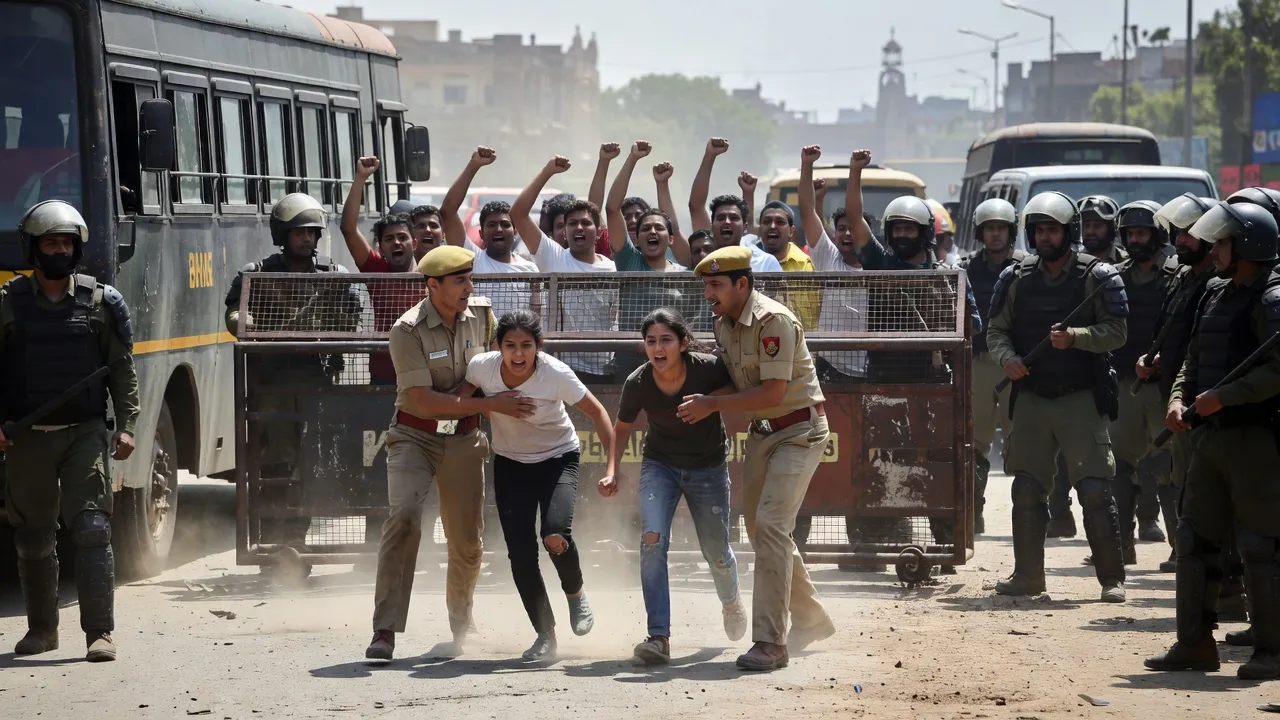
New Delhi, October 11, 2026. The capital was transformed into a fortress on Saturday, October 10, to prevent the Cockroach Janta Party (CJP) from gathering at Jantar Mantar and demanding the resignation of Chief Election Commissioner Gyanesh Kumar. The movement denounces the intensive revision of electoral rolls (SIR), which the commission denies having used to manipulate voter files.
The numbers vary depending on the sources. The Hindu Business Line reports over 2,000 people arrested, including communist leaders Brinda Karat and M A Baby and former Delhi Chief Minister Arvind Kejriwal. Free Press Journal mentions nearly 7,000 arrested, all released in the evening except for CJP leaders, after the deployment of some 15,000 police officers and 25,000 paramilitaries. The police invoked Article 163 of the BNSS code and requested the closure of 57 metro stations.
Founder Abhijeet Dipke and his two lieutenants, Saurav Das and Ashutosh Ranka, were arrested on the plane as soon as they landed in Delhi. Dipke live-streamed the scene on Instagram: "Come arrest us, we're not afraid." On Sunday morning, an executive magistrate released them after about 24 hours of preventive detention (Articles 126 and 170 of the BNSS), against a bail of 50,000 rupees and a commitment not to disturb the peace for a year.
The opposition calls it an act of cowardice. In Mumbai, Supriya Sule, Sanjay Raut, and Aaditya Thackeray accuse the Modi government of trying to crush the protest. The Bombay Lawyers Association mentions an "undeclared emergency". Dipke's parents ask if students are "dacoits of Chambal". On the government side, Minister Pralhad Joshi qualifies the mobilizations as "political drama" and defends the security measures.
The judicial aspect also occupies the columns. On Sunday, the Supreme Court began examining appeals against the arrests and transport cuts, Kapil Sibal invoking the Anuradha Bhasin jurisprudence on internet suspensions. The Guardian reports that the UN High Commissioner is concerned about mass detentions and that the Indian Ministry of Foreign Affairs considers this approach "selective".
The CJP, born in May after a remark by the Chief Justice about young unemployed people being compared to "cockroaches", promises new daily marches. Ajinkya Shinde, designated as Dipke's successor in a recorded video, has called a gathering at Shivaji Park in Mumbai, on Sunday at 4 pm.
SOURCES (5)
- The Hindu Business LineMEDIUM
- Deccan ChronicleMEDIUM
- Free Press JournalMEDIUM
- BBC IndiaMEDIUM
- The Guardian IndiaMEDIUM