Common ground and differences in coverage across the media analysed.
What the media report in common
1
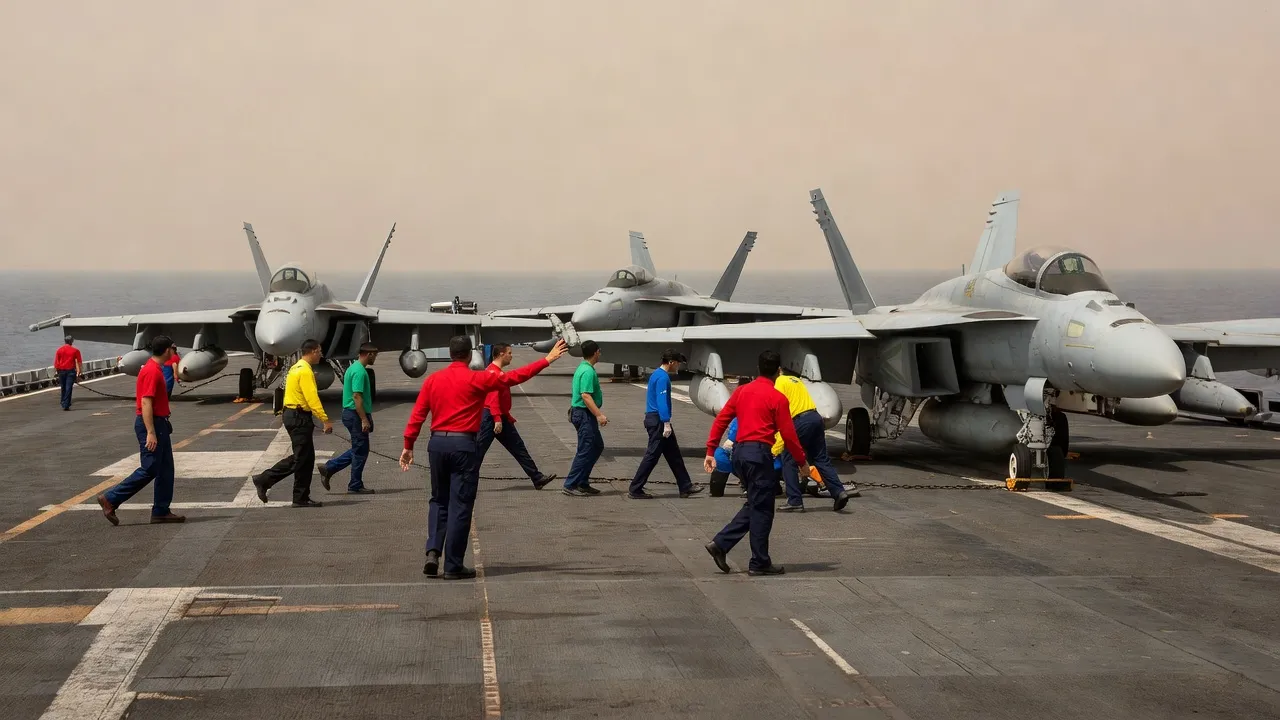
Seven out of nine perspectives (Canada, Israel, India, Pakistan, Portugal, Russia, United States) report the deployment of a third US aircraft carrier group and approximately 9,000 to 10,000 additional troops to the Middle East, according to US officials, the AP or the Wall Street Journal.
2
Six perspectives (India, Nigeria, Pakistan, Portugal, Russia, United States) mention the possibility of renewed US strikes against Iran following the November 3 midterm elections.
Where media coverage diverges
Additional troops sent
Question: how many soldiers are added to the deployment? Canada and Portugal estimate around 9,000 (AP); India, Pakistan, and Russia, 9,000 to 10,000 (WSJ); Israel also cites the Washington Post (up to 20,000) and the United States, CBS (around 20,000).
Question: is the reinforcement preparing for a resumption of strikes or aiming to influence the negotiations? Portugal presents both interpretations; Pakistan and Russia link it to a possible resumption of combat after November 3.
Ottawa is gauging the American escalation towards Iran: the third aircraft carrier and the threat of "very strong" strikes are linked to a diplomacy deemed to be at a standstill.
Paris is holding back on escalation: the threat from Trump to strike Iran "very hard" after the Flydubai flight incident eclipses, in the French press, any diplomatic lead.
Jerusalem is watching the US military buildup as a possible prelude to a resumption of strikes against Iran, with the Houthi front in Yemen in the background.
Ottawa is gauging the American escalation towards Iran: the third aircraft carrier and the threat of "very strong" strikes are linked to a diplomacy deemed to be at a standstill.
KEY POINTS
About 9,000 troops are being sent to the Middle East on a group of ships, including a third aircraft carrier, according to a US official cited Thursday (Globe and Mail).
Trump says Iran would be "hit very hard" if a link to the FlyDubai co-pilot is established, with over 180 people on board the flight (CBC).
Iranian officials say they received a US response to their proposal to end the war on Wednesday, without revealing its content (CBC).
ANALYSIS
Ottawa, October 3, 2026. In the Canadian press, the American announcement is first a military fact. The Globe and Mail reports that the United States is sending approximately 9,000 troops on board a group of ships to the Middle East, according to an American official cited on Thursday, October 1. The movement includes a third aircraft carrier and, the daily writes, highlights "the rapidly evolving dynamics" of Trump's war against Iran, as the midterm elections "weigh heavily".
The second thread is the attack on board the FlyDubai flight bound for Israel. CBC recalls that the co-pilot stabbed the captain, that the plane plunged before other people on board stopped the attack and landed the plane in Saudi Arabia, with over 180 people on board. Questioned at the White House, Donald Trump said that the answer to a link with Tehran was "yes", based on what he heard, while specifying: "we're working on it". On retaliation, he launched: "They will be hit very hard, don't worry." He gave no details. The Globe and Mail adds that Benjamin Netanyahu mentioned, on Fox News, a "radical Islamist indoctrination" of the suspect, without further clarification.
CBC devotes a subheading to "diplomacy at a standstill". Iranian officials indicated on Wednesday, September 30, that they had received an official American response to Tehran's latest proposal to end the seven-month war, which Trump had publicly rejected a few days earlier. They did not say if this response was a refusal. In an interview with Time magazine published on Thursday, Trump claims not to accept proposals that he "would not have approved a year ago" and leaves open the possibility of resuming bombings after the elections.
The Globe and Mail insists on the contradiction with the initial promises: a campaign of a few weeks, now extended, with an escalation after the November 3 election presented as a viable option. The daily also notes "new signs" that the nature of the conflict is becoming more complex, and relays a title on a 4% jump in oil after reports that China would suspend its fuel exports.
In total, the Canadian reading remains factual and sourced, centered on Trump's statements and troop movements, with few Iranian voices and no reaction from Ottawa in the available excerpts.
France
DOMINANT ANGLE
Paris is holding back on escalation: the threat from Trump to strike Iran "very hard" after the Flydubai flight incident eclipses, in the French press, any diplomatic lead.
KEY POINTS
On Thursday, October 1st, Donald Trump stated that Iran would be "hit very hard" if its involvement in the Flydubai flight attack was confirmed (BFMTV, Sud Ouest).
The Dubai-Tel Aviv plane, with 174 people on board including 166 Israelis according to the media, made an emergency landing in Saudi Arabia after the cockpit was attacked (BFMTV).
The United States has not struck Iran since September 1st, but ships are regularly targeted in the Strait of Hormuz (BFMTV).
ANALYSIS
Paris, October 3, 2026. In the French press, the common thread is the threat. On Thursday, October 1, Donald Trump stated that Iran would be "hit very hard" if Tehran's involvement in the knife attack against the pilot of a Flydubai flight was confirmed. "They will be hit very hard, don't worry," he replied to a journalist who asked if the United States would retaliate in the event of proven Iranian responsibility.
The starting point is the incident itself. According to BFMTV, the aircraft connecting Dubai to Tel Aviv, with 174 people on board, including 166 Israelis according to the media, made an emergency landing in Saudi Arabia two days ago. According to the account of travelers, the suspect stabbed the captain to make the plane crash, causing a loss of altitude of around 5,000 meters in one minute, before passengers overpowered him in the cockpit. The profile and motivations of the suspect remain unclear, notes the channel.
Israel has not waited for the investigations: it denounces a "jihadist terrorist attack attempt" and points to "Islamist indoctrination" of the copilot, targeting in particular the Emirates and the 2020 Abraham Accords. Questioned at the White House, Donald Trump said he believed Iran was involved: "I would say the answer is yes, based on what I'm hearing, but we're working on it right now."
Israel
DOMINANT ANGLE
Jerusalem is watching the US military buildup as a possible prelude to a resumption of strikes against Iran, with the Houthi front in Yemen in the background.
KEY POINTS
Secret meeting at Camp David on Friday, October 2, chaired by JD Vance, with Rubio, Hegseth, Witkoff, Ratcliffe, and General Caine, according to Axios citing three US officials.
The Washington Post mentions three aircraft carriers, up to 20,000 additional troops (in addition to around 50,000) and up to 150 fighter jets; the Wall Street Journal talks about 10,000 extra troops.
According to Reuters, Saudi Arabia is considering an offensive against the Houthis in Yemen to retake coastal areas and secure the Red Sea and Bab al-Mandab.
ANALYSIS
Jérusalem, October 3, 2026. The Israeli press is treating American news on Iran almost exclusively through a military prism, relying on leaks reported by Axios, the Washington Post, the Wall Street Journal, and Reuters.
The Jerusalem Post and Haaretz report that a circle of high-ranking national security officials met in secret on Friday, October 2, at Camp David, for several hours, under the presidency of Vice President JD Vance. According to Axios, which cites three American officials, Donald Trump participated. Marco Rubio, Pete Hegseth, Steve Witkoff, CIA Director John Ratcliffe, and General Dan Caine were present. Axios sources claim that "things were decided, or at least deeply discussed"; the White House did not respond to the request for comment.
The Jerusalem Post puts this meeting into a context of preparations. According to the Washington Post, the US military is considering a major expansion of its naval presence in the coming weeks: three aircraft carriers and their escort vessels, up to 20,000 additional soldiers adding to the approximately 50,000 already deployed, up to 150 fighter jets, and additional destroyers to counter missile fire. Haaretz, citing the Wall Street Journal, mentions around 10,000 more soldiers, as well as two additional Patriot batteries sent in recent weeks to protect oil and gas installations in Saudi Arabia and Qatar.
India
DOMINANT ANGLE
New Delhi sees the US naval escalation as a military countdown: a third aircraft carrier, 9,000 to 10,000 men and a threat of strikes after November 3.
KEY POINTS
According to the Wall Street Journal cited by the Times of India, 9,000 to 10,000 troops and a third aircraft carrier are set to arrive in the Middle East by the end of November.
Trump stated on Thursday, October 1, that Iran would be "hit very hard" if it was linked to the FlyDubai copilot, a plane with over 180 people on board.
In Time, Trump leaves open the possibility of resuming bombings after the American election on November 3; Iran says it has received an official US response to its proposal.
ANALYSIS
New Delhi, October 3, 2026. Indian media, led by the Times of India and NDTV, are treating the matter as a movement of forces. According to the Times of India, citing the Wall Street Journal, the United States is sending a third aircraft carrier group and additional Marine Corps ships to the Middle East, totaling around 9,000 to 10,000 men. NDTV specifies that the USS Theodore Roosevelt and its group will arrive by the end of November, with two other aircraft carriers, the USS George HW Bush and the USS George Washington, already in place.
The Times of India details the schedule: the Theodore Roosevelt left San Diego on Sunday for a scheduled deployment, the amphibious group Makin Island, with the 13th Expeditionary Unit Marines, on Monday. The crews are preparing for a longer-than-usual deployment, according to Navy officials. If the Washington remains in the region, it would be the first time since April that three aircraft carrier groups are present. The daily also notes a "relative lull" in direct combat in recent days, while Washington prepares for a resumption of hostilities.
The political aspect comes from the agency republished by The Hindu Business Line. On Thursday, October 1, Donald Trump stated that if Iran was linked to the FlyDubai copilot who stabbed the captain, it would be hit "very hard": "Oh they'll be hit, very hard, don't worry". Asked about a link with Tehran, he replied that "the answer, based on what I'm hearing, is yes, but we're working on it right now", without explaining his suspicions. The plane, which was carrying over 180 people, was able to land in Saudi Arabia.
Nigeria
DOMINANT ANGLE
Abuja is relaying without filter Donald Trump's threat to strike Iran "very hard", which the Nigerian press is treating as a military escalation of a bogged-down war.
KEY POINTS
Trump says Iran will be "hit very hard" if it is linked to the attack on the copilot of the flydubai Dubai-Tel Aviv flight, according to Vanguard and Punch (Thursday, October 1).
In Time, Trump considers it "possible" to resume bombings after the November 3 midterm elections.
More than seven months after the first American and Israeli attacks, Iran still controls the Strait of Hormuz.
ANALYSIS
Abuja, October 3, 2026. The Nigerian press is covering the escalation of verbal attacks by Washington through an article reprinted identically by Vanguard and Punch, published on Thursday, October 1. The main thread: American President Donald Trump believes that Tehran is probably involved in the attack of a co-pilot against the commander of a flydubai flight bound for Israel, and that Iran would be "hit very hard" if the link was confirmed.
The article details the incident. The co-pilot allegedly assaulted the commander before passengers were able to prevent the plane from crashing. The Israeli Prime Minister claims that the man had undergone "radical Islamist indoctrination". When asked at the White House about Iranian involvement, Donald Trump replied: "I would say that the answer, based on what I'm hearing, is yes, but we're working on it". On potential retaliation: "Oh, they will be hit very hard, don't worry".
The two newspapers highlight a change in tone on a war that has reached a stalemate. In an interview with Time magazine, published on Thursday, Trump considers it "possible" that bombing will resume after the midterm elections next month. He also reiterates the threat to "annihilate" Iran, already expressed at the UN General Assembly last week, when he presented himself as the "president of peace". His justification: "by annihilating Iran, we have created peace in the world".
Pakistan
DOMINANT ANGLE
Islamabad is watching the US military buildup around Iran, largely reported by Axios and the Wall Street Journal, and sees a Trump ready to resume strikes if talks remain stalled.
KEY POINTS
Trump, Thursday, October 1: if Iran is linked to the attack on the flydubai flight, "they'll be hit very hard" (Geo News).
The Pentagon is preparing to send a third aircraft carrier group and Marine ships, with up to 10,000 troops expected by the end of November, according to the WSJ as cited by the Express Tribune.
A secret meeting at Camp David, chaired by JD Vance, focused on Iran and the Saudi-Houthi conflict in Yemen, according to Axios (Express Tribune).
ANALYSIS
Islamabad, October 3, 2026. Pakistani media are treating the announcement as a step in the escalation between Washington and Tehran, citing mainly American media. Geo News reports that Donald Trump warned on Thursday, October 1, that Iran would be "hit very hard" if it was linked to the attack on a flydubai co-pilot against the commander of a Dubai-Tel Aviv flight. Asked at the White House, the president replied: "the answer, based on what I'm hearing, is yes but we're working on it right now", and then, about potential retaliation: "they'll be hit very hard, don't worry". The media outlet specifies that passengers helped avoid a crash, that the plane made an emergency landing in Saudi Arabia, that the United Arab Emirates are investigating a terrorist lead, and that Benjamin Netanyahu mentions the suspect's "radicalization".
Geo News places this threat in a broader deployment. Axios, cited by the site, reports on additional Patriot batteries in Saudi Arabia and Qatar to protect energy installations from potential Iranian retaliation, and the USS Theodore Roosevelt aircraft carrier heading to the region, where two other American naval air groups are already located.
The Express Tribune emphasizes the discreet meeting held on Friday, October 2, at Camp David. According to Axios and three American officials, Vice President JD Vance chaired it for several hours, with Marco Rubio, Pete Hegseth, Steve Witkoff, John Ratcliffe, and General Dan Caine. The topic: the war against Iran and the Saudi-Houthi conflict in Yemen. The newspaper writes that, "talks being at a standstill", Trump is considering a return to large-scale combat operations. It cites the Wall Street Journal, according to which the Pentagon is preparing to send a third naval air group and additional Marine ships, up to 10,000 troops, expected by the end of November. Trump also said he could resume strikes after the early November midterm elections, in the absence of an agreement.
Portugal
DOMINANT ANGLE
Lisbon sees the third American aircraft carrier as a device with a dual interpretation, preparation for a resumption of strikes after the midterm elections or simply pressure on Tehran.
KEY POINTS
About 9,000 military personnel (more than 7,000 sailors and 2,000 marines) are heading to the Middle East with the USS Theodore Roosevelt and USS Makin Island groups, according to RTP citing AP.
Three aircraft carriers could be present by the end of October; the Roosevelt, which departed from San Diego, is expected during the first half of November, according to SAPO.
The US deployment could exceed 50,000 personnel if the three aircraft carriers remain in place, according to Executive Digest (SAPO).
ANALYSIS
Lisbon, October 3, 2026. The Portuguese press is treating the deployment of a third US aircraft carrier as a military signal, and is questioning it: preparation for a resumption of strikes or mere pressure?
RTP Notícias is reporting the information from the Associated Press agency: the United States has sent around 9,000 troops to the Middle East, on board a group of ships, according to an American official. The convoy includes over 7,000 sailors and 2,000 marines. It comprises the USS Theodore Roosevelt aircraft carrier group, accompanied by the USS Chosin cruiser, and the USS Makin Island amphibious group, with the USS John P. Murtha and USS Anchorage ships. This could mean three aircraft carriers in the region by the end of October, according to an anonymous American source cited by the agency.
According to RTP, this reinforcement would bring the US naval presence to an "invulgarmente elevado" level: over 20,000 sailors and marines, as well as hundreds of aircraft. The channel recalls that Donald Trump had promised his fellow citizens a campaign of a few weeks and that he is now maintaining an escalation after the midterm elections as a viable option. It sees a war with a rapid dynamic, whose nature becomes more complex as the election approaches.
Russia
DOMINANT ANGLE
Moscow is counting the ships and personnel of the American reinforcement in the Middle East, linking it to Trump's rejection of the Iranian de-escalation plan and the possible resumption of strikes after November 3.
KEY POINTS
According to the Wall Street Journal, as reported by Interfax and TASS, the Pentagon is sending a third aircraft carrier group and Marines, totaling 9,000 to 10,000 additional troops, by the end of November.
The Theodore Roosevelt left San Diego on Sunday, September 27, escorted by the cruiser Chosin and the destroyers Paul Hamilton, Decatur, and Carl M. Levin; the Makin Island group followed on Monday, September 28.
Trump rejected the Iranian de-escalation plan and does not rule out resuming strikes after the November 3 election, Interfax reports, citing the WSJ.
ANALYSIS
Moscow, October 3, 2026. The Russian press is treating the American reinforcement as a matter of numbers and calendar, citing American media. Interfax, on Thursday, October 1, reported, according to the Wall Street Journal, that the Pentagon is sending "the third assault naval force" and additional ships from the Marine Corps, which brings the number of personnel in the region from 9,000 to 10,000 men. TASS, from New York, picked up the same source and specified that ships, fighters, Marines, and sailors are expected by the end of November.
The aircraft carrier USS Theodore Roosevelt left San Diego on Sunday, September 27. The amphibious group of the Makin Island, with three vessels and the Marines of the 13th expeditionary unit, set sail on Monday, September 28. TASS noted that this departure, according to the newspaper, is part of a scheduled deployment.
In a dispatch on October 3, Interfax detailed, according to The War Zone and a spokesperson for the US Navy, the composition of the group. The escort includes the cruiser Chosin and the destroyers Paul Hamilton, Decatur, and Carl M. Levin. The embarked aviation includes a squadron of F-35C, three of F/A-18E/F Super Hornet, a squadron of electronic warfare EA-18G, E-2D Hawkeye, helicopters, and CMV-22B convertibles. The amphibious group carries 2,500 military personnel and two squadrons of F-35B. Two aircraft carriers, the George H.W. Bush and the George Washington, are already on site.
United States
DOMINANT ANGLE
The United States government deciphers the third aircraft carrier group as a step up in escalation dictated by the electoral calendar: Trump promises to finish it "right after the election" while his cabinet meets in secret at Camp David.
KEY POINTS
The USS Theodore Roosevelt aircraft carrier group and the USS Makin Island amphibious group are heading to the Middle East; the US could have three aircraft carrier groups and around 20,000 military personnel there (CBS News).
Trump said on Thursday, October 1, that he believes the war will end "right after the election"; according to the Wall Street Journal cited by CNBC, he expects to resume bombings in November.
Vance chaired an unannounced meeting at Camp David with Rubio, Hegseth, Witkoff, Ratcliffe, and General Caine, according to three officials cited by Axios.
ANALYSIS
The United States, October 3, 2026. The American press is treating the deployment as a military escalation. CBS News, citing a US official, reports that the USS Theodore Roosevelt aircraft carrier group and the USS Makin Island amphibious group are heading to the Middle East; upon arrival, the United States could have three aircraft carrier groups and approximately 20,000 military personnel in the region. CNBC specifies that the two formations left San Diego, that 2,000 Marines are on board, and that, according to the Wall Street Journal, the deployment is expected to be complete by November. Bloomberg is more cautious: the final destination is not known.
The political calendar is weighing on the narrative. On Thursday, October 1, Donald Trump stated that the war, which began seven months ago, would end "right after the election," or even before the November mid-term elections, and that the Iranian theocracy "is ready to fold up." CNBC reports, according to the Wall Street Journal, that he told his staff to expect the resumption of bombings the same month. Axios cites his phrase from the same day: "either Iran signs the deal, or it won't exist any longer."
Explore every perspective on this subject across 9 countries.
Iran: Washington sends a third aircraft carrier and 9,000 troops to the Middle East as Trump threatens to hit "very hard"
published on
October 3, 2026
9
countries
21
sources
23
articles
0/100
gap
The figures for the American reinforcement vary depending on the cited media outlet: AP, Wall Street Journal, Washington Post, CBS. The perspectives in the corpus mainly draw on American sources, and each one focuses on a different aspect: ships, Trump's statements, the Camp David meeting, or the FlyDubai flight.
No strike is announced: the link between Iran and the copilot has not been established and mediators continue their efforts for an agreement.
Staff numbers according to the source
The figure of 9,000 comes from the Associated Press agency, which is reported by RTP and the Globe and Mail, according to an American official. Interfax, TASS, the Times of India, and the Express Tribune cite the Wall Street Journal and mention 9,000 to 10,000 troops expected by the end of November.
Other sources provide a higher total. The Washington Post, cited by the Jerusalem Post, mentions up to 20,000 additional soldiers, in addition to the approximately 50,000 already deployed, and up to 150 fighters. CBS News, quoting an American official, writes that the United States could have three aircraft carrier groups and around 20,000 troops. These figures respond to the same question, that of the scope of the operation, but do not measure it in the same way.
Interfax, according to The War Zone and a spokesperson for the US Navy, details the escort of the Theodore Roosevelt: the cruiser Chosin and the destroyers Paul Hamilton, Decatur, and Carl M. Levin. The amphibious group carries 2,500 troops according to the agency, some 4,000 Marines according to Executive Digest on SAPO. Two aircraft carriers, the George H.W. Bush and the George Washington, are already on site.
The electoral calendar and the negotiation
According to CBS News, Donald Trump said on Thursday, October 1, that the war would end "right after the election", or even before the midterm elections. CNBC reports, according to the Wall Street Journal, that he told his collaborators to expect the bombings to resume the same month. Axios cites another phrase from the same day: "either Iran signs the deal, or it won't exist any longer".
In his interview with Time magazine, published on Thursday according to the Globe and Mail and the CBC, Trump asserts that he will not accept proposals that he "would not have approved a year ago". Iranian officials indicated on Wednesday, September 30, that they had received an official American response to Tehran's latest proposal. The CBC specifies that they did not say whether this response was a refusal.
CNBC describes indirect talks scheduled after Washington rejected Iran's proposal to reopen the Strait of Hormuz in exchange for the lifting of the American blockade. The site adds that the Treasury sanctioned the Iranian automotive and railway sectors on Thursday.
Camp David and the Yemeni front
Axios describes the Camp David meeting as "highly unusual" and unannounced. According to the site, the last such meeting dates back to June 2025, just a few days before the Israel-Iran war. It lasted several hours. The Jerusalem Post and Haaretz report, based on Axios and three US officials, that Donald Trump participated in it. The White House has not commented.
« Things were decided or at least deeply discussed »
a US official quoted by Axios, October 3, 2026, regarding the Camp David meeting
The Yemeni dossier was on the agenda. Axios, as reported by the Express Tribune, writes that Riyadh is pressing Washington to join strikes against the Houthis and that Trump is showing reluctance but could change his mind. Citing Reuters, the Jerusalem Post indicates that Saudi Arabia is studying an offensive to retake coastal areas, after the Houthis' gains last month. The Express Tribune also reports that a Houthi projectile hit a school in Najran, according to the Saudi civil defense.
Axios and Geo News also mention additional Patriot batteries sent to Saudi Arabia and Qatar to protect energy facilities.
The FlyDubai flight in the coverage
BFMTV reports that the profile and motivations of the suspect remain unclear. When questioned at the White House, Donald Trump responded, according to the CBC and Geo News, that the answer to a link with Tehran was "yes", based on what he has heard, but that "we are working on it". Benjamin Netanyahu mentioned, according to the Globe and Mail, a "radical Islamist indoctrination" of the co-pilot. Geo News adds that the United Arab Emirates are investigating a terrorist lead.
The corpus includes nine perspectives. Seven of them report the deployment of a third aircraft carrier group, according to the meta-analysis. This count measures the coverage of the corpus, not the importance of the subject for readers in each country. Russian agencies focus on military logistics and do not mention the FlyDubai flight or Camp David. The two Nigerian newspapers relay a dispatch centered on the threat and do not mention the deployment.
In the French press, BFMTV notes that the United States has not struck Iran since September 1, even though ships are regularly targeted in the Strait of Hormuz.
Camp David
Meeting chaired by JD Vance with Rubio, Hegseth, Witkoff, Ratcliffe, and General Caine, according to three officials cited by Axios.
Arrival schedule
The Wall Street Journal mentions 9,000 to 10,000 troops expected by the end of November; SAPO places the Roosevelt in early November.
Yemeni front
According to Reuters, Saudi Arabia is considering an offensive against the Houthis to retake coastal areas in Yemen.
Key figures
9,000
American military personnel sent to the Middle East: more than 7,000 sailors and 2,000 Marines
The military aspect is treated as the logical consequence. BFMTV headlines with "9,000 to 10,000 additional American soldiers", while Sud Ouest mentions, in its headline, the deployment of "thousands of additional soldiers" to the Middle East, relying on American media. BFMTV recalls that the United States has not struck Iran since September 1, even if ships are regularly targeted in the Strait of Hormuz.
On the diplomatic level, the assessment is dry: "no diplomatic solution seems in sight between Washington and Tehran", writes BFMTV. The French account thus remains focused on the presidential statement and the military device, the two available articles not detailing the mediations or the issues of American domestic policy.
The second issue is Yemen. Citing Reuters, the Jerusalem Post indicates that Riyadh is studying a large-scale offensive against the Iran-backed Houthis, in order to retake key coastal areas and secure the Red Sea's maritime routes, after the Houthis' gains last month, which gave them control of the Bab al-Mandab Strait. Haaretz mentions a possible American involvement in this offensive.
Haaretz sums up the issue in one sentence: Donald Trump is "weighing" a resumption of military action against Iran. The two publications do not dwell on the American response to Tehran's proposal or the ongoing mediations: the narrative retained is one of accumulating armed pressure, rather than negotiation.
Diplomacy has taken a back seat. Iranian officials indicated on Wednesday, September 30, that they had received an official US response to their latest proposal to end the seven-month-old war, which Trump had publicly rejected a few days earlier; they did not say if it was negative. In an interview with Time magazine published on Thursday, Trump asserts that he will not accept proposals that he "would not have approved a year ago" and does not rule out resuming bombings after the US election on November 3.
The Times of India adds that the Navy aims to enforce its blockade and ensure security in the region. Indian coverage remains factual and focused on the means employed, without commentary on the consequences for Indian oil imports or the security of the Strait of Hormuz.
The article recalls that Iran continues to exercise control over the Strait of Ormuz, more than seven months after the first American and Israeli attacks against the Islamic Republic. It also mentions Trump's line, according to which the war aims to prevent Tehran from acquiring nuclear weapons.
The American political context is only mentioned in the background: Republicans fear losing control of Congress on November 3, with presidential popularity near its lowest levels due to the war and the rise in the cost of living linked to high oil prices. At this stage, Nigerian content does not offer any editorial, reaction from Abuja, or analysis of the consequences for the African oil market.
The Express Tribune finally notes that Riyadh is pressing Washington to join strikes against the Houthis, that Trump is showing reluctance but could change his mind, and that a Houthi projectile hit a school in Najran, Saudi Arabia, according to Saudi civil defense. The two articles remain factual and do not have any Pakistani editorial commentary; they do not detail the American response to the Iranian proposal or the Strait of Hormuz.
Executive Digest, on the SAPO portal, details the calendar. The Roosevelt left San Diego and is expected to reach the region during the first half of November, a date that is still indicative. It could replace one of the two aircraft carriers already present, the Washington or the Bush, or the three ships could stay, which would bring the US device to over 50,000 men. The Makin Island amphibious group, with around 4,000 Marines, is to join the Boxer group, of comparable size.
The SAPO title asks the central question: "preparação militar ou pressão sobre o Irão?" (military preparation or pressure on Iran?). The text admits both readings: a reinforcement linked to a new offensive against Tehran after the midterm elections, or a maneuver aimed at increasing pressure without any decision to resume attacks having been taken. It also mentions options on the table, including large-scale strikes against Iranian military targets and the extension of the air campaign.
The two articles remain focused on the military device and the American electoral calendar. Neither of them, in the available passages, develops the diplomatic or economic aspects of the case.
The political context comes from the Wall Street Journal, cited by the two agencies. According to Interfax, the aircraft carrier left a few days after Donald Trump stated that he rejected the Iranian de-escalation plan. TASS added that the president is considering resuming strikes against Iran after the midterm elections, and that he allegedly told his entourage to expect the resumption of bombings in November.
The George Washington could return to its Japanese port once the Roosevelt arrives. If this is not the case, TASS noted that it would be the first time since April that the United States has aligned three aircraft carrier groups in the region.
The two agencies are sticking to military logistics. They are not repeating Trump's statements on the link between Iran and the FlyDubai flight incident, nor the Camp David meeting, nor the American response to Tehran's proposal.
On Friday, October 2, according to three US officials cited by Axios, the top national security officials met for hours at Camp David under the chairmanship of JD Vance, with Marco Rubio, Pete Hegseth, Steve Witkoff, John Ratcliffe, and General Dan Caine. Axios judges the meeting "highly unusual" and unannounced; the last of its kind dates back to June 2025, just days before the Israel-Iran war. An official confides: "Things were decided or at least deeply discussed." The White House has not commented.
Other fronts are overlapping. Saudi Arabia is pressing Washington to strike the Houthis in Yemen; Trump is reportedly reluctant but could change his mind, say officials. On the investigation into the FlyDubai co-pilot, Benjamin Netanyahu asserts that any potential sponsor "will pay a very heavy price."
CNBC finally describes a stalled war: indirect talks have broken down after Washington rejected Iran's proposal to reopen the Strait of Hormuz in exchange for the lifting of the US blockade, and oil prices remain above their pre-war level. On Thursday, the Treasury sanctioned Iran's automotive and railway sectors.
No story in the recent reference set has a lower score (reference: 90 recent stories measured with the same method).