Common ground and differences in coverage across the media analysed.
What the media report in common
1
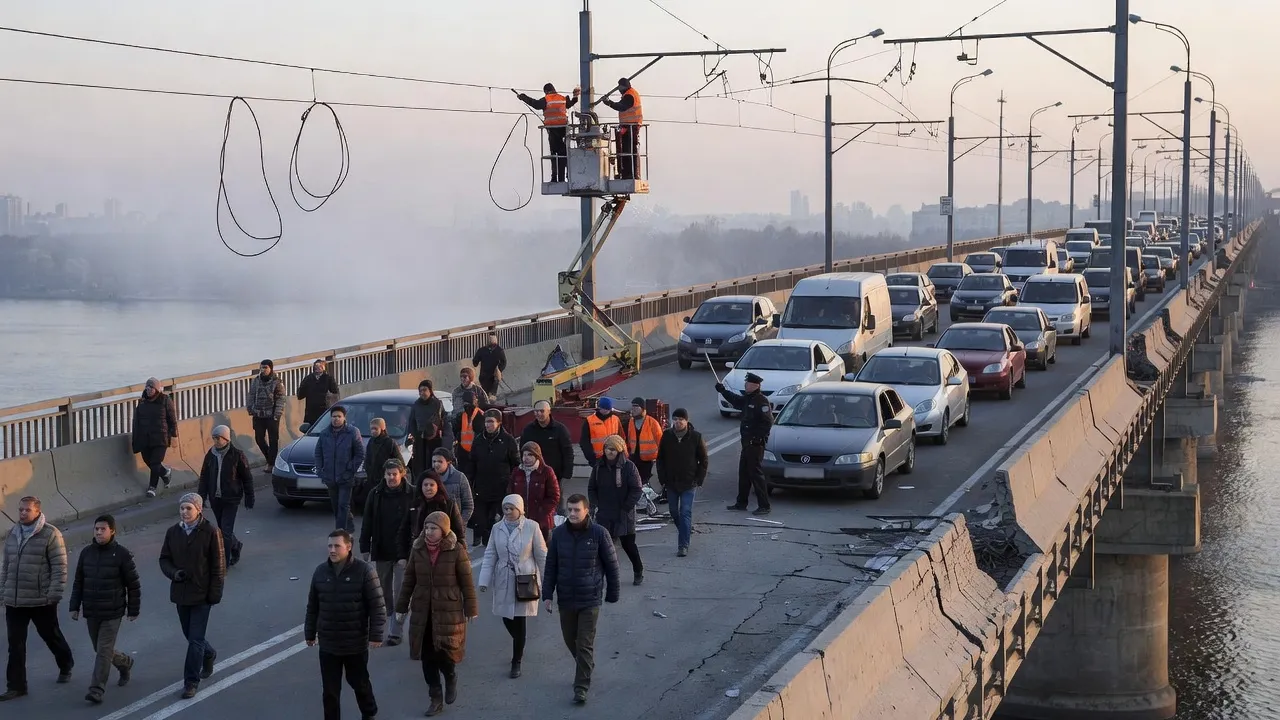
The North Bridge in Kiev was hit on Saturday, October 3, after the South Bridge was hit in the preceding days; traffic on the Dnieper is disrupted.
2
The Russian Ministry of Foreign Affairs again called on diplomats and foreigners to leave Kiev and announced massive retaliatory strikes.
Where media coverage diverges
Purpose of strikes on bridges
In response to the question 'what are the strikes on Kiev's bridges aimed at?', Russian coverage reiterates the version of the Ministry of Defense (bridge used for troop movement), while French, Ukrainian, Portuguese, and Polish coverage cite Klitschko and Zelensky: paralysis of the city and civilian targets before winter.
Berlin sees the strikes on Kiev's bridges as a targeted escalation of the air war, where drone technology and the paralysis of the city dominate the narrative.
Buenos Aires is deciphering an infrastructure war: after the northern bridge in Kiev, Russia promises massive strikes and Zelensky responds with Russian refineries.
Helsinki is primarily concerned about Moscow's ultimatum to foreigners in Kiev and the threat of massive strikes, fearing a winter without energy for Ukraine.
ANALYSIS
Helsinki, October 4, 2026.
France
DOMINANT ANGLE
Paris is deciphering the battle for Kiev's bridges in terms of its consequences for civilians: a capital cut in two by the Dnieper, where the Russian call for foreigners to leave weighs on daily life.
ANALYSIS
Paris, October 4, 2026.
Hungary
DOMINANT ANGLE
Budapest is first focusing on the military escalation: the Hungarian press is following the war on infrastructure, from Kiev's bridges to Russian refineries, through the statements of Zelensky and Klitschko.
ANALYSIS
Budapest, October 4, 2026.
Italy
DOMINANT ANGLE
Rome is watching the Kiev bridge war as a test of the home front's resilience ahead of a winter in which Moscow would target the power grid and infrastructure.
ANALYSIS
Rome, October 4, 2026.
Pakistan
DOMINANT ANGLE
Islamabad reports, through news agency dispatches, the infrastructure war that is disrupting Kiev: two bridges hit in a matter of days and a new ultimatum from Moscow to foreign diplomats.
ANALYSIS
Islamabad, October 4, 2026.
Poland
DOMINANT ANGLE
Warsaw is deciphering the infrastructure war: Kiev bridges targeted, pontoons urgently deployed, and a Ukrainian counterattack announced against Russian refineries.
ANALYSIS
Warsaw, October 4, 2026.
Portugal
DOMINANT ANGLE
Lisbon highlights the human and daily cost of the escalation over Kiev: bridges hit, foreigners invited to leave and fear of a winter of attacks on infrastructure.
ANALYSIS
Lisboa, October 4, 2026.
Romania
DOMINANT ANGLE
Bucharest is deciphering an infrastructure war: the bridges of Kiev and the Russian ultimatum to foreigners on one side, the targeted Russian refineries on the other, with an eye on the Romanian assets of Lukoil.
ANALYSIS
Bucharest, October 4, 2026.
Russia
DOMINANT ANGLE
Moscow presents the strikes on Kiev's bridges as blows to Ukraine's military logistics and announced reprisals, while the independent Russian press details the damage and civilian cost.
ANALYSIS
Moscow, October 4, 2026.
Sweden
DOMINANT ANGLE
Stockholm is deciphering the Russian campaign against Kiev's bridges as a security escalation aimed at cutting the capital in two, and is particularly relaying Moscow's warning to foreign diplomats.
ANALYSIS
Stockholm, October 4, 2026.
Turkey
DOMINANT ANGLE
Ankara is first concerned about the fate of a capital that the Dnieper risks cutting in two and the Russian warning addressed to diplomats and foreigners.
ANALYSIS
Ankara, October 4, 2026.
Ukraine
DOMINANT ANGLE
Kyiv is documenting the bridge war as a Russian campaign against civilian infrastructure and is responding with pontoons and strikes on Russian refineries.
ANALYSIS
Kyiv, October 4, 2026.
Explore every perspective on this subject across 14 countries.
Ukraine: Russia strikes a second major bridge in Kyiv, Zelensky vows to target Russian refineries
published on
October 4, 2026
14
countries
41
sources
51
articles
36/100
gap
The coverage of the corpus describes less the impact of the Nord Stream bridge than what it leaves behind: a city divided by the Dnieper, two readings of the purpose of the strikes, an ultimatum already launched in May and a dreaded winter.
Pontoon crossings are announced for next week, while Moscow promises new strikes and Kiev plans to intensify those on refineries.
A city cut in two
Figures on the state of bridges come mainly from the New York Times, relayed by Ukrainska Pravda. The American daily reports six attacks on the capital's bridges between October 1 and 3, including five on the South Bridge. It notes that the closest road bridge to the south is about 145 km away and that one million inhabitants live on the left bank, which is mostly residential, while most administrations and businesses are on the right bank.
« logistical nightmare »
New York Times, formula quoted by Ukrainska Pravda, TASS and RIA Novosti, October 3
Meduza provides details of the damage to the South Bridge: it has lost its support, its guardrail, and part of the road, and the metro no longer runs on it. The media outlet specifies that these are, according to it, the first strikes on Kiev's bridges since the start of the war. The FAZ describes a structure of over one kilometer, which was hit, notably on its suspender cables, and estimates that Moscow can probably not destroy such structures but can cause lasting disruptions. Ukrainian experts cited by Meduza agree: drones are not enough to destroy these bridges, but they can reduce them to a state of ruin if they persist.
On the Ukrainian side, Minister Mykola Kalachnyk, interviewed by Suspilne, indicates that pontoon crossings may require up to three months of work and would offer at least half of the current capacity. A tunnel under the Dnieper is being considered in the long term, according to RMF24 and the Ukrainian press.
The human toll on the North Bridge is not consistent across all reports. The Tagesschau writes that no injuries or deaths are reported in its article; the FAZ, Svenska Dagbladet, YLE, and others report two injured, according to Mayor Vitali Klitschko.
What the strikes are aiming for
On this issue, the texts cite different sources. According to TASS, the Russian Ministry of Defense indicated on Friday, October 2, that it had hit a road and rail bridge that was crucial for the supply of Ukrainian groups in the Donbass. Vedomosti adds that it targeted the logistics center in Gostomel on Saturday, October 3. According to Expressen, Moscow also cites military-industrial sites and command centers.
« disrupt the city on a long-term basis and make it uninhabitable »
Libération, analysis published on October 3
Telex reports that the Russian president stated on Thursday that the strikes against Ukrainian economic targets were in response to Ukrainian attacks on refineries and ships in the Black Sea. The Russian Ministry of Foreign Affairs, for its part, refers to a response to "terrorist acts" by the Ukrainian army, according to Cumhuriyet.
Libération, on its part, judges that the objective is "double": logistical and military pressure, but above all to durably disrupt the city. Dziennik.pl quotes a high-ranking anonymous Ukrainian official, interviewed by Reuters, who links the strikes to a decision in September lifting the restrictions on the Russian air campaign. This attribution is not confirmed by a second text in the corpus.
An ultimatum already heard
Several media outlets recall that the call from the Russian Ministry of Foreign Affairs is not new. Cumhuriyet dates a similar message to May 25, 2026, accompanied by diplomatic notes and commented on by Deputy Minister Mikhail Galuzin on May 27. RMF24 writes that 50 states had then described the call as a "threat" and that Western embassies had remained.
ARY News, which reprints AFP, notes that heads of state and government of countries supporting Ukraine had traveled to Kiev despite this warning. Expressen quotes the Russian text, which takes a tougher tone: not everyone has heeded the warnings and "deliberately puts their life in danger".
The Guardian, cited by HVG and RMF24, mentioned a possible transfer of embassies to Lviv or eastern Poland. The Ukrainian Ministry of Foreign Affairs denied this, stating it had received no notification.
The FAZ, in its live coverage, also reports that Russian projectiles, including Banderol missiles, have fallen in Moldova according to President Maia Sandu.
Refineries, winter and Lukoil
In the interview with Reuters, Volodymyr Zelensky says, according to Telex, that he sees no sign of interest from Vladimir Putin in peace talks or an energy truce. Infobae, Telex, and G4Media report that he also mentions a recapture of around 140 km² in the Donbass. The Ukrainian press relays his mentions of strikes in the Samara region and on Iskander positions in the Briansk region.
Digi24 and the Portuguese press recall that Kiev regularly strikes refineries and depots, which would have contributed to a fuel crisis in Russia this summer. For the winter, ANSA cites the New York Times: the Russian general staff would be ready to launch over a thousand missiles against the energy network. MTV Uutiset, citing the same newspaper, mentions a strike that Russia is preparing to "plunge Ukraine into darkness".
Regarding Lukoil, Digi24 specifies, according to the New York Times, that it is an oil deal worth several billion dollars that would benefit Middle Eastern businessmen linked to Jared Kushner and Steve Witkoff, and that it depends on the approval of Washington and the Kremlin. The media outlet notes that Lukoil has assets in Romania. RFI, citing the New York Times, writes that the transaction "raises serious questions of conflict of interest".
This aspect is absent from several coverage reports. The German, Swedish, Turkish, Pakistani, and Finnish texts in the corpus do not mention either the refineries or Lukoil: this measures what the selected articles contain, not the interest of their readers.
The bypasses
Mykola Kalachnyk, Minister of Infrastructure, announces a pontoon bridge and a river wall as early as next week.
The "new doctrine"
According to Zelensky, Ukrainian intelligence documents authorize strikes on roads, schools, and hospitals.
What the Russian Defense asserts
It asserts that the Nord bridge was used for the movement of Ukrainian troops (TASS, Vedomosti).
The US-Russian discussions
According to the New York Times, they include the sale of Lukoil assets to close associates of Trump, Kushner, and Witkoff.
Key figures
5 bridges out of 6
Dnieper River road bridges in Kiev have limited or interrupted traffic, according to the New York Times