Common ground and differences in coverage across the media analysed.
A week after the Bhote Koshi flood (August 26), caused by a glacial collapse in Langtang, Nepal's official death toll exceeds 1,200 bodies found and several thousand people missing.
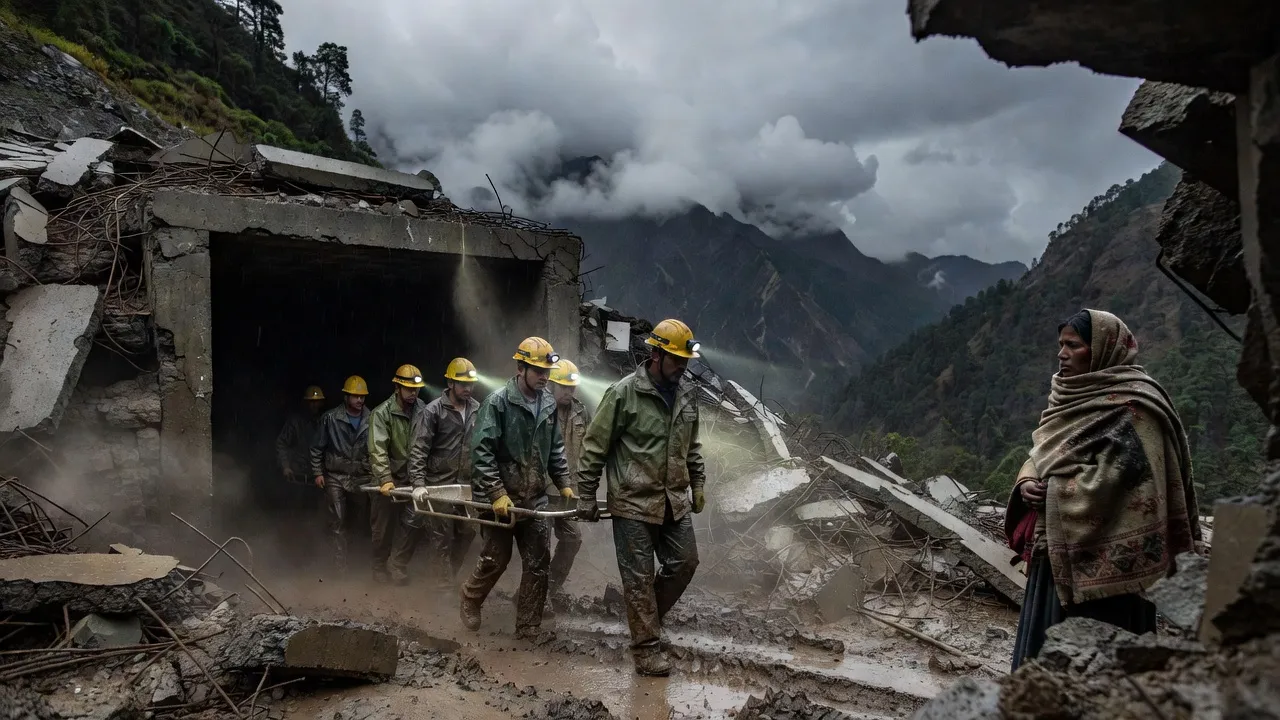
Rescue efforts are focused on the flooded tunnels of the Trishuli valley's hydroelectric construction sites (Chilime, Langtang, Upper Trishuli-1, Upper Trishuli-3A), where survivors may be trapped in air pockets.
China reports a separate toll for Xizang/Tibet, with around 16 deaths and 546 missing, which has remained unchanged for several days without update.
An Argentine presidency official publicly attributed the flood to a Chinese state-owned enterprise before denouncing communism; the Chinese embassy in Buenos Aires framed these comments as malicious rumors and ideological bias.
The German press believes Beijing strictly controls the dissemination of images and information from Tibet and has not updated its toll in several days, while the Chinese press presents its intervention as scientific and cooperative with Nepal.
Several media outlets combine the Nepalese and Chinese tolls into a single total, up to 1,130 deaths and 4,462 missing, while others, including Nepal and China themselves, maintain two separate counts without combining them.
Coverage aligned with this reading
Coverage that diverges
This grouping describes the publications analysed, not the position of these countries’ populations or of their governments.
What the coverage of each country leaves aside, while others put it forward.
United States
China
Nepal
Preview: 3 of 15 media perspectives. Syntheses of the media analysed — not direct quotations. Method & limitations
Ottawa is assessing its own share of the disaster: 30 Canadians and permanent residents are missing in Nepal, with ten officials dispatched to the scene, and families in Toronto are left searching police records due to a lack of news.
3 sources · View sources
Kuala Lumpur is accounting for its missing citizens: fifty-five Malaysians remain unaccounted for in Nepal, while seventy-seven others, found alive, await repatriation to Kathmandu.
2 sources · View sources
Kathmandu is grappling with a growing toll - 1,204 bodies, 4,216 missing - as it relies on the tunnels of hydroelectric construction sites to locate potential survivors.
4 sources · View sources
DOMINANT ANGLE
Ottawa is assessing its own share of the disaster: 30 Canadians and permanent residents are missing in Nepal, with ten officials dispatched to the scene, and families in Toronto are left searching police records due to a lack of news.
ANALYSIS
Ottawa, Thursday, September 3, 2026.
DOMINANT ANGLE
Kuala Lumpur is accounting for its missing citizens: fifty-five Malaysians remain unaccounted for in Nepal, while seventy-seven others, found alive, await repatriation to Kathmandu.
ANALYSIS
Kuala Lumpur, September 3, 2026.
DOMINANT ANGLE
Kathmandu is grappling with a growing toll - 1,204 bodies, 4,216 missing - as it relies on the tunnels of hydroelectric construction sites to locate potential survivors.
ANALYSIS
Katmandou, September 3, 2026.
DOMINANT ANGLE
Canberra is gauging the anxiety of thirty-eight Australian families on edge over the flooded tunnels in Nepal, caught between diplomatic uncertainty and community solidarity in Melbourne.
ANALYSIS
Canberra, Thursday, September 3, 2026.
DOMINANT ANGLE
Beijing claims an active role in addressing the disaster: the Chinese press scientifically documents the origin of the landslide, tallies its own losses in Xizang, and highlights its cross-border cooperation with Kathmandu.
ANALYSIS
Beijing, September 3, 2026.
DOMINANT ANGLE
New Delhi is assessing its own share of the Nepalese disaster: 163 nationals rescued, DNA profiling underway to identify its dead, and a rescue team still trapped in the mud of Chilime's tunnels.
ANALYSIS
New Delhi, Thursday, September 3, 2026.
DOMINANT ANGLE
Seoul is mobilizing its national rescue operation to locate nine missing nationals in the tunnels of the Rasuwa hydroelectric project, while its Nepalese diaspora is organizing its own solidarity effort.
ANALYSIS
Seoul, September 3, 2026.
DOMINANT ANGLE
Paris is questioning the role of climate change and American budget cuts in the scale of the Nepalese disaster, more so than just the body count in Rasuwa.
ANALYSIS
Paris, September 3, 2026.
DOMINANT ANGLE
The United States government is first and foremost concerned with the fate of its own citizens: more than seventy-five Americans remain unaccounted for in Nepal, while the US press highlights the ongoing confusion between the number of bodies recovered and the total death toll.
ANALYSIS
Washington, September 3, 2026.
DOMINANT ANGLE
Brazil gauges the Nepalese disaster on a human scale: the body-less funerals in Kathmandu and the testimony of a tunnel worker carry more weight in the Brazilian press than the official death toll, which varies daily.
ANALYSIS
Brasília, September 3, 2026.
DOMINANT ANGLE
Bangladesh is taking note of the Bhote Koshi flood, minus the tunnel count, and the call for climate compensation launched by Kathmandu to the largest emitters - a fight that Dhaka, a vulnerable delta downstream of the same Himalayan glaciers, recognizes as its own.
ANALYSIS
Dhaka, September 3, 2026.
DOMINANT ANGLE
Manila draws a bitter climate parallel from the Nepalese catastrophe: like Nepal, the archipelago suffers from disasters it did not provoke, without any international fund yet compensating for these losses.
ANALYSIS
Manille, September 3, 2026.
DOMINANT ANGLE
Germany distinguishes between two information systems in the same disaster: public reports and nominal lists in Nepal, frozen figures and digital blackout on the Tibetan side under Beijing's control.
ANALYSIS
Berlin, September 3, 2026.
DOMINANT ANGLE
Helsinki links the surge of the Bhote Koshi to climate injustice and the melting of the Himalayan glaciers, while following the fate of a fellow Finn who is among the 4,200 people still missing.
ANALYSIS
Helsinki, September 3, 2026.
DOMINANT ANGLE
Buenos Aires is dealing with an unexpected diplomatic incident: a member of President Milei's administration has attributed the Nepalese crisis to a Chinese state-owned company, prompting a sharp response from the Chinese Embassy just days before a ministerial trip to Beijing.
ANALYSIS
Buenos Aires, September 3, 2026.
Explore every perspective on this subject across 15 countries.
Compare viewpoints and see where they diverge.
published on
countries
sources
articles
gap
A week after the sudden flooding of the Bhote Koshi and Trishuli on August 26 in Rasuwa, Nepal, the Nepalese disaster risk management authority reported, as of September 2, 1,204 bodies found and 4,216 people still missing. Indian, Chinese, and South Korean rescue teams are searching the tunnels of the Trishuli valley's hydroelectric construction sites for potential survivors. Nepalese Prime Minister Balen Shah told Parliament that mud was hindering operations. The Australian government has reported 38 of its citizens still unaccounted for, South Korea nine, and India has evacuated over 160 nationals.
The toll remains provisional: Nepalese authorities themselves released two different counts on the same day.
China's Xizang (Tibet) reports a distinct tally: 16 dead and 546 missing, as of August 29.
The Finance Minister estimates the reconstruction cost to be between 4 and 5 billion dollars, nearly a tenth of the GDP.
There are 75 Americans still unaccounted for in Nepal, with no reported American fatalities.
Some media outlets combine Nepalese and Tibetan death tolls into a single total without disclosing this practice.
More divergent than 63% of recent comparable stories (reference: 91 recent stories measured with the same method).