Common ground and differences in coverage across the media analysed.
A week after the devastating glacier collapse on the China-Nepal border on Wednesday, August 26, 2026, the human toll is counted in hundreds of deaths and several thousand missing, with numbers continuing to shift as of Tuesday, September 1, 2026.
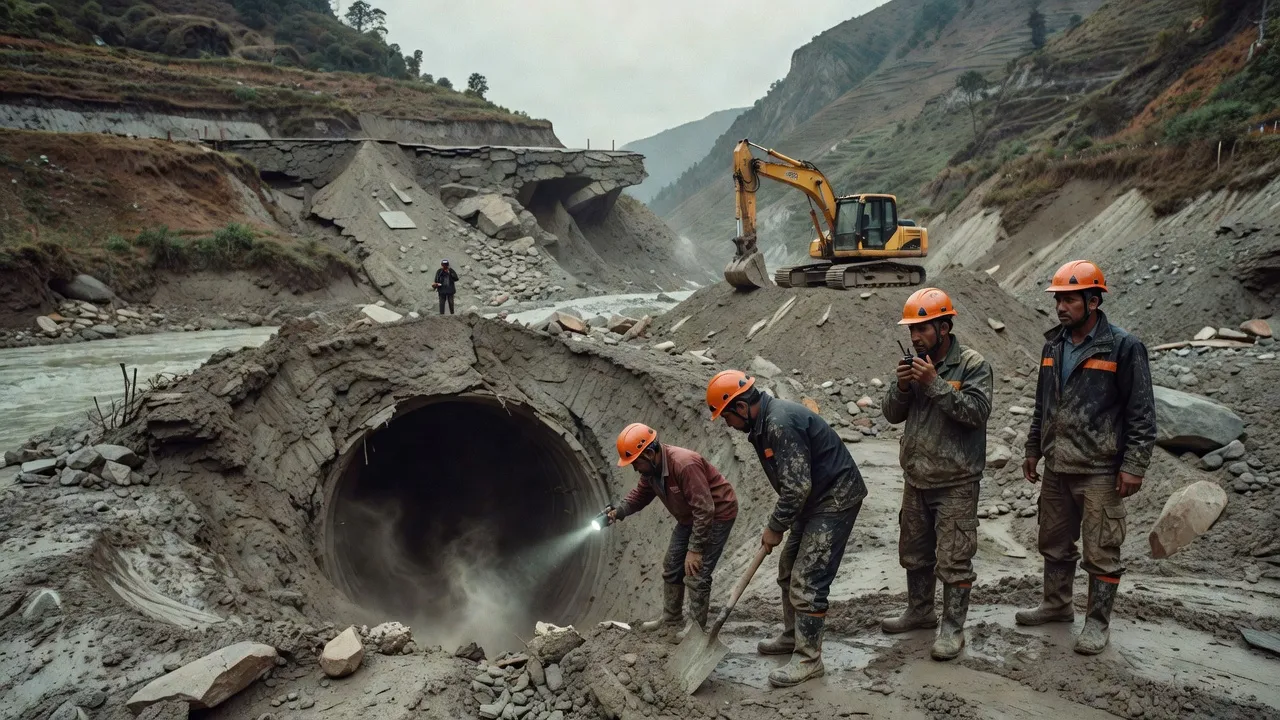
Hundreds of people, mostly workers, remain unaccounted for at the eleven hydroelectric construction sites in the Trishuli valley, particularly at the Upper Trishuli-1 tunnel where several hundred employees were working when the flood hit.
Nepal continues to count bodies district by district over a week after the disaster, with relief aid and equipment sent by numerous countries, including China, Australia, the United Kingdom, India, the United States, Japan, South Korea, and Malaysia, each also tracking the fate of its own citizens.
US and South Korean media outlets report that Kathmandu has been slow to allow access to foreign aid, a claim denied by Nepal's foreign minister, who says the government has not been slow or rigid in its response.
Coverage aligned with this reading
Coverage that diverges
Nepal's prime minister and some media outlets link the flood to climate change and call for international funding to cover losses and damages, while US media coverage focuses on geological explanations without referencing climate policy.
Coverage aligned with this reading
Coverage that diverges
French, British, Australian, German, South African, and Malaysian media outlets contrast the relative transparency of Nepal's casualty reports with China's lack of transparency on the Tibetan side, while Chinese media presents its response as a show of solidarity, without mentioning any restrictions.
Coverage aligned with this reading
Coverage that diverges
This grouping describes the publications analysed, not the position of these countries’ populations or of their governments.
What the coverage of each country leaves aside, while others put it forward.
Australia
China
United States
India
Preview: 3 of 14 media perspectives. Syntheses of the media analysed — not direct quotations. Method & limitations
New Delhi is first assessing the human cost paid by its own citizens in the Nepalese disaster, before linking the tragedy to its own Himalayan glacial vulnerability and the uncertainty maintained by Beijing on the Tibetan side.
4 sources · View sources
Kathmandu is tallying its living and dead, site by site: 987 bodies found, 894 workers still missing from eleven hydroelectric projects, with psychological support only just beginning a week after the flood.
6 sources · View sources
Beijing separates its national toll, contained in Xizang, from the much heavier one in Nepal, and highlights its aid to Kathmandu as well as the climate origin of the disaster.
2 sources · View sources
DOMINANT ANGLE
New Delhi is first assessing the human cost paid by its own citizens in the Nepalese disaster, before linking the tragedy to its own Himalayan glacial vulnerability and the uncertainty maintained by Beijing on the Tibetan side.
ANALYSIS
New Delhi, September 1, 2026.
DOMINANT ANGLE
Kathmandu is tallying its living and dead, site by site: 987 bodies found, 894 workers still missing from eleven hydroelectric projects, with psychological support only just beginning a week after the flood.
ANALYSIS
Katmandou, September 1, 2026.
DOMINANT ANGLE
Beijing separates its national toll, contained in Xizang, from the much heavier one in Nepal, and highlights its aid to Kathmandu as well as the climate origin of the disaster.
ANALYSIS
Beijing, September 1, 2026.
DOMINANT ANGLE
Dhaka draws a national lesson from the Nepalese disaster: its shared river basins, hills, and coastlines face the same climate risks.
ANALYSIS
Dhaka, September 1, 2026.
DOMINANT ANGLE
Canberra is gauging the Nepalese catastrophe by the 43 of its citizens who are missing, between partial relief for two of them and the first officially confirmed loss.
ANALYSIS
Canberra, September 1, 2026.
DOMINANT ANGLE
France notes a distinction in the Himalayan flooding, with two sides telling different stories: Nepal, which is detailing its toll down to the workers trapped in hydroelectric tunnels, and China, which is censoring and downplaying its own situation in Tibet.
ANALYSIS
Paris, September 1, 2026.
DOMINANT ANGLE
London is gauging the catastrophe by the toll on its own citizens: more than thirty Britons are missing, a rapid deployment team has been dispatched to the scene, while the British press is detailing the rescue efforts in the flooded hydroelectric tunnels.
ANALYSIS
London, September 1, 2026.
DOMINANT ANGLE
The United States government is questioning the slow response of the Nepalese government in accepting foreign aid, as 85 Americans remain unaccounted for and the US embassy releases $3.6 million in emergency assistance.
ANALYSIS
Washington, September 1, 2026.
DOMINANT ANGLE
Seoul is gauging the catastrophe based on its nine nationals who have gone missing in the tunnels of the Upper Trishuli-1 hydroelectric project, where access to rescue efforts was delayed by Nepalese authorities.
ANALYSIS
Seoul, September 1, 2026.
DOMINANT ANGLE
Brasília is gauging the Nepalese catastrophe by the individual plight of its victims: workers trapped in the tunnels of dams, families gathered in front of photo walls in Kathmandu, and doubts cast over fake videos that circulated online.
ANALYSIS
Brazil's capital, Brasília, Tuesday, September 1, 2026.
DOMINANT ANGLE
Kuala Lumpur is gauging the Nepalese disaster by the 51 of its nationals who remain unreachable, between waiting for the green light to deploy the SMART team and regional solidarity with Singapore.
ANALYSIS
Kuala Lumpur, Tuesday, September 1, 2026.
DOMINANT ANGLE
Berlin draws a clear distinction between the human toll in Rasuwa and the organized silence on the Chinese side of the border, where digital censorship erases images of the disaster.
ANALYSIS
Berlin, September 1, 2026.
DOMINANT ANGLE
Pretoria highlights the failed sharing of information between Kathmandu and Beijing on glacial risks before the flood, while emphasizing the commitment of South African rescuers on the ground in Nepal.
ANALYSIS
Pretoria, Tuesday, September 1, 2026.
DOMINANT ANGLE
Tokyo is first gauging the Nepalese catastrophe by the five of its nationals who remain unaccounted for, before questioning the vulnerability of the hydroelectric tunnels where workers are still trapped.
ANALYSIS
Tokyo, September 1, 2026.
Explore every perspective on this subject across 14 countries.
Compare viewpoints and see where they diverge.
published on
countries
sources
articles
gap
A week after the flood triggered by a glacial collapse on the China-Nepal border on Wednesday, August 26, 2026, Nepalese authorities announced on Tuesday, September 1, that 987 bodies have been recovered in Rasuwa district and more than 12,000 people have been rescued. On eleven hydroelectric construction sites in Rasuwa and Nuwakot, nearly 900 workers remain unaccounted for, including teams trapped in tunnels buried under mud. Prime Minister Balendra Shah attributes the flood to climate change, and Nepal is seeking emergency aid from the Loss and Damage Fund. The Rasuwagadhi border post has been destroyed, diverting trade with China to Korala.
The death toll is not finalized: Nepalese, Chinese, and international counts differ, and burials have begun before complete identification of the bodies.
Kathmandu has established a nine-step procedure to return the bodies; burials began before identification.
590 individuals from 39 countries are among the missing, according to Nepalese authorities.
In China, ten internet users were penalized for questioning the official account of Tibet.
The companies operating the construction sites were not allowed to join the rescue efforts until the seventh day.
From 5 (Japan) to 275 (India). 7 countries give none. · see the detail
From 5 (Japan) to 275 (India). 7 countries give none. ·
More divergent than 58% of recent comparable stories (reference: 91 recent stories measured with the same method).