Common ground and differences in coverage across the media analysed.
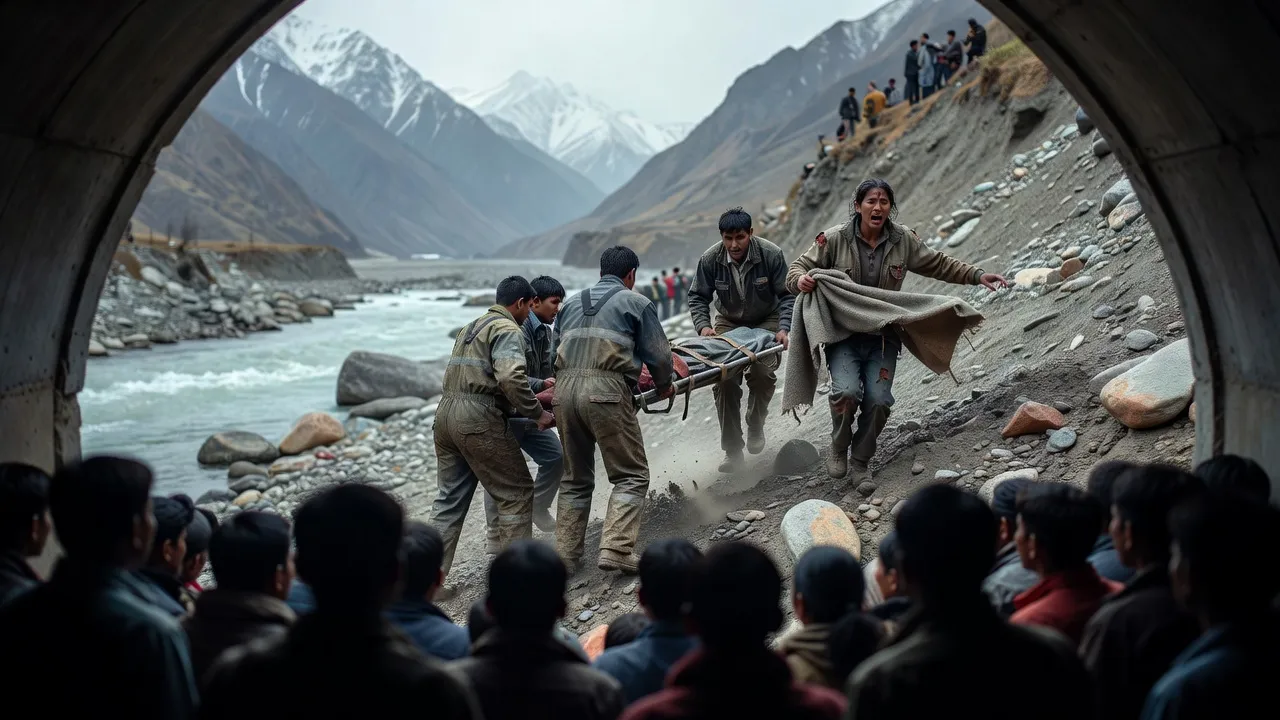
Two workers, a foreman (Sanjay Sah/Shah, 30 years old) and a supervisor (Kabir Maharjan, 45 years old), were rescued alive from the Trishuli-3A power plant tunnel on Friday, September 4, about nine days after the August 26 flood.
Hundreds of other workers remain missing in the tunnels of several hydroelectric construction sites along the Trishuli and Bhote Koshi rivers, and search operations are ongoing.
The national death and missing persons toll in Nepal continues to evolve, and the cited figures vary depending on the date of the official report, without a single stabilized total emerging.
Some coverage centers the narrative on the fate of their own nationals or experts (Australians located to safety, missing Chinese, South Korean or Indian workers on neighboring projects), while others prioritize the collective toll and the overall evolution of the rescue efforts.
Coverage aligned with this reading
Coverage that diverges
Estimates of the number of people still missing or trapped at the Trishuli-3A site vary significantly: 557 missing workers for the entire project according to a source cited in the United States, compared to around 42 employees trapped in the tunnel according to the Nepal Electricity Authority's estimate reported in Nepal.
Coverage aligned with this reading
Coverage that diverges
Some of the press explicitly distinguishes the number of bodies actually recovered from the tunnels, which is much lower than the total national toll, while elsewhere the Nepalese and Chinese tolls or aggregated totals are cited side by side without this distinction always being made explicit.
This grouping describes the publications analysed, not the position of these countries’ populations or of their governments.
What the coverage of each country leaves aside, while others put it forward.
Australia
India
South Korea
Preview: 3 of 9 media perspectives. Syntheses of the media analysed — not direct quotations. Method & limitations
The United States is first focusing on the human miracle - two workers extracted alive nine days after the flood - before measuring how many others remain unaccounted for in the same tunnels.
4 sources · View sources
Canberra is gauging the Nepalese rescue efforts through its own expert, Arnold Dix, who was sent on site to support tunnel rescue operations.
3 sources · View sources
Kathmandu is witnessing the contrast between two survivors rescued alive from the Trishuli-3A tunnel and the dozens of families who, nine days after the flood, continue to search for a name on the walls of the capital's hospitals.
6 sources · View sources
DOMINANT ANGLE
The United States is first focusing on the human miracle - two workers extracted alive nine days after the flood - before measuring how many others remain unaccounted for in the same tunnels.
ANALYSIS
Washington, September 4, 2026.
DOMINANT ANGLE
Canberra is gauging the Nepalese rescue efforts through its own expert, Arnold Dix, who was sent on site to support tunnel rescue operations.
ANALYSIS
Canberra, Friday, September 4, 2026.
DOMINANT ANGLE
Kathmandu is witnessing the contrast between two survivors rescued alive from the Trishuli-3A tunnel and the dozens of families who, nine days after the flood, continue to search for a name on the walls of the capital's hospitals.
ANALYSIS
Katmandou, Friday, September 4, 2026.
DOMINANT ANGLE
New Delhi takes away from this rescue the account of its own officer engaged on site, and the still uncertain fate of Indian workers gone missing in Nepal's tunnels.
ANALYSIS
New Delhi, September 4, 2026.
DOMINANT ANGLE
Dhaka takes note of the rescue of two workers, pulled alive from a Nepalese tunnel nine days after the flood, proof that a still evolving toll leaves room for hope.
ANALYSIS
Dhaka, September 4, 2026.
DOMINANT ANGLE
Beijing weighs the drama in light of its own citizens, as two workers emerged alive from a tunnel after nine days in the Bhote Koshi flood.
ANALYSIS
Beijing, September 4, 2026.
DOMINANT ANGLE
Seoul is weighing the rescue of two Nepalese workers in light of the fate of its nine nationals still missing just six kilometers away.
ANALYSIS
Seoul, September 4, 2026.
DOMINANT ANGLE
Paris notes, at the heart of a situation that continues to worsen, the rare good news of the two workers rescued nine days after the Nepal flood, without confusing this with the end of the search efforts.
ANALYSIS
Paris, September 4, 2026.
DOMINANT ANGLE
Brazil views the rescue of Trishuli-3A as a collective miracle, embodied by the survivor who stayed behind to alert his colleagues rather than fleeing.
ANALYSIS
Brasília, September 5, 2026.
Explore every perspective on this subject across 9 countries.
Compare viewpoints and see where they diverge.
published on
countries
sources
articles
gap
Two workers, Sanjay Sah (30 years old) and Kabir Maharjan (45 years old), were extracted alive on Friday, September 4, from the tunnel of the Trishuli-3A hydroelectric project in Rasuwa district, Nepal, nine days after the Bhote Koshi flood occurred on August 26. The two men received medical attention before being transferred to Kathmandu. Rescue efforts continue to search for hundreds of workers who remain missing at several Himalayan hydroelectric sites, including Chinese, South Korean, and Indian nationals.
Rescue operations continue at several sites, with no confirmation that all trapped workers have been located.
Thirteen members of the Nepalese armed police force lost their lives at the Timure post.
Dhaka has allocated $1 million in assistance for Nepal's disaster victims.
In the tunnels, rescue efforts have so far only uncovered a handful of bodies, far below the national total.
Sah is doing normally, but Maharjan remains in critical condition after being rescued, according to local rescue teams.
More divergent than 9% of recent comparable stories (reference: 91 recent stories measured with the same method).