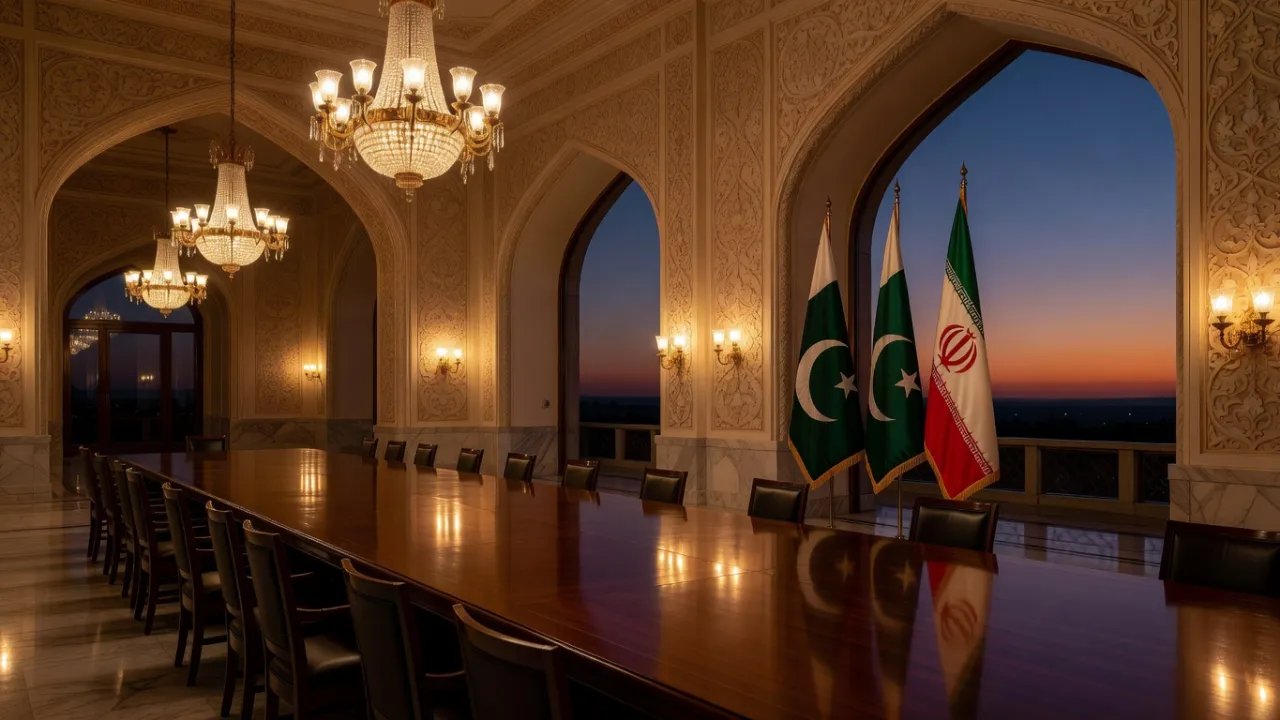
Pakistan's army chief in Iran as US's Rubio says 'slight progress' in talks
published on
countries
sources
articles
Measured with the previous method (distance between texts), on a different scale.
On 22 May 2026, Pakistani army chief Asim Munir travelled to Tehran as part of an official mediation between Washington and Tehran, acknowledged by all parties. On the sidelines of a meeting of NATO foreign ministers, US Secretary of State Marco Rubio spoke of "slight progress" in the negotiations, while declining any excessive optimism.
These talks unfold within a conflict that has been open since 28 February 2026 between the United States, Israel and Iran. Since the outbreak of hostilities, the Strait of Hormuz — through which roughly one-fifth of global oil and LNG supplies normally passed — has been closed to the vast majority of commercial traffic, triggering a major global energy shock. Pakistan emerged as a central mediator after securing a partial ceasefire on 8 April, with no substantive agreement reached since.
Two issues remain unresolved. The first concerns the stock of highly enriched uranium held by Iran: Supreme Leader Khamenei has barred its transfer abroad, while Washington demands its removal or destruction. The second relates to the status of Hormuz, which the United States and its allies refuse to see subjected to tolls, whereas Tehran sets recognition of its sovereignty over the passage as a precondition.
The actors also differ on method and scope. Israel and the United States want the nuclear file folded into any deal, which Iran refuses until the war has ceased. Several regional states promote Pakistani and Qatari mediation as the credible path, while Atlanticist countries present sanctions and pressure as indispensable. Six weeks after a ceasefire described as fragile, the proliferation of diplomatic channels reflects the absence of a consolidated framework for ending the crisis.
What the comparison reveals
Common ground and differences in coverage across the media analysed.
What the media report in common
Pakistani Chief of Staff Asim Munir visited Tehran on May 22, 2026 as part of an official mediation effort between Washington and Tehran, acknowledged by all parties.
Marco Rubio stated at the NATO Foreign Ministers meeting in Helsingborg that there has been slight progress in negotiations, while refusing to show excessive optimism.
The Strait of Hormuz has been closed to the vast majority of commercial traffic since the conflict began on February 28, 2026, representing approximately 20 percent of global oil and LNG supplies.
Where media coverage diverges
Legitimacy of the US-Israel military operation
Iran describes the February 28 strikes as a flagrant violation of Article 2 Section 4 of the UN Charter and aggression against a sovereign state. Western countries and their allies frame the operation as a response to a nuclear threat or as an act of war without explicitly contesting its legality.
Coverage aligned with this reading
Iranian tolls on the Strait of Hormuz
Washington, the EU and their allies view any Iranian toll system on the strait as illegal and incompatible with an agreement. Iran, by contrast, poses recognition of its sovereignty over this passage and the lifting of the American blockade as prerequisites for any negotiation.
Coverage aligned with this reading
Coverage that diverges
Inclusion of the nuclear issue in talks
Israel and the United States insist that the fate of Iranian enriched uranium and ballistic capabilities must be an integral part of any agreement. Iran refuses to address these questions until the war has ceased on all fronts, and several draft agreements circulating in the press exclude this point.
Coverage aligned with this reading
This grouping describes the publications analysed, not the position of these countries’ populations or of their governments.
Blind spots
What the coverage of each country leaves aside, while others put it forward.
 Iran
Iran- The precise conditions laid down by Washington and Israel on the nuclear issue
- Iranian economic losses linked to the blockade (estimated at 435 M$ per day by FDD)
- Qatar's advisory role in mediation
 Ukraine
- Iran's substantive conditions for a lasting agreement
- Pakistan's own strategic interests in mediation
- The fate of the Iranian nuclear issue in the talks
 Israel
- Iranian arguments on sovereignty and war damages
- Qatar's active role despite strikes suffered on its territory
- Pressure from Gulf states on Washington to prevent resumption of hostilities
How each country reads it
Preview: 3 of 20 media perspectives. Syntheses of the media analysed — not direct quotations. Method & limitations
 Greece
Athens closely follows US-Iran negotiations, seeing Pakistani mediation as a concrete opportunity to stabilize a region crucial to Eastern Mediterranean navigation.
2 sources · View sources
 Canada
Ottawa frames US-Iran talks through the prism of global energy shock, highlighting that the impasse on the Strait of Hormuz and enriched uranium maintains markets in uncertainty.
1 source · View sources
 Germany
Berlin views the Hormuz crisis as an economic showdown with global consequences, where neither Washington nor Tehran seems willing to back down, risking a wider conflict.
1 source · View sources
The full text, country by country
Greece
DOMINANT ANGLE
Athens closely follows US-Iran negotiations, seeing Pakistani mediation as a concrete opportunity to stabilize a region crucial to Eastern Mediterranean navigation.
ANALYSIS
Athens, May 22, 2026.
Canada
DOMINANT ANGLE
Ottawa frames US-Iran talks through the prism of global energy shock, highlighting that the impasse on the Strait of Hormuz and enriched uranium maintains markets in uncertainty.
ANALYSIS
Ottawa, May 22, 2026.
Germany
DOMINANT ANGLE
Berlin views the Hormuz crisis as an economic showdown with global consequences, where neither Washington nor Tehran seems willing to back down, risking a wider conflict.
ANALYSIS
Berlin, May 22, 2026.
 France
DOMINANT ANGLE
Paris sees a fragile attempt at de-escalation in Pakistani mediation between Washington and Tehran, in a context where NATO is fractured and the Strait of Hormuz remains closed, directly threatening European economic stability.
ANALYSIS
Paris, May 22, 2026.
Israel
DOMINANT ANGLE
Tel Aviv warns of major security risks as Washington-Tehran talks stall over nuclear issue.
ANALYSIS
Tel Aviv, May 22, 2026.
 India
India
DOMINANT ANGLE
New Delhi focuses on Pakistan's mediation in Iran, aware that Gulf stability directly affects its energy supplies and regional balance.
ANALYSIS
New Delhi, May 22, 2026.
Iran
DOMINANT ANGLE
Tehran welcomes Pakistani mediation as a recognition of its diplomatic legitimacy, while insisting that any agreement requires a global ceasefire and recognition of its sovereign rights.
ANALYSIS
Tehran, May 22, 2026.
 Japan
Japan
DOMINANT ANGLE
Tokyo retains the energy and financial impact of the crisis, while Pakistani mediation and calibrated statements from Rubio fuel cautious hope without dissipating uncertainty over Hormuz.
ANALYSIS
Tokyo, May 22, 2026.
 South Korea
DOMINANT ANGLE
Seoul is closely watching diplomacy around the Iran-US issue, where the role of mediator entrusted to Pakistan and persistent blocks on enriched uranium and the Strait of Hormuz continue to weigh on global energy markets.
ANALYSIS
Seoul, May 22, 2026.
 Philippines
DOMINANT ANGLE
Manila views US-Iran talks through an energy lens, aware that the Strait of Hormuz is a vital artery for the Philippine economy.
ANALYSIS
Manila, May 22, 2026.
 Pakistan
DOMINANT ANGLE
Islamabad emerges as the indispensable interlocutor between Washington and Tehran, a diplomatic posture publicly hailed by Marco Rubio who describes Pakistan as the 'principal' mediator in this conflict.
ANALYSIS
Islamabad, May 22, 2026.
 Qatar
Qatar
DOMINANT ANGLE
Doha places at the center the Pakistani mediation and its own role of support, presenting the ongoing dialogue as a fragile but decisive turning point in a conflict with unresolved nuclear parameters.
ANALYSIS
Doha, May 22, 2026.
 Romania
DOMINANT ANGLE
Bucharest retains from this diplomatic sequence the persistent gap between the movement signals sent by Washington and Islamabad and Tehran's outright refusal to announce any proximity of an agreement.
ANALYSIS
Bucharest, May 22, 2026.
 Russia
DOMINANT ANGLE
Moscow sees in the Pakistani and Qatari mediation a demonstration that the resolution of the Iranian conflict is now slipping out of the hands of Western actors alone, while Rubio's military rhetoric on Ormuz is framed as coercive pressure without a guarantee of results.
ANALYSIS
Moscow, May 22, 2026.
 Saudi Arabia
DOMINANT ANGLE
Riyadh measures every step in Iran-US negotiations against its direct interests: the reopening of the Strait of Hormuz, regional energy stability, and the Iranian nuclear file.
ANALYSIS
Riyadh, May 22, 2026.
 Singapore
DOMINANT ANGLE
Singapore views the Iran-US crisis as a test of multilateral diplomacy, with Pakistan at the center and the closure of the Strait of Hormuz as a determining factor for global economic stability.
ANALYSIS
Singapore, 22 May 2026.
 Turkey
DOMINANT ANGLE
Istanbul views Pakistani mediation and Qatari engagement as key to US-Iran crisis exit, while emphasizing structural blocks — enriched uranium and Hormuz Strait control — hindering any final agreement.
ANALYSIS
Istanbul, May 22, 2026.
Ukraine
DOMINANT ANGLE
Kyiv views Iran-Pakistan-Rubio diplomacy not as a peripheral issue, but as a factor directly linked to Moscow's ability to finance the war.
ANALYSIS
Kyiv, May 22, 2026.
 United Kingdom
DOMINANT ANGLE
London views the Iran-US conflict as a structural three-way impasse — nuclear, Hormuz, sanctions — that neither Pakistani mediation nor Rubio's cautious signals have yet been able to untangle.
ANALYSIS
London, May 22, 2026.
 United States
DOMINANT ANGLE
Washington signals progress while maintaining military pressure intact: Rubio cites 'good signs,' but Trump warns he has 'other options' if Tehran refuses an acceptable deal.
ANALYSIS
Washington, May 22, 2026.
Explore every perspective on this subject across 20 countries.
Compare viewpoints and see where they diverge.