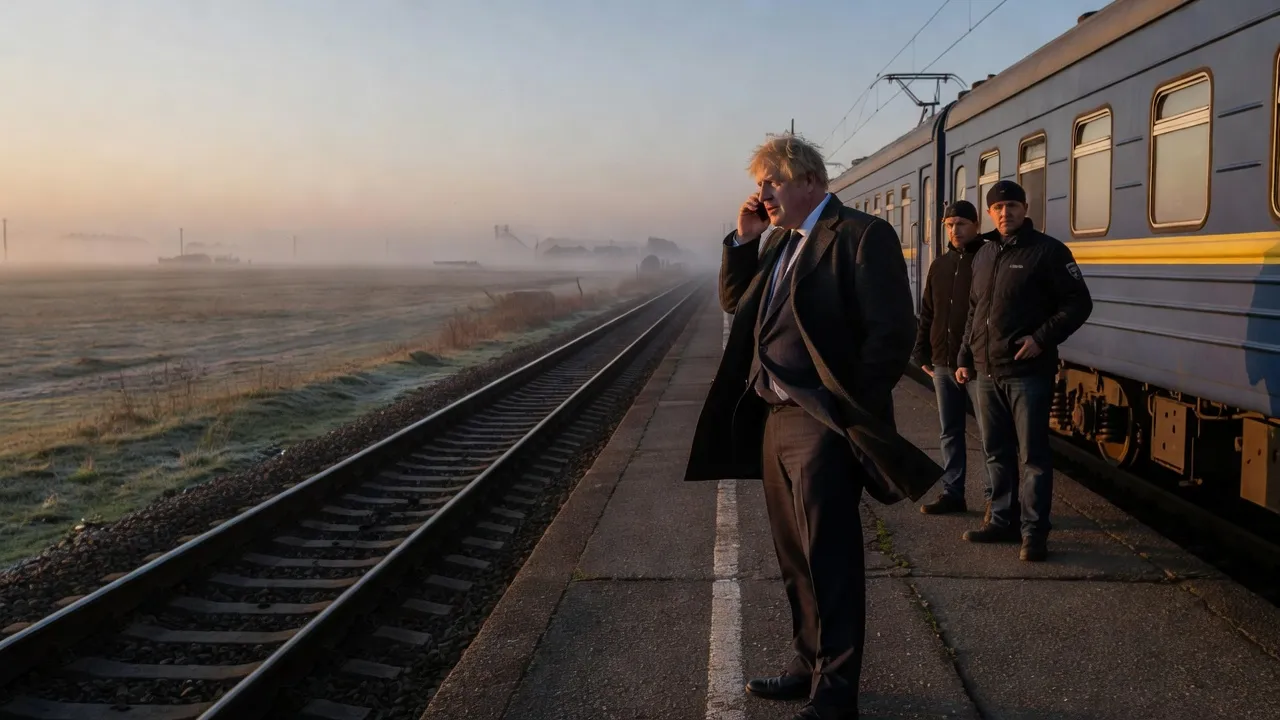
Common ground and differences in coverage across the media analysed.
What the media report in common
1
A Russian drone struck the locomotive of the Kyiv-Warsaw passenger train at the Yahodyn station in the Volhynie region, about two kilometers from the Polish border, shortly after a diplomatic train carrying Boris Johnson, David Petraeus, and European security advisors passed on the same line.
2
The 206 passengers of the targeted train were evacuated before the impact; no injuries were reported, according to Ukrzaliznytsia and PKP Intercity.
3
Ukrzaliznytsia believes it is possible that the drone's actual target was the diplomatic train, which departed earlier than scheduled, a hypothesis widely reported in the media but which remains, at this stage, unconfirmed independently.
Where media coverage diverges
Confirmation of the train being hit
The Ukrainian, German, British, American, Canadian, Argentine, Australian, Belgian, and French media present it as established, based on official statements, that the passenger train was hit and that the diplomatic train was probably the target, while the Polish government refrains from confirming these elements on Sunday evening.
Isolated incident or hybrid campaign
The German press explicitly links the strike to a series of hybrid incidents affecting European soil, including a drone attempt at Leipzig/Halle airport, while the Polish press limits the event to specific operational parameters, without mentioning a broader hybrid campaign.
National political reactions
In the United Kingdom, Labour MPs are calling for an official government statement on the incident involving Boris Johnson, while in the United States no official reaction is reported despite the presence of former CIA director David Petraeus on a train that remained at the station at the time of the strike.
Canberra measures the range of the Russian strike at just two kilometres from the Polish border, a signal that the Australian press reads as a test of NATO's limits rather than a simple railway incident.
KEY POINTS
The targeted train was carrying 206 civilian passengers, all evacuated before the impact; no casualties were reported according to Ukrzaliznytsia
The strike occurred at the Yahodyn station, in the Volyn province, less than two kilometres from the Polish border
Ukrzaliznytsia considers it "highly probable" that the actual target was the diplomatic train that left earlier than planned, carrying Boris Johnson, Carl Bildt and European security advisors, while another convoy with David Petraeus remained at the station
ANALYSIS
Canberra, 14 September 2026. In the Australian press, the Yahodyn episode is told primarily through Boris Johnson. The former British Prime Minister was returning from the Kyiv security conference when he was woken up at 5 am by guards asking him to prepare for evacuation, just minutes after a Russian drone had struck another convoy right behind his, in the Volyn province, less than two kilometres from the Polish border.
According to Ukrainian railway operator Ukrzaliznytsia, the targeted train was carrying 206 civilian passengers, who were evacuated before the impact; no casualties were reported. The company believes it is "highly probable" that the drone's actual target was the diplomatic train that had left Yahodyn station earlier than planned, the same train that was carrying Johnson, former Swedish Prime Minister Carl Bildt, and security advisors from several European Union countries, all returning from the Yalta European Strategy Conference. Another train, with former CIA director David Petraeus on board, was still at the station at the time of the strike.
Bildt, who was present on the scene, confirmed on social media: "It was not our train, but the one right after us, near the Polish border crossing. It was evacuated as the Russian drone approached, and no one was injured."
Australian media highlight that this strike, which occurred just minutes after the passage of former Western leaders and only two kilometres from Polish territory, revives concerns about the ability of Russian drones to reach areas increasingly close to NATO's eastern flank. It is this geographical proximity, more than the diplomatic controversy between Kyiv and Moscow over the nature of the target, that structures the Australian treatment of the event.
Argentina
DOMINANT ANGLE
Buenos Aires is deciphering the attack through the enigma of the target: Boris Johnson and the former CIA boss targeted, or just railway infrastructure according to Moscow?
KEY POINTS
The Kyiv-Warsaw train was carrying 206 passengers, all evacuated before the impact; no injuries were reported, according to Ukrzaliznytsia and PKP Intercity
Ukrainian railway operator Ukrzaliznytsia suggested that the drone's actual target may have been a "diplomatic train" that had carried Boris Johnson, David Petraeus, and European advisors just minutes earlier
Estonian Foreign Minister Margus Tsahkna warned that "Russian attacks are becoming more intense and getting closer and closer to NATO and the EU"
ANALYSIS
Buenos Aires, Monday, September 14, 2026. The Argentine press is covering the drone strike on the Kyiv-Warsaw train less as another episode in the war and more as a ballistic enigma: who was the target of the Russian drone that hit, on Sunday, the locomotive of a convoy at the Yahodyn station, two kilometers from the Polish border?
La Nación, Ámbito, and Perfil all take up the same hypothesis, formulated by the Ukrainian railway operator Ukrzaliznytsia: the real target may have been a "diplomatic train" that had taken the same line a few minutes earlier, carrying former British Prime Minister Boris Johnson, former CIA director David Petraeus, and European security advisors returning from a conference in Kyiv, including British national Jonathan Powell. According to Ámbito, citing Der Spiegel, an advisor to German Chancellor Friedrich Merz, Günter Sautter, was also among those evacuated from a previous convoy.
The train that was finally hit was carrying 206 passengers, according to Ukrainian and Polish railway companies PKP Intercity; all were evacuated before the impact and no injuries were reported, the three Argentine media outlets specify.
The Buenos Aires press also relays a warning from Estonian Foreign Minister Margus Tsahkna, whose team was partially stranded at the Yahodyn-Dorohusk border post: "Russian attacks are becoming more intense and are getting closer and closer to NATO and the EU. Our response must also intensify."
Belgium
DOMINANT ANGLE
Brussels is interpreting the strike as a possible message to Westerners, just two kilometers from NATO territory.
KEY POINTS
The drone struck the locomotive of the Kyiv-Warsaw train two kilometres from the Polish border, at Yahodyn station; the 206 passengers had been evacuated before the impact, with no injuries (DH).
According to Ukrzaliznytsia, a "diplomatic train" carrying Boris Johnson, former CIA director David Petraeus, and EU security advisors had just left the same station: "it is quite possible that the target of the Russian drone was also the diplomatic train" (La Libre).
Volodymyr Zelensky described the strike as "deliberate" while Ukrzaliznytsia referred to a "systemic attack" targeting Ukrainian rail across the country.
ANALYSIS
Brussels, September 14, 2026. A Russian jet-powered drone struck the locomotive of a Kyiv-Warsaw passenger train on Sunday at the Yahodyn station in the Volhynie region, about two kilometers from the Polish border, a NATO member. The 206 passengers had been evacuated before the impact after an alert from Ukrainian authorities; no injuries were reported, but the convoy was delayed by more than six hours before resuming its route to Warsaw, according to DH.
The Belgian press is particularly focused on what happened before the strike. According to the Ukrainian railway company Ukrzaliznytsia, a "diplomatic train" carrying security advisors from several EU member states and former European leaders - including former British Prime Minister Boris Johnson - had just left the same Yahodyn station. Former CIA director David Petraeus was on board another train stationed at the same location at the time of the attack. "It is quite possible that the target of the Russian drone was also the diplomatic train," the company said, specifying that a coordinator had spotted the jet-powered device before it hit the locomotive of the passenger train rather than the diplomatic convoy, which had left earlier than planned.
Ukrainian President Volodymyr Zelensky deemed the strike "deliberate", denouncing Russian attacks also targeting energy infrastructure and "civilian buildings" in the west of the country. Ukrzaliznytsia mentioned a "systemic attack" on the rail network across the entire territory and has placed its surveillance center on high alert, inviting users to prepare for new evacuations. Warsaw, for its part, reported that another drone had struck near a Polish-Ukrainian border post the same night.
Canada
DOMINANT ANGLE
Ottawa views the Yahodyn strike as less of a missed shot at an empty locomotive and more as a signal sent to the diplomatic wagon that had just left the station, with Boris Johnson and European security advisors on board.
KEY POINTS
A drone alert and an evacuation order were issued fifteen minutes before the impact; the 206 passengers on the train were evacuated without injury, according to Ukrzaliznytsia as cited by the Toronto Sun.
Ukrzaliznytsia considers it "quite possible" that the drone was targeting the diplomatic train carrying Boris Johnson and security advisors from several EU states, reports the Globe and Mail.
Polish Minister Radoslaw Sikorski described the attack as an "escalation", while the Russian Ministry of Defense claims to have targeted a military transport infrastructure.
ANALYSIS
Ottawa, September 14, 2026. For the Canadian press, the notable fact of the weekend is not only that a Russian drone struck an empty locomotive in Yahodyn, two kilometers from the Polish border, but that the strike hit the rails just a few minutes after the passage of a "diplomatic train". The Globe and Mail and the Toronto Sun converge on this point: Ukrainian railway operator Ukrzaliznytsia confirmed that a convoy was transporting, at the time of the attack, "security advisors from several EU member states and former European leaders, including former British Prime Minister Boris Johnson". Another train present at the station was carrying former CIA director David Petraeus, Ukrzaliznytsia specified, as cited by the Toronto Sun via AFP.
These delegations were returning from a conference in Kyiv. The operator goes further in a statement taken up by The Globe and Mail: "it is quite possible that the target of the Russian drone was the diplomatic train", which left earlier than expected after an adjustment of schedules "due to the constant threat of Russian strikes". An alert and an evacuation order had been issued 15 minutes before the impact, according to the BBC as cited by the Toronto Sun. No injuries were reported among the 206 passengers.
Germany
DOMINANT ANGLE
Berlin links the strike on Yahodyn, two kilometres from the Polish border, to the wave of hybrid incidents that has already reached its own soil in Leipzig, and sees it as a test of NATO's determination on its eastern flank.
KEY POINTS
206 passengers were evacuated before the drone hit the locomotive of the Kyiv-Warsaw train at the Yahodyn station, according to Polish operator PKP Intercity.
Polish Interior Minister Marcin Kierwinski said: "Wir nehmen solche Vorfälle äußerst ernst" ("We take this type of incident very seriously").
Vladimir Putin warned Europeans that sending troops to Ukraine would be a "war against Russia", reports DW German, as trilateral talks are expected in October.
ANALYSIS
Berlin, September 14, 2026. A Russian drone struck the locomotive of the Kyiv-Warsaw passenger train at the border station of Yahodyn, about two kilometers from Poland, on Sunday, September 13. According to the Polish operator PKP Intercity, the 206 passengers had been evacuated before the impact; no injuries were reported. A second drone struck near the Dorohusk-Yahodyn border crossing, setting a gas station on fire. Ukrainian President Volodymyr Zelensky accused Moscow of deliberately targeting the convoy. On the Polish side, Interior Minister Marcin Kierwinski stated: "Wir nehmen solche Vorfälle äußerst ernst" — "We take this type of incident very seriously" — specifying that the situation is being "monitored continuously". The train resumed its route, recovered on the Polish side with over six hours of delay.
For the German press, this episode is not isolated. Tagesschau links it to the wave of hybrid incidents that has been sweeping Europe since summer: a surprise NATO air maneuver near Kaliningrad, a fire at the Polish drone manufacturer WB Electronics — which Prime Minister Donald Tusk described as deliberate sabotage —, arrests in Slovakia of suspects targeting a Ukrainian drone factory, and warnings from the Danish PET services against Russian sabotage targeting the defense industry. The public channel directly connects this series to the attempted drone attack on Leipzig/Halle airport, on German soil, which European Commission President Ursula von der Leyen described as a "new escalation on European soil".
France
DOMINANT ANGLE
Paris views the strike as the crossing of a new security threshold, two kilometres from NATO's border, just after the diplomatic train carrying Boris Johnson passed through.
KEY POINTS
The Russian drone hit the locomotive of the Kiev-Warsaw train at the Yahodyn station, two kilometres from the Polish border, with no casualties among the 206 passengers.
Polish Prime Minister Donald Tusk convened an emergency meeting at the Government Security Centre, and the Polish military command described the threat as "real and close".
Geopolitician Frédéric Encel, from Sciences Po Paris, estimates on BFMTV that "a threshold has been crossed" by this strike near the NATO border.
ANALYSIS
Paris, September 14, 2026. A Russian jet-powered drone struck the locomotive of a passenger train connecting Kiev to Warsaw, at the Yahodyn station, just two kilometers from the Polish border, on Sunday morning. The 206 passengers, evacuated before the impact, are unharmed, according to Le Monde and L'Express. The French press initially focuses on the immediate proximity to NATO territory rather than the zero toll of the strike itself.
The Polish Prime Minister, Donald Tusk, has convened an emergency meeting at the Government Security Center, reports Le Monde. The operational command of the Polish armed forces deemed the threat "real and close", citing other Russian drones that reached targets "just a few kilometers" from the border on the same night; Polish fighter jets patrolled at dawn. The Polish Deputy Minister of Defense, Cezary Tomczyk, urged anyone doubting the usefulness of supporting Ukraine to "draw conclusions from the events of this night".
On BFMTV, geopolitician Frédéric Encel, a professor at Sciences Po Paris, judges that "a threshold has been crossed". This security-focused reading dominates the French treatment, more so than the diplomatic track: another convoy, carrying Boris Johnson, former CIA director David Petraeus, and security advisors from several EU member states, had just left the same station a few minutes earlier. Ukrzaliznytsia considers it "highly likely" that it was the real target, according to Le Monde.
Poland
DOMINANT ANGLE
Warsaw is measuring the strike to the nearest kilometre, ruling out any diplomatic escalation as long as its airspace remains intact.
KEY POINTS
Two Geran-5 drones fell one and five kilometres from the border, without violating national airspace, according to Defence Minister Władysław Kosiniak-Kamysz.
The Kyiv-Warsaw train, hit at Yahodyn station two kilometres from the border, was carrying 206 passengers with no Polish nationals and arrived at Warsaw East 370 minutes late.
Prime Minister Donald Tusk did not confirm Sunday evening that the passenger train had been hit, despite Ukrainian and German statements.
ANALYSIS
Warsaw, September 14, 2026. On Sunday at dawn, Polish systems detected an attack by about fifteen Geran-5 jet drones against western Ukraine. Two devices fell one and five kilometers from the Polish border, one hitting a gas station in Jagodzin, setting two trucks on fire, the other hitting a truck about 800 meters from the Dorohusk-Jagodzin border crossing. Vice Premier and Defense Minister Władysław Kosiniak-Kamysz specified that in both cases they were Geran-5 jet drones and insisted: "there was no violation of our border". F-16s, helicopters, and a SAAB reconnaissance plane patrolled Polish airspace between 4 am and 10 am; the operational command reported no incursion.
It was on the same line, a few kilometers further on the Ukrainian side, that a drone hit the locomotive of the Kyiv-Warsaw train at the Yahodyn station, two kilometers from the border. The 206 passengers, among whom there were no Polish nationals, were evacuated on alert by a surveillance group; the convoy, received by PKP Intercity, arrived at Warsaw-East with a 370-minute delay. According to Ukrainian railways, a special train chartered for European diplomats - including former British Prime Minister Boris Johnson and German Chancellor's advisor Günter Sautter, returning from the YES security conference in Kyiv - had left the same station fifteen minutes before the impact, which could have made it the real target.
Ukraine
DOMINANT ANGLE
Kyiv denounces a deliberate strike against the diplomatic train carrying Boris Johnson and other Western officials, and demands a total Western embargo against Moscow.
KEY POINTS
The Russian drone struck the locomotive of the Kyiv-Warsaw train at the Yahodyn station, about two kilometres from the Polish border; the 206 passengers were evacuated and no injuries were reported.
Ukrzaliznytsia believes the true target may have been the diplomatic train that left earlier than planned, carrying Boris Johnson, Carl Bildt, and Friedrich Merz's advisor Günter Sautter.
Foreign Minister Andrii Sybiha called the strike "Russian terror striking directly at the gates of the EU and NATO" and demanded a total Western embargo.
ANALYSIS
Kyiv, September 14, 2026. Sunday morning, a Russian jet-powered drone struck the locomotive of a passenger train connecting Kyiv to Warsaw, at the Yahodyn station, in the Volhynie region, about two kilometers from the Polish border. The 206 passengers were evacuated after the Ukrzaliznytsia surveillance team, the national railway operator, detected the drone and alerted the crew fifteen minutes before the impact. No injuries were reported.
For Kyiv, the crucial detail is not the locomotive that was hit, but what had just left the same station: a "diplomatic train" carrying former British Prime Minister Boris Johnson, former Swedish Prime Minister Carl Bildt, Günter Sautter, one of the closest advisors to German Chancellor Friedrich Merz, as well as security advisors from the United Kingdom, France, and Italy, returning from a conference in Kyiv. Former CIA Director David Petraeus was on another train present at the same station. Ukrzaliznytsia estimates that this convoy, which departed earlier than planned after a "real-time" schedule adjustment due to the constant threat of Russian strikes, could have been the actual target: "It is quite possible that the target of the Russian drone was the diplomatic train, which left the station earlier than planned." The Institute for the Study of War (ISW) goes further: the strike was aimed, according to them, at injuring or killing current or former European government officials leaving Ukraine.
United Kingdom
DOMINANT ANGLE
London is first measuring the risk run by its own former Prime Minister, before demanding that the government make an official statement on the incident.
KEY POINTS
The train chartered by Boris Johnson, with British adviser Jonathan Powell and former CIA director David Petraeus on board, was partially evacuated after a drone alert around 5 am on Sunday.
Operator Ukrzaliznytsia considers it "quite possible" that the drone was targeting the diplomatic train, which had left earlier than planned; the Kyiv-Warsaw passenger train hit at Yahodyn was carrying 206 passengers who were evacuated without injury.
Labour MPs are considering an urgent question to force a government statement, while Conservative shadow minister Stuart Anderson has publicly reacted to the attack.
ANALYSIS
London, 14 September 2026. The British press first noted the name of its own former Prime Minister. Boris Johnson was returning from a security conference in Kyiv on a chartered train also carrying British national security adviser Jonathan Powell, former CIA director David Petraeus, former Swedish Prime Minister Carl Bildt, and French, Italian, and German advisers, when, around 5 am on Sunday, a drone alert stopped the convoy. Some of the passengers were evacuated as a precaution before the all-clear was given a few minutes later. No one was injured. A little earlier, a Russian jet-powered drone had struck the locomotive of a passenger train on the Kyiv-Warsaw line in Yahodyn, two kilometres from the Polish border. The 206 passengers had been evacuated 15 minutes before the impact. Ukrainian railway operator Ukrzaliznytsia considered it "quite possible" that the drone was actually targeting the diplomatic train, which had departed earlier than planned after a schedule adjustment due to the "constant threat of Russian strikes".
Back in London, Johnson denounced a "twisted logic" that had led Putin to "blow up a stationary Ukrainian locomotive at the Polish border", recalling that this type of attack "randomly and senselessly" affects Ukrainian civilians every day. In an op-ed in the Daily Mail, he described the Kremlin's strikes as "terrorist" and doomed to fail, and called for increased defence aid, including air defence, for Kyiv, citing 1.5 million Russian losses since the start of the war.
United States
DOMINANT ANGLE
The United States is scrutinizing the strike on Yahodyn through the fate of a train that still had, at the time of impact, former CIA director David Petraeus on board, two kilometres from the Polish border.
KEY POINTS
The Kyiv-Warsaw train was carrying 206 passengers, all evacuated before the drone impact; no injuries reported.
A second train, with former CIA director David Petraeus on board, was still at Yahodyn station at the time of the strike, according to Ukrzaliznytsia.
Ukrzaliznytsia considers it "highly likely" that the drone's actual target was the diplomatic train carrying Boris Johnson and Carl Bildt, which had departed ahead of schedule.
ANALYSIS
The United States, September 14, 2026. The American press is reporting on the Russian drone strike that occurred on Sunday, September 13, 2026, at the Yahodyn train station in the Ukrainian region of Volhynie, approximately two kilometers from the Polish border, emphasizing the proximity of a train carrying former CIA director David Petraeus. According to ABC News and NPR, this train, which was separate from the one that was returning former British Prime Minister Boris Johnson, former Swedish Prime Minister Carl Bildt, and security advisors from several European Union member states from Kyiv, was still at the Yahodyn station when the drone struck.
The targeted train, a Kyiv-Warsaw passenger convoy carrying 206 passengers according to the public railway operator Ukrzaliznytsia, had all its occupants evacuated before the impact; no injuries were reported, including on the diplomatic train that left earlier than scheduled and the one carrying Petraeus. Ukrzaliznytsia claims it is "highly likely" that the actual target of the Russian drone was the diplomatic train, which departed ahead of its usual schedule.
Bildt, who shared a video of the strike on X, specified that his convoy was not directly targeted but that the one that left a few minutes after his, near the Yahodyn-Dorohusk border crossing, was. He praised the "very good security system" that allowed for the timely evacuation. The passengers were returning from the Yalta European Strategy security conference, held in Kyiv, an annual meeting that brings together leaders and experts in politics, business, and security.
Explore every perspective on this subject across 10 countries.
A Russian drone hits a Kyiv–Warsaw train two kilometres from Poland, just after a “diplomatic train” passed
published on
September 14, 2026
10
countries
31
sources
42
articles
43%
gap
On Sunday, September 13, 2026, in the morning, a Russian jet-powered drone struck the locomotive of a passenger train connecting Kyiv to Warsaw, at the Yahodyn station, in the Volhynie region, about two kilometers from the Polish border. The train was carrying 206 passengers, who were evacuated before the impact; no injuries were reported. The strike occurred shortly after the passage, on the same line, of a train carrying former British Prime Minister Boris Johnson, a former CIA director, and security advisors from several European Union member states, who were returning from a conference in Kyiv. The same night, other Russian strikes caused fatalities in several regions of Ukraine.
Kyiv describes the strike as deliberate and Moscow claims to have targeted military infrastructure; neither version is independently confirmed.
Ukrzaliznytsia
The operator considers it "highly probable" that the diplomatic train, which had left early, was the actual target.
David Petraeus
The former CIA director was on a second train that remained in the station at the time of the impact.
The rail network
Ukrzaliznytsia mentions a "systemic attack" targeting the rail system across the entire country, with delays.
Polish airspace
The Polish Defense Minister states that no border violation was detected that night.
Understand the context
SEP 13, 2026
A Russian drone strikes the locomotive of the Kyiv-Warsaw train at Yahodyn, near Poland.
SEP 14, 2026
Boris Johnson denounces the attack; Polish and German authorities react.
Key figures
206
Passengers evacuated before the drone's impact on the locomotive
In the face of this accumulation of evidence, Kyiv describes the attack as "deliberate", while Moscow claims to have targeted a railway infrastructure used to transport military equipment from Europe. Perfil, however, recalls the need for caution: nothing confirms, at this stage, that Johnson, Petraeus, or Western officials were the real target of the drone; the hypothesis, born from Ukrzaliznytsia's statements, will have to be investigated. Buenos Aires is particularly concerned about the proximity, two kilometers, between the impact point and the territory of the Atlantic Alliance — a figure that the three titles emphasize as the true indicator of the level of escalation.
For the Belgian press, the episode illustrates the growing proximity between Russian strikes and NATO territory, with only two kilometers separating the impact point from the Polish border. The quasi-simultaneous convergence between a convoy that had transported high-ranking Western personalities and a strike qualified as deliberate by Kyiv fuels the interpretation of a message addressed as much to Ukraine as to European capitals.
Boris Johnson denounced "the twisted logic that led Putin to blow up a stationary Ukrainian locomotive at the Polish border", calling the attack "random and senseless", a gesture that "Ukrainians suffer every day, even on civilian rail lines". Former Swedish Prime Minister Carl Bildt, present in another car, specified on X that it was "not our train, but the one that followed a few minutes later, near the border post", evacuated before the arrival of the drone.
Polish Foreign Minister Radoslaw Sikorski described the multiplication of Russian strikes "at NATO's doorstep" as an escalation. Moscow claims, via its Ministry of Defense, to have targeted infrastructure serving the transport of military cargo. The Canadian press links the episode to the intensification, on both sides, of long-range strikes, as the terrestrial front remains largely frozen.
This perspective places the Yahodyn strike in the same category as incidents already recorded in Germany, Poland, Slovakia, and Denmark: a test of NATO's determination, carried out just two kilometers from its territory. DW German also recalls that Vladimir Putin warned Europeans that sending troops to Ukraine would be equivalent to declaring "war against Russia", even as Kyiv and Moscow are discussing a resumption of trilateral talks with Washington as early as October. For Berlin, the strike near the Polish border illustrates the difficulty of articulating Russian military pressure and ongoing diplomatic efforts. No official reaction from the federal government appears in the consulted articles: the German reading remains constructed from Polish and Ukrainian statements, complemented by the broader framework of hybrid threats already documented on national territory.
Volodymyr Zelensky accused Moscow of having struck the train "deliberately"; Ukrainian Foreign Minister Andrii Sybiha denounced attacks "at the gates of Europe and NATO", calling them "barbaric". Moscow, cited by L'Express, claims to have targeted "infrastructure facilitating the transportation of military cargo from Europe to western Ukraine" — a version barely picked up by the rest of the French press. The Ukrainian railway company has also warned of a "systemic attack" targeting the entire network, with delays and evacuations to be expected.
However, on Sunday evening, Prime Minister Donald Tusk did not confirm that the passenger train had indeed been hit, a caution that contrasts with Ukrainian and German statements. The Ministry of the Interior suspended controls at the border crossing and an alert was sent to residents of the Lublin and Subcarpathian voivodeships. For Warsaw, the essential thing remains elsewhere: no violation of national airspace was observed, even if the strike, two kilometers away, confirms the vulnerability of the country's most sensitive cross-border railway line.
Foreign Minister Andrii Sybiha denounced a cross-border escalation, qualifying the Russian terror strikes as "striking directly at the gates of the EU and NATO," and called for a total Western embargo. The same strike damaged a gas station near the Yahodyn-Dorohusk border crossing, setting several trucks on fire, and caused delays of one to ten hours on railway lines across the country.
Boris Johnson himself described the attack as "random and senseless," one of the daily examples suffered by Ukrainians, "even on civilian railways." For Kyiv, this episode illustrates a logic already documented: Russian strikes are now testing, two kilometers from the border, the Western will to hold firm.
On the domestic front, the incident quickly turned into a political debate. Labour MPs are considering an urgent question to force the government to comment, while the government is expected to make a statement anyway. Conservative shadow minister for war preparedness Stuart Anderson reacted publicly. The BBC mentioned a possible "escalation" of the Russian war, while Donald Trump, when asked in Ireland, merely called on Kyiv to stop targeting Russian diesel refineries.
The two American dispatches rely exclusively on Ukrzaliznytsia's statements, which indicate "constantly adjusting train schedules" to protect against this type of strike. No official reaction from Washington regarding the fate of its former top intelligence official is reported in these articles, which focus on the events that unfolded near the Polish border, on the edge of NATO territory.