EXPLORE THIS STORY

GERMANY PERSPECTIVE
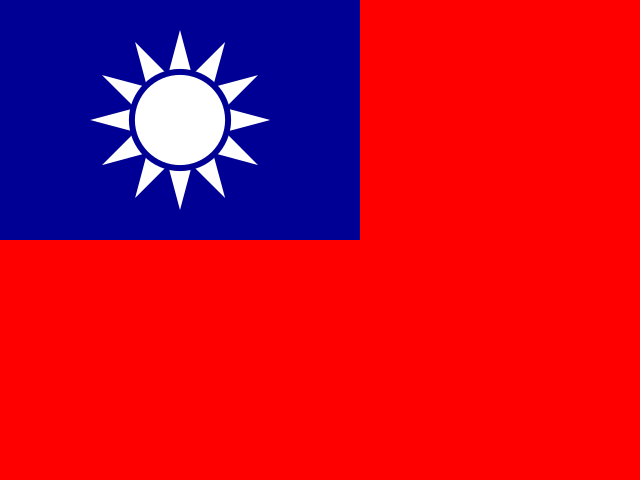
TAIWAN REAFFIRMS INDEPENDENCE DESPITE TRUMP WARNING
DOMINANT ANGLE
Berlin watches with concern Trump's decision to suspend arms sales to Taiwan as a bargaining chip against Beijing, viewing it as a weakening of Western deterrence posture in the Indo-Pacific.
Dominant angle identified — does not reflect unanimity of this country’s media
ANALYSIS
Berlin, May 16, 2026. Donald Trump's return from Beijing has placed Taiwan in an anxious waiting position. At the center of the issue: a second weapons package of approximately $14 billion, approved by the U.S. Congress in January 2025, but whose final validation remains suspended on the sole decision of the American president. "Frankly, it's a very good chip for us in negotiations," Trump declared to Fox News, making delivery dependent on "what China does."
German press, from Tagesschau to Deutsche Welle, notes the troubling symmetry between this rhetoric and Beijing's diplomatic framing: Trump has repeated the Chinese warning against any formal declaration of independence by the island, even though Taiwan President Lai Ching-te has never made such a request. "We don't want someone to say: 'Let's become independent because the United States is behind us'," the American president insisted, echoing almost word-for-word Beijing's diplomatic framework.
Faced with this ambiguity, Taipei responded with legal firmness. Vice Foreign Minister Chen Ming-chi recalled that "U.S. arms sales to Taiwan have always been a pillar of peace and stability in the region and are anchored in American law" — direct reference to the Taiwan Relations Act of 1979, which requires Washington to provide "defensive character weapons." President Lai's spokesperson Karen Kuo characterized Taiwan as a "sovereign and independent nation," adding that Beijing's military threat remains "the only destabilizing factor" in the Indo-Pacific region.
Deutsche Welle emphasizes that Xi Jinping had explicitly warned Trump during the summit: if the Taiwan question was "mishandled," the two powers could be drawn into conflict. Trump said he understood the stakes — "The last thing we need right now is a war 9,500 miles away" — but he neither confirmed nor denied delivery of military equipment. He specified he needed to first consult "the person running Taiwan," without pronouncing President Lai's name.
German coverage emphasizes the structural framework: Taiwan has been autonomous since 1949, was never part of the People's Republic founded that year, and has 23 million inhabitants under democratic governance. The first weapons package of $11 billion had been approved in December by the Trump administration; it is therefore the second tranche that remains in suspension. Secretary of State Marco Rubio reaffirmed that American policy remained "unchanged" and that "any change by force would be bad" for both parties.
KEY POINTS
- Trump conditions delivery of a $14 billion weapons package to Taiwan on Beijing's behavior, calling it a "negotiating chip" (Fox News, May 16, 2026)
- Taiwan's Vice Foreign Minister Chen Ming-chi invokes the 1979 Taiwan Relations Act to remind of America's legal obligation to provide defensive weapons to the island
- Xi Jinping warned Trump in Beijing that mishandling the Taiwan question could draw the two powers into conflict
COGNITIVE BIASES IDENTIFIED
Legal-institutional framing: German coverage systematically anchors the debate within the legal framework of the Taiwan Relations Act, at the expense of American domestic political dynamics
Preference for liberal order continuity: German media implicitly value the stability of alliances and predictability of American foreign policy against Trump's ambiguous signals
Limited coverage of direct Chinese position: Beijing's statements are reported succinctly, without in-depth analysis of Xi Jinping's strategic motivations in this power play
SOURCES (2)
Does this analysis seem accurate?