EXPLORE THIS STORY

JAPAN PERSPECTIVE
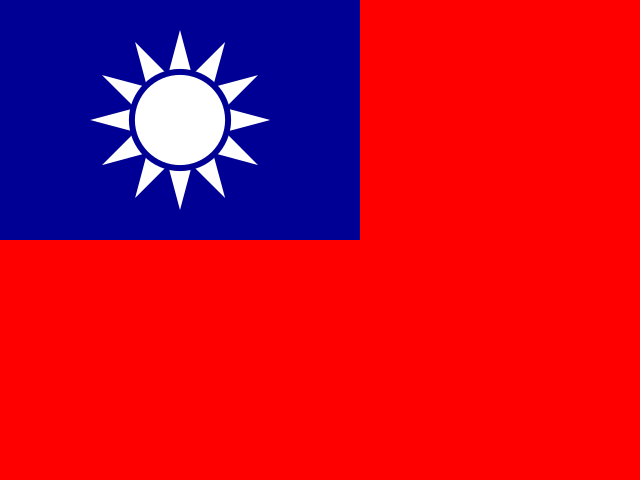
TAIWAN REAFFIRMS INDEPENDENCE DESPITE TRUMP WARNING
DOMINANT ANGLE
Tokyo watches with relief as Trump-Xi summit ends without shifting U.S. policy on Taiwan; Washington has held firm against Beijing's pressures, preserving the status quo that regional allies feared might be compromised.
Dominant angle identified — does not reflect unanimity of this country’s media
ANALYSIS
Tokyo, May 16, 2026. The Trump-Xi summit in Beijing concluded without altering Washington's official stance on Taiwan, a result that U.S. regional partners, notably Japan, had awaited with restrained anxiety. According to Kyodo News, the longstanding American formula—"not supporting" Taiwan's independence—remained intact despite Beijing's efforts to secure an explicit U.S. opposition to independence before the summit.
Secretary of State Marco Rubio, who accompanied Trump to China, told NBC News after the first day of negotiations: "U.S. policy on Taiwan is unchanged." He added that arms sales had not been a focus during discussions between the two leaders, despite Beijing's sharp objections to Washington's approval in December of a military equipment sale to Taiwan valued at over eleven billion dollars.
Trump himself, questioned aboard Air Force One after departing China, confirmed he had made "no commitments, either way," and stated in a Fox News interview that "nothing has changed" regarding U.S. policy. These assurances were well received in Tokyo, which had feared the American president might concede on Taiwan in exchange for gains in broader U.S.-China trade negotiations, according to Kyodo News.
Yet ambiguity persists. Trump cautioned Taiwan against any formal independence declaration and characterized arms sales as a "negotiating chip" in his exchanges with Beijing, according to the Japan Times. Taipei responded that the island was "already independent" and that its status was not subject to negotiation. Taiwan's Foreign Minister Lin Chia-lung expressed gratitude for continued American support and committed to ongoing cooperation with Washington and partner democracies.
Among analysts, Tai Wan-chin, professor emeritus of international relations at Tamkang University, views the outcome as "not particularly surprising." He suggests that Trump essentially heard Xi's position without directly challenging it, and that Beijing itself distrusts the consistency of the American president: "Even if he says exactly what Beijing wants, they may fear he doesn't fully grasp the distinction or that he contradicts himself the next day on Truth Social," noted Jonathan Czin, a researcher cited by Kyodo News.
For Tokyo, the stability of the Taiwan Strait remains a direct strategic priority. The preservation of the American status quo, while apparently secured in the near term, carries persistent uncertainty tied to Trump administration's transactional methods.
KEY POINTS
- The American formula of "not supporting" Taiwan independence remained unchanged after the summit, according to Secretary of State Marco Rubio (NBC News): "U.S. policy on Taiwan is unchanged"
- Arms sales to Taiwan, approved in December for over 11 billion dollars, were not a focus in Trump-Xi discussions, per Rubio's account
- Trump cautioned Taiwan against a formal independence declaration and referenced arms sales as a "negotiating chip," according to the Japan Times
COGNITIVE BIASES IDENTIFIED
Alliance-centered framing: Japanese coverage emphasizes the reassuring reading for Washington's regional partners, highlighting continuity in U.S. policy rather than points of ambiguity
Status quo preference: Japanese sources stress the preservation of existing diplomatic formulas rather than exploring the uncertainties introduced by Trump's transactional approach
Limited examination of Chinese pressures: Beijing's explicit pre-summit demands and their regional implications receive minimal development in the provided articles
SOURCES (2)
Does this analysis seem accurate?