EXPLORE THIS STORY

QATAR PERSPECTIVE
TAIWAN REAFFIRMS INDEPENDENCE DESPITE TRUMP WARNING
DOMINANT ANGLE
Doha reads the Trump-Xi summit closely and interprets Washington's statements as signaling a notable retreat from American support for Taiwan, favoring instead a tacit agreement with Beijing to preserve the status quo.
Dominant angle identified — does not reflect unanimity of this country’s media
ANALYSIS
Doha, May 16, 2026. The Trump-Xi summit in Beijing has placed Taiwan at the center of global diplomatic leverage, and Qatari media, dominated by Al Jazeera and Gulf Times, covers every nuance with particular attention to power-balance calculations. Central to the analysis is Donald Trump's explicit statement upon departing China: the president indicated he is not seeking "anyone to go toward independence" and declined to confirm that Washington would support such a move.
This statement departs from decades of American policy built on strategic ambiguity. Al Jazeera recalls that successive U.S. presidents maintained implicit support for Taiwan through arms sales and statements suggesting potential military protection. Trump openly questioned this rationale: "We're supposed to travel 15,000 kilometers to conduct a war. I'm not seeking that."
Coverage of China's perspective features prominently in Qatari media output. According to Chinese state media cited by Al Jazeera, Xi Jinping characterized Taiwan as "the most important question in China-U.S. relations," adding that mismanagement could lead "to confrontation, even conflict." This framing is presented in detail without Western counterweight, underscoring the weight Beijing assigns to the issue.
Uncertainty surrounding the 11 billion USD arms package—already approved by the U.S. Congress—occupies significant space in the coverage. Trump stated "I haven't approved it yet. We'll see what happens. I can do it. I may not do it." This phrasing is presented as a potential pressure lever in negotiations with Beijing rather than as a binding decision.
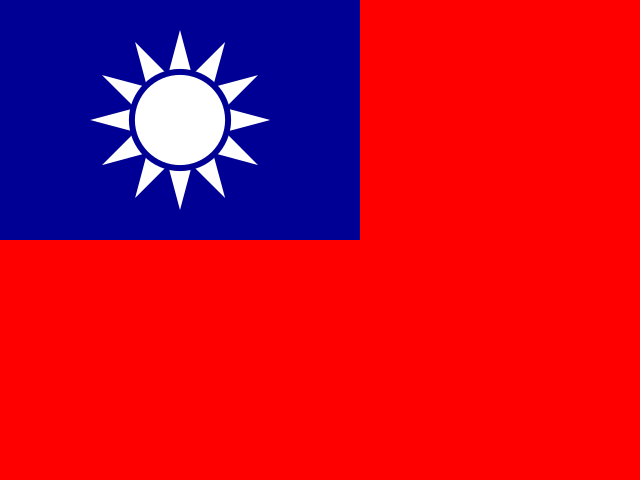
In response, Taipei issued a statement on May 17 asserting itself as a "sovereign and independent" nation while committing to preserve the status quo of cross-strait relations. Qatari media notes the tactical caution in this positioning: Taiwan asserts sovereignty without crossing the red line of formal independence declaration.
Gulf Times highlights an ancillary but telling element: Trump indicated that Xi promised not to supply military equipment to Iran and to help reopen the Strait of Hormuz—although official Chinese statements have not confirmed these commitments. Doha, as a regional actor directly affected by Gulf maritime routes, pays particular attention to this dimension.
KEY POINTS
- Trump stated upon leaving Beijing that he does not seek 'anyone to go toward independence,' without committing to Taiwan's defense
- The 11 billion USD arms package approved by Congress remains in suspension: Trump said 'I haven't approved it yet. We'll see what happens'
- Xi Jinping warned that mismanagement of the Taiwan question could push both countries 'toward confrontation, even conflict'
COGNITIVE BIASES IDENTIFIED
China-centered framing: Beijing's positions and warnings are detailed and presented without countervailing Western analysis, conferring notable editorial weight
Preference for de-escalation narrative: coverage implicitly valorizes signals of American restraint and status quo maintenance over analysis of risks to Taipei
Underrepresentation of Taiwan's civil society: reactions from Taiwan's population and domestic political actors are absent, reducing Taipei to a diplomatic negotiation object
SOURCES (2)
Does this analysis seem accurate?