EXPLORE THIS STORY

UKRAINE PERSPECTIVE
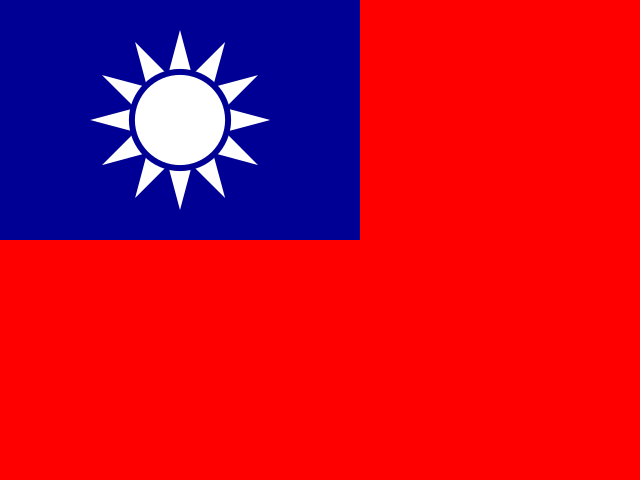
TAIWAN REAFFIRMS INDEPENDENCE DESPITE TRUMP WARNING
Single source
DOMINANT ANGLE
Kyiv closely monitors the American policy shift on Taiwan, reading it as a signal of a strategic partner reassessing security commitments under pressure from a direct adversary—a pattern Ukraine knows intimately.
Dominant angle identified — does not reflect unanimity of this country’s media
ANALYSIS
Kyiv, May 16, 2026. The two-day summit between Donald Trump and Xi Jinping in Beijing has resulted in a significant rhetorical shift by Washington toward Taiwan, covered by the Kyiv Post with particular attention to implications for American security guarantees worldwide.
Following the talks, Trump publicly warned Taipei not to seek formal independence. "I don't want anyone to declare independence," he stated on Fox News, adding: "We're supposed to travel 9,500 miles to wage war. I don't want that." The American president expressed wanting both sides to "cool" the situation and said that maintaining the status quo would satisfy Beijing.
These statements came after Xi Jinping framed Taiwan as "the most important issue" in US-China relations during bilateral discussions. The Chinese leader reportedly warned that mistakes on this matter could drive the two powers toward direct confrontation. Chinese state media widely reported these Beijing positions.
Taipei responded within hours. Taiwan's Foreign Ministry reaffirmed that the island is "a sovereign and independent nation, not subordinate to the People's Republic of China." Taipei also recalled that American arms sales constitute "a security commitment clearly stipulated by the Taiwan Relations Act" and a form of joint deterrence against regional threats.
One of the most closely watched points concerns the American defense package valued between 11 and 14 billion dollars, approved before the summit. After discussions with Xi, Trump stated he had made "no commitment either way," specifying that he would consult Taipei's leadership before deciding. In parallel, Taiwan's parliament had approved a defense budget of 25 billion dollars, with nearly 9 billion earmarked to fund this package, plus a second tranche of over 15 billion still awaiting American approval.
On the American side, Secretary of State Marco Rubio attempted to temper expectations: core US policy toward Taiwan would remain "unchanged." Trump himself confirmed that "nothing has changed" fundamentally, while having called Taiwan "a very good negotiating tool" with Beijing—a framing noted by the Kyiv Post.
For Kyiv, this saga illustrates the tension between formal guarantees inscribed in legislative texts and political signals sent by an executive undergoing strategic reorientation. Ukrainian press observes that Taipei, like other Washington partners, is forced to distinguish between the president's public statements and institutional positions held by the State Department.
KEY POINTS
- Trump stated he does not want to "travel 9,500 miles to wage war" and asked Taiwan not to seek formal independence after his Beijing summit with Xi Jinping
- An American defense package valued between 11 and 14 billion dollars is in limbo: Trump said he made "no commitment either way" following discussions with Xi
- Taiwan responded by reaffirming it is "a sovereign and independent nation" and its parliament had approved a 25 billion dollar defense budget that includes this package
COGNITIVE BIASES IDENTIFIED
Parallel Ukraine-Taiwan framing: the Kyiv Post covers the Taiwan matter through the lens of security guarantees for partners under pressure, directing interpretation toward implications for Washington allies
Preference for reliability of American commitments: coverage highlights divergences between Trump's statements and those of Rubio, amplifying uncertainty about the durability of institutional pledges
Limited coverage of Chinese positions: Beijing's arguments on sovereignty and red lines are summarized briefly, without thorough analysis of China's strategic interests in the equation
SOURCES (1)
Does this analysis seem accurate?