
DOMINANT ANGLE
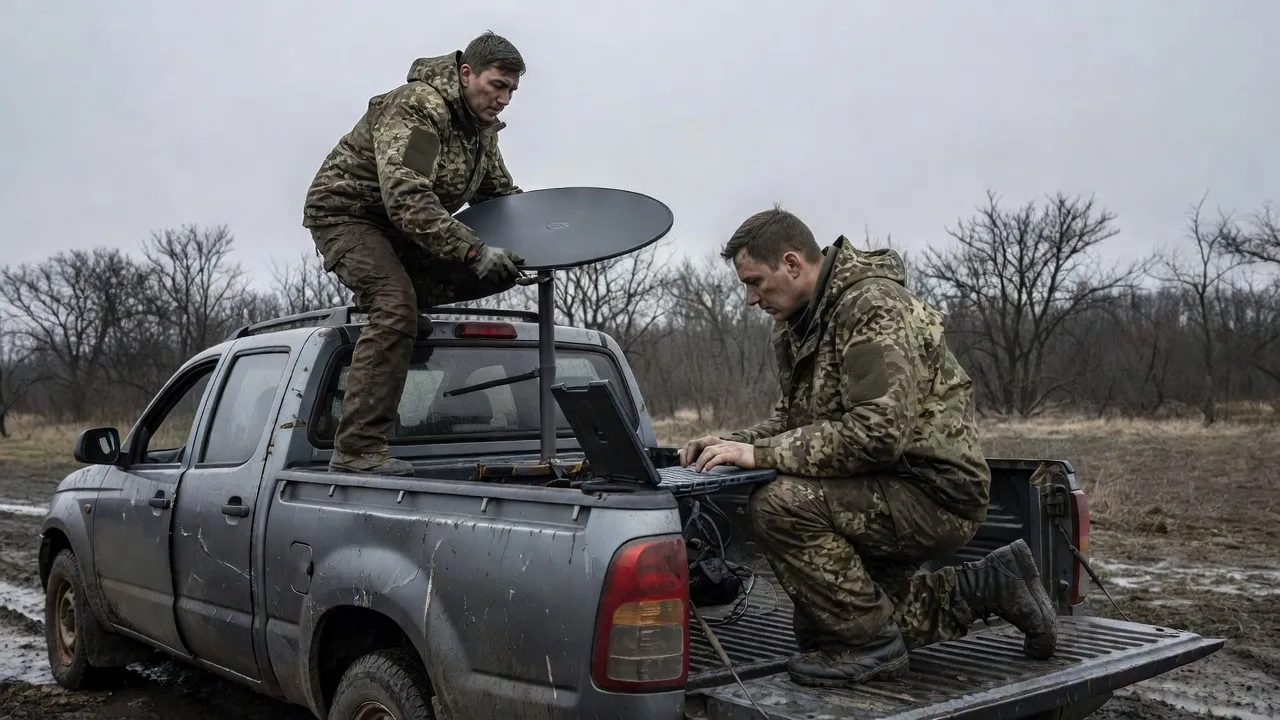
Riga is gauging the Starlink affair from the perspective of the front: Ukrainian interceptor drones remain hamstrung, regardless of what Trump says, and dependence on a private American network appears to be a security flaw.
Dominant angle identified — does not reflect unanimity of this country’s media
KEY POINTS
- 01
Trump stated on Thursday that Musk had restored Starlink, without confirming he had called him; the WSJ says he phoned Musk on Wednesday.
- 02
The restrictions, which appeared on the night of October 14, cut off the connection beyond 160 km/h; Zelensky believes that drones at 450-500 km/h can no longer be intercepted with a throttled speed of 70-100.
- 03
A representative of the Ukrainian Ministry of Defense indicated to TVNET on Friday that signal losses persisted and no lifting had been confirmed.
ANALYSIS
Riga, October 23, 2026. The Latvian press, as reported by Jauns, TVNET, and BNN, is following the Starlink case from the perspective of the battlefield: what, concretely, does the limit imposed on Starshield change for Ukrainian drones?
On Thursday, October 22, Donald Trump stated that Elon Musk had restored everything. When asked about a call to the SpaceX boss, he replied, "Nevēlos to komentēt," or "I don't want to comment," adding that the essential thing was that Musk "had restored everything." Jauns and TVNET recall that, according to the Wall Street Journal, Trump had called Musk on Wednesday to ask him to lift the Starshield restrictions, the military version of Starlink.
The Latvian media are emphasizing Kiev's denial. Volodymyr Zelensky told CNN that military communications remained limited. He described the arithmetic of interceptions: if an Iranian drone flies at 450 or 500 km/h and the speed is limited to 70 or 100 at night, "we can't intercept anything." A source cited by CNN judges the available speed to be clearly insufficient to intercept jet-powered drones. On Friday, a Ukrainian Defense Ministry official confirmed to TVNET that there had been signal losses that morning and no confirmation of the lifting of restrictions.
The Latvian account also reconstructs the chronology: the first malfunctions date back to the night of October 14, with a 160 km/h ceiling that cuts off the connection of any faster vehicle. The Telegraph and the Wall Street Journal claim that Musk himself proposed the measure and discussed it with the Pentagon, while the White House says it gave no instructions. On October 16, Trump said, "it wasn't me, I don't think it was Elon."
BNN, citing the BBC, puts the episode into the American context: Trump's pressure on Kiev to stop striking Russian refineries, easing of certain sanctions against Russia, purchase of Russian diesel, and a Republican senator's warning against dependence on Musk, ahead of the early November midterm elections. TVNET sees it mainly as a measure of the billionaire's influence, once again close to the president.
For a Baltic country neighboring Russia and attentive to drones, the lesson is one of vulnerability: an army whose interceptors depend on the goodwill of a private company and a political decision in Washington.
SOURCES (3)
- JaunsMEDIUM
- TVNETMEDIUM
- BNNMEDIUM


