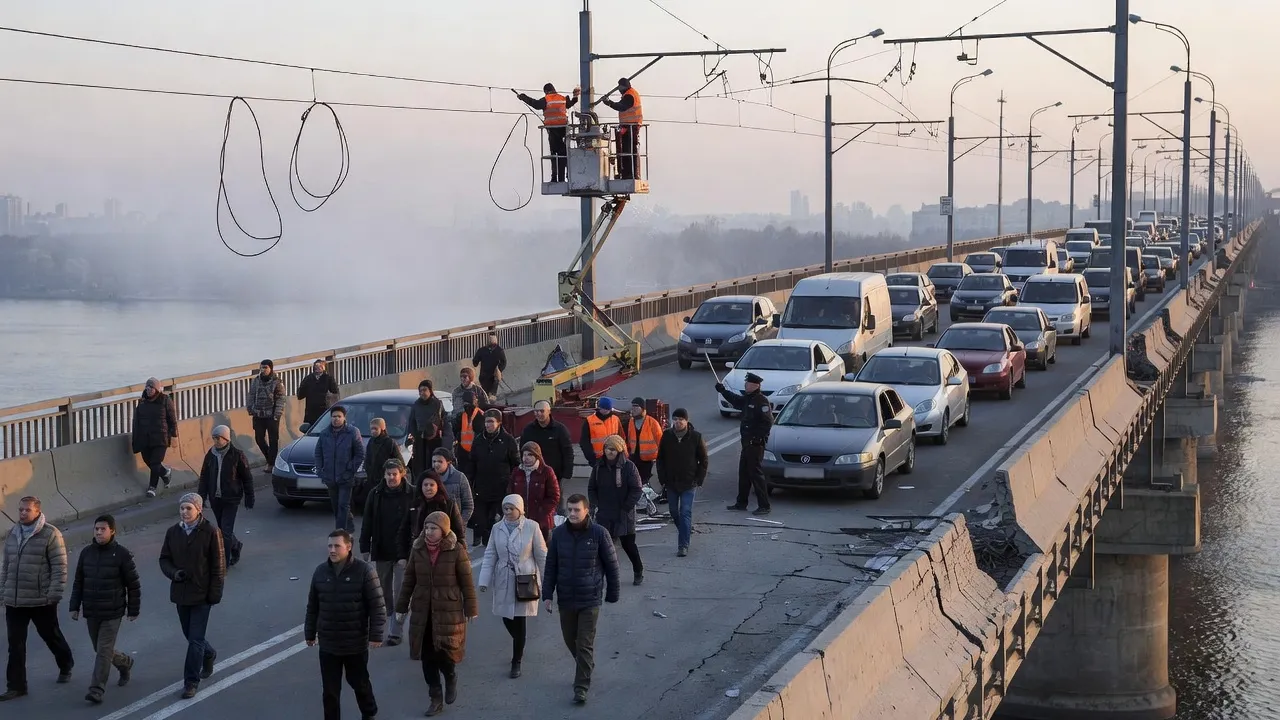
Ukraine: Russia strikes a second major bridge in Kyiv, Zelensky vows to target Russian refineries
published on
countries
sources
articles
More divergent than 12% of recent comparable stories (reference: 90 recent stories measured with the same method).
The coverage of the corpus describes less the impact of the Nord Stream bridge than what it leaves behind: a city divided by the Dnieper, two readings of the purpose of the strikes, an ultimatum already launched in May and a dreaded winter.
Pontoon crossings are announced for next week, while Moscow promises new strikes and Kiev plans to intensify those on refineries.
A city cut in two
Figures on the state of bridges come mainly from the New York Times, relayed by Ukrainska Pravda. The American daily reports six attacks on the capital's bridges between October 1 and 3, including five on the South Bridge. It notes that the closest road bridge to the south is about 145 km away and that one million inhabitants live on the left bank, which is mostly residential, while most administrations and businesses are on the right bank.
« logistical nightmare »
Meduza provides details of the damage to the South Bridge: it has lost its support, its guardrail, and part of the road, and the metro no longer runs on it. The media outlet specifies that these are, according to it, the first strikes on Kiev's bridges since the start of the war. The FAZ describes a structure of over one kilometer, which was hit, notably on its suspender cables, and estimates that Moscow can probably not destroy such structures but can cause lasting disruptions. Ukrainian experts cited by Meduza agree: drones are not enough to destroy these bridges, but they can reduce them to a state of ruin if they persist.
On the Ukrainian side, Minister Mykola Kalachnyk, interviewed by Suspilne, indicates that pontoon crossings may require up to three months of work and would offer at least half of the current capacity. A tunnel under the Dnieper is being considered in the long term, according to RMF24 and the Ukrainian press.
The human toll on the North Bridge is not consistent across all reports. The Tagesschau writes that no injuries or deaths are reported in its article; the FAZ, Svenska Dagbladet, YLE, and others report two injured, according to Mayor Vitali Klitschko.
What the strikes are aiming for
On this issue, the texts cite different sources. According to TASS, the Russian Ministry of Defense indicated on Friday, October 2, that it had hit a road and rail bridge that was crucial for the supply of Ukrainian groups in the Donbass. Vedomosti adds that it targeted the logistics center in Gostomel on Saturday, October 3. According to Expressen, Moscow also cites military-industrial sites and command centers.
« disrupt the city on a long-term basis and make it uninhabitable »
Telex reports that the Russian president stated on Thursday that the strikes against Ukrainian economic targets were in response to Ukrainian attacks on refineries and ships in the Black Sea. The Russian Ministry of Foreign Affairs, for its part, refers to a response to "terrorist acts" by the Ukrainian army, according to Cumhuriyet.
Libération, on its part, judges that the objective is "double": logistical and military pressure, but above all to durably disrupt the city. Dziennik.pl quotes a high-ranking anonymous Ukrainian official, interviewed by Reuters, who links the strikes to a decision in September lifting the restrictions on the Russian air campaign. This attribution is not confirmed by a second text in the corpus.
An ultimatum already heard
Several media outlets recall that the call from the Russian Ministry of Foreign Affairs is not new. Cumhuriyet dates a similar message to May 25, 2026, accompanied by diplomatic notes and commented on by Deputy Minister Mikhail Galuzin on May 27. RMF24 writes that 50 states had then described the call as a "threat" and that Western embassies had remained.
ARY News, which reprints AFP, notes that heads of state and government of countries supporting Ukraine had traveled to Kiev despite this warning. Expressen quotes the Russian text, which takes a tougher tone: not everyone has heeded the warnings and "deliberately puts their life in danger".
The Guardian, cited by HVG and RMF24, mentioned a possible transfer of embassies to Lviv or eastern Poland. The Ukrainian Ministry of Foreign Affairs denied this, stating it had received no notification.
The FAZ, in its live coverage, also reports that Russian projectiles, including Banderol missiles, have fallen in Moldova according to President Maia Sandu.
Refineries, winter and Lukoil
In the interview with Reuters, Volodymyr Zelensky says, according to Telex, that he sees no sign of interest from Vladimir Putin in peace talks or an energy truce. Infobae, Telex, and G4Media report that he also mentions a recapture of around 140 km² in the Donbass. The Ukrainian press relays his mentions of strikes in the Samara region and on Iskander positions in the Briansk region.
Digi24 and the Portuguese press recall that Kiev regularly strikes refineries and depots, which would have contributed to a fuel crisis in Russia this summer. For the winter, ANSA cites the New York Times: the Russian general staff would be ready to launch over a thousand missiles against the energy network. MTV Uutiset, citing the same newspaper, mentions a strike that Russia is preparing to "plunge Ukraine into darkness".
Regarding Lukoil, Digi24 specifies, according to the New York Times, that it is an oil deal worth several billion dollars that would benefit Middle Eastern businessmen linked to Jared Kushner and Steve Witkoff, and that it depends on the approval of Washington and the Kremlin. The media outlet notes that Lukoil has assets in Romania. RFI, citing the New York Times, writes that the transaction "raises serious questions of conflict of interest".
This aspect is absent from several coverage reports. The German, Swedish, Turkish, Pakistani, and Finnish texts in the corpus do not mention either the refineries or Lukoil: this measures what the selected articles contain, not the interest of their readers.
Mykola Kalachnyk, Minister of Infrastructure, announces a pontoon bridge and a river wall as early as next week.
According to Zelensky, Ukrainian intelligence documents authorize strikes on roads, schools, and hospitals.
It asserts that the Nord bridge was used for the movement of Ukrainian troops (TASS, Vedomosti).
According to the New York Times, they include the sale of Lukoil assets to close associates of Trump, Kushner, and Witkoff.
Key figures
- 5 bridges out of 6Dnieper River road bridges in Kiev have limited or interrupted traffic, according to the New York Times1 source · Ukrainska Pravda
- 600,000Vehicles crossing the Dnieper River bridges in Kiev every day, according to Minister Kalachnyk1 source · RMF24
- around 60 %Proportion of new Russian jet drones that Kiev can intercept, according to the FAZ1 source · FAZ
What the comparison reveals
Common ground and differences in coverage across the media analysed.
What the media report in common
The North Bridge in Kiev was hit on Saturday, October 3, after the South Bridge was hit in the preceding days; traffic on the Dnieper is disrupted.
The Russian Ministry of Foreign Affairs again called on diplomats and foreigners to leave Kiev and announced massive retaliatory strikes.
Where media coverage diverges
Purpose of strikes on bridges
In response to the question 'what are the strikes on Kiev's bridges aimed at?', Russian coverage reiterates the version of the Ministry of Defense (bridge used for troop movement), while French, Ukrainian, Portuguese, and Polish coverage cite Klitschko and Zelensky: paralysis of the city and civilian targets before winter.
This grouping describes the publications analysed, not the position of these countries’ populations or of their governments.
Understand the context
- OCT 1, 2026First strikes on the South Bridge of Kiev, renewed the next day
- OCT 3, 2026Strike on the North Bridge; Moscow renews its call for foreigners to leave Kiev
How each country reads it
Preview: 3 of 14 media perspectives. Syntheses of the media analysed — not direct quotations. Method & limitations
 Germany
Berlin sees the strikes on Kiev's bridges as a targeted escalation of the air war, where drone technology and the paralysis of the city dominate the narrative.
2 sources · View sources
 Argentina
Buenos Aires is deciphering an infrastructure war: after the northern bridge in Kiev, Russia promises massive strikes and Zelensky responds with Russian refineries.
2 sources · View sources
 Finland
Helsinki is primarily concerned about Moscow's ultimatum to foreigners in Kiev and the threat of massive strikes, fearing a winter without energy for Ukraine.
3 sources · View sources
The full text, country by country
Germany
DOMINANT ANGLE
Berlin sees the strikes on Kiev's bridges as a targeted escalation of the air war, where drone technology and the paralysis of the city dominate the narrative.
KEY POINTS
- The North Bridge in Kiev was hit on Saturday, October 3, after the South Bridge was struck on Thursday and Friday; three of the six road bridges over the Dnieper were already out of service the day before (Tagesschau).
- Kiev can intercept only about 60% of the new Russian jet drones, according to the FAZ.
- Moscow again called on foreigners and diplomats to leave Kiev, citing a "mortal danger" (FAZ, direct).
ANALYSIS
Berlin, October 4, 2026. In the German press, the strike on the North Bridge of Kiev, on Saturday, October 3, is seen as part of a systematic campaign against the infrastructure of the Ukrainian capital. Tagesschau reports that Russia "beschießt erneut" a bridge in Kiev, a day after attacks that had rendered three of the six road bridges over the Dnieper totally or partially impassable. According to Mayor Vitali Klitschko, the road and trolleybus lines were damaged and traffic was interrupted, with congestion for the third consecutive day. The public channel specifies that no injuries or fatalities have been reported, and that videos of the impact posted on social media have not been verified.
The FAZ, for its part, reports two injured and an attack drone hitting the North Bridge on Saturday morning. The daily recalls that Russia struck the South Bridge on Thursday and Friday, including its suspension cables, and that this structure, over a kilometer long and also carrying a metro line, has been closed since. It judges that Moscow can probably not destroy these massive structures, but is causing damage and lasting disruptions. Many residents live on the left bank and cross every day: local media spoke on Friday of a "collapse of traffic", and images showed pedestrians crossing the bridges on foot.
On the military front, the Russian Ministry of Defense claims, as quoted by Tagesschau, that the bridge facilitates "the movement of Ukrainian troops and the transport of military goods". The FAZ sees these shots as part of the "escalation of the Russian air war" of recent weeks and devotes an article to the new jet drones, which Kiev can only intercept about 60% of the time.
The FAZ live feed also relays the new warning from the Russian Ministry of Foreign Affairs, which again urged foreigners and diplomats to leave Kiev, or else they would be exposed to "mortal danger". It also reports that Russian projectiles, including Banderol missiles, have fallen in Moldova, according to President Maia Sandu, which broadens the focus to the southern flank of Europe. The statements by Volodymyr Zelensky on Russian refineries and the oil aspect of US-Russian discussions are not addressed in the provided articles.
Argentina
DOMINANT ANGLE
Buenos Aires is deciphering an infrastructure war: after the northern bridge in Kiev, Russia promises massive strikes and Zelensky responds with Russian refineries.
KEY POINTS
- The North Bridge in Kiev was hit on Saturday, October 3, after two attacks on Thursday and Friday against the southern bridge, according to La Nación.
- The Russian Ministry of Foreign Affairs urges diplomats and foreigners to leave Kiev and announces "massive retaliatory attacks".
- Zelensky announces the intensification of strikes against Russian refineries in response to a "new doctrine" from Putin, without targeting civilians.
ANALYSIS
Buenos Aires, October 4, 2026. The Argentine press is following the escalation around Kiev through two converging narratives, those of La Nación and Infobae, which focus their analysis on the military logic of the strikes and the cross threats.
According to La Nación, a strike hit the North Bridge of Kiev on Saturday, October 3, "the second bridge bombed this week", after two attacks on Thursday and Friday against a key road passage in the south of the capital. The newspaper specifies that the Russian Ministry of Defense claimed responsibility for the operation, stating that the structure serves to "facilitate troop movements and logistics". The mayor of Kiev indicated on Telegram that the North Bridge is one of the eight structures that cross the Dnieper.
La Nación also highlights the call from the Russian Ministry of Foreign Affairs to "foreign citizens and diplomats" to leave the city, accompanied by the promise of "massive retaliatory strikes" against "military targets in Kiev and other Ukrainian cities". The daily recalls that a similar call was made in May without Western chancelleries withdrawing their personnel. It mentions almost daily waves of drones, including jet-powered models that are more difficult to intercept, while Ukraine lacks anti-aircraft defense systems.
Infobae, reprising Zelensky's interview with Reuters, focuses on the Ukrainian response. The president asserts that intelligence has obtained documents proving that Vladimir Putin has issued a "new doctrine" of strikes against a much wider range of civilian targets before winter: "infrastructure, logistics, roads, schools, hospitals", in order to push the population to leave the capital. Ukraine will therefore intensify its strikes on Russian refineries, without targeting civilians. Zelensky attributes this change to Putin's desire to show his strength while his army is losing ground and suffering more losses.
Infobae adds that Ukraine claims to have retaken approximately 140 km² in the Donbass during the "Vivaldi" counteroffensive, a region over which Moscow demands total control as a condition for any peace agreement. The Kremlin was not available for comment on Saturday, and the newspaper notes that both sides deny targeting civilians.
The two texts leave out of the picture the pontoon bridges announced by Kiev and the US-Russian discussions on Lukoil, which are absent from the Argentine corpus used.
Finland
DOMINANT ANGLE
Helsinki is primarily concerned about Moscow's ultimatum to foreigners in Kiev and the threat of massive strikes, fearing a winter without energy for Ukraine.
KEY POINTS
- The Russian Foreign Ministry is calling on diplomats and foreigners to leave Kiev and is promising "massive" strikes (YLE, MTV).
- The North Bridge in Kiev was hit: the road and electric bus cables were damaged, two injured (YLE).
- According to Ukrainian authorities cited by HS via the Kyiv Independent, at least eight civilians were killed and more than 80 injured in twenty-four hours.
ANALYSIS
Helsinki, October 4, 2026. The Finnish press is treating the episode mainly through the Russian warning, more than the state of the bridges. YLE and MTV Uutiset lead with the call from the Russian Ministry of Foreign Affairs: diplomats and other foreigners should leave Kiev. Moscow promises "massive" strikes and claims that those who stay "will themselves bear the responsibility for the consequences".
On Saturday, October 3, in the morning, Russia struck the North Bridge of the capital, according to YLE. The impact damaged the road and the overhead electric bus cables; two people were injured. Finnish articles from the pool do not mention the South Bridge hit in previous days, nor the restricted traffic on five of the city's six road bridges.
Helsingin Sanomat broadens the picture by citing Reuters and the Kyiv Independent. According to Ukrainian authorities, at least eight civilians were killed and more than 80 injured in 24 hours in the country, particularly in the Odessa, Sumy, and Kharkiv regions. In Odessa, a strike hit a foreign-flagged ship in the port: one dead, three injured. The newspaper notes that Moscow presents its strikes on cities as retaliation for Ukrainian attacks on Russian territory, and that, according to Reuters, both sides deny targeting civilian targets.
The fear of a winter without energy structures the rest of the coverage. MTV refers to a New York Times article stating that Russia is preparing its strongest strike to date, with the goal of "plunging Ukraine into darkness". HS recalls that the same American newspaper reported on Friday that Moscow is considering the complete destruction of Ukraine's energy system.
The tone remains that of the dispatch: no editorial or official Finnish reaction in these texts. Volodymyr Zelensky's announcements about Russian refineries and US-Russian discussions related to Lukoil are not mentioned; attention is focused on the threat to Kiev and its inhabitants.
 France
DOMINANT ANGLE
Paris is deciphering the battle for Kiev's bridges in terms of its consequences for civilians: a capital cut in two by the Dnieper, where the Russian call for foreigners to leave weighs on daily life.
KEY POINTS
- The North Bridge in Kiev was hit on Saturday, October 3, after the South Bridge was struck on Thursday and Friday; the road and trolleybus cables were damaged, according to Mayor Vitali Klitschko.
- The Russian Foreign Ministry again called on diplomats and foreigners to leave Kiev, promising "massive retaliatory strikes".
- Zelensky claims that Putin has adopted a "new doctrine" targeting more civilian targets before winter and announces an intensification of strikes on Russian refineries.
ANALYSIS
Paris, October 4, 2026. For the French press, the central information is the strike, on Saturday, October 3, of the North Bridge of Kiev, the second major structure hit after the South Bridge, which was struck by Russian drones on Thursday and Friday. Mayor Vitali Klitschko wrote on Telegram: "The North Bridge has been hit. Emergency services are on their way." According to him, the road and trolleybus cables are damaged and traffic is cut off in the direction from the left bank to the right bank of the Dnieper. Le Monde reports two injured, one of whom is hospitalized.
France 24 and HuffPost France emphasize the geography: Kiev has feared attacks on its eight main road and rail bridges since 2022, "essential infrastructure for the logistics of the capital." HuffPost adds that the city hall has limited traffic on the Paton and Metro bridges, and AFP has observed restrictions on the Darnytsky Bridge. On Friday, "gigantic" traffic jams paralyzed a large part of the city.
The human aspect dominates. RFI, through the voice of its correspondent Emmanuelle Chaze, describes public transportation that operates "at the mercy of the opening or closing of bridges" and a city center that is emptying. Libération talks about "civilians trapped in the battle of the bridges" and judges that the Russian objective is to "durablely disrupt the city." Le Monde collects the testimony of Olga, a refugee from Crimea: "we are now used to explosions."
The Russian Ministry of Foreign Affairs has again called on diplomats and foreigners to leave Kiev. According to its statement, reported by RFI and 20 Minutes, "the responsibility for any negative consequences lies entirely with those who ignore this warning," and Russian forces "will continue to carry out massive retaliatory strikes" against "military targets." Klitschko judges the situation "extremely dramatic" and accuses Moscow of "devastating" the city; 20 Minutes recalls that the authorities fear the winter and new strikes on energy, as in 2025.
Le Monde also reports on Volodymyr Zelensky's interview on Saturday: Ukrainian intelligence would have obtained documents showing a "new doctrine" by Vladimir Putin aiming at a wider range of civilian targets before winter, and Ukraine will intensify its strikes on Russian refineries. On Sunday, RFI relays the New York Times on the sale of Lukoil's assets to close associates of Donald Trump, a transaction that "raises serious questions of conflict of interest."
 Hungary
DOMINANT ANGLE
Budapest is first focusing on the military escalation: the Hungarian press is following the war on infrastructure, from Kiev's bridges to Russian refineries, through the statements of Zelensky and Klitschko.
KEY POINTS
- The North Bridge in Kiev was hit overnight Friday to Saturday: two injured, roadway and trolleybus cables damaged, according to Klitschko as cited by Telex.
- The Russian Foreign Ministry again called on diplomats and foreigners to leave Ukraine and promised "massive retaliatory strikes" (HVG, via MTI).
- Zelensky tells Reuters that Ukraine will double its strikes against Russian refineries in response to a new Russian "doctrine" targeting civilian targets.
ANALYSIS
Budapest, October 4, 2026. Hungarian media outlets Telex and HVG are treating the strike on the North Bridge of Kiev as a turning point in the war. According to Telex, which cites Mayor Vitali Klitschko on Telegram, a Russian strike hit the bridge on Friday night: two people were injured, the road and trolleybus cables were damaged, and the bridge was closed to traffic. The site notes that the two bridges over the Dnieper River connecting the western and eastern parts of the capital had not been hit until Thursday, and that both were hit in a matter of days, which, it writes, "marks a further escalation" by the Russian side. The South Bridge had been hit by two drones, near a full metro train.
Telex also reports Moscow's version: its drones allegedly targeted two bridges used for the movement of Ukrainian troops and military convoys. Russian President Vladimir Putin stated on Thursday that strikes against Ukrainian economic targets were in response to Ukrainian attacks on refineries and ships in the Black Sea. Zelensky said, after the strike on the South Bridge, that there were "no longer any rules".
HVG details the urban consequences: public transportation almost paralyzed, traffic jams, two other bridges closed as a precaution, residents crossing on foot. It relays a warning from the Russian Ministry of Foreign Affairs, via the MTI agency, of "massive retaliatory strikes" and a call for diplomats and foreigners to leave Ukraine. It mentions information from The Guardian about possible transfers of embassies to Lviv or eastern Poland, denied by the Ukrainian Ministry of Foreign Affairs.
The second part, published by HVG and Telex on October 3, is Zelensky's interview with Reuters. In it, he claims that Ukrainian intelligence has seen documents authorizing strikes against logistics, roads, schools, and hospitals to push the population to leave cities. Ukraine will "double" its strikes against Russian refineries, but, he specifies, "unlike them, we do not respond with attacks on civilian targets". Telex adds that Zelensky says he has no sign of Putin's interest in peace talks or an energy truce, and that Ukraine has retaken approximately 140 km² in the Donetsk basin. The provided articles do not discuss US-Russian talks or Lukoil.
 Italy
Italy
DOMINANT ANGLE
Rome is watching the Kiev bridge war as a test of the home front's resilience ahead of a winter in which Moscow would target the power grid and infrastructure.
KEY POINTS
- The Russian Foreign Ministry acknowledges striking the Severny (North) road bridge in Kiev with drones, two days after the strikes on the South bridge.
- According to La Repubblica, the Pivdennyi bridge is fundamental for the travel of 900,000 people and was hit by several waves of drones in 48 hours.
- ANSA cites the New York Times: the Russian General Staff is reportedly ready to launch over a thousand missiles against the energy network before winter.
ANALYSIS
Rome, October 4, 2026. The Italian press dedicated its Saturday, October 3, coverage to the infrastructure war around Kiev. ANSA reported that the Russian Ministry of Foreign Affairs acknowledged having struck the Severny road bridge, over the Dnieper, namely the North Bridge of the capital, with drones during the night. Moscow claimed that the structure facilitates the movement of Ukrainian troops and the delivery of military supplies. Mayor Vitali Klitschko confirmed the strike on Telegram: "The North Bridge has been hit. Emergency services are arriving." The South Bridge had been targeted two days earlier, multiple times.
In a second article, the agency described a "race against time" between Vladimir Putin and Volodymyr Zelensky to see who would first undermine the population's morale, the "home front". It wrote that the capital is now "cut in two" and that the Kremlin is "unleashed", with Zelensky having warned that the order has been given to lift all brakes. ANSA linked these strikes to the upcoming winter: according to the New York Times, the Russian General Staff is ready to launch over a thousand missiles against the energy network, and Zelensky, who claims to have Russian documents, stated that Moscow wants to "force" Ukrainians to "abandon" Kiev and other cities. No truce is in sight.
The Russian Ministry launched a new appeal to diplomats and foreigners to leave Kiev, announcing new "massive" attacks, according to askanews, as reported by Libero Quotidiano. The daily added its own judgment: the war, which is entering its fifth year, would be "the tangible demonstration of the Russian defeat" on strategic and diplomatic levels.
La Repubblica focused on urban vulnerability. The Pivdennyi Bridge connects the two halves of Kiev, with the metro and six lanes, and is "fundamental for the movement of 900,000 people". Its 1,200 meters rest on a single large pillar, hit in 48 hours by several waves of drones, including the new Geran 5 jet-powered drones. The title announced "the toughest winter": Moscow is now targeting bridges and the electrical network.
The Italian account remained centered on the threat to the population and the holding of the home front. The American-Russian aspect and the Ukrainian response to the refineries did not appear in the compiled articles.
 Pakistan
DOMINANT ANGLE
Islamabad reports, through news agency dispatches, the infrastructure war that is disrupting Kiev: two bridges hit in a matter of days and a new ultimatum from Moscow to foreign diplomats.
KEY POINTS
- The North Bridge in Kiev was hit on Saturday, October 3, a day after the South Bridge; two people were injured, according to Mayor Vitali Klitschko.
- The South Bridge, one of the eight crossings between the two banks, was closed on Friday, causing major traffic jams in the capital.
- The Russian Ministry of Foreign Affairs again called on diplomats and foreigners to leave Kiev, announcing new "massive" attacks.
ANALYSIS
Islamabad, October 4, 2026. Pakistani media is covering the escalation around Kiev with dispatches from AFP, relayed by Business Recorder and ARY News. The story is centered on the bridges of the Ukrainian capital and Moscow's warning to foreigners.
According to Business Recorder, a Russian strike hit the North Bridge on Saturday, October 3, following the strike on the South Bridge the day before. Mayor Vitali Klitschko wrote on Telegram: "Northern Bridge has been hit." He specified that the road and trolleybus cables were damaged and that traffic from the left bank to the right bank was blocked. ARY News adds that the attack injured two people and that AFP reporters saw signs of an explosion on a pedestrian walkway, as well as technicians repairing power lines.
The economic daily describes the effects on the daily lives of residents. On Friday, authorities closed the South Bridge, one of the eight crossings connecting the two parts of the city, and restricted traffic on another after a wave of jet drones. Long lines of cars and buses blocked the main roads, and some users had to continue on foot. Klitschko judged that the capital must now be "on a war footing" and that the enemy was "tearing Kyiv apart".
ARY News highlights the call from the Russian Ministry of Foreign Affairs, which again asked diplomats and foreigners to leave Kiev and refrain from traveling to Ukraine. Moscow announces new "massive" air strikes and claims that "the responsibility for any negative consequences lies entirely with those who ignore this warning". The dispatch recalls that a similar warning was issued in May and that heads of state and government from countries supporting Ukraine visited Kiev despite this.
The two texts place the episode in a war that began with the large-scale invasion in February 2022, mainly concentrated in the east, with Kiev having been largely spared until now. ARY News also notes that Volodymyr Zelensky accuses Vladimir Putin of trampling the rules of armed conflict. The provided articles contain no official reaction from Islamabad and do not address the Ukrainian response to Russian refineries or US-Russian discussions.
 Poland
DOMINANT ANGLE
Warsaw is deciphering the infrastructure war: Kiev bridges targeted, pontoons urgently deployed, and a Ukrainian counterattack announced against Russian refineries.
KEY POINTS
- According to Kalachnyk (RMF24), 600,000 vehicles cross the Dnieper River bridges in Kiev every day; a river wall and a pontoon bridge are to be launched as early as next week.
- Zelensky claims that Ukrainian intelligence has seen documents authorizing strikes on roads, schools, and hospitals to push residents to leave Kiev; the Kremlin has not commented.
- The Russian Ministry of Foreign Affairs has called on foreigners to leave Ukraine; Kiev has denied a Guardian article about a possible transfer of embassies to Lviv or Poland.
ANALYSIS
Warsaw, October 4, 2026. For the Polish press, the strikes on the bridges of Kiev mark a change in method. RMF24 reports that Russia attacked the North Bridge on Saturday, October 3, a day after a drone strike on the South Bridge, which carries one of the three metro lines of the capital. Dziennik.pl specifies that the road and trolleybus network of the North Bridge were damaged and that, according to Mayor Vitali Klitschko, traffic from the left bank to the right bank has been closed.
The South Bridge is closed in both directions, while traffic is limited on the Paton Bridge and the Metro Bridge. RMF24 cites Minister Mykola Kalachnyk, quoted via Suspilne: the priority is to protect the bridges, and a river protection wall and a pontoon bridge are set to start next week. The minister indicates that 600,000 vehicles cross the Dnieper bridges every day. In the long term, a tunnel is being considered, which would require investment and foreign partners.
The Polish account links these strikes to an order from Vladimir Putin. Dziennik.pl quotes a high-ranking Ukrainian official, interviewed by Reuters, who attributes them to a decision in September lifting restrictions on the Russian air campaign. Klitschko judges the situation "very dramatic". RMF24 relays Volodymyr Zelensky: Ukrainian intelligence would have obtained documents authorizing strikes on "infrastructure, logistics, roads, schools, hospitals" to push residents to leave the capital. According to him, Putin wants to show strength while his army is losing ground. The Kremlin has not commented on this information.
The response is presented as symmetrical but limited. Zelensky announces the intensification of strikes on Russian refineries, "they provide them with the means for this war", while ensuring that Kiev will not attack civilian targets.
One aspect directly affects Poland. The Russian Ministry of Foreign Affairs has again called on foreigners and diplomats to leave Ukraine, particularly Kiev, and promises "systematic and uninterrupted" strikes on "military targets". RMF24 recalls that 50 states had qualified a similar call in late May as a "threat" and that Western embassies had stayed. Kiev has denied a Guardian article mentioning a possible transfer of missions to Lviv or Poland, stating that it had received no notification.
 Portugal
DOMINANT ANGLE
Lisbon highlights the human and daily cost of the escalation over Kiev: bridges hit, foreigners invited to leave and fear of a winter of attacks on infrastructure.
KEY POINTS
- Two bridges in Kiev were hit by drones in 24 hours, according to RTP News.
- The Russian Ministry of Foreign Affairs again asked diplomats and foreigners to leave Kiev and announced "massive retaliatory strikes".
- Klitschko described the situation as "extremely dramatic" and Ukraine is described as regularly attacking Russian refineries, which has contributed to a fuel crisis in the summer.
ANALYSIS
Lisboa, October 4, 2026. The Portuguese press is following the escalation over Kiev mainly through the prism of the cost to the population and the warning addressed to foreigners. RTP Notícias reports that two bridges in the Ukrainian capital were hit by drones in 24 hours and recalls that Moscow warned diplomats and foreign citizens that they are at risk. According to the broadcaster, the threat repeats the one made in May, but comes at a time when Russian bombings are increasing. The Ukrainian president, RTP writes, says that Russia wants to make it impossible to live in Kiev.
The Jornal Económico and SAPO Notícias, which publish the same dispatch, detail the statement from the Russian Ministry of Foreign Affairs. Moscow has again asked diplomats and foreigners to leave the city and announced that its forces will continue to carry out "mass retaliatory attacks" against "military targets in Kiev and other Ukrainian cities". The Russian text adds that responsibility for any consequences "falls entirely on those who ignore this warning".
The newspapers quote the mayor of Kiev, Vitaly Klitschko, who described the situation on Friday as "extremely dramatic" and said that Moscow is "devastating" the city by systematically attacking its infrastructure and logistics. The attacks have hit bridges and caused major traffic congestion, which poses the problem of daily mobility in a city divided by the Dnieper.
The horizon projected by the press is that of Winter. The Ukrainian authorities fear, above all, the arrival of a critical period in which Russia may strike a severe blow against the country's energy infrastructure, "as happened in 2025". The coverage also notes, in contrast, that Ukraine regularly attacks refineries and oil depots in Russia, which has helped trigger a fuel crisis this summer, as well as commercial warehouses and cargo ships.
In the Portuguese texts, the diplomatic dimension and ongoing negotiations are left out of the account: the focus is on the bridges, the warning to foreigners, and the fear of Winter, with the economic reading limited to the effect of the attacks on Russian refineries.
 Romania
DOMINANT ANGLE
Bucharest is deciphering an infrastructure war: the bridges of Kiev and the Russian ultimatum to foreigners on one side, the targeted Russian refineries on the other, with an eye on the Romanian assets of Lukoil.
KEY POINTS
- On Saturday, October 3, the Russian Foreign Ministry again called on diplomats and foreigners to leave Kiev, promising "massive retaliatory attacks" (AFP via Digi24 and G4Media).
- Zelensky told Reuters that Ukraine would step up its strikes on Russian refineries in response to a "new doctrine" from Putin, and mentioned around 140 km² retaken in the Donbass (G4Media).
- According to the New York Times as reported by Digi24, US-Russia talks include a multibillion-dollar oil deal involving Lukoil, a group that also holds assets in Romania.
ANALYSIS
Bucharest, October 4, 2026. Romanian media, led by Digi24 and G4Media, are reporting on the escalation around Kiev, framing it as a war on infrastructure, citing dispatches from news agencies (AFP, Reuters, New York Times).
On Saturday, October 3, according to AFP as cited by Digi24 and G4Media, Russia once again called on diplomats and foreigners to leave Kiev. Its Ministry of Foreign Affairs is threatening "massive retaliatory attacks" on "Kiev's and other Ukrainian cities' military targets" and adds that those who ignore this warning will be "fully responsible for the consequences". The two outlets note that the capital has been under attack for weeks, with the strikes mainly targeting bridges, causing "major traffic jams".
Digi24 reports on the comments of Mayor Vitali Klitschko, who on Friday described the situation as "extremely dramatic" and stated that Moscow is "devastating" the city by systematically attacking its infrastructure and logistics. Ukrainian authorities are bracing for winter, a period when Russia could heavily target the energy grid, as it did in 2025.
G4Media, citing Mediafax, details an interview given by Volodymyr Zelensky to Reuters. The Ukrainian president claims to have seen intelligence documents showing a "new doctrine" by Vladimir Putin, which would allow for attacks on "infrastructure, logistics, roads, schools, hospitals" to push the population to leave the capital. He announces that Ukraine will intensify its strikes on Russian refineries and mentions a counter-offensive in the Donbass that has allowed for the recapture of around 140 square kilometers. Digi24 recalls that Kiev is already regularly striking refineries and depots, which led to a fuel crisis in Russia this summer.
Digi24 also dedicates an article to a New York Times report: US-Russia discussions on ending the war include a multibillion-dollar oil deal involving Lukoil, which would benefit Middle Eastern businessmen linked to Jared Kushner and Steve Witkoff. The media outlet highlights to its readers that Lukoil has assets "including in Romania". The article specifies that the deal depends on approval from Washington and the Kremlin.
 Russia
DOMINANT ANGLE
Moscow presents the strikes on Kiev's bridges as blows to Ukraine's military logistics and announced reprisals, while the independent Russian press details the damage and civilian cost.
KEY POINTS
- The Defense Ministry claims the Nord bridge struck on October 3 was used for the movement of Ukrainian troops (TASS, Vedomosti).
- The Foreign Ministry has again urged foreigners and diplomats to leave Kiev, citing "massive retaliatory strikes" (Vedomosti).
- Meduza notes that these are the first strikes on Kiev's bridges since the start of the war, with two injured on the Nord bridge.
ANALYSIS
Moscow, October 4, 2026. The Russian press, both official and independent, is treating the strikes on Kiev's bridges as an episode in the logistical war. According to the TASS agency, the Russian Ministry of Defense announced on Friday, October 2, that it had hit a road and rail bridge over the Dnieper River, which Ukrainian groupings in the Donbass depended on for their supplies. On Saturday, October 3, the North Bridge, described as "a route used by the Ukrainian armed forces to move troops," was also targeted, as was the Gostomel logistics center, according to Vedomosti.
Russian media are heavily relying on The New York Times. TASS and RIA Novosti are using its formula of a "logistical nightmare" for Kiev: the attacks "could weaken the load-bearing structures" and lead the authorities to close the bridges for an indefinite period. RIA adds that, according to the American daily, drones are now buzzing over the capital for entire days, with almost continuous alerts, and notes that residents are massively leaving the city, with the supply of rental housing rapidly increasing.
Meduza, an independent media outlet, provides material details: the South Bridge, hit by drones on October 1 and 2, lost its support, its slide, and part of the roadway, and metro traffic has been interrupted. The North Bridge suffered damage to the roadway and trolleybus lines, with two injured, according to Mayor Vitali Klitschko. Meduza specifies that these are the first strikes on Kiev's bridges since the start of the war and cites Ukrainian experts who say that drones are not enough to destroy these structures but can bring them to a state of ruin if they persist.
The Ministry of Foreign Affairs has again called on foreigners and diplomats to leave Kiev, promising "massive retaliatory strikes" in response to what it calls "terrorist acts" by the Ukrainian army against the civilian population and Russian infrastructure. It recalls its warnings of May 25 and states that "the responsibility for the consequences lies entirely with those who ignore this warning."
The Moscow Times reports on Volodymyr Zelensky's interview with Reuters: Ukraine will intensify its strikes on Russian refineries in response to a "new doctrine" that Vladimir Putin is said to have adopted, without targeting civilians. The Kremlin was not available for comment, and the newspaper notes that both sides deny targeting civilians. The state media outlets provided do not address this doctrine, the refineries, or Lukoil.
 Sweden
DOMINANT ANGLE
Stockholm is deciphering the Russian campaign against Kiev's bridges as a security escalation aimed at cutting the capital in two, and is particularly relaying Moscow's warning to foreign diplomats.
KEY POINTS
- The North Bridge in Kiev was targeted by Russian drones on Saturday, October 3; according to Vitali Klitschko, two people were injured (Svenska Dagbladet).
- This is the third consecutive day of strikes on Kiev's bridges; on Friday, three bridges were completely or partially closed (Sveriges Radio).
- The Russian Ministry of Foreign Affairs urges diplomats and foreigners to leave Kiev and promises "massive retaliatory strikes" (Expressen).
ANALYSIS
Stockholm, October 4, 2026. The Swedish press is treating the strikes on the bridges of Kiev as a direct military escalation against the Ukrainian capital. Svenska Dagbladet reports that the North Bridge (Pivnichnyi) was attacked by Russian drones early on Saturday, October 3. Mayor Vitali Klitschko wrote on Telegram that two people were injured. The newspaper specifies that the road was damaged and traffic from the west bank to the east bank remained blocked. This is, according to the newspaper, the "third consecutive day" that Russia has targeted one of the eight major bridges connecting the two banks of the Dnieper.
Sveriges Radio, citing AFP, recalls that the day before, three bridges had been completely or partially closed, causing traffic chaos. The public radio places at the top of its story Russia's call for diplomats and foreigners to leave Kiev, accompanied by the threat of "massiva anfall", massive attacks.
Expressen details the message from the Russian Ministry of Foreign Affairs, which toughens a warning issued in May: "Not everyone has listened to the warnings and is deliberately putting their life in danger." According to the Kremlin, the targets are bridges used to transport weapons to the front, military-industrial sites, and command centers. The ministry promises that the armed forces will carry out "massive retaliatory strikes" and places the responsibility for the consequences on those who ignore the warning.
Citing The Guardian, Expressen broadens the picture: in one week, Russia has also hit a school, a hospital, a data center, and energy facilities, leaving several neighborhoods without electricity. Concern about the winter has given way to a sharper fear of missiles and jet drones. Klitschko says that "the enemy is tearing Kiev in two" and that one can no longer pretend to live in peacetime. Volodymyr Zelensky believes that the Russians want to drive Ukrainians out of the capital, and that one must not give in to this pressure.
The articles in the Swedish corpus focus on the bridges, traffic, and Russian ultimatum. They do not address the announced response by Kiev against Russian refineries, nor the US-Russian negotiations.
 Turkey
DOMINANT ANGLE
Ankara is first concerned about the fate of a capital that the Dnieper risks cutting in two and the Russian warning addressed to diplomats and foreigners.
KEY POINTS
- According to Vitali Klitschko, the strike on Saturday, October 3, injured two people and damaged the road and trolleybus lines of Kiev's North Bridge, after drone attacks on the South Bridge.
- Russian attacks have cut off road, rail, and trolleybus links across the Dnieper, and most of the roughly three million inhabitants rely on the metro (BBC Türkçe).
- The Russian Ministry of Foreign Affairs again called on foreigners and diplomats to leave Kiev on Saturday, October 3, and announced large-scale retaliatory strikes (Cumhuriyet).
ANALYSIS
Ankara, October 4, 2026. Turkish media outlets are covering the strike on the North Bridge in Kiev from the angle of its consequences for residents and foreigners present in the Ukrainian capital.
BBC News Türkçe reports, according to Mayor Vitali Klitschko, that the attack on Saturday, October 3, in the morning injured two people and damaged the road and trolleybus lines on the North Bridge. This comes after repeated drone strikes on the South Bridge earlier in the week. Klitschko states that "the enemy is tearing Kiev apart." The media outlet notes that the two bridges over the Dnieper River, which connect the western and eastern parts of the city, had not been attacked before Thursday. Traffic on the North Bridge has been closed in one direction, and emergency services have been dispatched to the scene.
The account highlights daily life: the strikes have cut off road, rail, and trolleybus links over the river, and the ongoing threat of drones is causing restrictions on other routes and traffic jams. Most of the city's approximately three million inhabitants rely on the metro to get around. According to BBC Türkçe, there are fears that this new Russian tactic, based on continuous attacks, will effectively divide the city in two. Moscow claims that its drones targeted two bridges used to transport Ukrainian troops and military equipment.
Cumhuriyet focuses on the communication from the Russian Ministry of Foreign Affairs, which again called on Saturday, October 3, for foreign nationals, including diplomats, not to be in Ukraine or travel there, and to avoid Kiev and the surroundings of military sites. The ministry announces the continuation of "large-scale retaliatory strikes" against military targets in Kiev and other cities. It presents these strikes as a response to "terrorist acts" that Ukraine is allegedly committing against civilians and civilian infrastructure in Russia. It adds that the responsibility for the consequences "lies with those who ignore this warning."
Cumhuriyet recalls that this is not the first warning: a similar message was published on May 25, 2026, accompanied by diplomatic notes sent to foreign countries, and then commented on by Deputy Minister Mikhail Galuzin on May 27.
The two articles in the corpus do not address Volodymyr Zelensky's statements on Russian refineries or US-Russian discussions.
 Ukraine
DOMINANT ANGLE
Kyiv is documenting the bridge war as a Russian campaign against civilian infrastructure and is responding with pontoons and strikes on Russian refineries.
KEY POINTS
- On October 3, a jet drone damaged the roadway and trolleybus cables of Kyiv's North Bridge; two injured, according to Mayor Vitali Klitschko.
- According to the New York Times as reported by Ukrainska Pravda, six attacks targeted Kyiv's bridges between October 1 and October 3, and five of the six road bridges are restricted or closed.
- Zelensky tells Reuters that strikes on Russian refineries will be intensified, without targeting civilian objects, in response to a "new doctrine" from Putin.
ANALYSIS
Kyiv, October 4, 2026. Ukraine's press is treating the strikes on the capital's bridges as an episode in a campaign against civilian infrastructure. On Saturday, October 3, in the morning, a Russian jet-powered drone hit the North Bridge, the second major bridge in Kyiv to be targeted after the South Bridge. According to Mayor Vitali Klitschko, cited by Ukrinform and Ukrainska Pravda, the road and the trolleybus cable network are damaged; two people were injured, one treated on the spot, the other hospitalized and then followed as an outpatient. TSN specifies that three lanes are operating from the left bank to the right and only one in the opposite direction.
Ukrainska Pravda relays the New York Times: six attacks on the capital's bridges between October 1 and 3, including five on the South Bridge, and restrictions or interruptions on five of the six road bridges. The American daily mentions a "logistical nightmare": the nearest road bridge to the south is about 145 km away, and one million inhabitants live on the left bank, which is mostly residential, while most of the administrations and businesses are located on the right bank.
The practical response comes from Infrastructure Minister Mykola Kalachnyk, interviewed by Suspilne: crossings on pontoons with dikes, whose construction is to begin soon and may last up to three months, to offer at least half of the current capacity, or about 600,000 vehicles per day; a tunnel under the Dnieper is being considered in the long term. TSN gives the floor to reserve officer Andrii Rijenko, who says Moscow has found a weakness in the face of guided jet drones relayed from Belarus; he proposes cutting off this relay, slowing down production, and strengthening air defense.
On the political level, Volodymyr Zelensky tells Reuters that Ukrainian intelligence has seen documents showing a "new doctrine" by Vladimir Putin targeting roads, schools, and hospitals in order to push the population to leave the capital. The announced response: to strike more Russian refineries, "which gives them money for this war", without targeting civilian objects. He also mentioned strikes in the Samara region and on Iskander positions in the Briansk region. Kyiv Post reports the warning from the Russian Ministry of Foreign Affairs to diplomats and foreigners, which mentions a "deadly danger" and "massive retaliatory strikes".
Explore every perspective on this subject across 14 countries.
Compare viewpoints and see where they diverge.