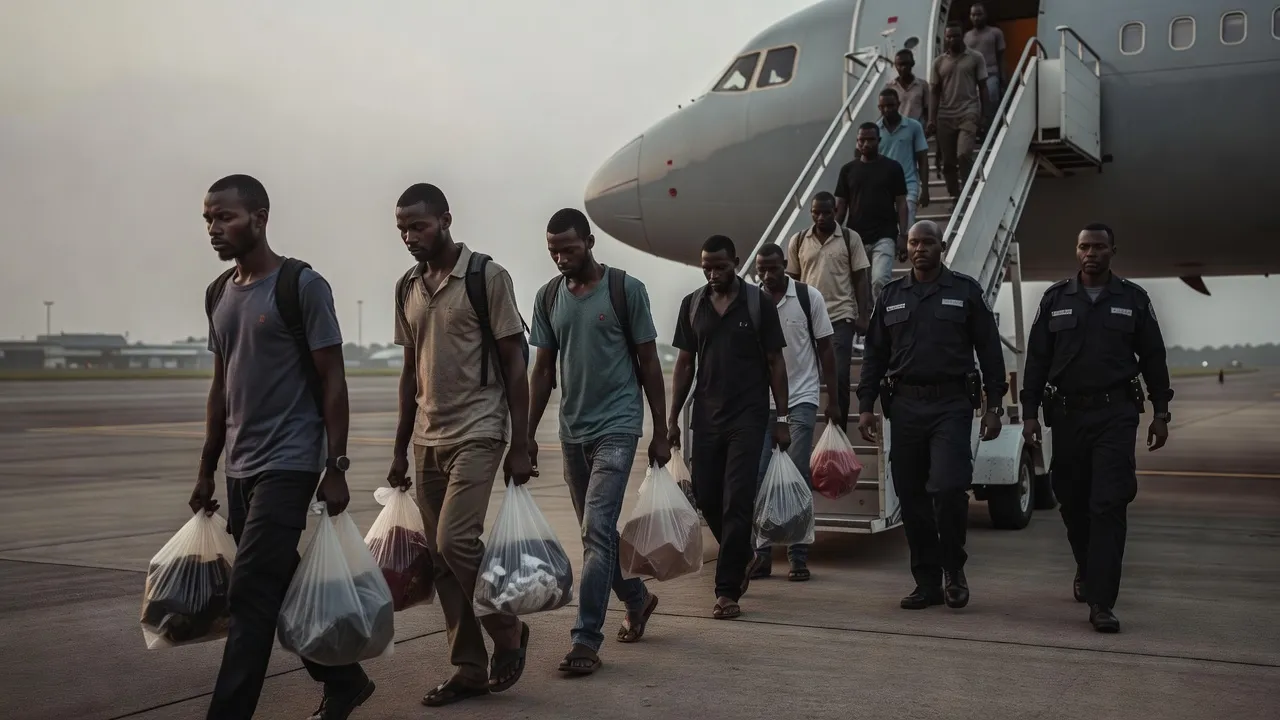
US Supreme Court lets deportations of migrants to third countries resume
published on
countries
sources
articles
Behind the authorization given by the Supreme Court, the press from the eight corpus mainly details three things: what the Boston decision imposed, the administration's arguments for having it suspended, and the alerts about the destination countries.
Deportations to third countries can resume immediately; the Supreme Court will review the case on its merits in December.
The guarantees that are suspended
According to Axios, Judge Brian Murphy required that detained migrants receive "real notice" and be able to express their fears before being sent back to a third country. Efecto Cocuyo (Venezuela) specifies that this judge reproached the Department of Homeland Security for not notifying individuals and not giving them time to invoke a well-founded fear of persecution or torture.
« does not meet the requirements of a fair trial for a whole series of reasons »
Fox News recalls that lower courts had not categorically prohibited these deportations. They demanded procedures that would allow for assessing the risk in the destination country. France 24 describes the same mechanism: notifying the destination country and allowing a deadline.
G1 (Brazil) describes the applied mechanism: a migrant can be sent to a third country if their government guarantees the absence of persecution or torture. Also according to G1, the authorities only examine the risks if the individual themselves declares that they fear such violence.
The administration's arguments
The World and HuffPost France give a lengthy interview to the government's legal advisor, John Sauer. He cited "substantial logistical problems": the lower court's decision would have forced the cancellation of a flight to three countries transporting 70 foreigners with criminal convictions. He described these deportations as an "essential tool".
« significant logistical problems »
Efecto Cocuyo reports that the Justice Ministry urgently seized the Court on Thursday, September 24. According to the media outlet, it argued that the requirements for notification and individual appeal were paralyzing the diplomatic agreements concluded by Washington. Fox News relays a similar argument: these requirements would disrupt sensitive negotiations with countries willing to host deported individuals.
El Financiero (Mexico) writes that the administration also spoke of a "national emergency" and presents the measure as necessary to deport individuals with criminal records. According to The World and HuffPost, the opposing party responded that the suspension "would not prevent expulsions to third countries" but would require them to be carried out legally.
The alerts on destinations
RFI frames the decision in the context of human rights. UN experts denounce "a cascade of human rights violations" and cite risks of torture, slavery, or forced disappearance. They recall the principle of non-refoulement. RFI adds that the International Organization for Migration, which is also being criticized, disputes this responsibility by invoking its mandate.
Berlingske and Politiken, which quote Reuters, date this request to Monday, September 28: twelve UN experts wrote to Washington to demand the cessation of expulsions. Berlingske indicates that the most exposed would be children, women, people with disabilities, trafficking victims, LGBT+ individuals, and stateless persons.
El Financiero cites Equatorial Guinea, where, according to a New York Times investigation, deportees from the United States were hooded, tied up, and beaten by police. The Globe and Mail, Berlingske, and DR note that the US State Department advises its citizens against traveling to South Sudan, one of the countries of destination.
What each coverage retains
Six corpora (Brazil, Canada, Finland, France, United States, Venezuela) highlight the procedural angle: emergency suspension, 6-3 vote, December hearing. This count measures the coverage of the corpus, not the opinion of readers. The CBC title adds "for now"; Axios writes that the Court has "once again" cleared the way for the executive.
The title of El Financiero, "Trump gana de nuevo", retains the decision as a success of the executive before the Court. Reforma and El Norte publish the same Reuters dispatch, without this framing.
Some coverage omits elements that others carry. Danish articles, brief, do not cite dissenting judges or the December hearing. Finnish articles give approximately 25,000 people expelled without naming a destination country.
Mostly Mexico, then South Sudan, Uganda, Eswatini, Equatorial Guinea, Liberia, and Central African Republic.
Deportations without notice to countries that have provided diplomatic guarantees of no persecution and no torture.
Legal advisor James Percival welcomed "a bad day for clandestine criminals".
How each country reads it
8 perspectives, each in the voice of that country's press.
 Brazil
Brasília is dissecting the judicial mechanics of the decision: an emergency suspension, an in-depth examination in December, and a 6-to-3 split, more than a debate on the fate of the expelled.
3 sources
 Canada
Ottawa is first looking at the judicial calendar: the Canadian press is presenting the Supreme Court's decision as a temporary victory for Trump ("for now"), with the substance still to be decided in December.
2 sources
 Denmark
Copenhagen is quietly relaying, via a Ritzau dispatch picked up by Berlingske, DR, and Politiken, the judicial lifting of the ban on deportations to third countries, adding to it the alert from UN experts.
3 sources
 Finland
Helsinki is primarily focused on the procedural aspect: an emergency authorization from the Supreme Court prior to the substantive review in December, with the dissent of the three liberal judges.
2 sources
 France
Paris is deciphering an emergency decision from the Supreme Court: deportations to third countries are resuming, and the core of the case is being referred to December.
4 sources
 Mexico
Mexico City first notes the US executive's judicial victory: the Supreme Court reopens expulsions to third countries pending a full review in December.
3 sources
 United States
The United States government takes a stance on procedural grounds: the Supreme Court provisionally lifts the safeguards imposed on referrals to third countries and sets the matter for December.
3 sources
 Venezuela
Caracas views the Supreme Court's emergency decision as a procedural step: the Venezuelan press is following the thread of the dispute, from the Boston judge to the request from the Ministry of Justice, and is holding off on the outcome of the debate on the merits, which has been postponed until December.
2 sources
What the comparison reveals
Common ground and differences in coverage across the media analysed.
What the media report in common
The US Supreme Court suspended, on Tuesday, September 29, the decision of federal judge Brian Murphy of Boston and allowed the resumption of deportations to third countries.
The Supreme Court will review the case on the merits in December; the decision of Tuesday, September 29, remains provisional.
The progressive judges of the Supreme Court opposed the immediate resumption of deportations.
Where media coverage diverges
Nature of the decision
Question: is the decision primarily a provisional judicial step or an executive success? Canada ("for now"), France, Venezuela, and Brazil emphasize the suspension and December review; El Financiero (Mexico) presents it as a new Trump victory.
This grouping describes the publications analysed, not the position of these countries’ populations or of their governments.
The full text, country by country
Brazil
DOMINANT ANGLE
Brasília is dissecting the judicial mechanics of the decision: an emergency suspension, an in-depth examination in December, and a 6-to-3 split, more than a debate on the fate of the expelled.
KEY POINTS
- The Supreme Court suspended Judge Brian Murphy's decision on Tuesday, September 29, and will review the case in December (Folha, G1, Jornal de Brasília).
- Over 25,000 migrants have been expelled to 29 countries, according to human rights organizations, with the vast majority being sent to Mexico (Folha, G1).
- According to G1, authorities only assess the risk of persecution or torture if the migrant themselves reports fearing such violence.
ANALYSIS
Brasília, September 30, 2026. The Brazilian press reports on the decision of the US Supreme Court on a largely procedural matter. On Tuesday, September 29, according to Folha de S.Paulo and G1, the Court authorized the Donald Trump government to resume deporting migrants to countries that are not their own, without giving them the opportunity to argue the threats they face there.
The articles detail the judicial mechanism. The Court granted the emergency request from the Justice Department and suspended the decision of Boston federal judge Brian Murphy, who had ruled that the Department of Homeland Security's "third country" policy was illegal. Jornal de Brasília, quoting AFP, specifies that the judge had established in February that the individuals concerned must be able to invoke a risk of persecution or torture, and that an appeals court had confirmed this decision on September 18. The Court will examine the merits of the case in December.
The internal division within the court is reported in numerical terms: a conservative majority of 6 judges to 3, with the three progressive judges expressing their disagreement with the immediate resumption of deportations pending the outcome of the dispute.
G1 devotes a sidebar to the practical application: a migrant can be sent to a third country if the government of that country guarantees the absence of persecution or torture; otherwise, the person must be informed of their destination. The authorities only examine the risks if the individual themselves claims to fear such violence. Immigrant advocacy groups are challenging the system in court.
The administration's argument is relayed through its legal advisor, John Sauer, quoted by AFP: the initial decision caused "significant logistical problems" and led to the cancellation of a flight to three countries carrying 70 foreigners with criminal convictions. He describes these deportations as an "essential tool" for expelling "some of the worst foreign criminals".
On the balance sheet, the Brazilian press quotes the tally from human rights organizations: more than 25,000 migrants deported to 29 countries since the policy was implemented last year, mostly to Mexico. G1 also cites Uganda, Equatorial Guinea, Liberia, the Central African Republic, and South Sudan. These deportations, writes Folha, are part of Trump's goal of mass expulsions.
Canada
DOMINANT ANGLE
Ottawa is first looking at the judicial calendar: the Canadian press is presenting the Supreme Court's decision as a temporary victory for Trump ("for now"), with the substance still to be decided in December.
KEY POINTS
- The Supreme Court has suspended Judge Brian Murphy's decision and authorized the resumption of expulsions to third countries, but will hear arguments in December.
- The Court has 6 conservative judges versus 3 progressive ones, the latter having expressed their dissent.
- According to a count by human rights advocacy organizations, more than 25,000 migrants have been expelled to 29 countries, mostly Mexico.
ANALYSIS
Ottawa, September 30, 2026. The Globe and Mail and CBC News are covering the decision of the US Supreme Court based on the same agency report, published on Tuesday, September 29. The Court has authorized the Trump administration to resume deporting migrants to countries other than their own, without giving them the opportunity to demonstrate the dangers they would face. Canadian media describe a measure that strengthens "a tool" used by the administration for rapid deportations, as part of its fight against immigration.
The CBC title adds nuance: the Court says Trump can continue deportations to third countries, "for now". The judges granted the emergency request from the Department of Justice and suspended the decision of Boston federal judge Brian Murphy, who had ruled the Department of Homeland Security's policy illegal. The Court also agreed to hear arguments in December, with a formal decision on the policy to follow.
Both articles recall the composition of the Court, with a conservative majority of 6 judges to 3. The three progressive judges expressed their dissent regarding the immediate resumption of deportations pending the outcome of the dispute. They mention the origin of the case: a collective appeal filed by immigrant rights organizations to prevent deportations to third countries without notice or opportunity to assert the risks incurred.
The numerical toll comes from human rights organizations: more than 25,000 migrants have been deported to 29 countries since the policy was implemented last year, with the vast majority being sent to Mexico. The Globe and Mail specifies that the administration has also carried out deportations to South Sudan, a country that the US State Department advises Americans against visiting due to risks.
The coverage remains factual and sober, situating the decision within the Republican president's goal of "mass deportations", which has been one of his priorities since his return to power last year, without any Canadian editorial commentary in the provided excerpts.
Denmark
DOMINANT ANGLE
Copenhagen is quietly relaying, via a Ritzau dispatch picked up by Berlingske, DR, and Politiken, the judicial lifting of the ban on deportations to third countries, adding to it the alert from UN experts.
KEY POINTS
- Migrants can be deported to third countries without notice if they provide credible diplomatic guarantees against persecution or torture (Berlingske, DR, Politiken).
- Most migrants have been sent to Mexico, but also to South Sudan, Uganda, Equatorial Guinea, Liberia, and the Central African Republic.
- On Monday, Reuters reported that twelve UN experts called for an end to these deportations, which are a source of "a wave of human rights violations" (Berlingske).
ANALYSIS
Copenhagen, September 30, 2026. The Danish press is covering the decision of the US Supreme Court via the Ritzau wire, which cites the Reuters agency, and is publishing it almost verbatim in Berlingske, DR Nyheder, and Politiken. The headline is the same everywhere: "Højesteret lader Trump genoptage deportationer til tredjelande", or the Supreme Court allows Trump to resume deportations to third countries.
The substance of the story is contained in a few lines. The Supreme Court has given the Donald Trump administration permission to deport migrants again to countries other than their country of origin. These deportations can take place without notice if the host country has provided a "credible diplomatic guarantee" that the individuals will not be persecuted or tortured. The articles recall that at the beginning of 2025, a federal judge in Massachusetts had estimated that deporting migrants to third countries without notice violated the constitutional guarantee of due process and immigration law. This judgment is now suspended by the Court.
The texts also detail the destinations. Most migrants have been sent to Mexico. Others have been sent to South Sudan, which the US State Department advises its own citizens against traveling to due to crime, kidnappings, and armed conflicts. Also cited are Uganda, Equatorial Guinea, Liberia, and the Central African Republic. Berlingske and DR highlight this contrast with the US travel advisory without commenting further.
Berlingske and Politiken add a reminder from Reuters dated Monday: more than a dozen UN human rights experts, twelve according to the editorial staff's precision, have written to Washington to demand the cessation of these deportations, which they say are causing "a wave of human rights violations". Berlingske specifies that the most exposed would be children, women, people with disabilities, victims of trafficking, LGBT+ individuals, and stateless persons.
The account remains brief and factual. It does not mention the three progressive judges who disagree, the schedule for the hearing in December, the figure of more than 25,000 deportees, or the reaction of the Ministry of Homeland Security. The Danish reader therefore receives primarily the announcement, the list of countries, and the UN warning.
Finland
DOMINANT ANGLE
Helsinki is primarily focused on the procedural aspect: an emergency authorization from the Supreme Court prior to the substantive review in December, with the dissent of the three liberal judges.
KEY POINTS
- The Supreme Court must review the substance of expulsion practices to third countries in December (MTV Uutiset, YLE).
- The three liberal judges on the Court expressed their disagreement with the decision.
- Approximately 25,000 people have already been expelled from the United States under this practice.
ANALYSIS
Helsinki, September 30, 2026. The Finnish press is covering the US Supreme Court's decision with brief reports published on September 29. MTV Uutiset, citing CNN, writes that the Supreme Court has "once again" allowed the president's administration to pursue the expulsion of individuals to countries with which they have no connection. YLE headlines a "green light" for expulsions to third countries.
Both media outlets provide the same timeline: the Court is set to review the substance of expulsion practices to third countries in December. The decision is therefore not a final judgment, but rather an authorization issued prior to this review, allowing the policy to be applied in the interim. MTV Uutiset has even titled its article on "contested" expulsions.
Internal disagreement is noted in a single phrase: the three liberal judges on the Court expressed their disagreement with the decision. The texts do not name them and do not detail their motivations; the divide is presented solely through its ideological tally.
The two articles also recall the position of lower courts: according to them, individuals seeking to enter the United States must have the opportunity to oppose their expulsion before being sent elsewhere than their country of origin. This is the central legal point retained by Finnish coverage: the right to contest before removal.
Finally, the order of magnitude: approximately 25,000 people have already been removed from US territory under this practice. The figure is given without source or list of destination countries. The tone remains factual, without editorial commentary or Finnish or European reaction.
France
DOMINANT ANGLE
Paris is deciphering an emergency decision from the Supreme Court: deportations to third countries are resuming, and the core of the case is being referred to December.
KEY POINTS
- The Supreme Court lifted limits on expulsions to third countries on Tuesday, September 29, contrary to the opinion of its three progressive judges, and will review the matter in December.
- Boston Judge Brian Murphy had ruled the guidelines "illegal" in February; an appeals court confirmed this on September 18.
- According to RFI, more than 25,000 people have been expelled to third countries since January 2025; UN experts denounce "a cascade of human rights violations".
ANALYSIS
Paris, September 30, 2026. The French press presents the Supreme Court's decision as an emergency ruling, made before any in-depth examination. On Tuesday, September 29, the conservative-majority court lifted "until further notice" the limits on deporting undocumented immigrants to third countries, write Le Monde and HuffPost France. It granted a petition from the Trump administration, contrary to the opinion of the three progressive judges out of nine.
The newspapers recall the timeline. In February, Boston Judge Brian Murphy had ruled that the directives issued in 2025 by the Department of Homeland Security were "illegal". He believed that the individuals concerned should be able to invoke the risk of being persecuted or tortured in those countries. An appeals court had confirmed his decision on September 18, before the emergency appeal to the Supreme Court. The latter will examine the case in December, particularly regarding the legality of these directives.
Le Monde and HuffPost give extensive coverage to the government's argument. Its legal advisor, John Sauer, cited "substantial logistical problems": the initial ruling would have forced the cancellation of a flight to three countries carrying 70 foreigners with criminal convictions. He defended these deportations as an "essential tool". The opposing side responded that the suspension "would not prevent deportations to third countries", but would require them to be carried out legally.
France 24 specifies, in its English version, that the Court suspended guarantees that required notifying individuals of their destination country and giving them time to express fears of persecution. The media also recalls that Donald Trump campaigned on the expulsion of millions of undocumented immigrants. Le Monde mentions a deportation to South Sudan in its report.
RFI places the decision in a broader context, that of human rights. According to the radio, the administration has deported over 25,000 people to "third countries" since January 2025, often without any connection to them. UN experts denounce "a cascade of human rights violations" and evoke risks of torture, slavery, or forced disappearance. They recall the principle of non-refoulement and point to the responsibility of the host countries as well as the International Organization for Migration, which the latter contests by invoking its mandate.
Mexico
DOMINANT ANGLE
Mexico City first notes the US executive's judicial victory: the Supreme Court reopens expulsions to third countries pending a full review in December.
KEY POINTS
- The Supreme Court authorized on Tuesday, September 29, the resumption of expulsions to third countries and will hear arguments in December (El Financiero).
- The six conservative judges voted for the government; Sotomayor, Kagan, and Jackson opposed it.
- The administration had cited a "national emergency" and justifies the measure by the expulsion of individuals with criminal records.
ANALYSIS
Mexico, September 30, 2026. The Mexican press, from El Financiero to Reforma and El Norte, reports on the decision of the US Supreme Court on Tuesday, September 29, from the angle of the judicial balance of power between the executive and lower courts.
According to El Financiero, the Court temporarily authorized the Donald Trump administration to reactivate its policy of sending certain deportees to third countries, and will hear arguments on the matter in December. The decision leaves in limbo the judgments of the lower courts, which required informing migrants of their destination country and allowing them to contest their transfer before deportation.
The newspaper notes that the six judges of the conservative majority voted for the government, while progressive judges Sonia Sotomayor, Elena Kagan, and Ketanji Brown Jackson opposed it. Its headline, "Trump gana de nuevo," frames the episode as part of a series of successes for the executive branch before the Court.
The administration had argued in the preceding days that a suspension would constitute a "national emergency" and hinder its ability to deport certain migrants. It presents the measure as necessary to return individuals with criminal records. El Financiero links this reactivation to the strategy of mass deportations and the president's campaign promises, and recalls that the targeted third countries include states accused of human rights violations.
The newspaper cites Equatorial Guinea, where, according to a New York Times investigation, deportees from the United States were hooded, tied up, and beaten by police.
Reforma and El Norte publish the same Reuters dispatch from September 29, 14:22. It retains the essential information: the Court allows the resumption of deportations to countries other than those of the migrants, without "the opportunity to demonstrate the harm" to which they may be exposed, which strengthens a tool used for rapid deportations. None of the three articles detail the role of Mexico as a receiving country.
United States
DOMINANT ANGLE
The United States government takes a stance on procedural grounds: the Supreme Court provisionally lifts the safeguards imposed on referrals to third countries and sets the matter for December.
KEY POINTS
- The Supreme Court suspended on Tuesday, September 29, a February 2026 decision by a federal court in Massachusetts (Judge Brian Murphy) requiring notice before removals to third countries.
- Sotomayor, Kagan, and Jackson would have denied the administration's request for a stay.
- The Court is treating the emergency application as a petition for review and has set oral arguments for its December session.
ANALYSIS
Washington, September 30, 2026. The Supreme Court gave the Trump administration a provisional victory on Tuesday, September 29, in its deportation policy. It suspended the decision of a federal court in Massachusetts, made in February 2026, which imposed procedural guarantees before any migrant was sent back to a country that was not their own. Axios summarizes: the Court "allows" the rapid resumption of these deportations and will examine the legal issue later.
The challenged text comes from federal judge Brian Murphy. According to Axios, he required that detained migrants receive "real notice" and be able to express their fears before being sent back to a third country. The judge estimated that the administration's policy "does not meet the requirements of a fair trial for a whole series of reasons." A recent decision by an appeals court largely confirmed this.
The Court also agreed to hear the case. Fox News specifies that it is treating the emergency request as a petition for review and that it has asked the parties to prepare to argue during its December session. The Hill emphasizes the provisional nature of the verdict: deportations can resume "for now," until the judges rule on their legality.
Three judges dissented: Sonia Sotomayor, Elena Kagan, and Ketanji Brown Jackson would have rejected the request for suspension. None of the three articles details written motives from them.
Fox News recalls that lower courts have not categorically prohibited these deportations. They required procedures allowing migrants to assert a risk of persecution or torture in the destination country. The administration claims that these requirements hinder deportations and disrupt sensitive diplomatic negotiations with countries willing to accept the people being sent back.
The American press is therefore treating the case as a procedural step: what the Court is allowing from now on, and what it is reserving for the December hearing. Fox News sees it as another step in the president's immigration policy, Axios recalls that the Court has "once again" cleared the way for the executive.
Venezuela
DOMINANT ANGLE
Caracas views the Supreme Court's emergency decision as a procedural step: the Venezuelan press is following the thread of the dispute, from the Boston judge to the request from the Ministry of Justice, and is holding off on the outcome of the debate on the merits, which has been postponed until December.
KEY POINTS
- The Supreme Court granted an emergency request filed on September 24 by the Trump administration's Justice Department on Tuesday, September 29 (Efecto Cocuyo).
- The federal judge in Boston had found that the DHS was violating the right to due process by not notifying individuals and not giving them time to allege a risk of persecution or torture.
- A hearing on the merits of the case is scheduled for December, the conservative majority leaving previous decisions pending in the meantime (El Nacional).
ANALYSIS
Caracas, September 30, 2026. Venezuelan media are covering the decision of the US Supreme Court from a primarily procedural angle. According to Efecto Cocuyo, the high court granted on Tuesday, September 29, an emergency request filed on September 24 by the Justice Department of the Donald Trump administration. It authorizes the temporary resumption of accelerated expulsions of undocumented migrants to third countries, "even if they are not their countries of origin" and without any connection to them.
The media outlet retraces the milestones of the dispute. In February 2026, a federal judge in Boston had suspended these direct expulsions: he estimated that the Department of Homeland Security (DHS) was violating the right to a regular procedure, by not notifying individuals and not giving them time to invoke a well-founded fear of persecution or torture. The Court of Appeals for the First Circuit then confirmed this decision. On September 24, the Justice Department turned to the Supreme Court in an emergency, arguing that the notification and individual appeal requirements were paralyzing the diplomatic agreements concluded by Washington to control migration flows.
Efecto Cocuyo specifies that the Supreme Court's decision provisionally suspends the current restrictions, while the magistrates examine the legality of this policy on its merits. The program can therefore resume immediately.
El Nacional, in a shorter text, emphasizes the balance of power within the court: "the conservative majority" leaves in abeyance the decisions that required informing migrants in advance of their destination, and sets the hearing on the merits of the case for December.
Both media outlets treat the decision as an episode in an ongoing dispute, whose outcome remains open, rather than as a definitive verdict. The Venezuelan readership, marked by the importance of the diaspora, remains referred to what this expulsion regime means for undocumented migrants, but the provided articles do not detail the nationalities concerned or the number of expelled individuals.
Explore every perspective on this subject across 8 countries.
Compare viewpoints and see where they diverge.