11 perspectives, each in the voice of that country's press.
Canberra is particularly concerned about the threat to oil routes: the Australian press links the attack on Riyadh and Yanbu to the growing risk for crude oil exports from the Gulf, between the Houthi naval blockade in the Red Sea since July and the already blocked Strait of Hormuz.
5 sources
Dhaka is first measuring the threat that the escalation around Riyadh poses to global oil supplies and the Red Sea trade route, more than to the Yemeni military theater itself.
2 sources
Paris details a security escalation between Riyadh and the Houthis, presenting side by side the conflicting versions of the Saudi coalition and the Yemeni movement on Saturday's strikes.
3 sources
Jakarta is assessing the security implications of the Houthi attack on Riyadh, where the interception of a ballistic missile and a fire near the international airport have reignited fears of escalation in the Gulf, a vital region for Indonesian pilgrims and workers.
2 sources
New Delhi is scrutinizing the Saudi defensive gap revealed by the Riyadh attack, with particular attention being paid to the kingdom's use of military aid from Pakistan, a strategic neighbor of India, to compensate for its shortage of interceptors.
3 sources
Kuala Lumpur is first assessing the extent of the air disruption in Riyadh, where King Khaled Airport was classified at the maximum level of disruption by FlightRadar24, leaving the military cause of the intercepted shot out of the framework retained by the Malaysian press.
Islamabad is mainly weighing the energy and logistical risks of this surge near Riyadh, more than its sole military aspect, linking it to the US-Iranian war that is already affecting the global economy.
Saudi Arabia denounces a deliberate Houthi escalation against civilians in Riyadh, highlighting the effectiveness of its air defense and the solidarity of its Arab allies.
Stockholm is measuring Riyadh's attack by the human toll in Yemen, more than that of the Saudi capital: nearly 50 dead in one day of fighting, according to Dagens Nyheter.
The United States is scrutinizing Riyadh's attack through the prism of the larger war against Iran, between the sale of F-35s to the kingdom and conditions transmitted by Tehran via Qatar.
2 sources
Cross-media analysis
What the comparison reveals
Common ground and differences in coverage across the media analysed.
What the media report in common
1
The Saudi-led coalition claims to have intercepted and destroyed a Houthi ballistic missile targeting Riyadh at dawn on Saturday, September 19, after a nighttime air alert over the capital and the city of Al-Kharj.
2
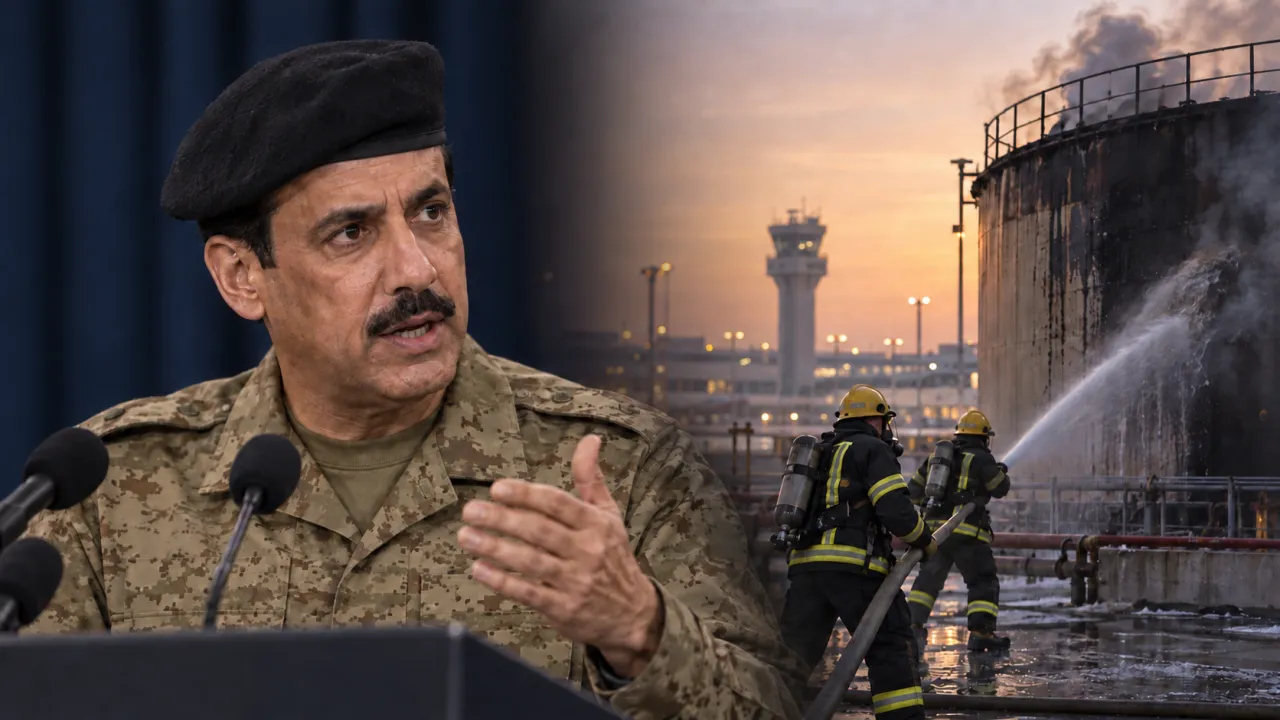
A fuel tank bearing the Aramco logo caught fire in a depot near Riyadh's King Khaled International Airport, causing a thick column of black smoke observed by witnesses and journalists on the scene.
3
Riyadh airport's air traffic was classified by FlightRadar24 at its maximum disruption index, with significant flight cancellations and delays.
Where media coverage diverges
Oil Stakes vs Human Toll
Several newsrooms link the episode primarily to the threat to oil exports from the Gulf and the Red Sea route, while the Swedish press emphasizes the heavy toll of fighting on the ground in Yemen rather than the damage in Riyadh.
Coverage aligned with this reading
Coverage that diverges
Link to Iran-USA War
The British and American press resituate the attack on Riyadh within the broader framework of the conflict between Tehran and Washington, with its diplomatic channels and arms sales, while other perspectives, including the French and Saudi ones, treat it as an episode specific to the confrontation between the kingdom and the Houthis.
Coverage aligned with this reading
Coverage that diverges
Houthi Designation
The Saudi press reproduces without distance the designation of 'terrorist militia' for the Houthis, while other perspectives use neutral terms such as 'rebels' or 'Houthis'.
Coverage aligned with this reading
Coverage that diverges
This grouping describes the publications analysed, not the position of these countries’ populations or of their governments.
Canberra is particularly concerned about the threat to oil routes: the Australian press links the attack on Riyadh and Yanbu to the growing risk for crude oil exports from the Gulf, between the Houthi naval blockade in the Red Sea since July and the already blocked Strait of Hormuz.
KEY POINTS
The Saudi coalition claims to have intercepted a ballistic missile targeting Riyadh early Saturday and foiled other strikes in Bisha, Farasan, Taif, and Yanbu.
The Houthists claim to have hit "sensitive sites" in Riyadh and an Aramco facility in Yanbu, using missiles, cruise missiles, and drones, according to their spokesman Yahya Saree.
The press links the episode to the risk for global oil supplies: the Houthist naval blockade imposed since July threatens the Red Sea route, while the Strait of Hormuz remains blocked.
ANALYSIS
Canberra, September 20, 2026. Australian newsrooms — ABC, SBS, Sydney Morning Herald, The Age, and PerthNow — all opened their weekend coverage with the same images: a thick plume of black smoke above Riyadh's international airport, coming, according to witnesses, from a fuel depot bearing the Aramco logo. Yemen's Houthi rebels claim to have targeted "sensitive sites" in the Saudi capital with missiles and drones, just hours after Riyadh and the city of Al-Kharj received nighttime alerts signaling an aerial threat, lifted on Saturday morning.
The coalition led by Saudi Arabia claims to have intercepted a ballistic missile fired towards Riyadh early on Saturday, and says it foiled other attempts targeting civilians in Bisha, Farasan, and Taif, as well as Yanbu, on the Red Sea, where an Aramco facility is also claimed by the rebels. Houthi military spokesman Yahya Saree asserts that the operation is in response to a strike on Sanaa, and mentions the deployment of Saudi F-15 and Typhoon fighters from Khamis Mushait and Taif; he promises "a blockade for a blockade, escalation for escalation".
The Australian press emphasizes the energy dimension of the episode. PerthNow and ABC recall that the Houthi rebels, who control the most populated regions of Yemen and a large part of the north since a lightning offensive launched this month on the entire Red Sea coast, have been conducting a naval blockade against Riyadh since July and multiplying strikes on Saudi ships. These attacks, ABC writes, create "new threats to the global oil supply", by putting the main alternative route for Gulf exports through the Red Sea in jeopardy, while the Strait of Hormuz remains already blocked.
No official Saudi confirmation was available on Sunday regarding the extent of the damage near the airport; the government's media office did not respond to questions from Reuters. A Reuters agency journalist present in the Olaya neighborhood of Riyadh says he heard detonations before the alert was lifted. FlightRadar24 classified King Khaled Airport at its maximum level of disruption, with cancellations and prolonged delays. The newsrooms note that similar alerts had already targeted Riyadh earlier in the year, at the beginning of the war between the United States and Iran, but that those over the weekend are the first since the escalation with the Houthi rebels began in July.
Bangladesh
DOMINANT ANGLE
Dhaka is first measuring the threat that the escalation around Riyadh poses to global oil supplies and the Red Sea trade route, more than to the Yemeni military theater itself.
KEY POINTS
The Riyadh-led coalition announced it had intercepted and destroyed a Houthi ballistic missile targeting Riyadh in the early hours of September 19, after a nighttime alert over the capital and Al-Kharj.
Houthi military spokesman Yahya Saree claimed responsibility for two operations: one against "sensitive sites" in Riyadh, the other against Aramco facilities in Yanbu, a key hub for Saudi oil exports.
The attacks launched since July against the kingdom and its ships in the Red Sea pose a new threat to global oil supplies, endangering the alternative Red Sea route as the Strait of Hormuz remains blocked.
ANALYSIS
Dhaka, September 20, 2026. The Bangladeshi press first picked up Reuters dispatches on the escalation between the Houthists and the coalition led by Riyadh on Saturday, September 19, emphasizing its consequences for global energy supplies more than the military theater itself. According to articles reprinted in Dhaka, the Saudi coalition announced that it had intercepted and destroyed a ballistic missile fired towards Riyadh early on Saturday, after a alert was sent out by the Saudi civil defense during the night for the capital and the city of Al-Kharj, to the east. An all-clear followed on Saturday morning.
In the morning, a Reuters journalist filmed a thick column of black smoke near Riyadh's international airport, with visible flames behind what appeared to be fuel tanks, near the main terminal and access highway. The Saudi government's press office did not immediately respond to Reuters' questions about the smoke and nighttime alerts, note the articles reprinted by the Bangladeshi press, leaving uncertainty about the exact origin of the fire.
Houthist military spokesman Yahya Saree claimed, via Telegram according to the cited articles, two operations combining ballistic missiles, cruise missiles, and drones: one against "sensitive sites" in Riyadh, the other against Aramco facilities in Yanbu, on the Red Sea, described as a key hub for Saudi oil exports. The coalition, for its part, claims to have foiled attempts to strike civilians in Bisha, Farasan, and Taëf.
France
DOMINANT ANGLE
Paris details a security escalation between Riyadh and the Houthis, presenting side by side the conflicting versions of the Saudi coalition and the Yemeni movement on Saturday's strikes.
KEY POINTS
The Saudi-led coalition claims to have intercepted and destroyed a Houthi ballistic missile targeting Riyadh at dawn on Saturday, September 19
An AFP journalist observed that an Aramco fuel tank near Riyadh's international airport was on fire, with Flightradar24 placing the airport on its maximum alert level
Houthi military spokesman Yahya Saree claims on Telegram two separate attacks, one targeting "sensitive sites" in Riyadh, the other targeting Aramco facilities in Yanbu
ANALYSIS
Paris, September 20, 2026. The French press accurately reports the sequence of events on Saturday in Riyadh: a ballistic missile fired by the Houthists in the direction of the Saudi capital was "intercepted and destroyed" at dawn, according to the military coalition led by Riyadh, after an alert was issued overnight in Riyadh and Al-Kharj. Le Monde quotes the coalition's spokesman as saying that the Houthists had "also attempted to target civilians and civilian property in Bisha, Taif, Farasan, and Yanbu", attacks that he claims were "thwarted by the kingdom's air defenses".
At the same time, France 24 documents the subsequent fire on the ground: an AFP journalist observed that a fuel tank bearing the Aramco logo, located near Riyadh's international airport, was on fire, while firefighters attempted to bring the blaze under control. Residents reported seeing "black smoke and flames near the airport" and hearing two loud explosions during the night. Flightradar24, cited by several French media outlets, placed the airport on its maximum alert level, before reporting a gradual return to normal traffic in the afternoon.
The French media also give a voice to the Houthist camp: military spokesman Yahya Saree claims, on Telegram, two separate operations carried out with "a large number of ballistic missiles, cruise missiles, and drones" - one targeting "sensitive sites" in Riyadh, the other targeting Aramco facilities in Yanbu, on the Red Sea. He presents these strikes as a response to the "criminal attempts by the Saudi enemy to target the capital Sanaa", which the Houthists control.
Indonesia
DOMINANT ANGLE
Jakarta is assessing the security implications of the Houthi attack on Riyadh, where the interception of a ballistic missile and a fire near the international airport have reignited fears of escalation in the Gulf, a vital region for Indonesian pilgrims and workers.
KEY POINTS
The Saudi-led coalition claims to have intercepted and destroyed a Houthi ballistic missile targeting Riyadh at dawn on Saturday, according to spokesman Turki al-Malki.
A fuel tank bearing the Aramco logo caught fire in a nearby depot of King Khaled International Airport, a scene witnessed by an AFP journalist.
FlightRadar24 has ranked King Khaled Airport at its maximum disruption index, with cancellations and long delays, after alerts were issued in Riyadh and Al-Kharj.
ANALYSIS
Jakarta, September 20, 2026. The Indonesian press is detailing the security escalation that hit Riyadh on the night of September 19. According to CNN Indonesia, citing the spokesperson for the Saudi-led coalition, Turki al-Malki, the Saudi air force "succeeded in intercepting and destroying a ballistic missile launched by the Houthi terrorist militia towards Riyadh, at dawn on Saturday". Al-Malki, quoted via his message on X, also claims that the Houthis attempted to target civilians and civilian infrastructure in Bisha, Taif, Farasan, and Yanbu, attacks that the Saudi air defense claims to have foiled.
The attack coincided with a fire near King Khaled International Airport, in the Saudi capital. Firefighters extinguished flames from a fuel tank bearing the Aramco logo, in a fuel depot near the airport - a scene observed by an AFP journalist and confirmed by verified images from the agency, showing thick black smoke above the airport buildings. Tempo English, citing Reuters and AFP, reports that a "hostile air threat" alert was issued in Riyadh and Al-Kharj, east of the capital, before the alert was lifted. A message received by residents before 3 am instructed them to stay at home; journalists on the scene, including one from AFP in the Olaya district, reported hearing explosions before the end of the alert, half an hour later.
India
DOMINANT ANGLE
New Delhi is scrutinizing the Saudi defensive gap revealed by the Riyadh attack, with particular attention being paid to the kingdom's use of military aid from Pakistan, a strategic neighbor of India, to compensate for its shortage of interceptors.
KEY POINTS
The Saudi coalition intercepted and destroyed a Houthi ballistic missile targeting Riyadh at dawn on Saturday, announced spokesman Turki al-Malki (Deccan Chronicle).
An AFP journalist saw firefighters extinguish a fire at an Aramco reservoir near King Khaled Airport; no casualties or damage were reported (The Hindu Business Line).
According to regional officials cited by the AP, Saudi Arabia lacks interceptors and has sought air defense assistance from France, the UK, Pakistan, and Egypt (Times of India).
ANALYSIS
New Delhi, September 20, 2026. The Indian press accurately reports the Saudi sequence of Saturday: at dawn, the coalition led by Riyadh announced that it had "intercepted and destroyed a ballistic missile launched by the Houthi terrorist militia" towards the capital, according to spokesman Turki al-Malki, quoted by the Deccan Chronicle. An AFP journalist saw firefighters extinguishing a fire on a tank bearing the Aramco logo, in a depot near King Khaled International Airport; verified images show a column of black smoke above the airport buildings. No casualties or damage have been reported at this stage, The Hindu Business Line notes, emphasizing that this is the first shot directly targeting Riyadh since the escalation of fighting with Tehran-backed rebels — an escalation that Indian headlines explicitly place in the broader context of the "Iranian war".
On the Houthi side, military spokesman Yahya Saree claimed on Telegram "two successful military operations" combining ballistic missiles, cruise missiles, and drones, one against "sensitive sites" in Riyadh, the other against Aramco facilities in Yanbu, where the group claims to have caused "massive fires" — an allegation that Aramco has not commented on. Al-Malki, for his part, mentions foiled attempts in Bisha, Taif, Farasan, and Yanbu.
Malaysia
DOMINANT ANGLE
Kuala Lumpur is first assessing the extent of the air disruption in Riyadh, where King Khaled Airport was classified at the maximum level of disruption by FlightRadar24, leaving the military cause of the intercepted shot out of the framework retained by the Malaysian press.
KEY POINTS
FlightRadar24 has rated King Khaled Airport at its maximum disruption index (5.0), reporting long delays and several cancelled flights.
Residents of Riyadh saw black smoke and flames near the airport and reported hearing explosions on Saturday, September 19.
The disruption follows a nighttime air alert issued by Saudi authorities, the first since the escalation of fighting in Yemen this month.
ANALYSIS
Kuala Lumpur, September 20, 2026. The Malaysian press, which reproduces here the AFP dispatch, focuses its account on the immediate consequences of the air alert that occurred overnight in Riyadh: a major disruption to traffic at King Khaled International Airport, rather than a detailed count of the intercepted device. The Sun Malaysia and Malay Mail, both citing AFP, report that residents of the Saudi capital saw black smoke and flames rising near the airport on Saturday, while others testified to hearing explosions in several neighborhoods of the city. "Heading towards the airport, we saw black smoke and fire," a resident told AFP.
The FlightRadar24 air traffic tracking site ranked King Khaled at its maximum disruption index of 5.0, indicating "major problems with long delays and several flights cancelled". According to the two Malaysian titles, this airport chaos follows a nighttime air alert issued by Saudi authorities — the first of its kind since the intensification of fighting in neighboring Yemen this month. Several hours after the morning alert, residents again reported to AFP, anonymously, hearing what sounded like a new series of explosions resonating in certain neighborhoods of the Saudi capital.
For a Malaysian readership linked to the Gulf by migrant work and transit flights, it is the airport disruption index, quantified and verifiable through a public tool, that structures the information rather than a military reading of the incident: the two articles, almost identical, emphasize "cancellations" and "long delays" as a tangible measure of the crisis.
Pakistan
DOMINANT ANGLE
Islamabad is mainly weighing the energy and logistical risks of this surge near Riyadh, more than its sole military aspect, linking it to the US-Iranian war that is already affecting the global economy.
KEY POINTS
FlightRadar24 has rated King Khaled Airport at its maximum disruption index (5.0), with cancellations and long flight delays.
Coalition spokesman Turki al-Malki claimed to have foiled Houthi attacks targeting civilians and infrastructure in Bisha, Taif, Farasan, and Yanbu.
Houthi military spokesman Yahya Saree claimed on Telegram two operations, one against "sensitive sites" in Riyadh, the other against Aramco facilities in Yanbu.
ANALYSIS
Islamabad, September 20, 2026. The Pakistani press widely reported on Saturday the escalation between the Houthis and Saudi Arabia, but framed it from the outset in the broader context of the nearly seven-month-long American-Iranian war that is already affecting the global economy. The Daily Times emphasizes that this attack on Riyadh is "the first time since the resurgence of the civil war in Yemen" that the Saudi capital is directly threatened, an episode that "further shakes an already pressured global economy".
According to Pakistani articles, the Riyadh-led coalition announced that it had intercepted and destroyed a ballistic missile fired by the Houthis towards the capital at dawn on Saturday, after an air alert was issued in Riyadh and Al-Kharj during the night. A column of black smoke rose near King Khaled International Airport: firefighters were battling a fire at a fuel tank bearing the Aramco logo, in a fuel depot near the airport, according to journalists on the scene cited by ARY News and Business Recorder. The FlightRadar24 website classified the airport at its maximum disruption index, 5.0, resulting in cancellations and long delays.
The coalition's spokesman, Turki al-Malki, stated that the Houthis had also attempted to target civilians and infrastructure in Bisha, Taif, Farasan, and Yanbu, attacks that he claimed were foiled. The Houthi military spokesman, Yahya Saree, claimed on Telegram two operations combining ballistic missiles, cruise missiles, and drones: one against "sensitive sites" in Riyadh, the other against Aramco facilities in Yanbu.
Saudi Arabia
DOMINANT ANGLE
Saudi Arabia denounces a deliberate Houthi escalation against civilians in Riyadh, highlighting the effectiveness of its air defense and the solidarity of its Arab allies.
KEY POINTS
The air defense intercepted and destroyed a Houthi ballistic missile targeting Riyadh at dawn on Saturday, September 19, according to the Arab coalition for the restoration of legitimacy in Yemen.
Coalition spokesman Turki Al-Malki claims that the Houthis also attempted to strike civilian areas in Taif, Baysh, Yanbu, and Farasan, all of which were thwarted by Saudi defense systems, he said.
Jordan and Lebanon expressed their full solidarity with Riyadh, condemning the attacks as a violation of Saudi sovereignty and international law.
ANALYSIS
Riyadh, September 20, 2026. Saudi authorities have confirmed that they intercepted and destroyed a ballistic missile fired by the Houthi militia towards Riyadh at dawn on Saturday, September 19. According to the Arab coalition for the restoration of legitimacy in Yemen, the royal air defense neutralized the device before it reached the capital, which has a population of over 8 million inhabitants and residents.
The coalition's spokesman, Major General Turki Al-Malki, described the attack as a new stage in the escalation by the Houthi militia, which he accuses of deliberately and systematically targeting civilians and civilian infrastructure in Riyadh. According to him, the Houthis also attempted to strike civilian areas in Taif, Baysh, Yanbu, and Farasan; these attempts, he said, were all thwarted by Saudi air defense systems.
The coalition command reaffirmed its right to take any necessary measures, in accordance with international humanitarian law and its customary rules, to deter what it describes as the terrorist behavior of the Houthi militia.
The incident has prompted messages of solidarity from several Arab capitals. The Jordanian Ministry of Foreign Affairs condemned the missile fire as a blatant violation of Saudi sovereignty, a threat to its security, stability, and territorial integrity, and an infringement on international law and the United Nations Charter; Amman expressed its absolute solidarity with Riyadh. The Lebanese Ministry of Foreign Affairs also firmly condemned the missile fire targeting Riyadh, seeing it as a serious violation of international law and a threat to regional security, and expressed Beirut's full support for the kingdom.
Sweden
DOMINANT ANGLE
Stockholm is measuring Riyadh's attack by the human toll in Yemen, more than that of the Saudi capital: nearly 50 dead in one day of fighting, according to Dagens Nyheter.
KEY POINTS
The Houthi movement confirmed it had struck "important sites" in Riyadh and the port city of Yanbu, according to Dagens Nyheter
Dagens Nyheter reports nearly 50 deaths in a single day in the fighting in Yemen
Sveriges Radio, citing AFP, reports fires near Riyadh airport, a burning oil depot, and "major disruptions, with numerous delays and cancelled flights"
ANALYSIS
Stockholm, September 20, 2026. Swedish editorial offices are covering Saturday's attack on Riyadh by immediately placing it in the context of the war in Yemen, rather than as a simple air security incident. Dagens Nyheter (DN) headlines the Houthi movement "behind the attack on Riyadh airport" and recalls that it, supported by Iran, confirmed hitting "important sites" in the Saudi capital and in the port city of Yanbu, where there are oil installations. The newspaper emphasizes that the ground fighting in Yemen continues to claim a high number of victims, "nearly 50 dead in a single day", a figure highlighted even as the article details little of the material damage on the Saudi side, focusing on the scope of the war rather than the isolated episode in Riyadh.
Sveriges Radio, on the other hand, sticks to a more factual account of the episode in the Saudi capital: citing the AFP agency, the public radio reports fires around the international airport after an alert reported several explosions and air alerts during the night, an oil depot having caught fire. The airport reported, according to this source, "major disruptions, with many delays and canceled flights". Neither of the two Swedish media outlets relays an official statement from the spokesperson of the Saudi coalition or a numerical toll transmitted by the kingdom; the emphasis is on the agency dispatch and developments on the Yemeni side, without taking up the coalition's discourse on foiled attacks elsewhere in the country.
Singapore
DOMINANT ANGLE
Singapore first gauges the Houthi attack on Riyadh in terms of its consequences on commercial routes, oil supplies, and air traffic in the Gulf.
KEY POINTS
FlightRadar24 has rated King Khaled Airport at its maximum disruption index, with cancellations and delays following the fire at an Aramco tank farm near the site.
The Houthis have been enforcing a naval blockade against Saudi Arabia in the Red Sea since July, threatening "the main alternative route" to Gulf exports while the Strait of Hormuz remains blocked, according to Channel News Asia.
The UN has recorded more than 110,000 displaced people since the start of the Houthi offensive in September in Yemen, according to the Straits Times.
ANALYSIS
Singapour, 20 septembre 2026. For the city-state, whose economy is heavily dependent on maritime trade and refining, the Houthi attack on Riyadh is first and foremost seen through its impact on commercial routes and energy. According to Channel News Asia, the Houthis, who control the most populated areas of Yemen, have been waging a campaign against Saudi Arabia since July after declaring a naval blockade targeting the kingdom, with strikes against Saudi ships in the Red Sea. These attacks target "Saudi cities, energy infrastructure, and maritime transport, creating new threats to the global oil supply," reports the Singaporean media, as the Strait of Hormuz remains blocked elsewhere.
On Saturday, 19 September, at dawn, the coalition led by Riyadh announced that it had intercepted a ballistic missile fired towards the capital, after a nighttime alert targeting Riyadh and Al-Kharj. A thick column of black smoke rose near King Khaled International Airport: according to the Straits Times, firefighters were battling a fire at a fuel tank bearing the Aramco logo, in a depot adjacent to the airport. FlightRadar24 classified the airport at its maximum disruption index, with cancellations and delays cascading.
Houthi military spokesman Yahya Saree claimed on Telegram two operations, one against "sensitive sites" in Riyadh, the other against Aramco facilities in Yanbu, a key oil port on the Red Sea. Coalition spokesman Turki al-Malki stated that other civilian targets in Bisha, Taif, Farasan, and Yanbu had also been targeted but thwarted by air defense.
United States
DOMINANT ANGLE
The United States is scrutinizing Riyadh's attack through the prism of the larger war against Iran, between the sale of F-35s to the kingdom and conditions transmitted by Tehran via Qatar.
KEY POINTS
Saudi Arabia claims to have intercepted a Houthi ballistic missile targeting Riyadh on Saturday, a first since the opening of this front in the war with Iran (NPR).
The Trump administration approved the potential sale of nearly 50 F-35s to Saudi Arabia for $24.3 billion last week (CNBC).
Iranian official Mohsen Rezaei claims that Tehran has transmitted its conditions for ending the war via Qatar and is awaiting a response from Donald Trump (NPR).
ANALYSIS
The United States, September 20, 2026. In the US capital, the failed attack on Riyadh is seen as a new episode in a much broader regional war, one that now pits the United States against Iran on several fronts. According to NPR, Saudi Arabia announced on Saturday that it had intercepted a Houthi ballistic missile targeting its capital, a first since the opening of this Yemeni front in the conflict with Tehran. Residents of Riyadh heard an explosion and saw a plume of smoke near the airport; no casualties or damage were reported. The Saudi Directorate of Civil Defense had issued preventive alerts; Reuters, cited by CNBC, reported two detonations before giving the "all clear", and then reported a plume of smoke and flames visible near King Khalid Airport. Riyadh also claims to have foiled attempts targeting civilian infrastructure in Yanbu, where a key Saudi oil pipeline ends, as well as in Taif, Bisha, and Farasan. The Houthis claimed to have struck "sensitive sites" in Riyadh and Aramco facilities in Yanbu, causing "massive fires", according to them; the oil giant did not respond to requests.
The US press links this episode to two files being followed in Washington. First, diplomacy with Tehran: according to Al Jazeera, cited by NPR, the head of Iran's Supreme National Security Council, Mohsen Rezaei, says that Iran has transmitted its conditions for ending the war via Qatar, and is awaiting a response from President Donald Trump, including a cessation of hostilities on all fronts, the return of seized assets, and the lifting of the US naval blockade of Iranian ports. Rezaei also says he wants an end to the fighting between the Houthis and the Saudis. The US Central Command also indicates that it has supported the transit of one billion barrels of oil through the Strait of Hormuz.
Explore every perspective on this subject across 11 countries.
Houthi ballistic missile intercepted over Riyadh, an Aramco fuel depot ablaze near the airport and air traffic badly disrupted
published on
September 20, 2026
11
countries
29
sources
34
articles
90%
gap
In the aftermath of the attack, accounts differ on what was actually hit in Yanbu, and several Arab capitals express their solidarity with Riyadh, while Washington links the incident to its negotiations with Tehran, and other perspectives place it in the context of the ongoing Houthi military advance on the ground.
Neither the Saudi government nor Aramco has publicly confirmed the extent of the damage or the toll of the strikes, including Houthi claims.
Versions that contradict each other about Yanbu
The spokesperson for the Saudi-led coalition, Major General Turki al-Malki, claims that the Houthi rebels also attempted to target civilians and civilian infrastructure in Bisha, Taif, Farasan, and Yanbu, attacks that he says were all thwarted by Saudi air defense. He describes these attacks as a new stage in an escalation, in his words, by the "Houthi terrorist militia" deliberately and systematically targeting civilians in Riyadh.
Houthi military spokesperson Yahya Saree, on the other hand, claims on Telegram to have carried out two successful operations combining "a large number of ballistic and cruise missiles and drones": one against "sensitive sites" in Riyadh, the other against the Aramco facility in Yanbu itself, in retaliation, he says, for Saudi "criminal attempts" to target Sanaa.
Regarding Yanbu, the two sides thus respond to the same question with opposing answers: a thwarted strike according to the coalition, and a hit installation according to the Houthi rebels. According to the Indian press, the Associated Press reports that it was unable to verify these claims independently.
Arab solidarity, Yemeni warning
The Jordanian Ministry of Foreign Affairs condemned the shootings as a blatant violation of Saudi sovereignty and an attack on international law and the United Nations Charter, expressing Amman's absolute solidarity with Riyadh. The Lebanese Ministry of Foreign Affairs also firmly condemned the attack, seeing it as a serious violation of international law and a threat to regional security, and assured the kingdom of Beirut's full support.
Yemeni Foreign Minister Afrah al-Zouba, for her part, warned that Yemen was "nobody's bargaining chip", its future to remain, in her view, in the hands of the Yemenis — a warning addressed to the regional and international powers involved in the file.
Iranian conditions transmitted via Qatar
The head of Iran's Supreme National Security Council, Mohsen Rezaei, detailed in an interview with Al Jazeera the conditions transmitted by Tehran to Washington, via Qatar, to end the war engaged with the United States: cessation of combat on all fronts, restitution of Iranian assets seized, and lifting of the American naval blockade targeting Iranian ports. Rezaei also wants an end to combat between Houthis and Saudis.
Pakistani Foreign Minister Ishaq Dar, for his part, emphasized to his Iranian counterpart the need for uninterrupted energy supplies and safe passage for ships. The US Central Command (CENTCOM) indicates it has supported the transit of one billion barrels of oil through the Strait of Hormuz.
According to Singaporean press, Washington fears a rapid escalation in the region and has advised American citizens there to reconsider any travel; President Donald Trump has also cut his weekend short to return to the White House, without any official explanation given for this decision.
Houthi advance continues on the ground
Beyond the Riyadh episode, the US press notes that the Houthis are pursuing a ground offensive around the Bab-el-Mandeb strait, with the capture of the port of Moka and neighboring islands. The movement also claimed this week to have destroyed a Saudi fighter jet over Yemen.
The Saudi coalition points out in its statements that Riyadh has more than 8 million inhabitants and residents — a figure highlighted to emphasize the size of the population exposed to the capital's targeting.
F-35 Contract
Washington approved, the previous week, the sale to Riyadh of nearly 50 F-35s for 24.3 billion dollars.
Houthi naval blockade
The Houthists have been carrying out a naval blockade targeting Saudi ships in the Red Sea since July.
Request for air defense
Lacking interceptors, Riyadh has sought support from France, the United Kingdom, Pakistan, and Egypt, according to the AP.
Houthi ground offensive
Since early September, the Houthi advance in Yemen has displaced more than 110,000 people, according to the UN.
For the Bangladeshi press, the stakes that go beyond the Yemeni theater are clear: the attacks, carried out since July against the kingdom and its ships in the Red Sea, create new threats to global oil supplies, putting at risk the alternative route of the Red Sea for Gulf exports while traffic via the Strait of Ormuz remains blocked. A sensitive point for a country like Bangladesh, dependent on energy imports and with hundreds of thousands of its nationals working in the Gulf, potentially affected by the disruption of air traffic in Riyadh, classified as maximum level of disruption by FlightRadar24.
20 Minutes puts the episode into a broader context of escalation: tensions between Saudi Arabia, the world's largest oil exporter, and its Houthist neighbors "increase a little more each day". France 24 recalls that the pro-Iranian fighters, who control much of neighboring Yemen, have just made a "spectacular breakthrough" against the government recognized by the international community and supported by the Riyadh-led coalition - an advance that Saudi airstrikes have not stopped.
The FlightRadar24 website classified King Khaled Airport as being in a "major problems" situation, with flights canceled and significant delays. The Saudi authorities have not publicly confirmed the exact origin of the explosions heard by residents or the precise cause of the alerts.
The Indonesian press also recalls the context: this escalation comes just a few days after Riyadh accused the Houthis of targeting Mecca, an accusation that the Iran-backed movement called a "worn-out lie". For a predominantly Muslim audience, this religious dimension of the Yemeni conflict - which affects the holy sites of Islam - weighs in the Indonesian reading of the event, as much as its repercussions on air traffic and regional security.
The Times of India emphasizes a detail that the Indian press is alone in highlighting with this degree of precision: according to regional officials quoted by the AP, Saudi Arabia would be lacking interceptors and would have requested air defense support from France, the United Kingdom, Pakistan, and Egypt — a mention of Pakistan that resonates particularly in New Delhi, given the scrutiny of defense ties between Islamabad and Riyadh in the region. The articles also recall the Houthi progress along the Red Sea, with the capture of the port of Mokha and islands near the Bab-el-Mandeb Strait, as well as the precedents of the week: a drone intercepted targeting Mecca on Wednesday, then on Thursday the first civilian casualty of the conflict, a Yemeni resident killed by debris from a downed drone in Saudi Arabia.
The Malaysian press, dependent on AFP dispatches for this file, thus sticks to the concrete impact on civil aviation — cancellations, delays, visible smoke — rather than a military or diplomatic analysis of the origin of the shot. No human toll, no precise identification of the infrastructure hit near the airport, nor any mention of a claim are included in these reports reproduced in Kuala Lumpur: the Malaysian reader receives a snapshot of the disruption, without the complete causal link between the incident and the ongoing fighting in Yemen or the broader tensions in the Gulf region.
ARY News directly links the episode to the Gulf's oil exports: with the Strait of Hormuz still blocked by the war with Iran, the Red Sea route constitutes the main alternative for Gulf exports, and is now also threatened by the naval blockade imposed by the Houthis on Saudi ships since July. Pakistani media recall that the Houthis have carried out a lightning offensive in recent weeks, allowing them to conquer large portions of Yemeni territory, without Saudi airstrikes being able to stop it. A resident of Riyadh told AFP: "I heard the alarm, then my windows shook."
For Riyadh, this sequence confirms the reading defended by the coalition for months: the Houthi militia continues to target the Saudi capital and cities in the kingdom, justifying the continuation of military deterrence measures in the face of a perceived persistent threat.
This way of handling the event reflects a deeper trend in the Swedish press to place punctual military actions in the duration of the Yemeni conflict, rather than dwelling on the isolated incident that occurred in Riyadh. DN's choice to devote a significant part of its article to the mortality of ground fighting, rather than to material damage or the air impact in the Saudi capital, situates the Swedish reading on the humanitarian side of the war, rather than on the strictly security or diplomatic regional side highlighted by other countries covering the same episode.
The Straits Times notes that Washington fears a "rapid escalation" and has advised American citizens outside the region to reconsider any travel, while President Trump cut his weekend short to return to the White House without official explanation. The UN estimates that over 110,000 people have been displaced since the start of the Houthi offensive in September, which has allowed the movement to seize large portions of Yemeni territory despite dozens of Saudi airstrikes.
For an open economy like Singapour, dependent on energy flows and freight transiting through the Gulf and the Red Sea, the direct targeting of an Aramco facility combined with the partial paralysis of Riyadh's airport is first and foremost seen as a signal of the fragility of global oil supply chains.
Next, the alliance with Riyadh: CNBC recalls that the Trump administration approved the potential sale of nearly 50 F-35 aircraft to Saudi Arabia last week, for $24.3 billion, 48 Lockheed Martin aircraft and 49 Pratt & Whitney engines. CNBC also reports on the Houthi land offensive around the Bab-el-Mandeb Strait, with the capture of Moka and neighboring islands, and Pakistani diplomatic pressure: the head of Islamabad's diplomacy, Ishaq Dar, insisted to his Iranian counterpart on the need for uninterrupted energy supplies and safe passage for ships.