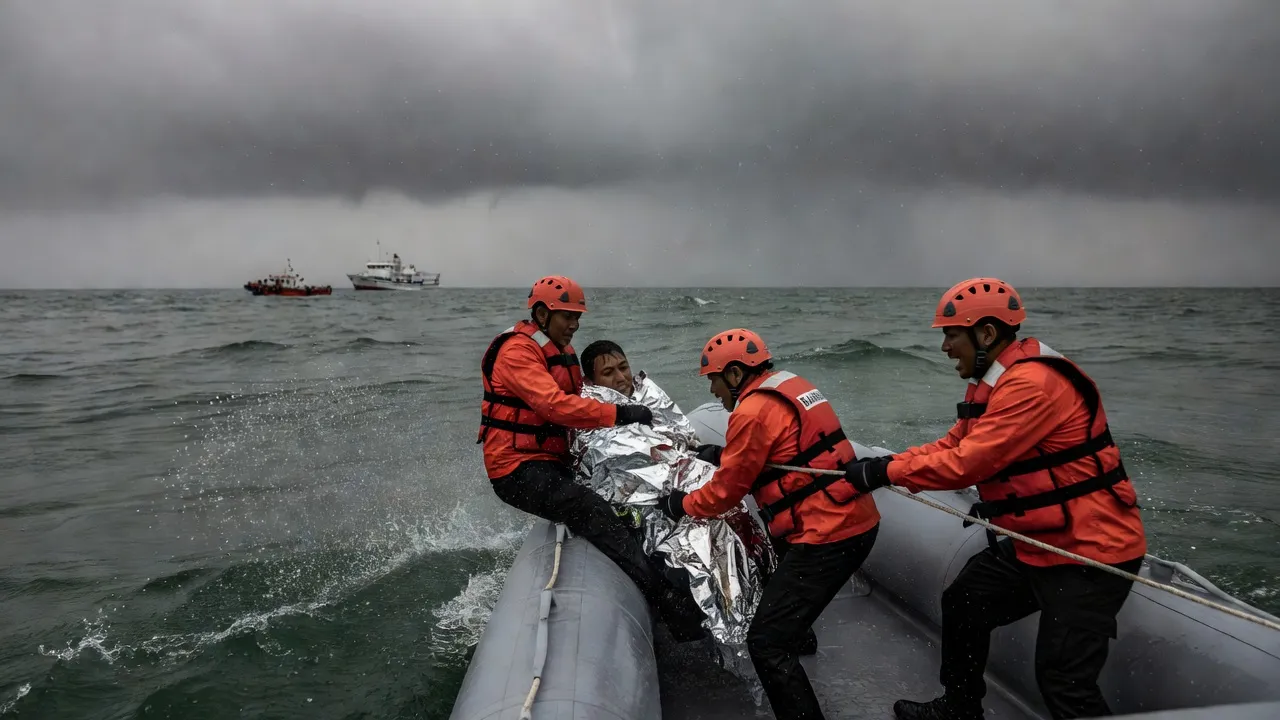
The Indonesian ferry Virgo Transport 8, which departed from Surabaya bound for Banjarmasin with around 243 people on board (213 passengers, 30 crew members), lost contact with authorities early Sunday, September 13, 2026, in the Java Sea, after encountering bad weather.
The Indonesian search and rescue agency (Basarnas), through its local head I Putu Sudayana, coordinated the rescue operations and released successive updates to the media.
Significant sea troughs, described as making operations particularly risky, are reported to have complicated both the ship's crossing and the search efforts.
Where it breaks apart
— Causal framing of the shipwreck — The majority of headlines link the shipwreck to Indonesian maritime safety standards deemed insufficiently applied in an archipelago dependent on ferries, while others focus solely on the rescue operation or note that the cause remains to be determined.
— Reliability of the 243 passenger figure — The Argentine and Russian press relays a structural doubt about the gap, frequent in Indonesia according to them, between the official number of passengers declared and the reality on board, while the majority of headlines reiterate the figure of 243 without reservation.
— Human or operational angle — The British press opens its account with the testimony of a family without news of relatives on board, while almost all other headlines focus their coverage on the rescue device and institutional reports.
The full text, country by country
Peru
DOMINANT ANGLE
Lima sees the sinking of the Virgo Transport 8 as a repeat of a structural flaw in Indonesia: precarious infrastructure, overloading, and poorly enforced safety standards, a scenario already witnessed in 2018.
KEY POINTS
The Virgo Transport 8, traveling from Surabaya to Banjarmasin with 243 registered individuals, stopped transmitting its position around 1am local time Sunday, amidst 2 to 2.5 meter waves, 80 nautical miles southwest of Basirih Banjarmasin.
The toll varies by source: RPP reported one dead, 102 survivors, and 140 people unaccounted for, while El Comercio later mentioned six dead, 107 survivors, and 130 missing.
RPP recalls that in 2018, over 150 people drowned in the sinking of a ferry on a lake in Sumatra, and attributes the frequency of these accidents to precarious infrastructure, overloading, and lax enforcement of safety standards.
ANALYSIS
Lima, September 13, 2026. Peru views the sinking of the ferry Virgo Transport 8 as a reproduction of a structural Indonesian flaw rather than a simple isolated accident. The ship, which departed from Surabaya, on the island of Java, bound for Banjarmasin, in southern Borneo, with 243 people registered on board according to the passenger manifest, stopped transmitting its position around 1 am local time on Sunday, in the middle of the Java Sea, while facing waves of 2 to 2.5 meters. Its last coordinates placed it about 80 nautical miles southwest of the town of Basirih Banjarmasin, according to the national search and rescue agency, Basarnas, quoted by RPP Noticias.
The toll has evolved over the hours and differs depending on the sources. RPP reported one dead and 102 survivors, with 140 people still unaccounted for according to the passenger manifest, without the regional director of Basarnas in Banjarmasin, Putu Sudayana, specifying the exact number of missing people. El Comercio, citing a later update from the agency, then mentioned six dead, 107 survivors, and 130 missing. Basarnas has mobilized several ships, with the support of the navy and the police, for a device considered a priority "given the relatively large number of passengers and crew members on board".
The Peruvian press sees the accident as part of a recurring series rather than an exception. RPP recalls that maritime accidents are frequent in Indonesia, due to precarious infrastructure, overloading of passengers and goods, lax application of safety standards, and weather conditions. The archipelago, composed of more than 17,000 islands and home to more than 270 million inhabitants, is structurally dependent on maritime transport, which explains the repetition of the phenomenon: in 2018, more than 150 people drowned in the sinking of a ferry on one of the deepest lakes in the world, in Sumatra. This historical reminder, present in both RPP dispatches, situates the drama of the Virgo Transport 8 in a continuity rather than a rupture, without any article mentioning sanctions or announced reforms by the Indonesian authorities.
Argentina
DOMINANT ANGLE
Buenos Aires views this sinking as a chronic problem rather than an isolated accident: overcrowded ferries, lax standards and unpredictable weather in the Indonesian archipelago.
KEY POINTS
The Virgo Transport 8 lost contact around 1-2 am Sunday after encountering 2-3 meter waves in the Java Sea, according to I Putu Sudayana (Basarnas Banjarmasin).
According to the manifest, 243 people were on board (213 passengers, 30 crew members) with 89 vehicles; the actual number of passengers often differs from the official record in Indonesia, note the media.
103 people have been evacuated, including one deceased, while around 140 were still being searched for, with eight vessels (including four from the navy) and two helicopters deployed.
ANALYSIS
Buenos Aires, September 13, 2026. The Indonesian ferry Virgo Transport 8, which departed on Saturday at 10:13 a.m. local time from Surabaya to Banjarmasin on the island of Borneo, stopped transmitting its signals between 1 and 2 a.m. on Sunday in the Java Sea, report Clarín, Infobae, and Perfil, citing the Indonesian search and rescue agency Basarnas. The captain had reported waves of 2 to 3 meters before the ship began to list, according to I Putu Sudayana, head of the Banjarmasin rescue office. The alert was transmitted by the general manager of the shipping company PT Virgo, Yoel Rihi, about two hours after contact was lost.
According to the manifest, 243 people were on board -- 213 passengers and 30 crew members -- as well as 89 vehicles, although, note the Argentine media, the actual number of passengers often differs from the official register in Indonesia. On Sunday, authorities confirmed that 102 to 103 people had been evacuated, including one deceased, while around 140 people remained missing according to the passenger list. Eight vessels, including four from the navy, and two helicopters were participating in the search around the last known position of the ship, 148 kilometers from the Basirih rescue pier.
The Argentine press links the episode to a broader problem: "maritime accidents are common in Indonesia due to precarious infrastructure, overloading of passengers and cargo, lax compliance with safety regulations, and inclement weather," recalls Infobae, highlighting that boats remain an essential means of transportation in an archipelago of more than 17,000 islands and 270 million inhabitants. Perfil mentions the 2018 shipwreck, which killed over 150 people, as a sign that the issue of maritime regulations remains unresolved.
Australia
DOMINANT ANGLE
Australia views this sinking as a structural signal rather than an isolated incident: the press in Sydney, Melbourne, and Perth soberly reports the human toll, but immediately emphasizes that the Indonesian archipelago operates under unevenly applied safety standards.
KEY POINTS
The Virgo Transport 8, which departed from Surabaya on Saturday at 10:13 for Banjarmasin, was carrying around 243 people and lost contact around 2 am Sunday in bad weather.
103 people were evacuated by various ships, one of whom died; 140 people were still being searched for on Sunday, according to I Putu Sudayana, local head of the search and rescue agency.
The archipelago of 17,000 islands relies heavily on ferries because sea links are more affordable and available than air travel, but safety standards are not always strictly enforced, according to cited reports.
ANALYSIS
Canberra, September 13, 2026. The Australian press reported on Sunday the sinking of an Indonesian ferry in the Java Sea, in a subdued manner, without much editorial commentary of its own — closely following the Reuters/AP wire picked up by several local titles. The Virgo Transport 8, which departed from Surabaya at 10:13 a.m. on Saturday and was headed to Banjarmasin, on the island of Borneo, was carrying around 243 people when it lost contact with its operator, PT Virgo Yoel Rihi, at around 2 a.m. on Sunday, in the midst of bad weather. The search and rescue office in Banjarmasin did not receive the report until two hours later. A rescue ship and a helicopter were dispatched to the last known position of the boat, about 148 kilometers from a dock in Banjarmasin.
According to I Putu Sudayana, head of the local branch of the search and rescue agency, cited by Australian titles, "the ship's operator reported the incident to the authorities after receiving information that the vessel had encountered bad weather." 103 people were evacuated by different ships — some of whom were taken to a port in East Java — and one person died. 140 people were still missing on Sunday.
Brazil
DOMINANT ANGLE
Brazil draws a parallel between this sinking and its own river territory, where the ferry remains, as in Indonesia, the most accessible mode of transport for millions of passengers without an air alternative.
KEY POINTS
The Virgo Transport 8 was carrying 243 passengers and crew members between Surabaya and Banjarmasin when it lost contact Sunday morning, according to Basarnas.
The reported toll includes at least six dead, 130 missing and 107 people rescued.
A reconnaissance helicopter confirmed that the ship had capsized, information relayed by Transport Minister Dudy Purwagandhi.
ANALYSIS
Brasília, September 13, 2026. The sinking of the Virgo Transport 8 in the Java Sea holds a lesson for Brazil that goes beyond the human toll: that of an archipelago where ferries remain, as in some Amazonian regions, one of the only affordable means of connecting islands.
According to the Basarnas, the Indonesian search and rescue agency, cited by Veja, UOL Notícias, and Folha de S.Paulo, the ship was carrying 243 passengers and crew members when it lost contact with the shipping company on Sunday morning, amidst deteriorating weather conditions. Having departed from Surabaya, in eastern Java, it was headed to Banjarmasin, in southern Kalimantan, on the island of Borneo. Its last known position was recorded about 15 kilometers from the destination port.
The toll reported by the Brazilian press mentions at least six dead, 130 missing, and 107 people rescued. The operations involve the Basarnas, the Navy, the Police, and the company responsible for the vessel. "Considering the relatively large number of passengers and crew on board, we are optimizing coordination with all relevant entities to speed up the search process," the rescue agency indicated, as cited by Veja.
According to Folha de S.Paulo and UOL, a helicopter flying over the area confirmed to the authorities that the ship had capsized, information relayed by the Minister of Transportation, Dudy Purwagandhi. An earlier update mentioned the complete sinking of the ship. The survivors were transferred to other vessels, with some to be taken to a port in eastern Java, according to the head of the local Basarnas office in Banjarmasin. Families of passengers gathered in Banjarmasin, the ferry's intended destination.
France
DOMINANT ANGLE
Paris draws from the sinking of the Virgo Transport 8 a reminder of the chronic flaws in Indonesia's maritime security, between a still uncertain human toll and tribute to local rescue efforts.
KEY POINTS
The Virgo Transport 8, which departed from Surabaya on Saturday for Banjarmasin, was carrying 243 people (213 passengers, 30 crew members), according to the Basarnas agency.
Indonesian Transport Minister Dudy Purwagandhi stated that the ship had turned over but had not sunk by 15:00, according to helicopter surveillance.
Rescue operations are being slowed down by waves reaching 2.5 metres, deemed "extremely risky for boats" by I Putu Sudayana, local rescue chief.
ANALYSIS
Paris, September 13, 2026. The French press is reporting hour by hour on the sinking of the Virgo Transport 8, a ferry that departed from Surabaya on the island of Java on Saturday to reach Banjarmasin on the island of Borneo, with 243 people on board — 213 passengers and 30 crew members, according to the national search and rescue agency, Basarnas. Contact was lost early Sunday morning in the Java Sea, about 150 kilometers from the port of destination.
Editorial offices are emphasizing the rapid deterioration of the situation. The captain of the ship had reported to the company, before losing contact, that the vessel was "tilting," according to I Putu Sudayana, local head of rescue operations. The Indonesian Minister of Transportation, Dudy Purwagandhi, later confirmed that the ship had capsized but had "not yet sunk" at 3 pm, according to helicopter surveillance.
The human toll is evolving with the news updates. Initial reports indicate one death and 102 to 103 people rescued out of the 243 on board. Later reports put the number of deaths at six and the number of missing at 129, with around 108 survivors. This ongoing update reflects the difficulty of the rescue efforts in establishing a stable count at sea.
French articles systematically link the accident to the structural vulnerabilities of Indonesian maritime transport. They recall that the archipelago, with more than 17,000 islands, is heavily dependent on its ferry connections, and that shipwrecks remain frequent "due in particular to insufficient safety standards and unpredictable weather conditions." Rescue operations are being hindered by waves reaching 2.5 meters: "It's extremely risky for the boats. Even our 40-meter Basarnas ship is in great danger," warned I Putu Sudayana.
Indonesia
DOMINANT ANGLE
Jakarta is coordinating a massive rescue effort in the Java Sea, mobilizing the Navy, police, Pelindo, and commercial vessels around the Virgo Transport 8 and its 243 passengers.
KEY POINTS
The Virgo Transport 8, which departed from Surabaya on Saturday with 243 people, lost contact around 2am Sunday in the Java Sea after severe weather, according to Basarnas.
Three merchant vessels (TB Mauhaw IX, TB TCP, MV Haida) rescued a total of 103 people, including one who did not survive, according to I Putu Sudayana, SAR chief of Banjarmasin.
A later report from Basarnas stated six deaths and 140 people still missing, on a ship also carrying 89 vehicles.
ANALYSIS
Jakarta, September 13, 2026. In Indonesia, the national press is following the rescue operation of the Virgo Transport 8, a passenger ship that departed from Surabaya on Saturday bound for Banjarmasin, the capital of South Kalimantan, with 243 people on board, hour by hour. The vessel lost contact around 2 am on Sunday, after encountering severe weather in the Java Sea, according to the search and rescue agency Basarnas.
I Putu Sudayana, head of the Banjarmasin search and rescue office, detailed the mechanics of the rescue at a series of press conferences: three merchant ships - the oil tanker TB Mauhaw IX, operated by Pertamina Patra Niaga, the tugboat TB TCP, from Transcoal Pacific, and the cargo ship MV Haida, operated by PT Virgo, the same company as the missing ship - have recovered a total of 103 people from the water, including one who did not survive. The survivors were distributed between the port of Tuban in East Java and the port of Trisakti in Banjarmasin. "We have made efforts to search for victims with the maximum means," Sudayana said.
Basarnas has deployed a joint device: the helicopter HR-3601 from the Juanda naval airbase with five crew members and two rescuers, the ship KN SAR 249 Permadi, the KN SAR Laksmana 241, as well as the warship KRI Nala and the navigation vessel KM Kunyit. The East Java water and air police have also been mobilized. The last known position of the ferry was about 80 nautical miles from the Basirih SAR dock.
India
DOMINANT ANGLE
New Delhi is gauging the scope of the search operation underway in the Java Sea, where more than 240 passengers of the Virgo Transport 8 remain unaccounted for after contact was lost during a severe storm.
KEY POINTS
The Virgo Transport 8 left Surabaya on Saturday, September 12, at 10:13 a.m., headed for Banjarmasin, with more than 240 people on board.
Contact with the ship was lost around 2 a.m. Sunday after encountering bad weather; its last known position was 148 km from a Banjarmasin dock.
The Banjarmasin Search and Rescue Bureau, led by I Putu Sudayana and Arianto Ardi, deployed an operations post and a search vessel despite difficult weather conditions.
ANALYSIS
New Delhi, September 13, 2026. The Indian press is relaying without hesitation the alert issued by the Indonesian authorities on Sunday: the Virgo Transport 8, a passenger ship that left Surabaya on Saturday at 10:13 am bound for Banjarmasin, in South Kalimantan, lost all contact with land around 2 am after encountering bad weather in the Java Sea. More than 240 people were on board, according to information reported by the Free Press Journal and the Deccan Chronicle, citing respectively Reuters and AFP.
The Search and Rescue Office of Banjarmasin, the capital of the province of South Kalimantan, received the report about two hours after the loss of contact. The last known position of the ship was 148 kilometers from a Banjarmasin dock, specify the two Indian titles, which describe a device deployed "despite difficult weather conditions": an operations post was established and a search ship sent to the last known location of the Virgo Transport 8.
Indian media name the local officials in charge, the head of SAR Banjarmasin, I Putu Sudayana, and the head of operations, Arianto Ardi, a sign of coverage that prioritizes the rescue command chain over the profile of passengers or the responsibilities of the shipowner. No victim toll was available at the time of these initial reports, the two articles insist, which present the situation as an ongoing development, with the promise of new updates from the Indonesian authorities.
Malaysia
DOMINANT ANGLE
Kuala Lumpur takes away from this shipwreck a familiar regional lesson: in an archipelago where the ferry remains the cheapest daily transportation, bad weather and lax safety standards form a recurrent deadly cocktail.
KEY POINTS
The Virgo Transport 8 was carrying 243 people (213 passengers, 30 crew members) on the Surabaya-Banjarmasin route, according to Basarnas.
The captain had reported that the ship was "listing" before losing contact around 2 am Sunday, reports I Putu Sudayana.
Basarnas revised its tally to six confirmed dead, 108 survivors, and 129 missing, compared to an initial count of 103 evacuated and one dead.
ANALYSIS
Kuala Lumpur, September 13, 2026. The Malaysian press is closely following the sinking of the Virgo Transport 8 in the Java Sea, where the toll of Indonesian rescue efforts continued to worsen on Sunday. The ferry, which departed from Surabaya on Saturday bound for Banjarmasin in South Kalimantan, was carrying 243 people — 213 passengers and 30 crew members, according to Basarnas, the national search and rescue agency. It lost contact with its operator around 2 am after encountering bad weather; its captain had reported just before that the boat was "tilting", according to I Putu Sudayana, the head of the Banjarmasin rescue office, as quoted by The Sun and Malay Mail.
The rescue efforts initially reported 103 people evacuated, including one who died, while 140 were still being searched for. Transport Minister Dudy Purwagandhi later confirmed, during a press conference in Banjarmasin, that the ferry had capsized, spotted by helicopter about 80 nautical miles from its destination, with the hull still visible above the water. Basarnas revised its toll upwards: six confirmed dead, 108 survivors, and 129 missing, according to its latest update. The Laksmana 241 ship and two helicopters were deployed to face waves reaching 2.5 meters. "It's extremely risky for ships. Even our 40-meter boat is in great danger," Sudayana warned.
The Malaysian press is emphasizing the repetition of these tragedies: a ferry fire killed one person and left five missing last month, and a speedboat carrying journalists disappeared near the Anak Krakatau volcano. It also notes the navigation permit, issued by the Surabaya port office (KSOP) before departure. Indonesia, an archipelago of more than 17,000 islands, relies heavily on maritime links, which are cheaper than air travel, while safety standards, according to these media outlets, are not always strictly enforced — a factor they place, along with unpredictable weather, at the heart of the explanation for the sinking.
Nepal
DOMINANT ANGLE
Kathmandu takes away a familiar security lesson from this shipwreck: in an archipelago that relies on ferries, bad weather shows no mercy when standards are not followed.
KEY POINTS
The Virgo Transport 8, which departed from Surabaya with 243 people, including 30 crew members, lost contact around 2 am Sunday in the Java Sea.
The toll has evolved from 103 evacuated and 140 missing (initial report) to 6 dead and 129-130 missing for 107-108 survivors (updated toll from Ratopati/Kathmandu Post).
The captain had reported a leak before losing contact, and the head of rescue operations in Banjarmasin described 2.5-meter waves making the operation very risky.
ANALYSIS
Katmandou, September 13, 2026. Nepal's media have reconstructed the sinking of the Virgo Transport 8 hour by hour, which set sail on Saturday from Surabaya (East Java) to Banjarmasin (South Kalimantan) with 243 people on board, including 30 crew members. The ship lost contact around 2 am on Sunday in the Java Sea, in bad weather, about 150 kilometers from its destination. Khabarhub reports that a six-person rescue team was dispatched, with an estimated five-hour journey to reach the ship's last known position.
The Kathmandu Post initially reported 103 people evacuated, including one deceased, with 140 people still being searched for. The toll then worsened: Ratopati and The Kathmandu Post reported 6 deaths and 129 to 130 missing, with 107 to 108 survivors. Indonesian Transport Minister Dudy Purwagandhi stated that a surveillance helicopter saw the ship overturned, "not yet sunk at 3 pm, but overturned". The head of the Banjarmasin rescue office, I Putu Sudayana, had previously revealed that the captain had reported a "breach" before losing contact, and described 2.5-meter waves making the operation "extremely risky", with his own 40-meter ship "in great danger".
A passenger, Putri, told The Kathmandu Post that she lost phone contact with her husband Herman on board: "after that, no more contact, we couldn't reach him anymore". Families have gathered in Banjarmasin waiting for news.
Pakistan
DOMINANT ANGLE
Islamabad sees in the sinking of the Virgo Transport 8 a symptom of a structural problem: inadequately enforced maritime safety standards in an archipelago that relies on ferries for its daily transportation.
KEY POINTS
103 people were evacuated, one of whom died after being rescued, according to I Putu Sudayana, head of the Banjarmasin SAR office
140 people were still missing on Sunday, out of the 243 passengers and crew members of the Virgo Transport 8
The archipelago of 17,000 islands relies heavily on ferries, which are more affordable than planes, but safety standards are not always strictly enforced, according to Business Recorder and Geo News
ANALYSIS
Islamabad, September 13, 2026. The sinking of the Virgo Transport 8, an Indonesian ferry that departed from Surabaya on Saturday bound for Banjarmasin with 243 passengers and crew members, holds the attention of Pakistanis less as a distant news item than as a reminder of a vulnerability shared by all countries where the boat remains, due to a lack of affordable alternatives, the daily means of transportation.
The ship lost contact with its owner early Sunday in the Java Sea, while facing bad weather conditions, according to the Indonesian search and rescue agency. Its last known position was about 150 kilometers from Banjarmasin. "We received the report of the loss of contact with the Virgo Transport 8 and immediately deployed personnel and the ship KN SAR Laksmana 241 to the last estimated position," said I Putu Sudayana, head of the Banjarmasin search and rescue office, quoted by ARY News and Business Recorder. "Given the relatively large number of passengers and crew on board, we are optimizing coordination with all parties concerned to accelerate the search and ensure the safety of all," he added. The navy, police, and shipping company have been mobilized, with ships and a helicopter.
On Sunday, 103 people were evacuated by different ships; one of them died after being rescued, the official said. 140 people were still being searched for at the end of the day, without the authorities indicating what had really happened to the ship.
Russia
DOMINANT ANGLE
Moscow first retains doubts about the actual number of passengers on the Indonesian ferry, an archipelago where the official list often deviates from the reality on board.
KEY POINTS
Around 130 people remain missing and six bodies have been retrieved from the water, according to Interfax citing Indonesian rescuers and the AP
The captain reported waves of up to three metres before sending out a distress signal; the ship listed and then capsized, according to Transport Minister Dudi Purwagandhi as quoted by Vedomosti
Interfax notes that in Indonesia "the actual number of passengers often differs from the official list", the 243 people announced to be on board remaining an unofficial figure
ANALYSIS
Moscow, Sunday, September 13, 2026. Interfax, Vedomosti, and TASS have been reporting since morning on the sinking of the Virgo Transport, a ferry that departed from Surabaya, in eastern Java, bound for Banjarmasin, in southern Kalimantan. According to Interfax, citing the Associated Press and Indonesian rescuers, around 130 passengers and crew members remain missing, while at least 107 people have been evacuated and six bodies have been retrieved from the water. TASS, quoting Reuters, reports that 103 people have been evacuated out of the 243 announced to be on board, with no further details at this stage.
Russian agencies are emphasizing the discrepancy between official figures and the reality on the ground: "officially, 243 people were on board — 213 passengers and 30 crew members. However, in Indonesia, the actual number of passengers often differs from the official list," Interfax notes. The captain had reported waves reaching three meters before sending out a distress call, and then informed authorities that the ship was starting to list. The vessel then apparently capsized before sinking, Vedomosti reports, quoting Indonesian Transport Minister Dudi Purwagandhi: the causes of the tragedy are still to be determined, but the ship "capsized and did not sink." Rescue ships, including a military vessel, as well as a helicopter, have been dispatched to the area.
United Kingdom
DOMINANT ANGLE
London first remembers the faces and the families: the testimony of Rusmilawati, at the dock in Banjarmasin, with no news of eight loved ones who boarded the missing ferry.
KEY POINTS
The Virgo Transport 8, which departed from Surabaya on Saturday at 10:33 for Banjarmasin, lost contact early Sunday in the Java Sea with 243 people on board (213 passengers, 30 crew members), according to the BBC
The Guardian reports, via I Putu Sudayana from the Banjarmasin search and rescue agency, 103 people evacuated including one dead, and 140 still being searched for
280 rescuers, ships, and a helicopter have been mobilized in a joint operation involving the search and rescue agency, the navy, and the maritime police, according to the BBC
ANALYSIS
London, 13 September 2026. The UK government is closely following the situation of the Indonesian ferry Virgo Transport 8, which lost contact with authorities early Sunday in the Java Sea, approximately 150 km south of its destination, Banjarmasin, while facing bad weather. The ferry, which departed from Surabaya on Saturday at 10:33, was carrying a total of 243 people - 213 passengers and 30 crew members. According to the authorities, cited by the BBC, six people have been confirmed dead, 130 are missing, and 107 have been rescued. However, The Guardian reports a different toll: 103 people evacuated, including one dead, and 140 still being searched for, according to I Putu Sudayana, head of the Banjarmasin search and rescue office. This discrepancy, typical of the early hours of an ongoing catastrophe, is due more to the confusion of field reports than to a fundamental difference.
The British press is focusing on the wait of the families. Rusmilawati told the BBC that her relatives, who had returned from a pilgrimage to the tombs of several Islamic scholars in Java, had chosen the boat for the return trip after flying there. The last sign of life received was a WhatsApp status. By Sunday afternoon, she had still not received any official information about their fate.
United States
DOMINANT ANGLE
The United States capital links this shipwreck to a structural problem: rarely applied maritime safety standards in the Indonesian archipelago, despite the country's dependence on ferries.
KEY POINTS
The captain had reported waves reaching 3 meters before a distress message indicated the ship was listing, according to I Putu Sudayana as cited by NPR
The toll has evolved from "no reported casualties" (ABC News, Fox News) to around 130 missing, 107 rescued, and 6 bodies found (NPR)
HuffPost/Reuters notes that Indonesia, an archipelago of 17,000 islands, relies on ferries but that safety standards are not always strictly enforced there
ANALYSIS
Washington, September 13, 2026. American newsrooms are reporting on the ill-fated crossing between Surabaya and Banjarmasin, on the island of Borneo, where the Virgo Transport 8 lost contact early in the morning in the Java Sea. According to NPR, which cites I Putu Sudayana, head of the search and rescue office in Banjarmasin, the captain had reported rough seas, with waves reaching 3 meters, before sending a distress message indicating that the ship was listing. The authorities then learned that the vessel had capsized and sunk.
The toll is evolving hour by hour in the American press. The initial reports from ABC News and Fox News, both based on the Associated Press, indicated on Sunday that no casualties had been reported immediately, with the manifest listing 241 passengers. The update from NPR, published on the same day, revises this figure upward: around 130 people were still missing, at least 107 had been rescued, and six bodies had been found, with the search operation extending around the last known position of the ferry, 148 kilometers from a dock in Banjarmasin.
HuffPost, which picks up a Reuters dispatch dated from Jakarta, puts the accident into a broader problem: Indonesia, an archipelago of 17,000 islands, heavily relies on ferries as a key means of transportation, with maritime links being more affordable and available than air transport, but safety standards are not always strictly enforced, resulting in a relatively high accident rate. The ship, operated by PT Virgo Yoel Rihi, had left Surabaya on Saturday at 10:13 local time, according to ABC News, before disappearing from screens two hours before the alert was transmitted to the rescue services.
Explore every perspective on this subject across 13 countries.
Indonesian ferry with 243 aboard loses contact in the Java Sea, 103 people rescued
published on
September 13, 2026
13
countries
35
sources
47
articles
15%
gap
The Indonesian ferry Virgo Transport 8, which departed from Surabaya on Saturday, September 12, 2026, with 243 people on board (213 passengers, 30 crew members) bound for Banjarmasin, lost contact with authorities around 2 am on Sunday, September 13, in the Java Sea, due to bad weather. The Indonesian search and rescue agency (Basarnas) launched a rescue operation. Merchant ships evacuated 103 people, one of whom died, while rescue teams were still searching for dozens of people on Sunday.
The toll remains uncertain and evolving according to Basarnas updates, with between 129 and 140 people still missing according to sources.
The state of the ship
Located in the afternoon, the ferry turned over but had not sunk by 3:00 PM, according to helicopter surveillance.
The rescue operation
280 rescuers, navy ships, and a helicopter are taking part in a joint operation.
The families
In Banjarmasin, a resident is waiting for news of eight relatives who were on board the ferry.
Understand the context
SEP 12, 2026
The Virgo Transport 8 sets sail from Surabaya to Banjarmasin
SEP 13, 2026
The ship loses contact in the Java Sea due to bad weather, rescue efforts underway
Key figures
243
People on board according to the manifest: 213 passengers and 30 crew members
For Buenos Aires, the focus is less on the individual responsibility of the shipping company than on this repeated pattern -- overloading, weather, insufficient controls -- which regularly affects inter-island connections in Indonesia.
The titles in Sydney, Melbourne, and Perth all emphasize the same contextual point, almost word for word from a common dispatch: Indonesia, an archipelago of 17,000 islands, is structurally dependent on ferries as a mode of transportation, with maritime links remaining more affordable and available than air travel. However, they add, safety standards are not always rigorously applied, which explains the relatively high accident rate. No commentary is added on the responsibility of the shipowner or the Indonesian state: the Australian coverage remains descriptive, driven by the agency, without local investigation or official reaction from Canberra. The exact fate of the ship itself is not specified in the relayed versions.
The Brazilian press emphasizes a structural point: Indonesia, an archipelago of approximately 17,000 islands, heavily relies on ferries for passenger transportation, these maritime routes being considered more accessible and available than air travel. A finding that resonates in Brazil, where river connections in the Amazon play a comparable role for populations without affordable air alternatives. The exact causes of the sinking remain to be determined, with Indonesian authorities currently pointing to bad weather as the triggering factor.
At the port of Banjarmasin, relatives of the passengers are scanning the lists of survivors. Jenah, 26, who came to seek news of her brother who was traveling alone, sums up the wait: "I'm saddened and very shocked [...] I hope he survived."
Locally, attention is also focused on the reception of survivors: the South Kalimantan regional police have placed trauma units and emergency services on alert, according to spokesperson Nur Khamid, who mentions ongoing coordination to ensure a rapid medical response.
At the end of the day, a heavier toll emerged: Basarnas reported six dead and 140 people still missing, on a ship carrying 89 vehicles for a total of 243 people. The cause of the accident, whether natural, technical, or human factors, remains to be determined by the authorities.
This factual sobriety, based on dispatches from Western agencies almost identical to those reproduced by the two titles, situates the shipwreck in the usual register of maritime dramas in the Indonesian archipelago, without establishing a parallel with other regional accidents or questioning the safety regulations of local ferries. The emphasis is on the search effort engaged at sea rather than on the causes of the loss of contact or its potential political consequences, an entry point that reflects the geographical distance of the Indian reader from this event, treated as international news to follow rather than as a subject directly involving Indian nationals.
The Kathmandu Post emphasizes the structural context: Indonesia, an archipelago of 17,000 islands, heavily relies on ferries, a more affordable and accessible maritime solution than planes, but where "safety standards are not always strictly enforced", resulting in a relatively high accident rate. For the Nepalese press, it is this regulatory fragility, more than the sole weather episode, that structures the narrative.
The Pakistani press, via Business Recorder and Geo News, reports a broader finding than the incident itself: Indonesia, an archipelago of 17,000 islands, is heavily dependent on ferries as a key mode of transportation, with maritime links being more affordable and accessible than air travel. But, these same articles emphasize, safety standards are not always strictly enforced, resulting in a relatively high accident rate.
This finding resonates with a readership familiar with the same trade-offs between cost and safety in public transportation. Pakistani articles also recall, in the background, the recent sinking of a ferry in the Philippines, where the fire's death toll rose to 76, a sign that maritime fragility goes beyond a single Southeast Asian country and raises, more broadly, the question of how island states enforce their own rules.
Vedomosti recalls a recent precedent off the coast of Cyprus: on August 30, a ferry from the company Filo Denizcilik capsized near Kyrenia with 279 people on board; nine died, including one Russian citizen. The newspaper thus highlights that the maritime safety of passenger links goes beyond the sole Indonesian case and directly concerns Russian nationals. The three agencies finally note that Indonesia, an archipelago of more than 17,000 islands, is structurally dependent on ferry transport to connect its populations, which explains the frequency of this type of accident in bad weather.
Operationally, 280 rescuers, ships, and a helicopter have been deployed in a joint operation involving the Indonesian search and rescue agency, the navy, and the maritime police. All vessels present in the Java Sea have been asked to report any signs of survivors.
The Guardian puts the event into a broader context: Indonesia, an archipelago of 17,000 islands, is heavily dependent on ferries, which are a cheaper and more accessible mode of transport than planes, but where safety standards are not always strictly applied, resulting in a relatively high accident rate. Neither of the two publications mentions at this stage any responsibility of the shipowner or an official investigation into the causes of the sinking.
Four vessels, including a naval ship, and a helicopter have been mobilized to find the ferry, according to Indonesian authorities cited by all the American titles consulted.