
DOMINANT ANGLE
Seoul sees the launch as a new military threshold following the DMZ mines: a combined defense posture with Washington and Tokyo, an emergency meeting at the presidency, and a dialogue with Lee Jae-myung rejected by Kim Yo-jong.
Dominant angle identified — does not reflect unanimity of this country’s media
KEY POINTS
- 01
The JCS detected the launch at around 6:30 from the Wonsan area; the missile traveled over 700 km before falling into the sea.
- 02
The National Security Office of the presidency held an emergency meeting and deemed the launch a violation of UN resolutions.
- 03
According to KBS and the Korea Herald, this is the 15th North Korean ballistic missile launch of the year, thirteen days after the one on September 20.
ANALYSIS
Seoul, October 3, 2026. North Korea fired a ballistic missile into the East Sea, the Korean name for the Sea of Japan, on Saturday. The Joint Chiefs of Staff (JCS) said it was detected at around 6:30 am from the Wonsan area; the missile traveled over 700 kilometers before falling into the sea. According to Yonhap, the military is analyzing its characteristics with the United States and does not rule out either a medium-range missile or an intermediate-range missile. "It is possible that the North fired a reduced-range IRBM," a government source said, drawing a comparison to the August 12 launch, which occurred in protest against the Ulchi Freedom Shield exercise.
The JCS claims to have strengthened surveillance in anticipation of potential additional launches and is sharing information with Washington and Tokyo. The National Security Office of the presidency, at Cheong Wa Dae, held an emergency meeting: it judges the launch to be in violation of UN Security Council resolutions and demands that Pyongyang put an immediate end to it.
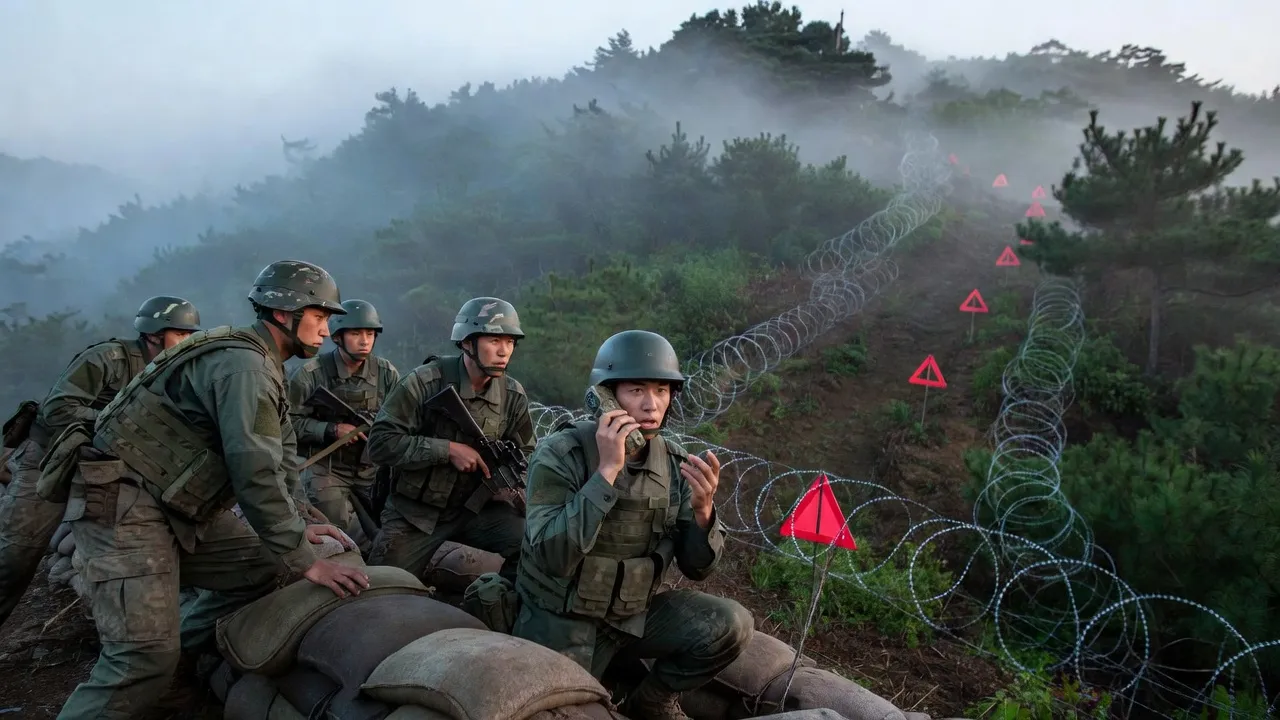
The South Korean press is putting the launch into the context of the DMZ. The explosion of North Korean mines on September 21 injured three South Korean soldiers, two of them seriously; the military sees this as a "flagrant violation" of the armistice and is demanding apologies as well as a halt to fortification work. Kim Yo-jong denied any responsibility on Wednesday, then repeated this through the KCNA on Friday, October 2: the fortification aims to "close the door forever," she said, and Seoul's call for calm would be "the height of absurdity."
The political aspect remains present. On Thursday, during the 78th Armed Forces Day, Lee Jae Myung promised to pursue "concrete measures" to reduce military tensions. According to KBS, Kim Yo-jong also described the proposal for dialogue by Unification Minister Chung Dong-young as an "illusion" that does not deserve a response.
The Korea Times is devoting a feature to the fortification: launched in 2024, it is expected to be completed around 2028; only about 250 of the original 1,292 markers would remain along the 248 km demarcation line, and North Korean troops would have crossed it around 20 times in August and 30 times in September. The Korea Herald and KBS are counting this launch as the 15th ballistic missile launch of the year, 13 days after the two short-range missiles on September 20.
SOURCES (4)
- YonhapMEDIUM
- Korea TimesMEDIUM
- KBS WorldMEDIUM





