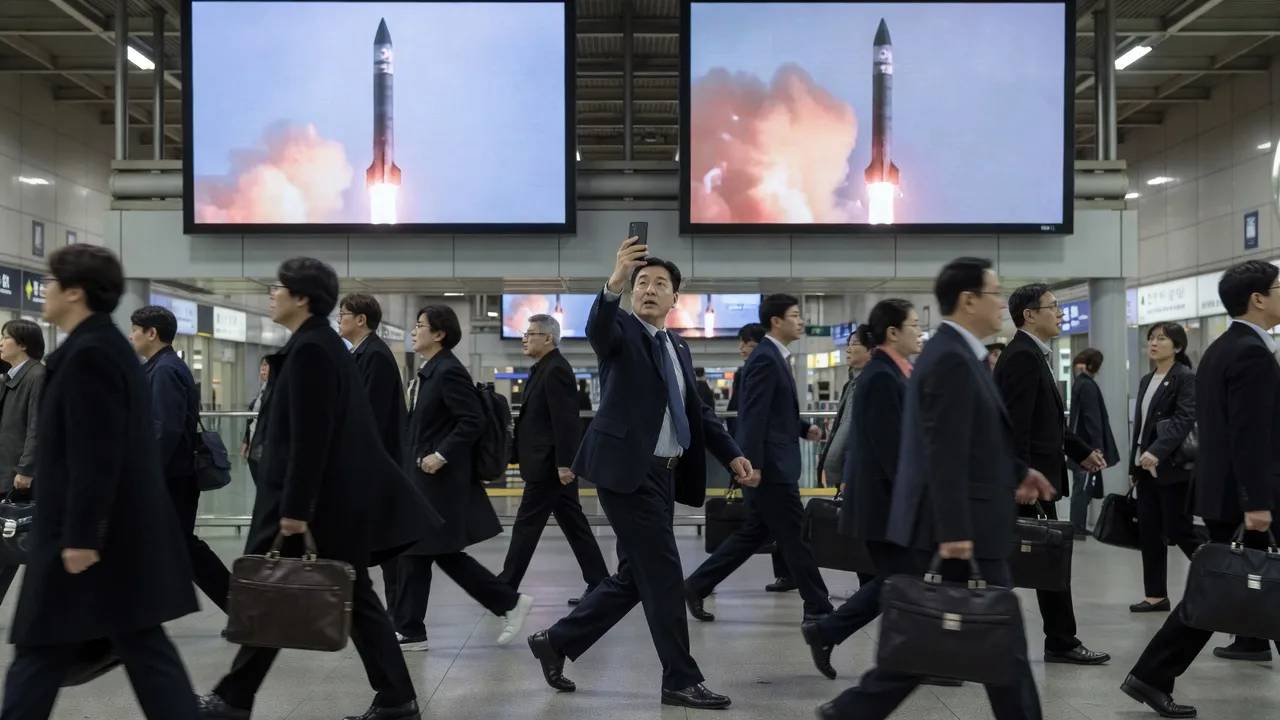
Common ground and differences in coverage across the media analysed.
What the media report in common
1
On October 12, several North Korean ballistic missiles were fired from the Pyongyang region, according to the South Korean military, as cited by the seven sources.
2
According to the South Korean military, one of the missiles traveled approximately 900 kilometers, or more according to some sources.
3
The firings are linked to the South Korean test of a hypersonic weapon, which was conducted a few days earlier.
Where media coverage diverges
Reading the Shot: Response to South's Test
South Korean, Philippine, and Pakistani media present the shot as a response to South Korea's hypersonic test, citing Seoul's general staff. German, Russian, and Swedish media stick to the facts, without offering this interpretation.
Paris sees these shots as a new episode in an arms technology race between Pyongyang and Seoul, between a hypersonic glider and a missile said to be equipped with AI.
Seoul is taking a strong security and institutional response: the general staff on high alert, an emergency meeting of the National Security Office, and the North Korean shots presented as a response to the South Korean hypersonic glider.
Berlin is recording the latest North Korean salvo as another link in a series of ballistic tests, according to South Korean and Japanese sources.
KEY POINTS
According to Yonhap, citing the South Korean military, the missiles fired from the Pyongyang region traveled approximately 900 kilometers towards the Sea of Japan.
NHK reports, based on government sources, that the projectiles fell outside Japan's exclusive economic zone.
The South had tested its first hypersonic glider last Thursday; a mine at the border injured three South Korean soldiers, which Pyongyang disputes.
ANALYSIS
Berlin, October 12, 2026. The German press is reporting on the event in a news agency dispatch, without extended commentary. Tagesschau and Handelsblatt report that North Korea has launched "again several ballistic missiles" from the Pyongyang region, towards the Sea of Japan, which the South Koreans call the East Sea. According to the Yonhap agency, citing the South Korean Joint Chiefs of Staff, the devices traveled approximately 900 kilometers. The Japanese channel NHK, relying on government sources, indicates that they fell outside Japan's exclusive economic zone.
The two titles emphasize what they do not know: the types of missiles are unknown and Pyongyang has made no statement. Tagesschau writes that "the background remains unclear", the background thus remaining uncertain.
The context is given in a few lines. Last Thursday, the South tested its first hypersonic glider, a system that allows for precision strikes by surprise, according to its government. Tensions had already risen before this test: a mine laid at the heavily fortified border injured three South Korean soldiers. Seoul sees this as a North Korean mine; Pyongyang disputes this version.
The series is placed in the calendar: a launch from the Wonsan port region on October 3, then at least one ballistic missile on September 20, which fell into the Sea of Japan. Handelsblatt, whose dispatch is dated from Beijing, adds that, according to experts, Pyongyang is thus seeking to develop its military capabilities and demonstrate its strength, with North Korea regularly testing ballistic missiles.
The German account therefore remains factual and focused on the sequence of tests and regional security. It does not mention any reaction from Berlin or diplomatic initiative, and does not provide technical details about the launched devices.
France
DOMINANT ANGLE
Paris sees these shots as a new episode in an arms technology race between Pyongyang and Seoul, between a hypersonic glider and a missile said to be equipped with AI.
KEY POINTS
On Monday, October 12, at around 9:20 a.m., the South Korean military detected several ballistic missiles fired from the Pyongyang region towards the East Sea.
Seoul tested its first domestically made hypersonic cruise missile on Thursday, after a North Korean hypersonic missile launch that Pyongyang said utilized AI.
A joint investigation by Seoul and the UN concluded that the North had laid the mines in the DMZ that injured three South Korean soldiers; Pyongyang denies it.
ANALYSIS
Paris, October 12, 2026. The French press reports that North Korea fired several ballistic missiles on Monday, October 12, from the Pyongyang region towards the East Sea, the Korean name for the Sea of Japan. "Our military detected several ballistic missiles fired from the Pyongyang region [...] at 9:20 am," or 2:20 am in Paris, indicated the South Korean Joint Chiefs of Staff, which has strengthened "surveillance and vigilance in the face of possible additional firings." Initially, the military had reported a "unidentified projectile." According to France 24, Tokyo has separately confirmed the firing of at least one presumed ballistic missile.
French newspapers are framing these firings as part of an arms sequence. On Thursday, Seoul tested a hypersonic glider vehicle, its first such weapon manufactured on its territory. Le Monde and Sud Ouest explain that these gliders, sent into the high atmosphere by rocket propellers, dive towards their target at a speed at least five times that of sound. This test followed a North Korean firing of an intermediate-range hypersonic missile, which Pyongyang says has been equipped with artificial intelligence.
The account focuses on North Korean statements. Kim Yo-jong, the leader's sister, presented this missile as "capable of modifying its flight trajectory at low altitude" and assured that "there is no way to avoid an attack by this type of missile," without detailing the role of AI. Kim Jong-un, for his part, claimed that "no country in the world could have access to such technology for at least several years." Sud Ouest devotes a subheading to "a technological arms race."
South Korea
DOMINANT ANGLE
Seoul is taking a strong security and institutional response: the general staff on high alert, an emergency meeting of the National Security Office, and the North Korean shots presented as a response to the South Korean hypersonic glider.
KEY POINTS
The JCS detected the launch at around 9:20 am from the Pyongyang region; at least one missile flew over 900 km (Yonhap).
The National Security Office demanded an immediate halt to the launches, calling them "serious" violations of UN resolutions (spokesperson Kang Yu-jung).
The JCS sees the launch as a protest against the first South Korean test of a hypersonic glider on Thursday, and a showcase of the achievements of the North Korean five-year plan.
ANALYSIS
Seoul, October 12, 2026. South Korea's Joint Chiefs of Staff (JCS) reported that North Korea fired multiple ballistic missiles into the East Sea on Monday, detecting the launch at 9:20 a.m. from the Pyongyang region. At least one missile traveled over 900 kilometers. Yonhap described it as an "apparent show of force" in response to South Korea's recent successful test of a hypersonic missile.
JCS spokesperson Jang Do-young provided an initial analysis, suggesting the launch was a protest against the successful test of the South Korean hypersonic glide vehicle (HGV), as well as a showcase of the achievements of North Korea's five-year defense plan and a deliberate demonstration of its capabilities. When asked about the nature of the missiles, whether hypersonic or intermediate-range, he declined to comment, citing the need for the military to further analyze the launch characteristics. The JCS assured that it has strengthened its surveillance, maintained a posture of total readiness, and shared information with the United States and Japan.
The presidential office responded through the National Security Office, which held an emergency meeting with the Ministry of Defense and the JCS, demanding an immediate halt to the missile launches. According to spokesperson Kang Yu-jung, these repeated launches are "serious acts that violate UN Security Council resolutions" and do nothing to help manage the situation on the peninsula. The office called for all necessary measures to be taken.
Philippines
DOMINANT ANGLE
Manila relays the ballistic escalation on the Korean peninsula through Seoul and Tokyo's dispatches, presenting it as a North Korean response to the South's hypersonic test.
KEY POINTS
According to the South Korean military, the missiles were fired around 9:20 am near Pyongyang, with one of them traveling over 900 km.
GMA News reports this as North Korea's fourth launch in a month, following the South Korean hypersonic test supervised by Lee Jae Myung.
Interaksyon notes that Pyongyang has conducted missile tests over 10 times this year, with the most recent ballistic launch dating back to October 3.
ANALYSIS
Manille, October 12, 2026. Philippine media outlets are reporting the information as provided by news agencies from Seoul and Tokyo: on Monday, North Korea fired several ballistic missiles into the sea off its east coast. According to the South Korean Joint Chiefs of Staff, the launches took place around 9:20 a.m. local time (0020 GMT) from the vicinity of Pyongyang. The devices "appeared to be of different types" and one of them traveled more than 900 kilometers, GMA News specifies. Earlier, the Japanese coast guard had mentioned two unidentified projectiles, presumed to be ballistic, which had already fallen.
The account places these launches in a sequence. GMA News sees this as the fourth North Korean launch in a month, just a few days after the first test of a South Korean hypersonic missile, supervised by President Lee Jae Myung, "a rare public display" of such a test by a South Korean head of state. A South Korean Joint Chiefs of Staff spokesperson reads this as "a show of force" in response to this test, as well as a deliberate demonstration of ballistic capabilities. The South Korean National Security Office held an emergency meeting and condemned violations of UN Security Council resolutions, calling for an immediate halt to the launches.
The articles also recall the precedent of October 3. The KCNA agency had then spoken of a hypersonic missile tested under the supervision of Kim Jong Un, while Kim Yo Jong, the leader's sister, had described a test of a medium-range strategic missile. Interaksyon emphasizes that Pyongyang has conducted missile launches more than ten times this year.
Pakistan
DOMINANT ANGLE
Islamabad sees these launches as an episode in the technological race between the two Koreas, where every hypersonic test prompts an immediate response.
KEY POINTS
According to the South Korean military, several ballistic missiles were fired around 9:20 from the Pyongyang area, one covering more than 900 kilometres (ARY News, Business Recorder).
Business Recorder notes that this is the fourth North Korean launch in a month, following the one on October 3, and it comes after South Korea's first hypersonic test supervised by President Lee Jae Myung.
Daily Times reports that South Korean officials have not confirmed whether they were intermediate-range missiles or hypersonic weapons, as trajectory analysis is underway.
ANALYSIS
Islamabad, October 12, 2026. Pakistani media, including ARY News (quoting AFP), Daily Times, and Business Recorder, are treating the North Korean missile launch on Monday, October 12, as a new escalation in the technological rivalry between Pyongyang and Seoul.
The reported facts are consistent. At around 9:20 a.m. local time, the South Korean Joint Chiefs of Staff detected "several ballistic missiles" fired from the Pyongyang region towards the East Sea, also known as the Sea of Japan. One of the missiles traveled more than 900 kilometers. Business Recorder specifies that the missiles appeared to be of different types and that this is the fourth North Korean launch in a month. According to Daily Times, the projectiles fell outside Japan's exclusive economic zone, without causing damage to ships.
The dominant framework is that of response. Daily Times writes that military analysts see this as "a direct response" to the test of South Korea's first hypersonic glider, which was conducted last Thursday, and concludes that this rapid counter-test "underscores an escalating cycle of military deterrence". Business Recorder quotes a South Korean Joint Chiefs of Staff spokesperson, who says these launches are "a show of force" in response to the success of Seoul's hypersonic missile. The same article notes that it is rare for a South Korean president, in this case Lee Jae Myung, to publicly oversee such a test.
Russia
DOMINANT ANGLE
Moscow soberly relays the North Korean shots of October 12 from the sole South Korean and Japanese sources, incorporating them into the series of tests opened on October 3.
KEY POINTS
According to the South Korean military as reported by TASS, several ballistic missiles were fired around 9:20 am near Pyongyang and traveled approximately 900 km.
According to the Japanese Ministry of Defense as cited by Vedomosti, two missiles were launched at 9:20 am and 9:40 am, falling outside Japan's exclusive economic zone, with no known damage.
The last previous North Korean launch dated back to October 3: a medium-range strategic missile fired from the Wonsan region, in the presence of Kim Jong-un according to KCNA.
ANALYSIS
Moscow, October 12, 2026. Russian agencies and newspapers are treating the North Korean firing on Monday, October 12, as a breaking news story, relying exclusively on foreign sources. TASS, from Seoul, reports that the South Korean army "claims" that the DPRK fired several ballistic missiles towards the Sea of Japan, citing the News1 agency, which in turn relays the South Korean Joint Chiefs of Staff. The devices were launched around 9:20 am local time (0:20 GMT) from an area near Pyongyang and traveled approximately 900 km. The South Korean army, the dispatch specifies, remains on alert for potential additional firings and is exchanging information with the United States and Japan.
A second TASS dispatch, dated Tokyo, reports the comments of the Japanese coast guard: the DPRK allegedly fired what could be two ballistic missiles. The first projectile flew for about two minutes before falling, while the second's fall was reported eight minutes after launch. Citing NHK television, the agency adds that the first missile fell outside Japan's exclusive economic zone. The use of the verb "claims" in TASS's English title, like the South Korean side's "claimed", marks a distance of attribution: the agency reports what Tokyo and Seoul say without confirming it through its own source.
Sweden
DOMINANT ANGLE
Stockholm soberly relays the South Korean military alert, without taking a national stance, primarily retaining the North Korean claim of a missile equipped with artificial intelligence.
KEY POINTS
The missiles were detected in the morning, local time, and launched near Pyongyang (Aftonbladet, SvD).
The South Korean army claims its defense has "increased surveillance and vigilance" in the face of potential new launches.
The North Korean regime claims that the missile fired earlier this month was equipped with AI technology and could change trajectory at low altitude.
ANALYSIS
Stockholm, October 12, 2026. The Swedish press is reporting the news in a brief dispatch, published identically by Aftonbladet and Svenska Dagbladet under the title "Nordkorea avfyrat flera robotar" (North Korea has fired several missiles). The text reports that the devices were detected in the morning, local time, and launched near Pyongyang, the North Korean capital.
The sole source is the South Korean army. In a statement, it indicates that "our defense has strengthened surveillance and vigilance in the face of potential additional firings". The dispatch does not specify the number of missiles or their range, and does not indicate where they fell; these elements, including the firing of over 900 kilometers reported by Seoul and Tokyo, are part of the broader context of the event and are not included in the Swedish articles collected.
The reminder concerns the previous firing: earlier this month, North Korea conducted a ballistic missile test. The Swedish media add a precision attributed to the North Korean power, which claims that this device was equipped with artificial intelligence technology and can change its trajectory at low altitude. The Swedish verb "påstår" (claims) marks the distance of the editorial staff from this claim, which nothing in the text comes to verify.
The framing is therefore that of a military alert in the peninsula, seen from afar: no Swedish reaction, no position from Stockholm, no diplomatic reading or call for a resumption of dialogue. Sweden relays the fact as one episode in a series of firings, relying solely on the South Korean account and leaving aside the political dimensions of the escalation between Seoul and Pyongyang. The short format, without analyst or correspondent cited, limits the reading to what the South Korean general staff chooses to communicate.
Explore every perspective on this subject across 7 countries.
North Korea fires several ballistic missiles towards the Sea of Japan, one flying more than 900 kilometres
published on
October 12, 2026
7
countries
16
sources
18
articles
67/100
gap
The nature of the projectiles fired remains open. The South Korean military headquarters did not want to qualify them, Tokyo describes an irregular trajectory, and the seven analyzed reports do not cite any North Korean source on these firings.
Seoul and Washington are analyzing the characteristics of the launches; Pyongyang has not commented and the exact number of missiles is not specified.
What Seoul's military headquarters says
The joint chiefs of staff spokesperson, Jang Do-young, provided an initial assessment, as reported by Yonhap. According to him, the launch would be a protest against the successful launch of the South Korean hypersonic glider. He also sees it as a showcase of the achievements of the North Korean five-year defense plan.
« serious acts that violate UN Security Council resolutions »
Kang Yu-jung, spokesperson for the South Korean National Security Office, as reported by Yonhap, October 12, 2026
When asked about the nature of the devices, whether hypersonic or intermediate-range, Jang Do-young refused to answer. The army still needs to analyze the characteristics of the launch, he said. According to GMA News, the missiles "appeared to be of different types".
The joint chiefs of staff claim to have strengthened their surveillance, maintain a posture of total readiness, and share information with the United States and Japan. Yonhap recalls that a hypersonic missile, which flies at least at Mach 5 on a maneuverable trajectory, is difficult to intercept with existing antimissile shields.
Japanese reports
The technical details come mainly from the Japanese authorities. According to the South Korean press, the two shots spaced 17 minutes apart and the irregular trajectory are absent from the dispatches of Yonhap and KBS, which stick to the figures from the South Korean general staff.
TASS quotes the Japanese coast guard: the first projectile would have flown for about two minutes before falling back, the fall of the second being reported eight minutes after launch. Citing NHK, the agency adds that the first missile fell outside Japan's exclusive economic zone.
Vedomosti, which relies on TV Asahi and the Japanese Ministry of Defense, reports two launches around 9:20 and 9:40. The newspaper specifies that no information is available on any potential damage.
What each media outlet retains
Five out of seven corpora (Germany, South Korea, Philippines, Pakistan, Russia) report a distance of approximately or over 900 kilometers. This count measures what the collected articles mention, not the state of facts: France and Sweden do not provide this figure.
The Swedish dispatch published by Aftonbladet and Svenska Dagbladet relies on the sole statement from the South Korean army. It does not quantify the number of missiles or their range.
The reading of a response to the South Korean test appears in the South Korean, Philippine, and Pakistani presses, which attribute it to the general staff in Seoul. Daily Times adds military analysts, who see it as "a direct response". Tagesschau, TASS, and Vedomosti report the facts without formulating this reading. Tagesschau writes that the background remains uncertain.
Russian dispatches do not mention the South Korean hypersonic test or the mines in the demilitarized zone.
The series of tests since early October
GMA News and Business Recorder report the fourth North Korean launch in a month. Interaksyon recalls that Pyongyang has conducted missile launches more than ten times this year. GMA News specifies that the North has been under UN sanctions since 2006.
« no country in the world could have access to such technology for at least several years »
Kim Jong-un, regarding the October 3 missile, as reported by the French press, October 12, 2026
For the October 3 launch, Vedomosti reports that the KCNA agency spoke of a strategic weapon launch exercise, with a medium-range strategic missile, in the presence of Kim Jong-un. According to the French press, Kim Yo-jong described it as "capable of changing its flight trajectory at low altitude". Swedish media note that the North Korean authorities claim the use of AI technology, a verb that marks a distance from the editorial.
On the mines, France 24 writes that the joint investigation concludes they were laid more than a year ago. Seoul has demanded apologies, according to Philippine media. ARY News reports that Kim Yo-jong qualified these demands as "despicable".
The October 3 shooting
Kim Yo-jong, sister of Kim Jong-un, described the intermediate-range missile as equipped with artificial intelligence technology.
The South Korean hypersonic glider
President Lee Jae-myung presented it as essential to the country's defense.
The mines in the DMZ
A joint investigation by Seoul and the UN attributes the laying of the mines to the North, which Pyongyang denies.
Key figures
+ de 900 km
Distance traveled by one of the missiles, according to the South Korean Joint Chiefs of Staff
The political aspect remains in the background. A dispute erupted at the end of September after the explosion of mines in the demilitarized zone, which injured three South Korean soldiers. According to France 24, a joint investigation by Seoul and the UN concluded that the North had laid them more than a year earlier, which Pyongyang vehemently denies. Seoul has demanded apologies; the North has denied any responsibility and denounced a "provocation." The South Korean government and the US-led multinational force accuse Pyongyang of violating the armistice agreement that ended the Korean War (1950-1953).
The two Koreas remain technically at war, the articles recall. None report any damage or official reaction from Paris at this stage.
The media recalled the sequence of events. The North had fired a ballistic missile from the Wonsan region on October 3; its state media described a strategic intermediate-range hypersonic missile, which was witnessed by Kim Jong-un, with a reported range of 1,000 kilometers. The South then revealed, on Thursday, its first test of a hypersonic glide vehicle, amid heightened tensions following the explosion of mines on September 21 on the southern side of the demilitarized zone, which injured three South Korean soldiers, two of them seriously.
A joint investigation by the JCS and the United Nations Command concluded that the mines had been deliberately laid by North Korean troops. Pyongyang denied any responsibility and accused Seoul of fabricating its conclusions. Yonhap noted that a hypersonic missile, which flies at least Mach 5 on a maneuverable trajectory, is difficult to intercept with existing antimissile shields.
The South Korean narrative remains centered on official statements: the JCS, the presidential office, and official communiqués. Technical details, such as the two launches spaced 17 minutes apart or the irregular trajectory, come from Japanese authorities and are absent from Yonhap and KBS reports.
The inter-Korean context is in the background: a mine explosion at the border last month injured three South Korean soldiers. Seoul claims that the North laid them and demands apologies; Pyongyang rejects this version and accuses the South of provocation. GMA News recalls that the North has been under UN sanctions since 2006, aimed at slowing down its nuclear and ballistic programs.
The coverage remains factual and without a national angle: there is no mention of consequences for the Philippines or a reaction from Manila. It closely follows South Korean military sources and the Japanese coast guard, and treats the escalation as a test race between the two Koreas rather than a broader regional issue.
The technical dimension remains open. Daily Times indicates that South Korean officials have not confirmed whether these were intermediate-range missiles or hypersonic weapons, and that experts are analyzing the trajectory. ARY News adds that Seoul and Washington are studying the exact characteristics of the missiles. The October 3 launch, presented by the KCNA agency as a hypersonic missile test supervised by Kim Jong Un, serves as a precedent. ARY also recalls that Kim Yo Jong had boasted about a particular technology.
The domestic political context in Korea is mentioned more briefly. ARY recalls the explosion of mines in the demilitarized zone that injured three South Korean soldiers, with a joint investigation by Seoul and the UN attributing the laying of the mines to the North, which Pyongyang denies, and Kim Yo Jong's judgment calling South Korea's apology demands "despicable". The South Korean National Security Office held an emergency meeting and, according to Business Recorder, condemned violations of UN Security Council resolutions.
The three titles stick to the South Korean and Japanese military statements, without commentary from Islamabad.
The daily Vedomosti follows the same pattern. It cites TV Asahi, which in turn relies on the Japanese Ministry of Defense: two missiles launched around 9:20 am and 9:40 am (3:20 am and 3:40 am in Moscow), likely falling outside Japan's exclusive economic zone, with no information on potential damage. The newspaper converts the times to Moscow time, a sign of treatment intended for the Russian reader rather than in-depth analysis.
Both media outlets recall the previous sequence: the last ballistic launch dates back to October 3. TASS reports it was towards the Sea of Japan from the Wonsan region; Vedomosti specifies that the North Korean agency KCNA spoke of a strategic weapon launch exercise, with a medium-range strategic missile, and that Kim Jong-un attended it in person.
None of the three dispatches include comments from the Russian Ministry of Foreign Affairs or the Kremlin, nor an assessment of the hypersonic nature of the devices, nor any mention of inter-Korean tensions or the mines in the demilitarized zone. The coverage remains focused on the raw military fact: number of missiles, times, distance, and location of impact.
For the Swedish reader, the essential information is threefold: missiles have been launched from the Pyongyang region, Seoul is in a state of heightened vigilance, and Pyongyang claims technological advances in its ballistic weapons. The tone remains factual and sober, without dramatic qualifiers, in line with the agency format.
More divergent than 68% of recent comparable stories (reference: 90 recent stories measured with the same method).