
DOMINANT ANGLE
Seoul is taking a strong security and institutional response: the general staff on high alert, an emergency meeting of the National Security Office, and the North Korean shots presented as a response to the South Korean hypersonic glider.
Dominant angle identified — does not reflect unanimity of this country’s media
KEY POINTS
- 01
The JCS detected the launch at around 9:20 am from the Pyongyang region; at least one missile flew over 900 km (Yonhap).
- 02
The National Security Office demanded an immediate halt to the launches, calling them "serious" violations of UN resolutions (spokesperson Kang Yu-jung).
- 03
The JCS sees the launch as a protest against the first South Korean test of a hypersonic glider on Thursday, and a showcase of the achievements of the North Korean five-year plan.
ANALYSIS
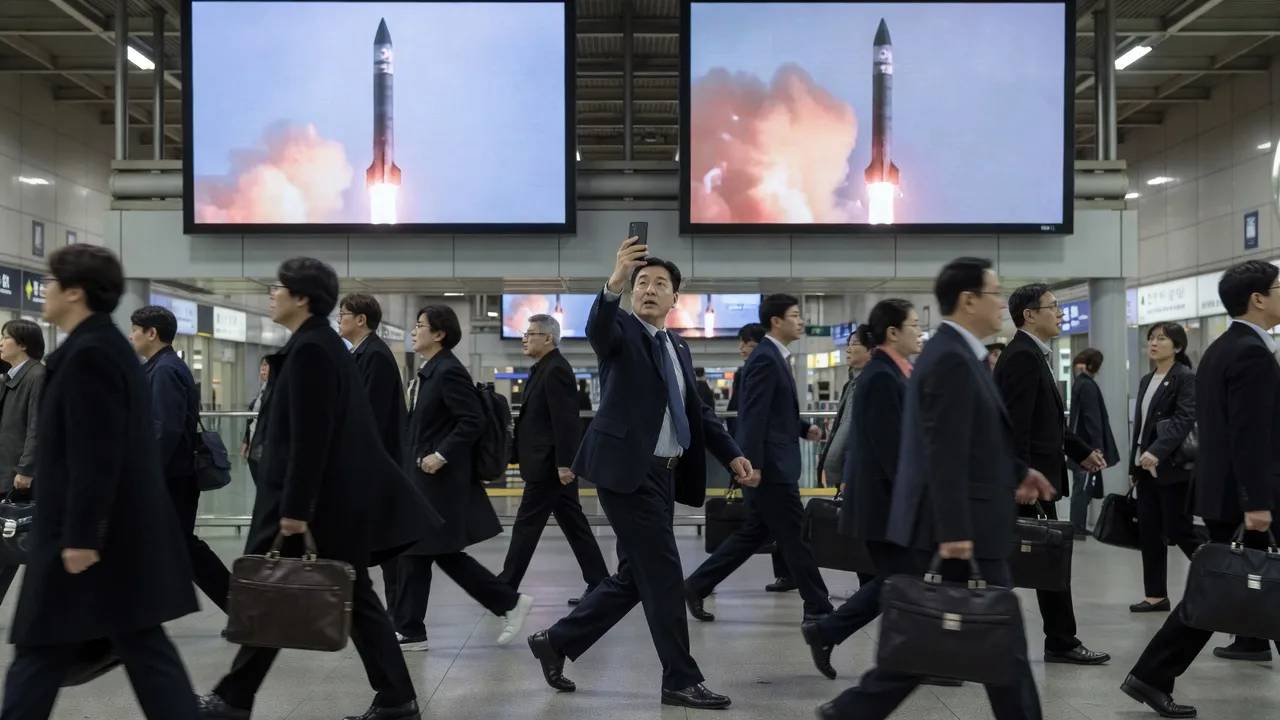
Seoul, October 12, 2026. South Korea's Joint Chiefs of Staff (JCS) reported that North Korea fired multiple ballistic missiles into the East Sea on Monday, detecting the launch at 9:20 a.m. from the Pyongyang region. At least one missile traveled over 900 kilometers. Yonhap described it as an "apparent show of force" in response to South Korea's recent successful test of a hypersonic missile.
JCS spokesperson Jang Do-young provided an initial analysis, suggesting the launch was a protest against the successful test of the South Korean hypersonic glide vehicle (HGV), as well as a showcase of the achievements of North Korea's five-year defense plan and a deliberate demonstration of its capabilities. When asked about the nature of the missiles, whether hypersonic or intermediate-range, he declined to comment, citing the need for the military to further analyze the launch characteristics. The JCS assured that it has strengthened its surveillance, maintained a posture of total readiness, and shared information with the United States and Japan.
The presidential office responded through the National Security Office, which held an emergency meeting with the Ministry of Defense and the JCS, demanding an immediate halt to the missile launches. According to spokesperson Kang Yu-jung, these repeated launches are "serious acts that violate UN Security Council resolutions" and do nothing to help manage the situation on the peninsula. The office called for all necessary measures to be taken.
The media recalled the sequence of events. The North had fired a ballistic missile from the Wonsan region on October 3; its state media described a strategic intermediate-range hypersonic missile, which was witnessed by Kim Jong-un, with a reported range of 1,000 kilometers. The South then revealed, on Thursday, its first test of a hypersonic glide vehicle, amid heightened tensions following the explosion of mines on September 21 on the southern side of the demilitarized zone, which injured three South Korean soldiers, two of them seriously.
A joint investigation by the JCS and the United Nations Command concluded that the mines had been deliberately laid by North Korean troops. Pyongyang denied any responsibility and accused Seoul of fabricating its conclusions. Yonhap noted that a hypersonic missile, which flies at least Mach 5 on a maneuverable trajectory, is difficult to intercept with existing antimissile shields.
The South Korean narrative remains centered on official statements: the JCS, the presidential office, and official communiqués. Technical details, such as the two launches spaced 17 minutes apart or the irregular trajectory, come from Japanese authorities and are absent from Yonhap and KBS reports.