Common ground and differences in coverage across the media analysed.
On Sunday, October 11, the Polish authorities reported information about a possible attack targeting Donald Tusk and Defense Minister Władysław Kosiniak-Kamysz, as reported in the seven corpora.
The Polish services (ABW, police, SOP) held an emergency meeting, mentioned in the Belgian, French, Hungarian, Polish, British, and Russian presses.
Jacek Dobrzyński mentioned a high probability of the threats being carried out, as reported in the Belgian, German, French, Polish, and British presses.
Question: does the alert stem from a serious security threat or a political show? Most reports echo the serious tone of the services; Russian press relays the accusation of the Polish opposition (PiS, Confederation) of a 'political show' and sown panic.
Question: is the alert linked to the attacks in schools? Berlin and Warsaw frame it within this climate (school violence, radicalization), while Brussels notes that any link remains unknown.
This grouping describes the publications analysed, not the position of these countries’ populations or of their governments.
What the coverage of each country leaves aside, while others put it forward.
Belgium
Germany
France
Hungary
Preview: 3 of 7 media perspectives. Syntheses of the media analysed — not direct quotations. Method & limitations
Brussels is interpreting the Polish alert as a matter of leader security: an emergency meeting at the ABW, services mobilized, and a threat whose nature and author remain unknown at this stage.
2 sources · View sources
Berlin is gauging the Polish alert based on established facts: a threat deemed very likely by the services, followed by an arrest whose contours remain unclear.
2 sources · View sources
Paris is focusing on the security angle: an alert from Polish services, a suspect in his sixties arrested in Lower Silesia, and an investigation still open into the reality of the threat.
3 sources · View sources
DOMINANT ANGLE
Brussels is interpreting the Polish alert as a matter of leader security: an emergency meeting at the ABW, services mobilized, and a threat whose nature and author remain unknown at this stage.
KEY POINTS
ANALYSIS
Brussels, October 12, 2026. The Belgian press reported, on Sunday, October 11, a security alert at the top of the Polish state, based on two articles: one from La Libre Belgique, the other from VRT NWS. The account remains focused on the triggering of the alert and the response of the services.
La Libre Belgique, in an article published on October 11 at 12:26, reports that the Polish Ministry of the Interior announced a meeting at the Anti-Terrorist Center of the Internal Security Agency (ABW), after the police received information about possible assassination attempts targeting Prime Minister Donald Tusk and Deputy Prime Minister and Minister of Defense. The daily quotes the ministry's spokesperson, Karolina Galecka, who wrote on X that the Minister of the Interior and the minister coordinating special services "ordered the launch of measures on this matter". It specifies that the authorities ordered security measures after reports deemed serious enough to mobilize specialized services.
VRT NWS provides an additional detail about the origin of the alert: the Polish police allegedly received a threatening email, which led to the urgent convening of the meeting at the ABW. The ministry coordinating special services made it known that it was a matter of life and death. The Flemish channel replays a statement that marks the gravity of the file: "We often receive threats in various forms, which sometimes turn out to be bad jokes. But in this case, it was a very likely execution of these threats."
The two media outlets highlight what remains unknown. According to VRT, the exact nature of the threat and its author are not known for the moment. The channel also notes that it is unknown whether there is a link with the series of violent incidents that occurred the previous week in Polish schools, which inscribes the alert in a broader climate of tension without linking it to it. It finally indicates that, according to Tusk's spokesperson, the Prime Minister is continuing his activities normally.
In these two accounts, the angle is therefore that of the security of the leaders: emergency meeting, mobilized services, information deemed serious. The geopolitical dimension, including Warsaw's accusations of possible Russian hybrid attacks, is not developed, and no Belgian or European reaction is quoted.
DOMINANT ANGLE
Berlin is gauging the Polish alert based on established facts: a threat deemed very likely by the services, followed by an arrest whose contours remain unclear.
KEY POINTS
ANALYSIS
Berlin, October 12, 2026. The German media is reporting on the Polish alert with marked caution. Tagesschau writes that "much remains unclear," "but the concern seems great": the Polish police allegedly received concrete indications of an attack targeting the head of government, Donald Tusk, and Defense Minister Władysław Kosiniak-Kamysz. According to the Ministry of the Interior, a crisis meeting was convened at the anti-terrorist center of the domestic intelligence service.
The public channel reports the words of Jacek Dobrzyński, spokesperson for the coordinator of the secret services, citing the PAP agency: the services estimate the probability of the threats being carried out as very high. "We take it very seriously," he is said to have said. The information first reached the state protection agency, which transmitted it to the police. Government spokesperson Adam Szłapka told TVN24 that Tusk had been informed early Sunday morning and that the signal was clearly more worrying than in the past.
Handelsblatt takes up the same thread, specifying that Interior Minister Marcin Kierwiński ordered measures. In a second article, the economic daily announced on Sunday afternoon the arrest of a man suspected of having planned the attack, according to a message from Kierwiński on X. Tusk himself confirmed the arrest on X and thanked the police for their "rapid and resolute" action. The newspaper emphasizes, however, that it is unknown who the man is and how he was found.
DOMINANT ANGLE
Paris is focusing on the security angle: an alert from Polish services, a suspect in his sixties arrested in Lower Silesia, and an investigation still open into the reality of the threat.
KEY POINTS
ANALYSIS
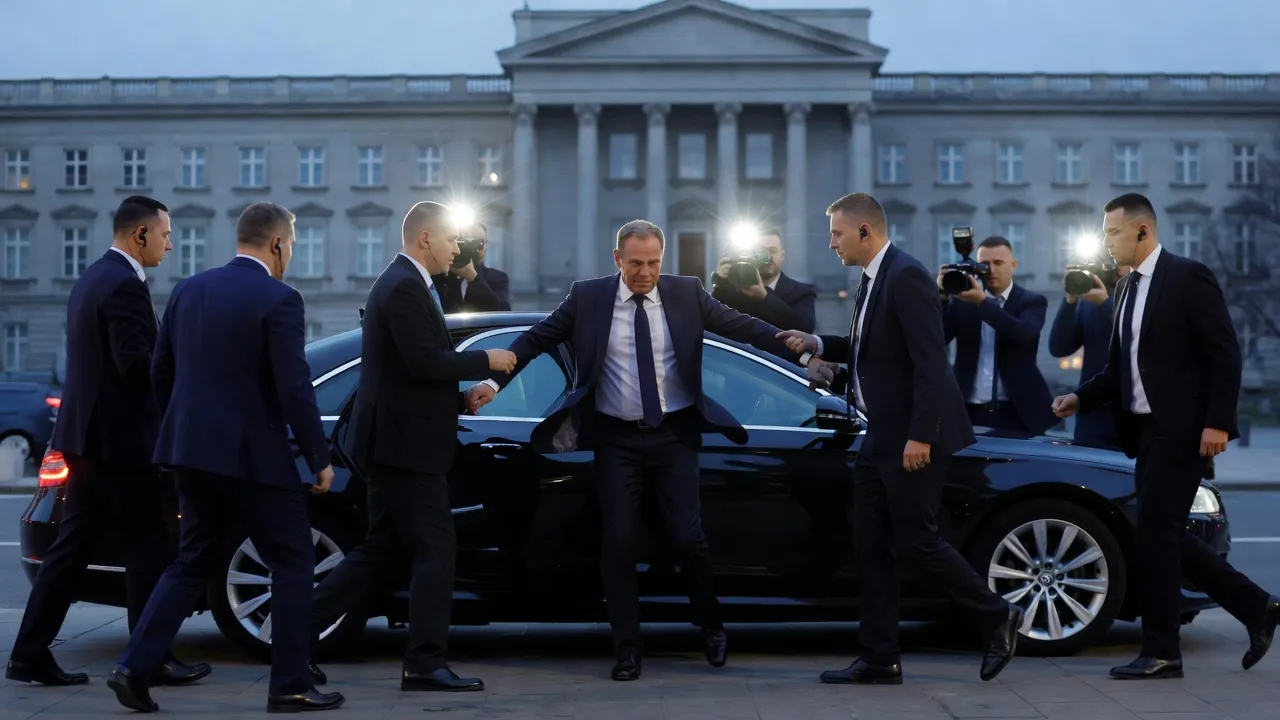
Paris, October 12, 2026. The French press is reporting on the case through official Polish statements, from Sunday's alert on October 11 to the arrest of the suspect. According to the spokesperson for the Ministry of the Interior, Karolina Gałecka, a report on a "possible assassination attempt" targeting Donald Tusk and Deputy Prime Minister and Minister of Defense Władysław Kosiniak-Kamysz was sent to the police by the State Protection Service (SOP). The Minister of the Interior and the coordinator of special services ordered measures, and a meeting brought together the police, SOP, and Internal Security Agency.
The spokesperson for the coordinator of special services, Jacek Dobrzyński, said the case is being treated "with the utmost seriousness". He mentioned a continuous increase in threats: "Month after month, year after year, more and more threats and disturbing messages of all kinds are reaching the police". In this case, he added, there is a "strong probability" that the threats will be carried out. L'Express notes that the exact nature of the threat and its origin were not immediately clear.
In the evening, Donald Tusk announced on X that "the man who threatened to commit an attack has been arrested", thanking the police for "their rapid and decisive intervention". Interior Minister Marcin Kierwiński specified on TVP Info that it is a man of around 60 years old, apprehended in Lower Silesia, in the southwest of the country. According to him, "the services tracked him down thanks to an in-depth analysis of online content", and his contacts and internet activity are being examined. His apartment is being searched; Karolina Gałecka indicated that the information about him will be verified by the police once the search is completed.
DOMINANT ANGLE
Budapest is relaying the Polish security alert: an emergency meeting of the services, followed by the arrest of a man from Lower Silesia, with no foreign lead mentioned.
KEY POINTS
ANALYSIS
Budapest, October 12, 2026. The Hungarian press is covering the affair in two parts, through Telex and then 444, which are mainly relying on Polish sources. On Sunday, October 11, Telex reported that the Polish security services had convened an emergency meeting after receiving information about a possible attack on Prime Minister Donald Tusk and Deputy Prime Minister and Minister of Defense Władysław Kosiniak-Kamysz. The announcement came from Jacek Dobrzyński, the spokesperson for the minister in charge of supervising the secret services, who published it on X; he told the PAP agency that he could not provide any additional information. The spokesperson for the Ministry of the Interior, Karolina Gałecka, confirmed the meeting.
Telex adds, according to the Polsat News channel, that the police received the information by email. The government spokesperson, Adam Szłapka, indicated to the same channel that Tusk's daily schedule remained unchanged and that the head of government was in Warsaw. According to the channel's reporter, Tusk arrived on foot, without special security measures, at the chancellery, where he participated in another meeting dedicated to the three knife attacks that occurred in schools in recent days and the threats of school violence published online.
The outcome, published by 444 on the same Sunday, is based on Interior Minister Marcin Kierwiński: the police have taken into custody the man who threatened Tusk and planned to attack him. He was arrested in Lower Silesia and his home was searched. According to Gałecka, cited by PAP, this Polish national had sent his threat by email to the State Protection Service (SOP), targeting the Prime Minister and the Minister of Defense. Tusk thanked the authorities: "Köszönöm a rendőrség gyors és határozott fellépését", which is a thank you for the rapid and firm action of the police. 444 specifies that its text comes from Gazeta Wyborcza.
DOMINANT ANGLE
Warsaw takes a grave tone: the services are talking about a "serious" threat, linked to the debate on the radicalization of young people and adults.
KEY POINTS
ANALYSIS
Warsaw, October 12, 2026. On Sunday, October 11, the Polish press reported on an alert with scarce details. According to Dziennik.pl, Prime Minister Donald Tusk and Deputy Prime Minister and Minister of Defense Władysław Kosiniak-Kamysz received information about a threat of an attack around 7:00 a.m., based on government spokesperson Adam Szłapka, who spoke on Polsat News.
The report initially reached the State Protection Service (SOP), which passed it on to the police, specifies Jacek Dobrzyński, spokesperson for the minister coordinating special services Tomasz Siemoniak. At 11:00 a.m., a meeting was held at the ABW Anti-Terrorist Center, with the Internal Security Agency, the police, and the SOP, on the instruction of Siemoniak and Interior Minister Marcin Kierwiński. The Interior Ministry spokesperson, Karolina Gałecka, announced it on X. A press briefing was scheduled for 1:00 p.m.
The official tone is grave. Dobrzyński states: "We are taking the matter extremely seriously," and mentions a "high degree of probability" that the threats will be carried out. He notes that more and more threats are reaching the services month after month, and that some turn out to be "stupid jokes," but not this one. Szłapka judges the information to be "exceptionally concerning," while ensuring that the head of government is "working normally" in Warsaw and that his mode of operation has not been changed.
DOMINANT ANGLE
Moscow is primarily relaying the suspicion of the Polish opposition, which describes the alert against Tusk as a "political show", rather than the government's security narrative.
KEY POINTS
ANALYSIS
Moscow, October 12, 2026. Russian media are covering the Polish announcement on two levels: the facts of the alert, and the controversy it is sparking in Warsaw.
On Sunday, October 11, as reported by Vedomosti, the Polish police received information about a possible attack on Prime Minister Donald Tusk and Deputy Prime Minister and Minister of Defense Władysław Kosiniak-Kamysz. The Interior Ministry spokesperson, Karolina Gałecka, wrote about it on X. Interior Minister Marcin Kierwiński and Minister-Coordinator of Special Services Tomasz Siemoniak ordered measures to be taken. An emergency meeting of the ABW, police, and SOP was scheduled for 11 am at the Counter-Terrorism Center. According to Interia.pl, cited by the newspaper, two men, aged 56 and 52, had already been detained in September for making threats against Tusk.
Meduza emphasizes the opacity of the communication. Spokesman Jacek Dobrzyński provided "no details" about the author of the threats or the state of the investigation. He responded to "pseudo-experts" who doubted the usefulness of discussing it, saying it was a threat of "mortal gravity." According to Gazeta Wyborcza, the threat had already been neutralized. Tusk thanked the police for their "rapid and decisive" action.
DOMINANT ANGLE
London sees the incident as a security alert that was quickly resolved, where the arrest of a suspect in Lower Silesia cut short a threat deemed "mortally serious" against Tusk and his Defense Minister.
KEY POINTS
ANALYSIS
London, 12 October 2026. For the British press, the case is first and foremost a security sequence: an alert, an emergency meeting, and then an arrest. The Independent leads with the information received by the Polish police regarding a possible attack against Prime Minister Donald Tusk and Defence Minister Władysław Kosiniak-Kamysz. The Polish security services held a special meeting on Sunday, 11 October, at 11 am at the Anti-Terrorist Centre of the Internal Security Agency, on the orders of Interior Minister Marcin Kierwiński and the coordinator of special services. The exact nature of the threat and its origin remained unclear at the time, the daily notes, citing private radio station Radio Zet: the police had received an email describing the project.
The BBC follows up with the outcome. Donald Tusk announced the arrest of a man accused of preparing an attack against him and his minister, and thanked the police for their "rapid and determined" action. According to the channel, a spokesperson for the special services, Jacek Dobrzyński, spoke of a "strong probability" that these threats would be carried out and a threat taken "mortally seriously". The suspect, a Polish national, was apprehended in Lower Silesia. The spokesperson for the Interior Ministry, Karolina Gałecka, specified that the email had been forwarded to the police by the State Protection Service, which is responsible for the security of ministers.
Explore every perspective on this subject across 7 countries.
Compare viewpoints and see where they diverge.
published on
countries
sources
articles
gap
The seven corpora report the Polish alert, but do not retain the same elements: the severity of the official terms, the gray areas, the climate of the schools, or the political quarrel. This count measures what the press has chosen to highlight, not the state of the investigation.
A suspect is in custody after the search of his home; his identity and any potential link to the school attacks have not been made public.
The spokesperson for the coordinating minister of special services, Jacek Dobrzyński, emphasized the seriousness of the report. According to Dziennik.pl, he explained that the threats to the services are becoming increasingly numerous from month to month, and some of them turn out to be "stupid jokes". That was not the case here, he said.
« We are taking the matter extremely seriously »
The government spokesperson, Adam Szłapka, on the other hand, judged the information to be "exceptionally worrying", the same media reports. He also assured that the Prime Minister is "working normally" in Warsaw. Telex, according to Polsat News, specifies that Donald Tusk arrived on foot at the chancellery, without special security measures.
Tagesschau quotes Szłapka, who told TVN24 that the signal was clearly more worrying than in the past.
Notes from Poland reports that at the time of writing, neither the location, nor the method, nor the presumed authors, nor the source of the information had been disclosed. VRT NWS similarly writes that the nature of the threat and its author were unknown.
The Handelsblatt, in its article on the arrest, notes that it is not known who the individual is or how they were found. The information about the analysis of online content comes from Marcin Kierwiński, as cited by the French press.
Meduza indicates that Dobrzyński gave "no details" about the author or the state of the investigation. The Russian media outlet adds, according to Gazeta Wyborcza, that the threat had already been neutralized. The Russian press uses the conditional tense when referring to the man who "would have threatened" Donald Tusk.
The corpora wonder if the alert is related to the school attacks. VRT NWS writes that it is unknown if there is a link to the series of incidents from the previous week. Dobrzyński, for his part, mentions "the radicalization of youth, which we have talked about so much", and that of adults, according to Dziennik.pl.
Handelsblatt writes that cybercrime specialists are examining whether a challenge launched on social networks triggered the school violence, with no evidence so far. Telex reports that Tusk attended a meeting dedicated to these knife attacks and online threats of school violence.
The Independent places the episode in a country "deeply polarized politically". The newspaper cites the arrest, in August, of a 23-year-old man accused of calling for the assassination of political officials. Vedomosti, citing Interia.pl, mentions two men, 56 and 52 years old, arrested in September for threats against Donald Tusk.
Only the Russian corpus details this reaction: Vedomosti, on Monday, October 12, and citing Onet, reports the statements of elected officials from Law and Justice and the Confederation. They reproach the ruling camp for sowing panic. The French and Polish corpora do not address these criticisms.
According to Vedomosti, Sławomir Mentzen says he has received death threats by email on several occasions, which the police have classified due to the lack of an identified sender. He hopes that "the services will manage" to protect Tusk.
Senator Stanisław Karczewski predicts, according to the same newspaper, that such announcements will multiply until it is declared, in 2027, that it is impossible to organize the legislative elections for security reasons. The perspectives read do not contain a response from the government to these criticisms.
A Polish man of around 60 years old, he had sent his threat by email to the SOP, according to Karolina Gałecka.
Tusk and Kosiniak-Kamysz informed around 7 am; meeting at 11 am at the ABW's Anti-Terrorist Centre.
Law and Justice and the Confederation cite a majority that would sow panic and put on a "political show".
The two editorial teams put the case back into the context of a Poland already on alert. Handelsblatt mentions a wave of violence in schools, where a janitor died on Thursday, and 117 people were arrested in recent days. Cybercrime specialists are examining whether a challenge launched on social networks could be the trigger, but nothing indicates this for the time being. Tusk stated on Sunday, before a special meeting with the Interior Minister, the police, and the services: "We are not dealing with a large, organized group of people who want to create a threat."
The German treatment therefore remains focused on the security chronology: alert, crisis meeting, risk assessment, arrest. Neither of the two articles mentions a foreign author or deals with the Russian track; Handelsblatt only refers, via a reading link, to a warning from the BND about a violent conflict with Russia.
The security context is recalled by L'Express: the Polish authorities were on high alert this week after three attacks on schools in four days in Mazovia, the province where Warsaw is located. The French articles do not detail the suspect's identity, motivations, or the authenticity of the threats, leaving them to the ongoing investigation.
The Hungarian reading remains sober: a security incident, a chronology, named spokespersons, an arrest. The two media outlets briefly link the alert to the attacks in schools, but neither of them, in the provided texts, mentions a foreign lead, Tusk's warnings about Russian hybrid attacks, or the issues of Polish domestic politics.
Dobrzyński links the case to a debate from the week: "the radicalization of youth, which we have talked about so much" after the attacks in schools, and that of adults. Notes from Poland, an English-language media outlet, points out that at the time of writing, neither the location, nor the method, nor the presumed authors, nor the source of the information had been communicated.
In the evening, according to the case files, Tusk announced on X the arrest of the man who threatened to commit an attack. Kierwiński specified that it was a man of around 60 years old, apprehended in Lower Silesia and found thanks to the analysis of online content; his apartment was searched.
On October 12, Vedomosti, citing Onet, gave the floor to the opposition. Law and Justice and Confederation lawmakers accuse the ruling camp of "sowing panic," turning security into a "political show," and trying to divert attention from embarrassing issues for the government. Sławomir Mentzen claims to have received several death threats by email, which were classified by the police due to the lack of an identified sender; he hopes that "the services will handle it" for Tusk. Senator Stanisław Karczewski predicts that such announcements will multiply "until it is declared in 2027 that the legislative elections are impossible for security reasons."
The two publications use the conditional tense when referring to the man who "allegedly threatened" the head of government, and they stick to official statements and the Polish press, without referencing the context of the attacks in Mazovian schools or Tusk's accusation against Moscow in September.
The British coverage takes care to situate the episode. The Independent recalls that violent crime remains relatively rare in Poland, but the country is "deeply polarized politically" and exposed to threats related to the proximity of the war in Ukraine. It cites two precedents: the arrest in August of a 23-year-old man accused of calling for the assassination of political leaders, and the threats Tusk had mentioned in 2024 after the attack on Slovak Prime Minister Robert Fico. It also mentions the increased vigilance of the police after three attacks in schools in four days.
The BBC finally devotes a few lines to the profile of the target: Tusk has been Prime Minister since 2023, after a first term from 2007 to 2014, and chaired the European Council from 2014 to 2019. Both articles stick to the statements of the Polish authorities, without identifying the suspect or detailing his motivations, and do not draw any geopolitical conclusions from the case.
More divergent than 11% of recent comparable stories (reference: 90 recent stories measured with the same method).