
DOMINANT ANGLE
Berlin is gauging the Polish alert based on established facts: a threat deemed very likely by the services, followed by an arrest whose contours remain unclear.
Dominant angle identified — does not reflect unanimity of this country’s media
KEY POINTS
- 01
According to Tagesschau, Polish services consider the probability of threats against Tusk and Kosiniak-Kamysz being carried out to be very high (Jacek Dobrzyński, via PAP).
- 02
Handelsblatt reports that a man was arrested Sunday afternoon, announced by Marcin Kierwiński on X and then confirmed by Tusk, with neither the identity nor the detection method known.
- 03
Handelsblatt notes 117 arrests in a few days during a wave of school violence, including the death of a janitor on Thursday.
ANALYSIS
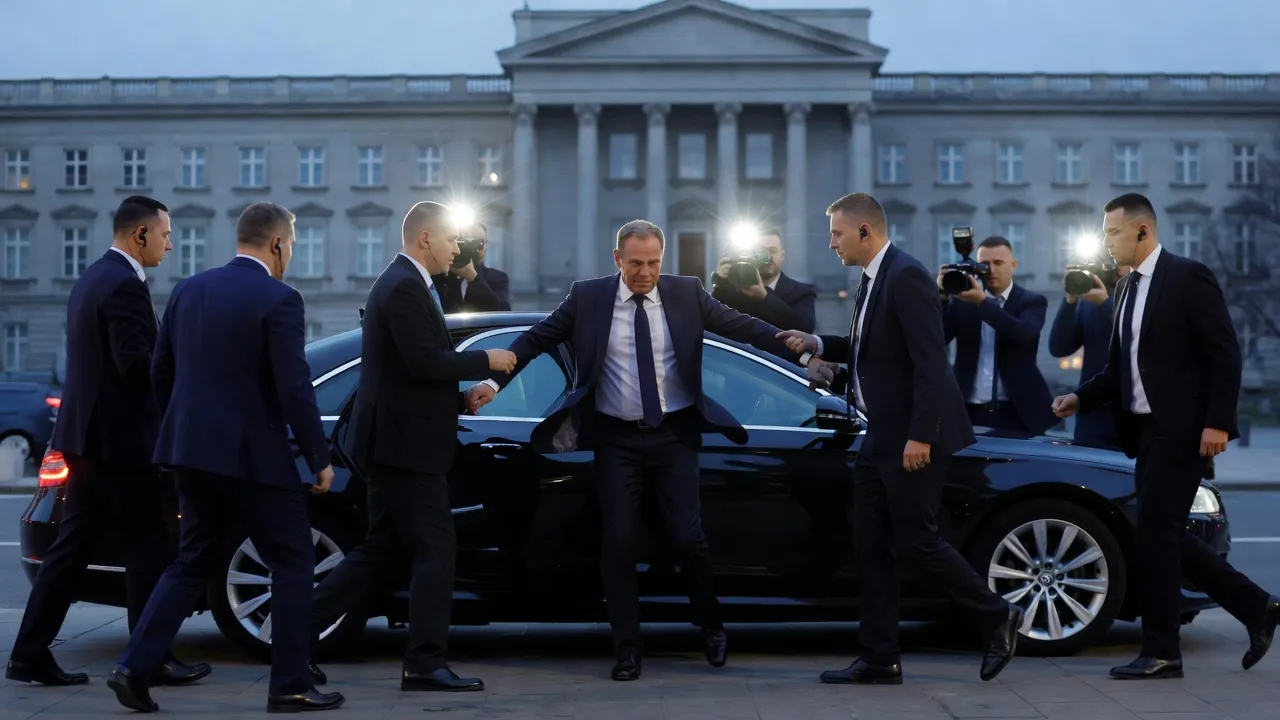
Berlin, October 12, 2026. The German media is reporting on the Polish alert with marked caution. Tagesschau writes that "much remains unclear," "but the concern seems great": the Polish police allegedly received concrete indications of an attack targeting the head of government, Donald Tusk, and Defense Minister Władysław Kosiniak-Kamysz. According to the Ministry of the Interior, a crisis meeting was convened at the anti-terrorist center of the domestic intelligence service.
The public channel reports the words of Jacek Dobrzyński, spokesperson for the coordinator of the secret services, citing the PAP agency: the services estimate the probability of the threats being carried out as very high. "We take it very seriously," he is said to have said. The information first reached the state protection agency, which transmitted it to the police. Government spokesperson Adam Szłapka told TVN24 that Tusk had been informed early Sunday morning and that the signal was clearly more worrying than in the past.
Handelsblatt takes up the same thread, specifying that Interior Minister Marcin Kierwiński ordered measures. In a second article, the economic daily announced on Sunday afternoon the arrest of a man suspected of having planned the attack, according to a message from Kierwiński on X. Tusk himself confirmed the arrest on X and thanked the police for their "rapid and resolute" action. The newspaper emphasizes, however, that it is unknown who the man is and how he was found.
The two editorial teams put the case back into the context of a Poland already on alert. Handelsblatt mentions a wave of violence in schools, where a janitor died on Thursday, and 117 people were arrested in recent days. Cybercrime specialists are examining whether a challenge launched on social networks could be the trigger, but nothing indicates this for the time being. Tusk stated on Sunday, before a special meeting with the Interior Minister, the police, and the services: "We are not dealing with a large, organized group of people who want to create a threat."
The German treatment therefore remains focused on the security chronology: alert, crisis meeting, risk assessment, arrest. Neither of the two articles mentions a foreign author or deals with the Russian track; Handelsblatt only refers, via a reading link, to a warning from the BND about a violent conflict with Russia.