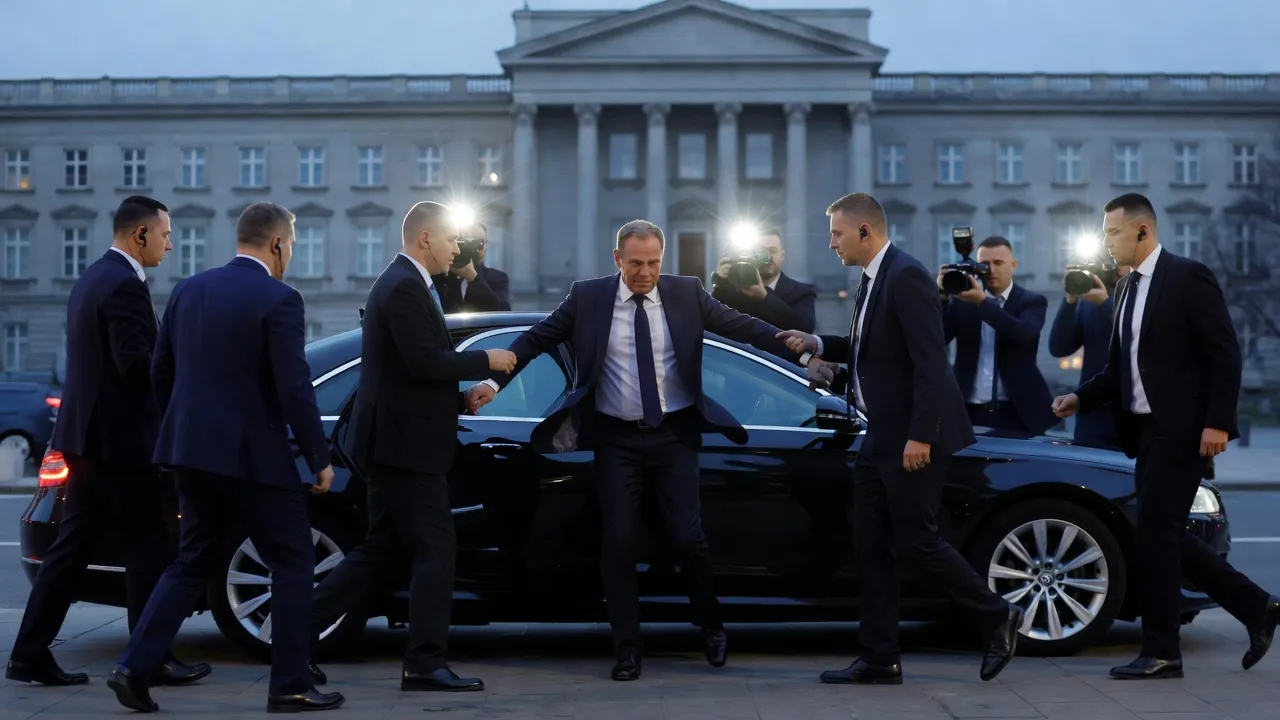

DOMINANT ANGLE
London sees the incident as a security alert that was quickly resolved, where the arrest of a suspect in Lower Silesia cut short a threat deemed "mortally serious" against Tusk and his Defense Minister.
Dominant angle identified — does not reflect unanimity of this country’s media
KEY POINTS
- 01
Polish security services held a special meeting on Sunday, October 11, after receiving information about a possible attack on Tusk and Kosiniak-Kamysz (The Independent).
- 02
The suspect, a Pole, was arrested in Lower Silesia; Jacek Dobrzyński mentioned a "strong probability" that the threats would be carried out (BBC).
- 03
The email describing the threat was forwarded to the police by the State Protection Service, according to Karolina Gałecka (BBC).
ANALYSIS
London, 12 October 2026. For the British press, the case is first and foremost a security sequence: an alert, an emergency meeting, and then an arrest. The Independent leads with the information received by the Polish police regarding a possible attack against Prime Minister Donald Tusk and Defence Minister Władysław Kosiniak-Kamysz. The Polish security services held a special meeting on Sunday, 11 October, at 11 am at the Anti-Terrorist Centre of the Internal Security Agency, on the orders of Interior Minister Marcin Kierwiński and the coordinator of special services. The exact nature of the threat and its origin remained unclear at the time, the daily notes, citing private radio station Radio Zet: the police had received an email describing the project.
The BBC follows up with the outcome. Donald Tusk announced the arrest of a man accused of preparing an attack against him and his minister, and thanked the police for their "rapid and determined" action. According to the channel, a spokesperson for the special services, Jacek Dobrzyński, spoke of a "strong probability" that these threats would be carried out and a threat taken "mortally seriously". The suspect, a Polish national, was apprehended in Lower Silesia. The spokesperson for the Interior Ministry, Karolina Gałecka, specified that the email had been forwarded to the police by the State Protection Service, which is responsible for the security of ministers.
The British coverage takes care to situate the episode. The Independent recalls that violent crime remains relatively rare in Poland, but the country is "deeply polarized politically" and exposed to threats related to the proximity of the war in Ukraine. It cites two precedents: the arrest in August of a 23-year-old man accused of calling for the assassination of political leaders, and the threats Tusk had mentioned in 2024 after the attack on Slovak Prime Minister Robert Fico. It also mentions the increased vigilance of the police after three attacks in schools in four days.
The BBC finally devotes a few lines to the profile of the target: Tusk has been Prime Minister since 2023, after a first term from 2007 to 2014, and chaired the European Council from 2014 to 2019. Both articles stick to the statements of the Polish authorities, without identifying the suspect or detailing his motivations, and do not draw any geopolitical conclusions from the case.