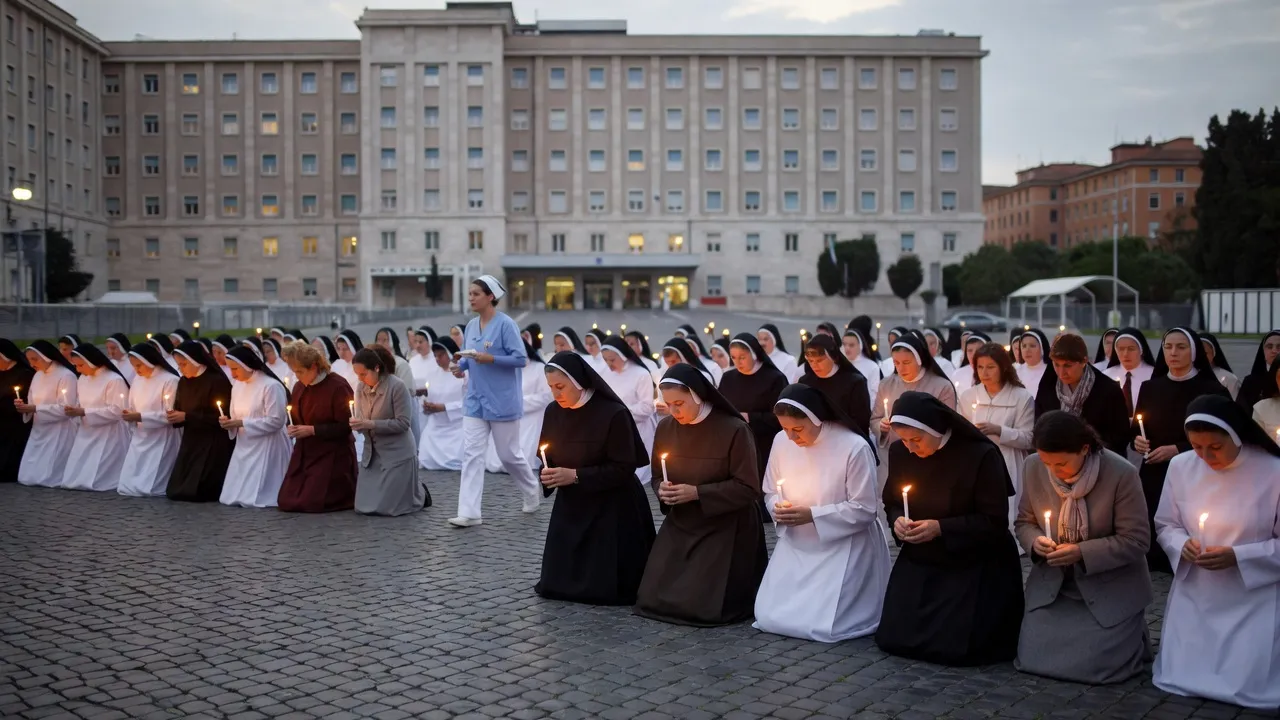
Pope Leo XIV undergoes lung cancer surgery: the Vatican confirms an adenocarcinoma after a lobe is removed
published on
countries
sources
articles
More divergent than 9% of recent comparable stories (reference: 90 recent stories measured with the same method).
The Vatican bulletin establishes the diagnosis, but does not specify the stage, so the press has looked elsewhere: to doctors outside the case, in the unusual manner in which the news was announced, and in the pope's calendar, particularly the November trip.
Further tests, including those on lymph nodes, are to determine if the cancer has spread; no treatment has been mentioned and audiences are canceled until October 20.
The stadium, great unknown
G1 notes that the bulletin does not indicate the stage of the disease, which will guide the next steps, and that the removed lymph nodes still need to be analyzed. The Korea Herald writes that the Holy See's press office sees the term "radical" as an indication that all suspicious tissue has been removed.
« While we have the diagnosis, we do not yet have the stage. This is critical to prognosis and treatment »
Dr. Stephen Liu, a lung cancer specialist at Georgetown, is quoted by Reuters (Daily Maverick, SABC News), the AP (Korea Herald), and the Globe and Mail. He considers adenocarcinoma to have the most favorable prognosis, but wants to know the size of the lesion, the number of foci, and the involvement of the lymph nodes. According to the Globe and Mail, if the cancer had spread, chemotherapy, immunotherapy, or targeted therapy could be considered.
The Korea Times writes that negative lymph nodes would correspond to stage one, without additional treatment. In Verona, pulmonologist Claudio Micheletto tells Adnkronos that treatment would be necessary if the final examination found malignant cells in the mediastinal lymph nodes. Folha cites Vatican sources as saying that the cancerous tissue was completely removed and chemotherapy was not mentioned.
The timelines vary depending on the doctors interviewed. Julie Torres, a pulmonologist quoted by Semana, mentions around 14 days for the complementary analyses. Oncology surgeon Edgar Amorín, interviewed by RPP, mentions a full-body PET scan and a brain MRI to measure the extent.
Who comments on the forecast
According to the meta-analysis of the corpus, the presses of the Philippines, Pakistan, Singapore, Mexico, and South Korea rely mainly on American specialists, cited in dispatches from AFP, Reuters, or AP. El Norte quotes Dr. Daniel Boffa, from Yale: a "localized nodule" operated on as a first treatment suggests, according to him, an early stage. Dr. Jaclyn LoPiccolo, from Dana-Farber, recalls that even at stage 1, the prognosis varies, with a five-year survival rate that can exceed 80%.
GMA News and Inquirer, reprising AFP, cite five-year survival rates of 63 to 67% for a localized form. These figures appear in different articles, with different sources.
Other corpora give the floor to local doctors. La Libre Belgique interviews Professor Frank Aboubakar (Cliniques universitaires Saint-Luc), Infobae interviews Argentine pulmonologist Ana María Putruele, who notes a lesion of "three millimeters", and Ámbito interviews Nicolás Minatta, from the Hospital Austral, who believes that biomarkers and molecular studies will have to complement the histological diagnosis. Estadão quotes Tiago Machuca, from the D'Or network, who says the patient can lead a "normal life" after the operation.
Several of these doctors specify that they do not know the file. Marisa Fazzino, an oncologist in Montevideo, tells El Observador; G1 writes that its interlocutor commented on the situation in general terms. This distribution describes the sources retained by each corpus, not the value of the opinions.
An uncommon communication
CBS News praises a rare level of transparency. Candida Moss, a theologian at the University of Birmingham, tells them that the Vatican "tends to keep these things under wraps". SBS describes the Holy See as "historically very secretive" about the health of popes, and the Buenos Aires Times notes increased openness under Francis. Estadão talks about a level of transparency that is "unusual".
« The doctors deem it appropriate to intervene and therefore, following their advice, I have decided to undergo surgery. »
The choice of words in the bulletin is noted by two media outlets. Expreso and Efecto Cocuyo observe that the Holy See's statement does not use the word "cancer", although adenocarcinoma is an oncological disease. Subrayado writes that the Vatican specified on Monday, October 12, that the nodule was detected during a routine check; Helsingin Sanomat emphasizes that no symptoms motivated the examination.
The initial reports did not all follow the same qualification. Legit.ng initially wrote that a nodule is "usually benign", and La República Perú talked about a "small nodule", before or on the margins of the diagnosis confirmation. La Libre Belgique reports that 98.5% to 99.2% of nodules detected in the at-risk population are not cancerous; La República (Colombia), El Deber, and El Observador cite the American Thoracic Society, which states that less than 5% of pulmonary nodules turn out to be cancerous. Pneumologist Micheletto considers it "predictable" that it is a tumor, because "benign nodules are not operated on".
The trip and the rest
The Argentine, Bolivian, and Peruvian presses are highlighting the November trip; the Colombian, German, and Finnish corpora do not mention it, according to the corpus analysis. This count measures what each corpus retained, not the opinion of its readers.
Ámbito reports that the diagnosis "casts doubt" on the tour and states that the Argentine government is conditioning the visit on recovery while continuing preparations: "La organización sigue". MercoPress indicates that the program has not been modified. According to CBC, Japanese Cardinal Kikuchi Tsutomu, who saw the pope on Monday, October 12, claims that Léon XIV wanted to undergo surgery without delay to avoid modifying this trip. Veja writes that the tour should not be affected, Moneyweb that it is maintained, and G1 that the Vatican had not confirmed its maintenance.
In Peru, Trome schedules the visit from November 11 to 16; Gestión notes that no official statement says what will happen. La República mentions a holiday that the Labor Minister would only announce after a forecast from the Vatican. Infobae estimates the cost of the Uruguayan leg at 2.7 million dollars, and the Korea Times counts more than 31,000 kilometers, 12 flights, and two helicopter trips.
On the Church's conduct, Ámbito writes that canon law does not provide for a "vice-pope" or regency, La Libre Belgique that it contains no provision in case of incapacity. CBS News finally reports, according to his wife Deborah, that Louis Prevost, the older brother of the pope living in Florida, is suffering from multiple myeloma.
Scheduled tour from November 6 to 17 in Uruguay, Argentina, and Peru, unchanged at this stage.
Ablation by video-assisted surgery, according to the bulletin relayed by the Australian press.
Cardinal Tagle presides over the Wednesday mass on October 14 during the pope's convalescence.
Key figures
- 90 minutesDuration of the procedure, for three hours spent in the operating room
29 sources
- Buenos Aires Times
- PerthNow
- DH (Dernière Heure)
- La Razon BO
- Folha Mundo
- Globe and Mail
- El Colombiano
- Tagesschau
- Primicias
- Expansión
- MTV Uutiset
- France 24
- MyJoyOnline
- ANSA
- Capital FM Kenya
- Korea Herald
- El Financiero
- Punch Nigeria
- Andina
- Geo News
- SAPO Notícias
- Digi24
- Aftonbladet
- Channel News Asia
- BBC
- CBS News
- Subrayado
- Efecto Cocuyo
- Daily Maverick
What the comparison reveals
Common ground and differences in coverage across the media analysed.
What the media report in common
The Vatican confirmed a pulmonary adenocarcinoma after the removal of the lower lobe of Pope Leo XIV's right lung, 71, on Tuesday, October 13, at Gemelli Hospital.
The operation lasted about 90 minutes, for about three hours in the operating room, and took place without complications according to the Vatican bulletin.
Further examinations, including lymph nodes, are to determine if the cancer has spread; the stage and potential treatment are not specified.
Where media coverage diverges
November trip schedule
Question raised: is the trip to Uruguay, Argentina, and Peru (6-17 November) being called into question? South American and Singaporean media see uncertainty; South African media says it is maintained, and Buenos Aires cites a government for which 'la organización sigue'.
Description of the removed nodule
Question raised: how to describe what was removed? The initial account from Legit.ng presents the nodule as 'usually benign' and La República Perú talks about a 'nódulo pequeño', when others headline the cancerous tumor and adenocarcinoma.
Coverage that diverges
Experts mobilized for the prognosis
The prognosis is provided by different doctors according to the sources: American specialists cited by AFP, Reuters or AP (Philippines, Pakistan, Singapore, Mexico, South Korea), and local pneumologists and oncologists (Belgium, Italy, Uruguay, Argentina, Peru, Colombia, Brazil).
Coverage aligned with this reading
This grouping describes the publications analysed, not the position of these countries’ populations or of their governments.
Blind spots
What the coverage of each country leaves aside, while others put it forward.
 Colombia
- the trip to Latin America planned for November
 Finland
- the trip to Latin America and the pope's agenda after October 20
 Germany
- the trip to Latin America planned for November
Understand the context
- OCT 11, 2026Leo XIV announces a pulmonary nodule during the Angelus
- OCT 13, 2026Removal of the lower lobe of the right lung at Gemelli; adenocarcinoma confirmed
How each country reads it
Preview: 3 of 32 media perspectives. Syntheses of the media analysed — not direct quotations. Method & limitations
 Argentina
Buenos Aires is gauging the illness of Léon XIV in light of his November visit: as long as the lymph nodes have not been analyzed, the trip to Argentina remains contingent on his recovery.
4 sources · View sources
 Australia
Canberra is decoding the operation of Léon XIV above all as a medical file: adenocarcinoma, lobe removed, tests underway, with national medical benchmarks for the reader.
4 sources · View sources
 Belgium
Brussels is deciphering the pope's operation through a medical lens: the Belgian press has a pulmonologist from Saint-Luc explain what a nodule, an adenocarcinoma, and the removal of a lobe entail.
3 sources · View sources
The full text, country by country
Argentina
DOMINANT ANGLE
Buenos Aires is gauging the illness of Léon XIV in light of his November visit: as long as the lymph nodes have not been analyzed, the trip to Argentina remains contingent on his recovery.
KEY POINTS
- On October 13, the lower lobe of the right lung was removed; the operation lasted about 90 minutes for three hours in the operating room, with no complications according to the Vatican.
- Further tests are to determine if the cancer has spread; audiences are cancelled until October 20.
- The trip to Uruguay, Argentina, and Peru from November 6 to 17 has not been modified at this stage; the Argentine government says "La organización sigue".
ANALYSIS
Buenos Aires, October 14, 2026. The Argentine press is following Léon XIV's operation with a two-pronged approach: the diagnosis, and what it means for the upcoming visit to the country. Infobae, Perfil, and La Nación are reporting the bulletin from the Holy See: on Tuesday, October 13, at the Gemelli in Rome, surgeons removed the lower lobe of the right lung using a video-assisted technique. The histological examination performed during the operation "confirmed the diagnosis of pulmonary adenocarcinoma," according to the Vatican. The procedure lasted approximately 90 minutes for a total of three hours in the operating room, "with success and without complications." A Vatican source cited by AFP, picked up by the Buenos Aires Times, adds that further tests will determine if the cancer has spread.
The media are consulting local specialists. Infobae quotes pneumologist Ana María Putruele (UBA), who is surprised by a lesion of "three millimeters"; according to her, without affecting the lymph nodes or mediastinum, no specific treatment would be required. Ámbito interviews Nicolás Minatta, from the Hospital Austral, who believes that the histological diagnosis is only part of the information: biomarkers and molecular studies will be needed to complete it. La Nación recalls that adenocarcinoma is the most common type of tumor and one of the most treatable.
The most worked-on topic remains the trip from November 6 to 17 to Uruguay, Argentina, and Peru. Ámbito headlines with a diagnosis that "puts his South American tour in doubt" and reports that the government is conditioning the visit on a full recovery without suspending preparations: "The organization continues." MercoPress indicates that the program has not been modified and that, according to Cardinal Kikuchi, the pope had the operation as soon as possible to make the trip. Infobae estimates the cost of the Uruguayan leg at $2.7 million.
The issue of governance is also occupying Ámbito: canon law does not provide for a "vice-pope" or regency, the Curia continues its tasks, and the pope remains the authority. Audiences are canceled until October 20. The register is also emotional: Ámbito compares the operation to that of Francis, who at 21 had the upper lobe of his right lung removed, and Clarín devotes a story to the Gemelli, nicknamed "Vatican III" by John Paul II. The Buenos Aires Times notes that the Vatican, long secretive about the health of popes, has become more transparent under Francis, an Argentine.
Australia
DOMINANT ANGLE
Canberra is decoding the operation of Léon XIV above all as a medical file: adenocarcinoma, lobe removed, tests underway, with national medical benchmarks for the reader.
KEY POINTS
- The Vatican confirmed a pulmonary adenocarcinoma after the removal of the lower lobe of the right lung, using a video-assisted technique, during an approximately 90-minute procedure.
- The bulletin states: "The surgery was successful, and there were no complications"; the hospital stay is estimated to be around one week.
- A Vatican source quoted by AFP indicates that further tests are underway to determine if the cancer has spread.
ANALYSIS
Canberra, October 14, 2026. The Australian press is treating the operation of Pope Leo XIV as a medical file to be decoded for the general public. The Age and the Sydney Morning Herald, which publish the same dispatch, open with the brute fact: the Pope "emerged from surgery" after doctors discovered lung cancer and removed the lower lobe of the right lung. The Vatican indicated, in a statement released Tuesday evening (around 7 am Wednesday in eastern Australia), that the surgeons had found a pulmonary adenocarcinoma, as preoperative exams had suggested.
The account focuses on the clinical details. Pope Leo XIV, 71, spent about three hours in the operating room, for an intervention of about 90 minutes led by the team of Stefano Margaritora, head of thoracic surgery at Gemelli. Citing the bulletin, ABC and PerthNow report that the lobe was removed by video-assisted technique "to make the intervention curative" and that a rapid histological examination during the operation confirmed the diagnosis. "The operation was a success, and there were no complications," the text says. The Pope woke up normally and returned to his room on the tenth floor.
ABC News also devotes a pedagogical article to the disease. Adenocarcinoma is defined as a cancer of glandular cells; the channel recalls that non-small cell lung cancers account for about 85% of cases and, according to Cancer Australia, that this form is the most common in non-smokers. The Age cites the Lung Cancer Foundation of America, which states that this form accounts for about 40% of lung cancers in the United States.
The question of the extent of the disease remains open: citing AFP and a Vatican source, the media indicate that further exams are underway to determine if the cancer has spread. The hospital stay is estimated to be around one week. SBS emphasizes that this is the Pope's first hospitalization since his accession on May 8, 2025, and recalls that the first American Pope, born in Chicago, was considered athletic and in good health.
SBS also places the episode in the history of Vatican communication: the Holy See is "historically very secretive" about the health of popes, but has been more transparent during the illness of Francis. Pope Leo XIV himself announced on Sunday, after the Angelus, a nodule discovered "at a very early stage". The articles in the corpus do not detail the governance of the Church during the convalescence or the planned trip to Latin America.
Belgium
DOMINANT ANGLE
Brussels is deciphering the pope's operation through a medical lens: the Belgian press has a pulmonologist from Saint-Luc explain what a nodule, an adenocarcinoma, and the removal of a lobe entail.
KEY POINTS
- The Vatican indicated that the operation "confirmed the diagnosis of pulmonary adenocarcinoma" and that the lower lobe of the right lung was removed, after an approximately 90-minute complication-free procedure.
- Dr. Frank Aboubakar (Saint-Luc University Clinics) recalls that 98.5% to 99.2% of nodules detected in the at-risk population are not cancerous.
- All the pope's audiences are cancelled until October 20; Cardinal Tagle replaces him at the closing mass of the family assembly.
ANALYSIS
Brussels, October 14, 2026. In the Belgian press, the operation of Léon XIV is first read as a medical file. On Tuesday, October 13, La Libre Belgique and La DH reported the Vatican's statement: the nodule removed at Rome's Gemelli hospital was cancerous and, "in order to make the intervention radical, the lower lobe of the right lung was removed". The operation "confirmed the diagnosis of a pulmonary adenocarcinoma, as suspected by the preoperative examinations".
The text is signed by the pope's referring physician, Dr. Luigi Carbone, and Professor Stefano Margaritora, who heads the thoracic surgery team. The pope spent about three hours in the operating room for an intervention of about 90 minutes, without complications. He woke up normally, returned to his 10th-floor room and, according to a Vatican source, asked to have dinner. Regarding a possible spread, the same source indicates that additional exams are underway.
La Libre Belgique gives the floor to Pr Frank Aboubakar, specialized in thoracic oncology and pneumology at the Saint-Luc University Clinics. His message is reassuring in principle: "the word nodule describes an image, not yet a diagnosis", and 98.5% to 99.2% of nodules detected in the at-risk population are not cancerous. The pope's nodule seems "well localized" and detected at a "very early" stage. The daily newspaper headlines with a "very positive" prognosis.
The chronology is recalled: on Sunday, October 11, at the end of the Angelus, the American pope had himself announced the discovery of the nodule, in a phrase quoted by La Libre: "The doctors deem it appropriate to intervene and therefore, following their advice, I have decided to have surgery." Belgian newspapers note an "unusual transparency at the Vatican", where communication about the popes' health remains sensitive despite Francis' efforts for more openness.
The institutional aspect remains secondary. La Libre reports that all appointments are cancelled until October 20 and that Cardinal Tagle, the new dean of cardinals, replaces the pope at the closing mass of the world assembly on the family, on Wednesday, October 14. It notes that the law of the Church does not provide for any particular provision in case of incapacity.
 Bolivia
DOMINANT ANGLE
La Paz is weighing the operation of Pope Léon XIV in light of the trip to Latin America planned for next month, the holding of which has become uncertain after the removal of a lung lobe.
KEY POINTS
- The Vatican confirmed an adenocarcinoma of the lung after the removal of the lower lobe of the right lung of Léon XIV, 71, on Tuesday, October 13, at Gemelli Hospital.
- The operation lasted about 90 minutes for three hours in the operating room, "successfully and without complications", according to the statement signed by Luigi Carbone and Stefano Margaritora.
- All the pope's audiences are cancelled until October 20 and the procedure raises questions about the upcoming trip to Latin America scheduled for next month.
ANALYSIS
La Paz, October 14, 2026. For the Bolivian press, the news of Léon XIV's operation is first and foremost a source of uncertainty about the pontiff's South American agenda. La Razón notes that the intervention "raises questions" about the upcoming long trip to Latin America scheduled for next month, and El Deber headlines the removal of the nodule "just a few weeks before his first trip to South America".
The medical facts are reported in detail in the Vatican bulletin. The 71-year-old pope was operated on Tuesday, October 13, at Rome's Gemelli hospital. "To ensure that the procedure was radical, the lower lobe of the right lung was removed," the statement indicates, specifying that the operation "confirmed the diagnosis of pulmonary adenocarcinoma, as suspected from preoperative examinations". The text is signed by the pope's referring physician, Luigi Carbone, and by Stefano Margaritora, who heads the thoracic surgery team. The pope spent approximately three hours in the operating room, including 90 minutes of intervention, "with success and without complications".
La Razón adds details of convalescence from Vatican sources: the pope "woke up normally" and asked for dinner after the operation. He is expected to stay several days in his room on the tenth floor of the Gemelli. All his audiences are cancelled until October 20, including the large mass on Wednesday for the closing of a world assembly on the family, where he will be replaced. A Vatican source indicates that further examinations are underway to determine if the cancer has spread.
El Deber, which reproduces content from the BBC, recalls that Léon XIV himself announced the news from the balcony of St. Peter's Square, after the blessing of the Angelus, saying that the nodule was "contained" and detected "at a very early stage". A second article explains what a pulmonary adenocarcinoma is: a nodule is a small and localized lesion, often benign, and according to the American Thoracic Society, less than 5% of pulmonary nodules turn out to be cancerous, the risk increasing with age, size, and smoking.
The treatment of the aftermath remains open: no complementary treatment is mentioned in the articles, and the question of the Latin American trip remains without an official answer at this stage.
 Brazil
DOMINANT ANGLE
Brasília is analyzing the Pope's cancer as a clinical case to be explained: unknown stage, lymph nodes to be analyzed, favorable prognosis if the tumor is localized, with the comparison to late detection in the SUS in the background.
KEY POINTS
- The lower lobe of the right lung was removed on Tuesday, October 13, using a video-assisted technique; the operation lasted about 90 minutes, for three hours in the operating room (G1, Folha).
- The bulletin does not specify the stage and the Vatican does not mention chemotherapy at this stage; the removed lymph nodes still need to be examined (G1).
- According to Estadão, nearly nine out of ten lung cancer diagnoses recorded in the SUS, when the stage is known, occur at stages three or four.
ANALYSIS
Brasília, October 14, 2026. The Brazilian press initially treats Pope Léon XIV's operation as a medical file, with lengthy educational sidebars on the disease. G1, Folha, Veja, and Estadão report that the 71-year-old pope underwent surgery on Tuesday, October 13, at Rome's Gemelli Hospital: the lower lobe of the right lung was removed using video-assisted technique, in approximately 90 minutes to three hours in the operating room. The bulletin signed by Luigi Carbone and Stefano Margaritora indicates that the histological examination "confirmed the diagnosis of pulmonary adenocarcinoma," which was suspected before the intervention, and that the surgery was "successful" and without complications.
Brazilian media emphasize what the bulletin does not say. According to G1, it does not indicate the stage of the disease, which will guide the next steps, and the removed lymph nodes still need to be analyzed. Folha cites Vatican sources stating that the cancerous tissue was completely removed and the doctors did not mention chemotherapy. The Vatican speaks of a "radical" removal of the lobe.
Estadão and Folha consult Brazilian specialists. Tiago Machuca, from the D'Or network, affirms that "in many cases, the patient can lead a normal life" after the operation, the healthy lung compensating. Folha recalls that adenocarcinoma is the most common type among people who have never smoked, and that the pope has no known history of smoking. When the tumor is localized, treatment can aim for a cure.
An editorial in Estadão brings the case back to Brazil: almost nine out of ten lung cancer diagnoses recorded in the SUS, when the stage is known, occur at stages three or four, whereas the pope was diagnosed early.
The transparency of Léon XIV, who announced the nodule himself during the Angelus on Sunday, October 11, is highlighted by Estadão as "an unusual level" and by G1, which refers to a chronicle on the break with the Vatican's tradition of silence. Audiences are canceled until October 20, and the hospitalization is expected to last approximately one week.
The regional stakes remain secondary but present: Veja writes that the tour from November 6 to 17 in Latin America should not be affected, Folha mentions Uruguay, Argentina, and Peru, and G1 notes that the Vatican had not yet confirmed the maintenance of the trip. The pope's older brother, Louis Prevost, 74, is also being treated for cancer in Florida.
 Canada
DOMINANT ANGLE
Ottawa is reviewing the Vatican's medical bulletin: the Canadian press is focusing on the stage of cancer, the prognosis described as favorable, and the lymph node exams that are still pending.
KEY POINTS
- The Vatican confirmed pulmonary adenocarcinoma after the removal of the lower lobe of the right lung, an operation lasting about 90 minutes to three hours in the operating room.
- Dr. Stephen Liu (Georgetown) estimates that the stage and any potential lymph node involvement must now be determined before deciding on a treatment.
- The pope's audiences are cancelled until October 20 and the planned trip to Latin America next month remains uncertain.
ANALYSIS
Ottawa, October 14, 2026. The Canadian press, from the Globe and Mail to CBC via the National Post, reports on Pope Leo XIV's operation, focusing on the medical aspect: what is known about the diagnosis and what is still unknown.
On Tuesday, October 13, the 71-year-old pontiff underwent thoracic surgery at Rome's Gemelli Hospital. According to the Vatican's bulletin, as reported by Global News and the Toronto Sun, "to ensure a radical resection," the lower lobe of the right lung was removed using a video-assisted technique. The histological examination performed during the procedure "confirmed the diagnosis of pulmonary adenocarcinoma." The pope spent about three hours in the operating room, including 90 minutes of surgery, "successfully and without complications," the Holy See specified. The chief surgeon at Gemelli, Stefano Margaritora, led the team.
The newspapers widely quote specialists. Dr. Stephen Liu, from Georgetown's Lombardi Cancer Center, cited by the Globe and Mail and Global News, considers adenocarcinoma "the most common type, with the most favorable prognosis," but notes that the stage now needs to be determined: the size of the lesion, the number of foci, and any potential lymph node involvement. According to him, if the cancer has spread, chemotherapy, immunotherapy, or targeted therapy could be considered. The Toronto Sun mentions an "excellent" prognosis according to oncologists, as the tumor was removed early. The Vatican has announced no treatment and is awaiting the results of further tests.
CBC and the National Post also highlight the unusual transparency of the American pope, the first pontiff from the United States: it was he who revealed the nodule, "at a very early stage," on Sunday at the Angelus, whereas the Vatican has historically been very discreet about the health of popes. CBC reports that Japanese Cardinal Kikuchi Tsutomu, who saw him on Monday, claims that Leo XIV wanted to undergo surgery without delay so as not to modify his trip to Latin America, scheduled for next month. The National Post notes that the operation raises doubts about this trip, while the Toronto Sun points out the lack of update on this matter.
The account remains factual: audiences canceled until October 20, a hospital stay of about one week, and the pope requesting dinner after the operation, according to a Vatican source cited by the National Post. The first hospitalization of his pontificate, which began on May 8, 2025, is presented as a medical step rather than a challenge to the governance of the Church.
 Chile
Chile
DOMINANT ANGLE
Santiago is deciphering the operation of Léon XIV through the prism of its relations with the Holy See: a message from the Cancillería of the Kast government and attention focused on the November trip to South America.
KEY POINTS
- The lower lobe of the right lung was removed by video-assisted surgery at the Gemelli polyclinic on October 13; the histological examination confirmed a pulmonary adenocarcinoma (El Ciudadano).
- The Kast government's Chancellery wished the pope a "prompt and complete recovery", citing a "long and deep" relationship between the government and the Holy See (Cooperativa).
- The operation comes less than a month before the planned trip to Uruguay, Argentina, and Peru from November 6 to 17 (BioBioChile).
ANALYSIS
Santiago, October 14, 2026. In Chile, news of Pope Léon XIV's operation on Tuesday, October 13, initially circulated in the form of a medical bulletin, followed by an official reaction.
El Ciudadano reprints the press office of the Vatican's statement, distributed on the Holy See's Telegram channel: the intervention, performed at the Gemelli polyclinic, allowed for "the removal of a localized nodule in the lung". Doctors Luigi Carbone and Stefano Margaritora specify that, "for the intervention to be radical", the lower lobe of the right lung was removed by video-assisted surgery. The histological examination "confirmed the diagnosis of pulmonary adenocarcinoma, as suspected from preoperative examinations". The Pope spent about three hours in the operating room, the procedure itself lasting nearly 90 minutes, without complications; he returned to his room on the tenth floor after a brief observation. Postoperative exams and analysis of the removed tissue are announced, with a new health update expected on Wednesday, October 14.
The political aspect is covered by Cooperativa. The Cancillería expressed on Tuesday the government's wishes for a "prompt and complete recovery" of the 71-year-old Pope. The statement highlights that Chile and the Holy See "share a long and deep relationship, forged at decisive moments in our history". The administration of President José Antonio Kast says it is accompanying "with particular affection the Sovereign Pontiff" as well as Catholic faithful, and wishes that he "may soon fully resume his ministry".
BioBioChile places the stakes in the calendar: the operation comes less than a month before Léon XIV's trip to Uruguay, Argentina, and Peru from November 6 to 17. Chile is not included in the cited itinerary, but its immediate neighbors are, which explains the attention paid to the duration of convalescence and the maintenance of the program.
Chilean texts remain close to official sources: the Vatican bulletin for medical information, the ministerial statement for the national reaction. They do not detail what remains uncertain, particularly the possible extension of cancer to the lymph nodes, or the organization of the Church's government during convalescence. The tone is sober, without dramatization, focused on the success of the operation and the links between Santiago and Rome.
Colombia
DOMINANT ANGLE
Bogotá is breaking down the diagnosis of Léon XIV in clinical terms: adenocarcinoma, lymph nodes, and prognosis, with specialists to explain what remains unknown.
KEY POINTS
- On October 13, the operation at Gemelli removed the lower lobe of the right lung in about 90 minutes, without complications (El Colombiano, La República).
- The medical report states that "the in situ histological examination confirmed the diagnosis of pulmonary adenocarcinoma" (Portafolio).
- Additional tests may take around 14 days and public acts are cancelled until October 20 (Semana, La República).
ANALYSIS
Bogotá, October 14, 2026. The Colombian press is covering Pope Léon XIV's operation from a medical and educational angle. El Colombiano reports that the pope underwent the removal of the lower lobe of his right lung on Tuesday, October 13, at Rome's Gemelli polyclinic, and that the procedure confirmed a pulmonary adenocarcinoma. According to the Holy See Press Office's statement, the operation lasted approximately 90 minutes, for nearly three hours in the operating room, without complications. The 71-year-old pope woke up normally and returned to his tenth-floor room; a Vatican source says he asked for his dinner.
Portafolio details a video-assisted technique and quotes the medical bulletin: "The in situ histological examination confirmed the diagnosis of pulmonary adenocarcinoma." The daily newspaper recalls that the pope had announced the nodule himself two days earlier. El Colombiano specifies that the nodule was detected during routine exams, without symptoms, and that the published information does not indicate that the disease is limited to the removed tissue or that the pontiff is cured: exams are still searching for an extension.
Semana gives the floor to pulmonologist Julie Torres: complementary tissue analyses can take around 14 days and the prognosis depends on the extension of the lesion. The diagnosis, she says, is just a name: "we need to find its surname," meaning the subtype. The same media outlet relays reactions, including those of Giorgia Meloni and Cardinal Pietro Parolin, who declares "We have confidence" after speaking with the pope.
La República, in an agency dispatch, recalls that this is the first serious health problem in 17 months of pontificate, that the convalescence is estimated to be around one week, and that all public acts are canceled until October 20. It quotes the American Thoracic Society: less than 5% of pulmonary nodules turn out to be cancerous. Semana adds a backdrop with the reserved wing of the Gemelli, which Jean-Paul II called "Vaticano III," and recalls the four hospitalizations of François.
The pool's articles do not address the trip to Latin America or the conduct of the Church during the convalescence.
Germany
DOMINANT ANGLE
Berlin is interpreting the announcement like a medical report: confirmed adenocarcinoma, successful operation, prognosis pending upcoming exams, with little attention to Church governance.
KEY POINTS
- On Tuesday, October 13, the lower lobe of Léon XIV's right lung, 71, was removed; the approximately 90-minute operation at Gemelli took place "without complication" (Tagesschau)
- The Vatican confirmed an adenocarcinoma, a common form of non-small cell lung cancer, which can form metastases early (FAZ)
- The pope had announced the nodule himself on Sunday after the Angelus; his audiences are cancelled until October 20 and he is to remain in the hospital for about a week (Tagesschau)
ANALYSIS
Berlin, October 14, 2026. The German press is treating Pope Leo XIV's operation as a medical file above all. Tagesschau and Handelsblatt are reporting the Vatican's bulletin: on Tuesday, October 13, surgeons removed the lower lobe of the 71-year-old pontiff's right lung, and the examination confirmed an adenocarcinoma. The 90-minute procedure at Rome's Gemelli clinic took place "with success and without complications," according to the doctors cited by the FAZ. The pope woke up normally and is resting in his room.
The FAZ is taking the time to explain the disease. Pulmonary adenocarcinoma is a type of non-small cell lung cancer. It often affects smokers, but also increasingly non-smokers, young patients, and women. It frequently develops in the peripheral areas of the lung and can remain unnoticed for a long time. When detected early, it generally offers better treatment options, but it can also form metastases early on. The daily newspaper thus suggests that the outcome will depend on the upcoming exams.
The headlines are also emphasizing the rarity of the gesture. On Sunday, after the Angelus, Leo XIV had announced himself that a nodule had been discovered during a check-up, "at a very early stage" and "well localized." Tagesschau notes that the operation took place just two days later and that no health problems were known until then for the first American to head the Catholic Church. The public channel also mentions his healthy lifestyle, including tennis, swimming, and regular exercise, and describes him as a pope who is still "relatively young."
The practical framework is occupying a significant place. Tagesschau describes the arrival at the Gemelli, where the popes have a dedicated sector with continuous surveillance. According to the cited media, the renovation of the papal suite requires him to be accommodated elsewhere. A Vatican spokesperson indicated that he would remain in the hospital for about a week, and his audiences are canceled until October 20. The thoracic surgery team is led by Professor Stefano Margaritora. In front of the clinic, faithful followers had come to wish him well.
In this context, the question of the Church's government during the convalescence or the planned trips is taking a back seat. The FAZ only recalls that at his election, last May, a long pontificate was expected, perhaps spanning several decades. The attention is focused on what the doctors already know: a confirmed diagnosis, a successful intervention, and an open prognosis.
 Denmark
DOMINANT ANGLE
Copenhagen first focuses on the medical report: the Danish press reports on the operation of Léon XIV, the confirmed adenocarcinoma and the one-week convalescence, without speculating on the follow-up.
KEY POINTS
- The Vatican indicates that the lower lobe of the right lung was removed and that examination of the tissues confirmed an adenocarcinoma, a common form of lung cancer (DR Nyheder, Politiken).
- The pope is expected to remain hospitalized for about a week and his audiences are cancelled until October 20 (DR Nyheder, Politiken).
- An 11-day tour of Uruguay, Argentina, and Peru is scheduled from November 6 to 17 (Politiken).
ANALYSIS
Copenhagen, October 14, 2026. Danish media are treating the operation of Pope Leo XIV as a medical update in several stages, following Vatican statements relayed on Tuesday, October 13.
DR Nyheder first published a brief report: the intervention at Rome's Gemelli hospital went well, according to the Vatican, which describes the procedure as "successful, within the expected timeframe and as planned." The channel recalls that the 71-year-old pope had announced himself, on Sunday, October 11, to the faithful in St. Peter's Square, the discovery of a nodule in his lung, detected "at an early stage." It also notes that many people had gathered to wish him good luck upon his arrival at the hospital.
A second DR dispatch, later in the evening, announces that the nodule turned out to be cancer. According to the Vatican, cited from Reuters, surgeons removed the lower lobe of the right lung and tissue examination confirmed an adenocarcinoma, a common form of lung cancer, which preoperative tests had already suggested. The pope is expected to remain hospitalized for about a week and all his public appointments are canceled until October 20.
Politiken, which reprints the text from the Ritzau agency, adds details: the operation lasted about an hour and a half, without complications; the pope woke up normally and is resting in his room. The Vatican explains that the lower lobe was removed "to ensure that the intervention is sufficiently extensive." The daily newspaper emphasizes that this is the first serious health problem in 17 months of pontificate.
The portrait drawn by Politiken is reassuring: Leo XIV is a "relatively young" leader of the Catholic Church, plays sports, likes tennis, does not smoke, and had not had any health issues. The newspaper compares him to Francis, who was hospitalized several times in his final years before his death in April 2025, at the age of 88.
The only agenda item mentioned is the scheduled 11-day tour in Uruguay, Argentina, and Peru, from November 6 to 17; none of the texts indicate whether it will be maintained. They also do not mention the examination of lymph nodes or possible complementary treatments.
 Italy
Italy
DOMINANT ANGLE
Rome is interpreting the operation of Léon XIV initially in clinical terms: adenocarcinoma, lobe removed, lymph nodes to be analyzed, with a reassuring tone and a crowd of faithful in the background.
KEY POINTS
- The Vatican bulletin indicates that the lower lobe of the right lung was removed using video-assisted technique and that the extemporaneous examination confirmed a pulmonary adenocarcinoma.
- The operation lasted about 90 minutes for about three hours in the operating room, "without complications" according to the Gemelli team.
- According to pulmonologist Claudio Micheletto (Aipo), treatment would only be necessary if the final histological examination found malignant cells in the lymph nodes.
ANALYSIS
Rome, October 14, 2026. The Italian press is following Pope Léon XIV's operation as closely as a clinical file as it is a faith event. On Tuesday, October 13, the Pope arrived at Gemelli, "sorridente e sereno" according to ANSA, greeted by a crowd that had been gathering since morning and by the hospital foundation's leaders, including his doctor Luigi Carbone. The Vatican had announced that he would undergo surgery in the afternoon by Stefano Margaritora's thoracic surgery team.
The bulletin, widely reported, is quoted almost in full: "to make the intervention radical", the lower lobe of the right lung was removed using a video-assisted technique, and the extemporaneous histological examination "confirmed the diagnosis of pulmonary adenocarcinoma, as suspected by preoperative tests". The operation lasted approximately 90 minutes for three hours in the operating room, without complications. ANSA notes that "the verdict was somehow expected" and emphasizes that the initial stage and the circumscribed nature of the nodule leave doctors with a positive conclusion. Spokesman Matteo Bruni added that the Pope had asked for his dinner when returning to his tenth-floor room, different from that of François.
Adnkronos dedicates most of its coverage to the medical explanation. Adenocarcinoma accounts for approximately 60% of non-small cell lung cancers; Airc, cited by the agency, reports 27,100 new diagnoses in men and 16,400 in women in Italy (Airtum 2025). Vatican sources specify that doctors have not mentioned chemotherapy. Pneumologist Claudio Micheletto from Verona considers it "predictable" that it is a tumor, as "benign nodules are not operated on", but warns that the outcome depends on the final examination: if malignant cells are present in the mediastinal lymph nodes, treatment will be necessary. Asked about the situation in South America in November, he replies: "Presto per dirlo".
La Repubblica focuses on the human and Roman dimension: the Pope himself had announced an "encapsulated nodule" discovered "at a very early stage" during the Angelus on October 11, Cardinal Baldassarre Reina presided over a rosary at 6 pm at Gemelli, and faithful say they love Léon XIV because he "fights against arrogance and violence". The newspaper also reports on the discretion surrounding the biopsy, whose results would be handed over in person to his team.
 Ecuador
DOMINANT ANGLE
Quito breaks down the diagnosis in educational terms: the Ecuadorian press explains the pulmonary adenocarcinoma of Léon XIV, what the Vatican bulletin says and what it still leaves open.
KEY POINTS
- The lower lobe of the right lung was removed by video-assisted surgery; the operation lasted about 90 minutes, without complications, according to the Vatican bulletin.
- A histological examination during the procedure confirmed the suspected pulmonary adenocarcinoma before the operation; no additional treatment was specified.
- Primicias places the operation at less than a month before the planned trip to Uruguay, Argentina, and Peru; the Archbishop of Quito, Alfredo José Espinoza, called for prayers for the pope.
ANALYSIS
Quito, October 14, 2026. Ecuadorian media are treating Pope Léon XIV's operation primarily as a medical file to be explained to readers. Primicias, Expreso, El Universo, and El Comercio report that the 71-year-old pope underwent surgery on Tuesday, October 13, at the Policlinico Gemelli in Rome: surgeons removed the lower lobe of the right lung using a video-assisted technique. The procedure lasted approximately 90 minutes for three hours spent in the operating room, "without complications," according to the Vatican's bulletin.
Expreso and El Universo quote the statement's phrase: "A histological examination confirmed the diagnosis of pulmonary adenocarcinoma, as suspected during preoperative exams." Expreso notes that the Holy See's text does not use the word "cancer," although this adenocarcinoma is indeed an oncological disease. Several articles recall, according to the American Cancer Society, that it is the most frequent subtype of non-small cell lung cancer, and that, originating in glandular cells, it is most often detected before spreading.
The headlines emphasize the uncertainty that remains: the medical team, led by Stefano Margaritora, has not detailed whether the pope will need complementary treatment. They also describe the pope's "normal" recovery, his return to his tenth-floor room, and the dinner he allegedly requested, according to Vatican sources cited by EFE. Primicias recalls that Léon XIV himself announced the "early and well-localized" nodule during the Angelus on Sunday, October 11.
The Latin American aspect occupies a notable place. Primicias situates the operation less than a month before the planned trip to Uruguay, Argentina, and Peru. Peruvian President Keiko Fujimori mentions "deep sadness" and a country in full preparation for the visit; in Chiclayo, where Robert Prevost was bishop for eight years, faithful say they hope to see him in November.
The national aspect goes through the Church: Quito Archbishop Alfredo José Espinoza called on the faithful to recite the rosary for a "prompt and happy recovery" and to entrust the pope to Our Lady of Health. Primicias publishes a review of reactions from episcopates, political leaders, and personalities, including US Secretary of State Marco Rubio.
 Spain
Spain
DOMINANT ANGLE
Madrid is analyzing the operation of Pope Francis under the medical angle: type of tumor, surgical procedure, Gemelli team, and what the Vatican has not yet said about a potential treatment.
KEY POINTS
- The Vatican indicates that an extemporaneous histological examination confirmed pulmonary adenocarcinoma, suspected before the operation (HuffPost España, Expansión).
- The procedure lasted approximately 90 minutes, led by Stefano Margaritora, with ablation of the lower lobe of the lung according to Expansión.
- The medical team did not specify whether the pope will need specific treatment; he remains hospitalized for postoperative exams.
ANALYSIS
Madrid, October 14, 2026. The Spanish press is treating the announcement as precise, almost clinical medical information. HuffPost España and Expansión have picked up the Vatican's statement: "A histological examination confirmed the diagnosis of pulmonary adenocarcinoma, as suggested by the preoperative tests." Pope Leo XIV, 71, was operated on Tuesday at Rome's Gemelli polyclinic; the procedure lasted about ninety minutes and took place "without complications".
Expansión details the nature of the tumor: adenocarcinoma is the most frequent subtype of non-small cell lung cancer. The medical team opted for a "radical" procedure to clean the tumor area, which is why the lower lobe of the lung was removed. The newspaper lists the surgical team led by Professor Stefano Margaritora, head of thoracic surgery at Gemelli, assisted by Elisa Meacci, Maria Teresa Congedo, and Leonardo Petracca Ciavarella, as well as anesthesiologists Massimo Antonelli, Giovanni Punzo, and Giuseppe Bello, according to the Efe agency. HuffPost presents Margaritora as an experienced thoracic surgeon with thousands of interventions of this type to his credit.
The account also follows the course of the day. The Pope entered the Gemelli on foot shortly after 1 pm, peninsula time, accompanied by his two secretaries and his personal physician. A first message from the Vatican announced that the operation had "concluded positively, within the expected timeframe and as planned". According to Expansión, the Pontiff "woke up normally" and, after a brief observation period, returned to his room on the tenth floor; he even asked to have dinner, according to Vatican sources.
HuffPost recalls that Leo XIV himself announced on Sunday, after the Angelus, that he would be operated on for a pulmonary nodule at a very early and localized stage, words by which one sought, the site writes, to minimize the importance of the operation. The unknown remains: the medical team has not specified whether the Pope would need specific treatment in view of the nature of the removed tumor. Leo XIV remains hospitalized for his convalescence and postoperative tests.
Finland
DOMINANT ANGLE
Helsinki is interpreting Pope Leo XIV's operation as a medical file: type of cancer, lobe removed, duration of the procedure, and the unknown of potential spread.
KEY POINTS
- The Vatican confirmed an adenocarcinoma, a common form of lung cancer, after the removal of the lower lobe of the right lung (MTV Uutiset, Yle).
- The operation lasted about 90 minutes and took place without complications; the pope is awake and resting in the hospital (Ilta-Sanomat, MTV Uutiset).
- The pope has cancelled all his meetings until October 20, and it is still unknown whether the cancer has spread (Yle).
ANALYSIS
Helsinki, October 14, 2026. Finnish media are treating the Vatican's announcement as a health issue above all, in a sober and factual tone. Ilta-Sanomat headlines "Paavilla todettiin keuhkosyöpä" (the pope has been diagnosed with lung cancer) and explains that the procedure involved removing the lower part of the right lung. The newspaper specifies that it is an adenocarcinoma, "a common form of lung cancer".
MTV Uutiset reproduces the Vatican's bulletin: the lower lobe of the right lung was removed, the operation lasted approximately 90 minutes and took place without complications. The pope woke up normally and returned to his room at Gemelli Hospital, which has a service reserved for popes. MTV notes that this is his first hospitalization since his accession to the head of the Church in May 2025.
Helsingin Sanomat, citing Reuters, AFP, and AP, emphasizes that the lung modification was detected during a routine check, and not due to symptoms. The daily recalls that the 71-year-old pope had no known notable health problems. Ilta-Sanomat adds that he regularly engages in sports and, to its knowledge, does not smoke, and that Pope Leo XIV himself had announced the nodule during the Sunday prayer.
Yle is the most cautious about the follow-up: "For now, we do not know if the cancer has spread further." A Vatican source told AFP that the examinations are ongoing. Yle also specifies that the pope has canceled all his meetings and appearances until October 20. The articles mention an estimated convalescence of about one week before the operation.
The four articles, brief and based on the agencies and medical statement, do not develop the governance of the Church during the pope's absence or the diplomatic consequences of his health status. The framing remains focused on what the doctors have done and what they do not yet know.
 France
DOMINANT ANGLE
Paris is dissecting the medical report of Léon XIV: adenocarcinoma, lower lobe removed, lymph nodes to be analyzed, with experts to assess the prognosis.
KEY POINTS
- The October 13 operation at Gemelli Hospital lasted about 90 minutes and "confirmed the diagnosis of pulmonary adenocarcinoma", with removal of the lower lobe of the right lung.
- Further tests are underway to detect any potential signs of spread, according to a Vatican source.
- The pope's appointments are cancelled until October 20; Cardinal Tagle replaces him on Wednesday for the mass at St. Peter's.
ANALYSIS
Paris, October 14, 2026. The French press is following Pope Léon XIV's operation primarily through a medical lens. On Tuesday, October 13, the 71-year-old pope underwent surgery for approximately 90 minutes at Rome's Gemelli hospital, spending three hours in the operating room. The Vatican, in a statement signed by Dr. Luigi Carbone and Professor Stefano Margaritora, specifies that "the lower lobe of the right lung was removed" in order to "make the intervention radical," and that the operation "confirmed the diagnosis of pulmonary adenocarcinoma, as suspected by preoperative exams." The procedure took place without complications; the pope woke up normally and returned to his room on the 10th floor.
France is taking note of the comments from specialists, as reported by France 24 and 20 Minutes via AFP. Adenocarcinoma is one of the "non-small cell" cancers, of which it is "the most common type," explains American oncologist David Spigel. Professor Federico Venuta, a thoracic surgeon in Rome, had judged before the operation that the prognosis for a cancer detected at such an early stage would be "absolutely favorable" for a person in good general health. The nodule had been discovered during routine exams, without symptoms.
The question of the cancer's extension remains: a Vatican source indicates that additional exams are underway to detect any potential signs of spread. No treatment is being considered at this stage. The Vatican had warned of a hospitalization of approximately one week, and Sud Ouest notes that it is unknown whether the convalescence will be longer.
The headlines also emphasize the unprecedented nature of the approach: on Sunday, at the Angelus, Léon XIV had announced himself that a nodule had been discovered "at a very early stage" and "well localized," and France 24 speaks of "an unprecedented announcement about the state of health of a sovereign pontiff." Le Monde recalls a first health alert after seventeen months of a pontificate "at an intense pace," since the election on May 8, 2025.
The institutional and diplomatic consequences are treated in just a few lines. All appointments are canceled until October 20, Cardinal Luis Antonio Tagle is replacing the pope for the large mass on Wednesday at St. Peter's, and Sud Ouest mentions doubts about the trip planned for next month in Uruguay, Argentina, and Peru, where he was a missionary for two decades. The details of the medical bulletin, however, dominate the coverage, down to the anecdote of the dinner requested after the operation.
 Ghana
Ghana
DOMINANT ANGLE
Accra relays the Vatican's medical bulletin and sticks to the clinical facts: confirmed adenocarcinoma, lobe removed, operation deemed successful, without broadening to the Church's governance issues.
KEY POINTS
- Pope Leo XIV, 71, underwent the removal of the lower lobe of the right lung at Gemelli Hospital on Tuesday, October 13, using a video-assisted technique.
- A rapid histological examination during the operation confirmed a pulmonary adenocarcinoma, suspected by preoperative tests.
- The operation lasted approximately 90 minutes, without complications, and the pope's schedule is clear until October 20.
ANALYSIS
Accra, October 14, 2026. The Ghanaian press is treating Pope Leo XIV's operation as a medical story first, largely relaying the Vatican's statements verbatim. MyJoyOnline and Graphic Online report the same sequence: on Tuesday, October 13, the 71-year-old pontiff was admitted to Rome's Gemelli Hospital to have a lung tumor removed, discovered during a recent health checkup.
MyJoyOnline focuses on the diagnosis. According to the Vatican's medical bulletin, the pope suffers from pulmonary adenocarcinoma, "a common form of lung cancer." Tissue analyses performed during the operation confirmed what doctors suspected after preoperative exams. The media cites Professor Stefano Margaritora, head of thoracic surgery at Gemelli: "To make the operation curative, the lower lobe of the right lung was removed using a video-assisted technique." The operation lasted about 90 minutes, without complications, and the pope woke up normally and is resting in his room.
Graphic Online sets the scene for the episode. The Holy See Press Office says the operation was "carried out successfully, within the expected timeframe and as planned." The title announces that the cancer was discovered after the removal of part of the lung, while the text recalls the announcement made by Leo XIV himself on Sunday from the balcony of St. Peter's Square, after the Angelus: the nodule was "contained" and detected "at a very early stage," but doctors had advised him to have it removed.
The newspaper also describes the scene outside the hospital: large crowds, some of whom had been waiting for several hours, greeted the pope, who responded with a wave and a smile from the rear window of his car. When a staff member told him "I'm sorry," he replied with a smile and a shrug. His schedule has already been cleared until October 20 to give him time to recover.
The focus remains on what the doctors know: confirmed cancer, a lobe removed, a successful operation. These two articles do not dwell on additional tests, potential treatment, or the consequences for the Church's government or planned trips. The Ghanaian angle is limited to the medical chronology and the outpouring of sympathy surrounding the pontiff.
 Kenya
Kenya
DOMINANT ANGLE
Nairobi is particularly focused on the medical report: the confirmed adenocarcinoma, the lobe removed and a deemed successful operation, reported almost word for word from the Holy See's statements.
KEY POINTS
- According to the bulletin cited by the Daily Nation, the 71-year-old pope has pulmonary adenocarcinoma, confirmed by a rapid histological examination during the October 13 operation.
- The lower lobe of the right lung was removed using a video-assisted technique; the procedure lasted about 90 minutes, for a total of three hours in the operating room, with no complications (Capital FM).
- Matteo Bruni indicates that the pope should stay at Gemelli for about a week; his audiences are cancelled until October 20 and Cardinal Tagle will preside over the October 14 mass (Capital FM).
ANALYSIS
Nairobi, October 14, 2026. Kenyan media are following the hospitalization of Léon XIV through the Holy See's press releases, focusing on the clinical details. The Daily Nation, which reprints a news agency dispatch, headlines the diagnosis: the 71-year-old pope suffers from pulmonary adenocarcinoma, "a common form of lung cancer," confirmed by the tissues removed during the operation on Tuesday, October 13. Capital FM specifies the nature of the disease: adenocarcinoma develops in glandular cells, it is the most frequent type and is one of the non-small cell lung cancers.
The three titles cite the surgeon's report, Professor Stefano Margaritora, head of thoracic surgery at Gemelli: to make the intervention curative, the lower lobe of the right lung was removed using a video-assisted technique, and a rapid histological examination confirmed the suspected diagnosis before the operation. Capital FM also lists the surgical and anesthesia teams. The procedure lasted approximately 90 minutes, for three hours spent in the operating room, without complications.
The story then focuses on the patient's condition. According to Capital FM, the pope woke up normally, returned to his tenth-floor room, asked to dine, and spent the evening with his secretaries and other Vatican staff members, according to Matteo Bruni, director of the press room. Tuko and Capital FM recall that the pontiff is expected to remain in the hospital for about a week and that all his audiences are canceled until October 20.
The human dimension is given significant attention: Tuko headlines the call to "accompany him with prayer," the Daily Nation describes the convoy leaving the Vatican just before 1 pm and the crowd of faithful shouting "Auguri" in front of the hospital. Capital FM mentions the messages of support from churches and political leaders around the world.
On an institutional level, the coverage remains brief. Capital FM indicates that the pope has entrusted Cardinal Luis Antonio Tagle with the mass on Wednesday, October 14, in St. Peter's Square and that he will not participate in the afternoon session of the meeting on the ten years of Amoris laetitia. The provided articles do not discuss the trip to Latin America or the therapeutic follow-up: the Vatican has not detailed any potential treatment or the extent of the disease. No Kenyan, ecclesiastical, or political reaction appears in these texts.
 South Korea
DOMINANT ANGLE
Seoul is analyzing the operation of Léon XIV from a medical angle: a confirmed adenocarcinoma, a stage still unknown, and lymph node exams that will determine the next steps.
KEY POINTS
- The Vatican confirmed pulmonary adenocarcinoma after the removal of the lower lobe of the right lung; the operation lasted about 90 minutes for three hours in the operating room (Korea Herald).
- No treatment is mentioned: doctors do not discuss chemotherapy while awaiting test results, including those of the lymph nodes (Korea Herald).
- Audiences cancelled until October 20; the trip from November 6 to 17 to Uruguay, Argentina, and Peru will depend on the convalescence (Korea Times).
ANALYSIS
Seoul, October 14, 2026. The two English-language South Korean dailies covering the story, Korea Herald and Korea Times, rely on agency dispatches and initially treat the case as a medical issue.
According to the Korea Herald, which picks up the AP agency, Pope Leo XIV underwent surgery on Tuesday and the procedure confirmed lung cancer: surgeons removed the lower lobe of the right lung. The Vatican bulletin mentions pulmonary adenocarcinoma, already suspected by preoperative exams and then confirmed during the operation. The 71-year-old pope spent about three hours in the operating room, for a procedure that lasted about 90 minutes. The Vatican calls it "successful", with no complications.
The newspaper emphasizes what remains open. The statement does not mention any further treatment, and the Vatican specifies that doctors are not currently discussing chemotherapy or other therapies, pending further exams. Lymph nodes had to be removed and analyzed, but no results are known. The Holy See press office sees the term "radical" as an indication that all suspicious tissue was removed. Dr. Stephen Liu, a lung cancer specialist at Georgetown, recalls that adenocarcinoma is the most common form, with the most favorable prognosis, but now the stage needs to be determined: size, number of foci, lymph node involvement.
The Korea Times, published on the eve of the confirmation, details the context. The pope walked through the main entrance of Gemelli hospital and greeted dozens of faithful. The team was led by thoracic surgeon Stefano Margaritora. If the lymph nodes are negative, the disease would be classified as stage one and no additional treatment would be necessary. The daily also explains that robotic surgery allows for the removal of a nodule through four small incisions.
In practical terms, the Korea Times indicates an expected hospitalization of one week and canceled audiences until October 20. The planned trip from November 6 to 17 to Uruguay, Argentina, and Peru will depend on his convalescence; it represents more than 31,000 kilometers, 12 flights, and two helicopter trips. The newspaper finally recalls that Leo had been hospitalized for typhoid in Chulucanas, Peru, in 1985.
 Mexico
DOMINANT ANGLE
Mexico City interprets the pope's operation first and foremost as a medical file, between a favorable prognosis judged by American surgeons and calls from the episcopate to pray to the Virgin of Guadalupe.
KEY POINTS
- The Vatican indicates that the October 13 operation lasted approximately 90 minutes, with three hours in the operating room, and took place without complications (El Financiero).
- The Vatican did not specify the stage; according to Dr. Daniel Boffa (Yale), a "localized nodule" operated on as a first treatment suggests an early stage, with a five-year survival rate potentially exceeding 80% (El Norte).
- The Vatican has cancelled the pope's audiences until October 20, with a hospital stay of approximately one week (El Informador).
ANALYSIS
Mexico, October 14, 2026. The Mexican press reports on the operation of Léon XIV primarily through a medical lens. On Tuesday, October 13, according to the Vatican bulletin reprinted by El Financiero and El Informador, the surgeons at Gemelli removed the lower lobe of the pope's right lung, 71 years old. A "histological examination" confirmed the suspected pulmonary adenocarcinoma during preoperative exams. The statement mentions an intervention of approximately ninety minutes, for three hours in the operating room, "successful, without complications".
The daily newspapers of the Reforma group (Reforma, El Norte) publish an explanation of what is known about the pope's cancer. They note that the Vatican did not specify the stage of the tumor. The fact that it was described as a "localized nodule" and that surgery was the first treatment suggests an early stage, according to Dr. Daniel Boffa, head of thoracic surgery at the Yale School of Medicine. Even at stage 1, recalls Dr. Jaclyn LoPiccolo, from Dana-Farber, the prognosis varies; however, the five-year survival rate can exceed 80%. The text notes that adenocarcinoma mainly affects people over 70, that one in seven patients has never smoked, and that the pope is not known to be a smoker.
Vanguardia reports on the ecclesiastical aspect: the Mexican Episcopal Conference calls for prayer and entrusts the pontiff's recovery to the Virgin of Guadalupe. The newspaper writes that, since the problem was detected early, specialists consider the prognosis favorable, and that the pope remains hospitalized for a few days in absolute rest.
The transparency of the pontiff is highlighted by El Financiero as "a rare level": Léon XIV revealed the nodule during the Angelus prayer on Sunday, October 11, and announced that he would undergo surgery. El Informador, citing the EFE agency, adds that updates are expected from official sources, that the hospital stay should last about a week, and that the Vatican has canceled all audiences until October 20.
In this corpus, neither the governance of the Church during convalescence nor the planned trip to Latin America is addressed. The attention remains on the pathology, the prognosis, and prayer, with a reassuring tone based on American doctors.
 Nigeria
DOMINANT ANGLE
Abuja is relaying the Vatican's medical bulletin as it is released: the Nigerian press is rolling out the chronology of the operation, from the announced nodule to the confirmed adenocarcinoma, emphasizing the surgical success and the upcoming exams.
KEY POINTS
- The Vatican stated that the operation "confirmed the diagnosis of pulmonary adenocarcinoma" and that the lower lobe of the right lung was removed (Vanguard).
- The procedure lasted about 90 minutes for three hours in the operating room, with no complications; tests are to determine if the cancer has spread (Vanguard).
- Léon XIV, 71, had announced the nodule himself at the Angelus; his audiences are cancelled until October 20 (Punch, Vanguard).
ANALYSIS
Abuja, October 14, 2026. Nigerian headlines are covering Leon XIV's operation, following the sequence provided by the Vatican. Vanguard, quoting a news agency, first reports that the 71-year-old pope was admitted to Rome's Gemelli hospital on Tuesday, October 13, to remove a lung nodule, and that cardinals say he is "very relaxed". The article recalls that this is his first hospitalization since his election on May 8, 2025, and that his audiences have been cancelled until October 20.
Punch relays the first statement from the Holy See: "The procedure was successfully completed, within the expected time and in the planned manner". The newspaper adds testimonies from faithful outside the hospital. A 57-year-old Italian, Giorgia Fei, says she is praying a lot for him; a 72-year-old retiree, Giuseppe Purpura, is relieved that the problem was "caught in time". Cardinal Baldassare Reina, vicar general of the Rome diocese, leads a rosary.
The tone changes in Vanguard's second report, published on Tuesday evening: the operation removed "a cancerous growth" from the right lung in 90 minutes, for a three-hour procedure. The Vatican specifies that it removed the lower lobe to make the intervention "radical", and confirms that it "confirmed the diagnosis of pulmonary adenocarcinoma". A Vatican source indicates that further tests must determine if the cancer has spread, and that the pope asked to have dinner after the operation.
Legit.ng, more educational, explains that a nodule is "usually benign", quotes CNN on the special suite reserved for popes on the tenth floor of the Gemelli, nicknamed "Vatican three" by John Paul II, and recalls Francis's hospitalization for pneumonia in early 2024. The site also quotes Leon XIV, who had spoken of a lesion discovered "at a very early stage".
The three media outlets emphasize the break with the traditional secrecy surrounding the health of popes: the announcement made by Leon XIV himself at the Angelus on Sunday, October 11, extends, according to them, the frankness of Francis. Vanguard finally notes that the operation "raises questions" about the long trip to Latin America scheduled for next month, without drawing any conclusions. None of the articles gather the reaction of the Catholic Church in Nigeria.
 Peru
Peru
DOMINANT ANGLE
Lima is gauging the operation of León XIV in light of the promised visit to Peru in November, which the cancer diagnosis has put in jeopardy.
KEY POINTS
- The Vatican confirmed pulmonary adenocarcinoma after the removal of the lower lobe of the right lung, a 90-minute operation without complications (Andina, Gestión).
- Doctor Elmer Huerta (RPP) emphasizes that the size of the tumor and any potential lymph node involvement remain unknown and will condition the treatment.
- Trome schedules the pope's visit from November 11 to 16; Gestión notes that no official statement says what will happen to it.
ANALYSIS
Lima, October 14, 2026. The Peruvian press is following the operation of Pope León XIV with a double concern, medical and national. On Tuesday, October 13, according to the Vatican's statement, reported by Andina (AFP), the surgeons at Gemelli removed the lower lobe of the right lung "to ensure that the procedure was radical." The peroperative histological examination "confirmed the diagnosis of a pulmonary adenocarcinoma, as suspected." The intervention lasted approximately 90 minutes, for three hours in the operating room, and took place without complications. The pope "woke up normally" and asked for his dinner, according to a Vatican source.
The medical aspect is mainly covered by RPP. Doctor Elmer Huerta states: "This is not good news, what the pope has is a malignant tumor." He recalls that the size of the tumor and the possible involvement of the lymph nodes are unknown, and that these elements will decide the treatment. Oncologist surgeon Edgar Amorín mentions a PET scan of the entire body and a cerebral MRI to measure the extension. RPP notes that the medical team did not specify if a specific treatment would be necessary.
But the Peruvian stake is the trip. Trome locates the visit from November 11 to 16; Gestión recalls that Peru is on the South American program and that no official statement says what will happen. La República mentions a holiday for the visit, which the Minister of Labor will only announce after a prognosis from the Vatican. Columnist Carlos Cacho believes that the pope "should not come to Peru": "the health of the Holy Father comes first." He adds that the final decision belongs to the pontiff.
The political and emotional dimension is expressed through the voice of President Keiko Fujimori, who writes on X: "Peruvians receive with deep sadness the news about the health of our dear Pope León XIV." She calls for a "prayer chain" and assures that Peru, "his home," embraces him. Andina also relays messages from US Secretary of State Marco Rubio and the Chilean chancellery.
On the Vatican side, its audiences are canceled until October 20, and the mass on Wednesday, October 14, at St. Peter's Square will be presided over by Cardinal Luis Antonio Tagle, announces Matteo Bruni. The hospitalization is expected to last approximately one week, according to Diario Correo and La República.
 Philippines
DOMINANT ANGLE
Manila is analyzing the operation of Pope Leo XIV from a medical perspective: confirmed adenocarcinoma, stage still unknown, and a Philippine cardinal, Luis Antonio Tagle, called to preside over the mass in his absence.
KEY POINTS
- On Tuesday, October 13, the lower lobe of the pope's right lung was removed at Gemelli Hospital; the perioperative examination confirmed a pulmonary adenocarcinoma, according to the Vatican bulletin.
- Dr. Stephen Liu (Georgetown) emphasizes that the stage, which is crucial for the prognosis, is not yet known, as the size of the tumor and the condition of the lymph nodes have not been disclosed.
- Cardinal Luis Antonio Tagle of the Philippines will preside over the mass on Wednesday, October 14, in St. Peter's Square in place of the pope; Pope Leo XIV's public events are cancelled until October 20.
ANALYSIS
Manille, October 14, 2026. The Philippine media are closely following the operation of Pope Leo XIV, 71 years old, in a country with a strong Catholic majority. Rappler and GMA News, which pick up the dispatches from Reuters and AFP, report that the pontiff was operated on Tuesday, October 13, at Rome's Gemelli hospital: the surgeons removed the lower lobe of the right lung using a video-assisted technique. According to the Vatican bulletin, "the operation was a success and there were no complications." Interaksyon quotes the press release from the Holy See Press Office: about three hours in the operating room, including a 90-minute intervention, and then a return to the tenth-floor room. The histological examination performed during the operation confirmed the suspected pulmonary adenocarcinoma from the preoperative tests. The doctors, surgeon Stefano Margaritora and personal physician Luigi Carbone, specify that the ablation aimed to make the gesture "curative."
The account emphasizes what remains unknown. GMA relays the experts interviewed by Reuters: the size of the tumor and the possible involvement of the lymph nodes have not been communicated. Dr. Stephen Liu, from Georgetown, summarizes: "We have the diagnosis, but not yet the stage." A second AFP dispatch, picked up by GMA and Inquirer, details what adenocarcinoma is, the most common form of non-small cell lung cancer, with five-year survival rates cited between 63 and 67% for a localized form. Interaksyon notes that the doctors have not mentioned chemotherapy at this stage and that new tests are expected in the coming days.
The press also recalls the context: the pope's first major hospitalization, elected in May 2025, a sportsman, and a non-smoker. His public audiences are canceled until October 20, and a week of hospitalization is planned.
The national angle appears in GMA's article on Cardinal Tagle. The Philippine prelate, pro-prefect of the Dicastery for Evangelization, is to preside over a mass with prayers for the pope's health on Wednesday, October 14, on St. Peter's Square. GMA recalls that he has just been approved as the dean of the College of Cardinals, the first Asian to hold this position, responsible for supervising a possible conclave. None of the pool's articles deal with the trip to Latin America scheduled for next month.
 Pakistan
DOMINANT ANGLE
Islamabad is examining the Vatican's medical bulletin: adenocarcinoma confirmed, successful operation, but the stage of the cancer still unknown pending analysis of the lymph nodes.
KEY POINTS
- Léon XIV, 71 years old, underwent the removal of the lower lobe of the right lung at Gemelli on Tuesday, October 13; the operation lasted about 90 minutes, without complications (Geo News).
- The Vatican does not mention any treatment at this stage; the analysis of the lymph nodes must determine if the cancer has spread (ARY News).
- The pope's public engagements are cancelled until October 20 and his hospital stay is estimated to be around one week (Geo News).
ANALYSIS
Islamabad, October 14, 2026. Pakistan's English-language press initially treats Pope Leo XIV's operation as a medical file. Geo News, ARY News, and Daily Times report that the 71-year-old pontiff underwent the removal of the lower lobe of the right lung on Tuesday, October 13, at Rome's Gemelli Hospital, and that the Vatican's bulletin confirms a pulmonary adenocarcinoma, suspected by preoperative examinations.
Geo News quotes the head of thoracic surgery at Gemelli, Stefano Margaritora: the lobe was removed using a video-assisted technique so that the intervention would be "curative". The operation lasted approximately 90 minutes, without complications, and the pope woke up normally. Daily Times specifies that the operating room session took three hours and that, according to Vatican sources, the pope, in good spirits, asked to dine after waking up.
ARY News emphasizes what is still unknown. The statement does not mention any treatment: the Vatican indicates that the doctors are not currently discussing chemotherapy or other therapies, pending further examinations. The term "radical" refers to the removal of all suspicious tissue, and the analyzed lymph nodes will indicate if the cancer has spread. ARY consults American specialists: Dr. Stephen Liu (Georgetown) recalls that adenocarcinoma is the most common type, "with the most favorable prognosis", but that the stage must now be determined. Daily Times quotes the spokesperson for the American Lung Association, Juanita Mora, who says that adenocarcinomas detected early offer high five-year survival rates.
The articles also recall how the news broke: on Sunday, during the Angelus, the pope himself announced a nodule detected at a very early and localized stage. Admitted on Tuesday around 1 pm, he is expected to stay in the hospital for about a week; his public engagements are canceled until October 20, including the mass scheduled for Wednesday in St. Peter's Square.
Daily Times finally notes the messages of support from US Secretary of State Marco Rubio and Australian Prime Minister Anthony Albanese, who praises an essential voice for world peace. The overall tone is one of cautious optimism, backed by medical opinions outside the Vatican.
 Portugal
DOMINANT ANGLE
Lisbon is sticking to the medical record: the Portuguese press details the adenocarcinoma, the lobe removed and the week-long convalescence, without involving the Church's government.
KEY POINTS
- The Vatican confirmed a pulmonary adenocarcinoma after the removal of the lower lobe of Leo XIV's right lung, at 71 years old.
- The operation at Gemelli lasted about 90 minutes and took place "successfully, without complications" according to the Vatican.
- No details on potential treatments were disclosed; a week-long hospitalization is planned.
ANALYSIS
Lisbon, October 14, 2026. The Portuguese press first reports the medical verdict. On Tuesday, October 13, the Vatican confirmed in a bulletin that Pope Leo XIV, 71, has lung cancer. The 10 pm news on Rádio Observador focuses on this point: the examination performed during the operation confirmed the presence of pulmonary adenocarcinoma, which it describes as one of the most common types of cancer.
SAPO Notícias quotes the bulletin: "The perioperative histological examination confirmed the diagnosis of pulmonary adenocarcinoma, as suspected by the preoperative examinations." The same media specifies that the removed nodule "was, as suspected, cancerous" and required the removal of the lower lobe of the right lung. Jornal Económico reiterates the phrase from the statement: "To make the intervention radical, the lower lobe of the right lung was removed."
The procedure is reported with precision. The operation, at Rome's Gemelli hospital, lasted approximately 90 minutes and took place "with success, without complications" according to the Vatican. The pope woke up normally and then returned to his room, on the tenth floor, according to Observador. The hospitalization is planned for about a week of convalescence.
The headlines also emphasize what remains unknown. SAPO notes that no additional details have been released, particularly regarding potential treatments, and Observador points out that the Holy See has not added anything to the bulletin. The coverage therefore remains strictly clinical: type of tumor, surgical procedure, duration, immediate aftermath.
Earlier, SAPO had recalled that the pope himself had revealed on Sunday, after routine examinations, a nodule detected at an early stage and well localized, and that he had thanked the faithful for their prayers. The tone of the articles is sober, without commentary on the governance of the Church or the pontiff's agenda: Portuguese sources stick to the chronology of the diagnosis and the Vatican's statement. Nothing is said, at this stage, about the possible extension of the disease: the articles do not mention the results of complementary examinations, and the next expected information remains a new bulletin from the Holy See on the patient's condition.
 Romania
DOMINANT ANGLE
Bucharest is relaying the Vatican's medical bulletin almost word for word and is focusing on the diagnosis: confirmed pulmonary adenocarcinoma, lower right lobe removed, operation presented as successful.
KEY POINTS
- The lower lobe of Pope Leo XIV's right lung, 71, was removed on Tuesday, October 13, at Rome's Gemelli Hospital, using a video-assisted technique.
- A perioperative histological examination confirmed the suspected pulmonary adenocarcinoma before the operation; the procedure lasted approximately 90 minutes, with no complications, according to the Vatican.
- On Sunday, October 11, during the Angelus, the Pope had announced a pulmonary nodule detected "at a very early stage" and "well-defined".
ANALYSIS
Bucharest, October 14, 2026. Romanian media are treating the operation of Pope Leo XIV as a medical story, closely following the bulletin published by the Holy See Press Office. Digi24 reports that the Pope "has been diagnosed with cancer" and underwent the removal of a lung lobe; Mediafax talks about "lung cancer" and doctors who removed "part of the lung".
The two media outlets provide the same information: the 71-year-old Pope was admitted to Rome's Gemelli Hospital on Tuesday, October 13. The lower lobe of the right lung was removed using a video-assisted technique "to ensure a radical resection". According to Digi24, citing Reuters, the procedure lasted about 90 minutes and was carried out successfully, without complications. Mediafax, relying on CBS News, specifies that the pontiff spent about three hours in the operating room.
The diagnosis is at the center of the story. Digi24 describes it as "a common form of lung cancer" and Mediafax quotes the statement: "A perioperative histological examination confirmed the diagnosis of pulmonary adenocarcinoma, as suspected after preoperative examinations". Digi24 names the signatories of the bulletin, Dr. Luigi Carbone and Professor Stefano Margaritora.
The articles also describe the Pope's condition after the operation. He woke up normally, is resting in his room on the tenth floor of the Gemelli, and, according to Mediafax, had waved to dozens of people gathered at his arrival. Digi24 recalls that the Vatican had planned about a week of hospitalization for convalescence.
Mediafax looks back on the announcement made by the Pope himself on Sunday, October 11, during the Angelus prayer: doctors had discovered a nodule in the lung, detected "at a very early stage" and "well-defined". The Tuesday evening statement is quoted: the operation was completed "within the expected timeframe and according to plan", and "further information will follow".
Romanian coverage remains factual and focused on the clinical aspect. The provided articles do not discuss the possible extension of the cancer, the schedule of the pontiff's audiences and trips, the governance of the Church during his convalescence, or the reaction of the faithful or the Catholic and Orthodox community in Romania.
 Sweden
DOMINANT ANGLE
Stockholm is relaying the Vatican's bulletin in brief dispatches and focusing its account on the lung operation and cancer diagnosis, without commentary on the Church's governance.
KEY POINTS
- According to Aftonbladet, the pope remained in the operating room for about three hours, including 90 minutes of surgery, and his engagements are cancelled until October 20.
- Expressen, citing the Vatican's statement, reports that the lower part of the right lung was removed at Gemelli Hospital.
- SvD reports that Pietro Parolin said the news came "like a bolt from a clear sky" and that the Vatican estimates the convalescence to last about one week.
ANALYSIS
Stockholm, October 14, 2026. Sweden's major newspapers treated the announcement as a breaking news update, continuously updated throughout the evening of Tuesday, October 13. Svenska Dagbladet initially reported it in its live report, between Russian strikes on Kiev and the announcement of a new season of the series "Girls": "Vatikanen: Påvens operation lyckad", according to Reuters. A few hours later, the same media headlined that the pope had lung cancer.
The story follows a simple chronology. The pope had announced on Sunday, during the Angelus prayer, that a nodule had been discovered in his lung, "avgränsad" (delimited) and detected at an early stage. On Tuesday, the operation took place at Gemelli Hospital. Aftonbladet specifies that the pope spent about three hours in the operating room, including 90 minutes of intervention, and that the Vatican had canceled all his appearances until October 20 the day before. Expressen, citing the statement, writes that the lower part of the right lung was removed.
The Vatican then indicated that the doctors had found cancer, consistent with the previous exams. SvD quotes the statement: "Påve Leo vaknade som vanligt efter operationen" and returned to his room after a short observation. The newspaper also reports that large crowds gathered in front of the hospital, some for hours, according to the BBC, and that Secretary of State Pietro Parolin spoke of news that "fell like a thunderbolt in a clear sky", while being convinced of a recovery. The convalescence is estimated to be around one week.
The headlines insist on the patient's profile: 71 years old, with no known health problems, a swimmer and tennis player, elected in May last year, first North American pope and successor to Francis, who died in April 2025. DN, behind its paywall, limits itself to reporting that the pope, "amerikanske", has been in office for just over a year and has lost part of his right lung.
The trip to South America is mentioned by only one media outlet: SvD recalls that the pope said during the Angelus that it would take place as planned in November. None of the provided articles cite the histological type of cancer, nor do they detail treatment or lymph node analysis. The Swedish press sticks to what the Vatican has communicated and does not open a debate on succession or analysis of the transparency of the Holy See.
 Singapore
DOMINANT ANGLE
Singapore is examining the operation of Pope Francis under the medical angle: type of tumor, probable stage and prognosis, before any question of agenda or Church governance.
KEY POINTS
- Pope Leo XIV, 71, underwent a 90-minute operation on October 13 at Gemelli, with the removal of the lower lobe of the right lung, "without complications" according to the Vatican.
- The operation confirmed a pulmonary adenocarcinoma; further tests are needed to determine if the cancer has spread and if chemotherapy or radiotherapy is necessary.
- The pope's audiences are cancelled until October 20 and his eleven-day trip to South America, scheduled for November, is in question.
ANALYSIS
Singapour, 14 October 2026. Channel News Asia and the Straits Times are treating the operation of Pope Léon XIV as a medical case first and foremost. The two titles are reporting the Vatican's bulletin: the pope underwent an approximately 90-minute procedure on Tuesday, 13 October, for a total of three hours in the operating room at Rome's Gemelli hospital. "To make the procedure radical, the lower lobe of the right lung was removed," the Vatican indicates, according to CNA. The operation "confirmed the diagnosis of pulmonary adenocarcinoma, as suspected by preoperative exams," and took place "with success and without complications."
The Straits Times is providing details on the technique and its sources. Surgeon Stefano Margaritora, head of thoracic surgery at Gemelli, specifies that the lobe was removed using a video-assisted technique and that a rapid histological examination during the operation confirmed the diagnosis. The Singaporean daily is then relying on American specialists questioned by AFP: adenocarcinoma is the most common non-small cell lung cancer, and early detection offers much better chances of recovery. According to this account, further exams will determine if chemotherapy or radiotherapy is necessary, but surgery alone suggests a very early stage and a good prognosis.
CNA notes that a Vatican source mentions ongoing exams to determine if the cancer has spread. The pope woke up "normally" and asked to have dinner, according to this source. He had entered the hospital smiling and waving to the crowd. He is to remain in his tenth-floor room for several days; the Straits Times mentions approximately a week.
The schedule is only a secondary concern. His audiences have been cancelled until 20 October, and the operation "raises questions" about the planned eleven-day tour of South America in November, according to the two titles. The tone remains sober and factual, without commentary on the Church's governance during the convalescence. The fact that the 71-year-old pope had announced the discovery of the nodule himself is not developed in the articles in the corpus.
 United Kingdom
DOMINANT ANGLE
London is examining the operation of Léon XIV from a medical angle: nodule, adenocarcinoma, removal of the lower lobe, and further tests are still awaited to determine if the cancer has spread.
KEY POINTS
- According to the Vatican, as cited by the BBC, the lower lobe of the right lung was removed during a 90-minute operation at Gemelli Hospital, and a pulmonary adenocarcinoma was diagnosed.
- Surgeon Stefano Margaritora, as cited by the Independent, indicates that a rapid histological examination confirmed the suspected adenocarcinoma before the operation; the procedure took place without complication.
- A Vatican source, as cited by the AFP via the BBC, says that further tests are seeking to determine if the cancer has spread; the pope's agenda is clear until October 20.
ANALYSIS
London, October 14, 2026. The British press is treating Pope Leo XIV's operation as a medical file above all. The BBC reports that the 71-year-old pontiff underwent a 90-minute procedure on Tuesday at Rome's Gemelli hospital, at the end of which a pulmonary adenocarcinoma was diagnosed. The Vatican, cited by the channel, specifies that the lower lobe of the right lung was completely removed "so that the procedure is radical".
The Independent details the procedure. The pope spent about three hours in the operating room, including 90 minutes of surgery. The chief surgeon, Professor Stefano Margaritora, writes that the lobe was removed using a video-assisted technique "to make the intervention curative", and that a rapid histological examination confirmed the diagnosis of adenocarcinoma, already suspected during preoperative examinations. The Vatican speaks of a successful operation without complications.
The BBC describes the pope's recovery, who "woke up normally" before returning to his room on the tenth floor. It also tells the scene in front of the hospital: crowds who came to wait sometimes for several hours, and a smiling Leo XIV at the lowered window of his car. When an employee told him "I'm sorry", he responded with a smile and a shrug.
British headlines insist on what remains unknown. A Vatican source cited by AFP via the BBC indicates that further tests are seeking to establish whether the cancer has spread. No additional treatment is mentioned. The pope's agenda is cleared until October 20 for his convalescence.
The Independent publishes a pedagogical explanation in parallel on pulmonary nodules, these small masses of less than three centimeters, very frequent and most often without link to cancer. It relies on Dutch, American and Australian studies. The newspaper also notes, in its report, "a rare level of transparency": it was Leo XIV himself who announced on Sunday, after the Angelus, the discovery of the nodule, "contained" and detected "at a very early stage".
The British coverage thus remains focused on the diagnosis, surgical technique, and immediate prognosis, without developing here the governance issues of the Church.
 United States
DOMINANT ANGLE
The United States views the news as a medical file above all: the first American pope, who underwent surgery for adenocarcinoma, has been given a favorable prognosis by the cited doctors, while the stage of the cancer remains unknown.
KEY POINTS
- The Vatican confirmed a pulmonary adenocarcinoma after the removal of the lower lobe of Leo XIV's right lung via video-assisted surgery; approximately 3 hours in the operating room, including 90 minutes of surgery, with no complications.
- The Vatican did not say what stage the cancer is at or if it has spread, and did not detail any further treatment (CBS News, Axios).
- Louis Prevost, the older brother of the living pope, who lives in Florida, has multiple myeloma, according to his wife, as quoted by CBS News; the November 6-17 trip to Latin America is mentioned by Fox News.
ANALYSIS
Washington, October 14, 2026. For American media, the news of Tuesday, October 13, is first that of their compatriot: Léon XIV, 71 years old, "first American pontiff" according to Axios, underwent at Gemelli Hospital the removal of the lower lobe of the right lung by a video-assisted technique. The Vatican announced that the histological examination during the operation confirmed a pulmonary adenocarcinoma, already suspected by preoperative examinations. CBS News and Fox News report approximately three hours in the operating room, including 90 minutes of intervention, "successful, and there were no complications".
The story unfolds in two stages. In the afternoon, the channels describe a "routine" operation on a nodule, with the pope entering on foot through the main entrance and greeting dozens of faithful, while the staff recited the rosary in the chapel. Then the bulletin on cancer shifts the coverage: CBS updates its article, Axios titles "Pope Leo diagnosed with lung cancer", The Hill summarizes in a few lines.
The dominant lens is medical and reassuring. NBC calls upon its medical contributor, Dr. John Torres, for whom adenocarcinoma is "one of the more treatable" cancers, a protocol to follow after additional exams. CBS recalls that oncologists judge the prognosis "excellent" if the tumor is removed early, and emphasizes the pope's active lifestyle, who swims and plays tennis. Axios adds an explanatory sheet: the most common subtype, often detected during an examination unrelated to the lungs.
However, the gray areas are named. The Vatican did not specify the stage or a possible extension, nor the expected consequences. Candida Moss, a theologian at the University of Birmingham, tells CBS that the Vatican "tends to keep these things under wraps", hence a lot of "reading between the lines". CBS also welcomes a rare level of transparency: the pope himself announced the nodule during the Angelus, on Sunday, October 11, judging it discovered "at a very early stage".
A more personal aspect is added: CBS reports, according to his wife Deborah, that Louis Prevost, the pope's older brother, installed in Florida, suffers from multiple myeloma, relapsed for three months, and is undergoing a clinical trial. Fox News finally recalls that the pope is to travel from November 6 to 17 to Uruguay, Argentina, and other destinations, without any of these sources deciding on the maintenance of the trip. The governance of the Church during the convalescence is hardly addressed.
 Uruguay
DOMINANT ANGLE
Montevideo is examining the operation of Léon XIV from a medical angle: adenocarcinoma, removal of the lower right lobe, and a local oncologist who recalls that the postoperative period must be awaited.
KEY POINTS
- The Vatican indicates that the October 13 operation, lasting around 90 minutes to three hours in the operating room, removed the lower lobe of the right lung and "confirmed the diagnosis of pulmonary adenocarcinoma" (Subrayado, according to AFP).
- A Vatican source says that further tests are underway to determine if the cancer has spread (Subrayado, El Observador).
- Oncologist Marisa Fazzino considers this type of cancer to be among the least aggressive, but believes it is necessary to wait for the postoperative and definitive pathological anatomy (El Observador).
ANALYSIS
Montevideo, October 14, 2026. Uruguayan media covered Pope Leo XIV's operation on Tuesday, October 13, mainly focusing on its medical aspect. Subrayado and El Observador picked up the AFP dispatch: doctors removed the lower lobe of the right lung during an approximately 90-minute procedure, which lasted three hours in the operating room. The Vatican stated that, "to ensure the procedure was radical," this lobe was removed, and the operation "confirmed the diagnosis of pulmonary adenocarcinoma, as suggested by preoperative tests." The bulletin specified that the procedure "was a success and without complications." The Pope woke up normally, returned to his tenth-floor room, and, according to a Vatican source, asked for his dinner. When asked about a possible extension of the cancer, this source replied that further tests are underway.
El Observador, which reprinted a text from BBC Mundo, recalled that a nodule is a small and localized lesion, often benign, and cited the American Thoracic Society: less than 5% of pulmonary nodules are found to be cancerous. The media also gave the floor to Marisa Fazzino, director of the oncology department at the Police Hospital of Montevideo. She explained that this type of cancer is "one of the least aggressive" and that, detected early, it often leads to a cure. She specified that she does not know the case and is speaking in general terms. For her, it is now necessary to wait for the postoperative period and the definitive pathological anatomy, because, she said, lung cancers have a "genetic identity card" today that allows for the orientation of potential treatment.
The portrait of the team is another axis. Montevideo Portal presented Stefano Margaritora, 66, head of thoracic surgery at Gemelli for ten years, and the Pope's personal physician, Luigi Carbone. It noted that Leo XIV, 71, entered the hospital on foot at 1:09 pm local time, after greeting the press. El Observador devoted a paper to Gemelli, nicknamed "Vatican III" by John Paul II, who was hospitalized there nine or ten times according to the articles. It recalled the four stays of Francis, whose weakened image appeared on the balcony in March 2025.
Subrayado summarized the sequence: the Pope announced the nodule on Sunday, detected "at a very early stage" in his own words, then the Vatican specified on Monday that it was detected during a routine check. The media spoke of at least a week of rest before deciding on potential treatment. In this context, the Pope's agenda, the trip to Latin America, and the government of the Church during convalescence were not addressed.
 Venezuela
DOMINANT ANGLE
Caracas is dissecting the Vatican's medical bulletin: confirmed adenocarcinoma, lower lobe removed, and a grey area regarding upcoming treatments.
KEY POINTS
- The Vatican confirmed a pulmonary adenocarcinoma after the removal of the lower lobe of the right lung by video-assisted surgery, approximately 90 minutes of intervention (Efecto Cocuyo, Descifrado).
- The pope had announced on Sunday, October 11, after the Angelus, a nodule "detected at a very early stage" and "well localized" (El Pitazo).
- The planned trip to Uruguay, Argentina, and Peru from November 6 to 17 falls less than a month after the operation (Efecto Cocuyo).
ANALYSIS
Caracas, October 14, 2026. Venezuelan media have been following the operation of Léon XIV almost hour by hour, largely reproducing the dispatches from EFE and the bulletin from the Press Room of the Holy See. Efecto Cocuyo, Descifrado, and Contrapunto report that the 71-year-old pope underwent video-assisted surgery on Tuesday, October 13, at the Policlinico Gemelli: the lower lobe of the right lung was removed. "A histological examination confirmed the diagnosis of pulmonary adenocarcinoma, as suspected during preoperative examinations," the statement quotes.
The headlines emphasize the procedure: an intervention of approximately ninety minutes, nearly three hours in the operating room, normal awakening, and return to the tenth-floor room. According to Vatican sources cited by Descifrado and Analitica, the pontiff even asked for his dinner. El Pitazo, from Caracas, attributes the statement to Dr. Luigi Carbone and Professor Stefano Margaritora, and quotes the pope's words at the Angelus on Sunday, October 11: a nodule "detected at a very early stage" and "well localized".
Efecto Cocuyo adds an educational aspect: adenocarcinoma is the most frequent form of non-small cell lung cancer and also affects people who have never smoked. The media notes that the word "cancer" is not mentioned in the Holy See's statement. Contrapunto notes that the medical team did not specify whether specific treatment would be necessary; Analitica observes that the official information says nothing about the long-term prognosis.
El Nacional and Contrapunto place the episode in the history of the Gemelli, the hospital where John Paul II was hospitalized ten times and joked in 1996: "Vatican Three has become the Polyclinic Gemelli". Francis was also treated there; Benedict XVI never was. The articles describe the pope's arrival on foot at 1:09 pm, accompanied by his secretaries, Edgard Rimaycuna (Peruvian) and Marco Billeri, and Dr. Carbone, as well as the rosary recited in the hospital chapel by the Vicar of Rome, Baldassare Reina.
On the political and diplomatic level, Efecto Cocuyo and El Pitazo only note that the operation comes less than a month before the planned trip to Uruguay, Argentina, and Peru from November 6 to 17. El Pitazo mentions "possible changes to the agenda". Since Venezuela is not on the itinerary, the coverage remains focused on the state of health, without any reading on the governance of the Church.
 South Africa
DOMINANT ANGLE
Pretoria is sticking to the medical prognosis: the South African press, largely based on Reuters dispatches, is mainly retaining what doctors know and still do not know about the stage of the Pope's cancer.
KEY POINTS
- The lower lobe of the right lung was removed using a video-assisted technique at Gemelli Hospital; the operation lasted about 90 minutes, without complications, according to surgeon Stefano Margaritora and doctor Luigi Carbone.
- Stephen Liu (Georgetown) notes: "While we have the diagnosis, we do not yet have the stage", with the size of the tumor and lymph node involvement remaining unknown.
- The trip to Uruguay, Argentina, and Peru, scheduled to start on November 6, remains on, while audiences are cancelled until October 20.
ANALYSIS
Pretoria, October 14, 2026. The South African press is treating the operation of Léon XIV as a medical file above all. Daily Maverick and SABC News are picking up the Reuters dispatch: the pope, 71 years old, was admitted on Tuesday, October 13, to Rome's Gemelli hospital, where surgeons removed the lower lobe of the right lung using a video-assisted technique. The Vatican bulletin indicates that tissue analyses performed during the operation confirmed what preoperative exams had suggested: a pulmonary adenocarcinoma, "a common form of cancer".
The media are detailing the chronology of the operation. Surgeon Stefano Margaritora and the pope's personal physician, Luigi Carbone, speak of an approximately 90-minute intervention, successful and without complications. According to Moneyweb, the pope spent nearly three hours in the operating room. The two doctors specify that the lobe was removed "to make the intervention curative", in other words to eliminate all cancerous tissue. The pope regained consciousness normally and returned to his room, where he is resting.
The central point of the South African account is what the Vatican has not said. The articles cite Stephen Liu, a lung cancer specialist at Georgetown, interviewed by Reuters: "We have the diagnosis, but not yet the stage. This is crucial for the prognosis and treatment." If the tumor is small and without lymph node involvement, surgery would probably be enough to cure it; a wider extension would signal a less favorable prognosis. The size of the tumor and the status of the lymph nodes have not been communicated immediately.
Moneyweb, a website with an economic focus, adds the angle of the calendar. The pope, the first American pontiff, had revealed the nodule during the Angelus on Sunday, October 11, saying it was localized and at a "very initial" stage. The announcement comes a few weeks before the apostolic trip to Uruguay, Argentina, and Peru scheduled to start on November 6, which is still maintained. All audiences are cancelled until October 20. The text recalls that Francis had also spent weeks at Gemelli in 2025, and that Léon XIV, a regular tennis player, leads an active life.
None of the three media outlets is dwelling on the governance of the Church or Vatican diplomacy; attention remains on the diagnosis, the operation, and the uncertainties of the stage.
Explore every perspective on this subject across 32 countries.
Compare viewpoints and see where they diverge.