EXPLORE THIS STORY

FRANCE PERSPECTIVE
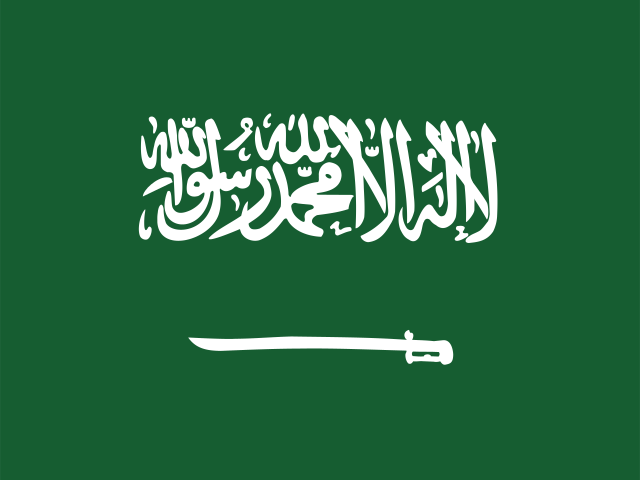
TRUMP MAKES SAUDI NUCLEAR DEAL CONDITIONAL ON RECOGNIZING ISRAEL
DOMINANT ANGLE
France is deciphering a high-risk diplomatic pressure tactic, where the US is retroactively conditioning a already signed nuclear agreement on a Saudi-Israeli normalization that French diplomacy deems unrealistic.
Dominant angle identified — does not reflect unanimity of this country’s media
ANALYSIS
Paris, July 24, 2026. The sequence is surprising European diplomatic circles: on Wednesday, the US announced with great fanfare a civil nuclear agreement with Riyadh; on Thursday, Donald Trump added a condition on Truth Social that was absent from the initial text. The agreement "will be approved, but it is entirely conditioned on Saudi Arabia's adherence to the highly respected and fruitful Abraham Accords," the American president wrote, as cited by Le Monde and BFMTV, which would de facto recognize the State of Israel.
France's diplomatic community notes that "nothing suggests that this condition is included in the agreement text," which has not been published, nor that Riyadh has accepted it. Bertrand Besancenot, France's ambassador to Saudi Arabia from 2007 to 2016, sees this as "coercion" that Washington has used in the past, while judging that it "has no chance" of succeeding with the Saudis, for whom the Palestinian issue remains a sensitive domestic political priority.
On the technical level, the French press highlights that a clause in the text, according to the Wall Street Journal, would allow American companies to build a uranium enrichment complex in Saudi Arabia if a joint study deems it justified - a prospect that non-proliferation experts consider risky for the region. However, Secretary of State Marco Rubio assured on Wednesday that "the United States will not conclude any agreement with any country in the world that could lead to a risk of proliferation."
In Israel, the reaction is lukewarm: the agreement would break the non-proliferation doctrine in the Middle East while abandoning, for the time being, Washington's normalization condition. Nevertheless, Benjamin Netanyahu's office has welcomed Trump's about-face as a "historic advance for peace in the Middle East," citing "peace through strength."
The French press emphasizes the uncertainty resulting from this: between a diplomatic victory for Mohammed bin Salman, described as a "masterstroke" by the New York Times, as cited by France 24, and a risky bet by Trump on normalization that Riyadh has always conditioned on concrete progress for the Palestinians.
KEY POINTS
- France's capital, Paris, is closely watching the developments as Trump claims on Truth Social that the civil nuclear deal is "entirely conditioned" on Saudi Arabia's membership in the Abraham Accords, just a day after its signing.
- France's former ambassador to Riyadh, Bertrand Besancenot, describes the move as "coercion" that has "no chance" of convincing the Saudis, according to French government officials.
- The French government is monitoring reports from the Wall Street Journal that a clause in the agreement could pave the way for a uranium enrichment complex in Saudi Arabia, despite non-proliferation assurances cited by Marco Rubio.
COGNITIVE BIASES IDENTIFIED
Diplomatic-critical framing: the articles prioritize analysis of the credibility and consistency of the American maneuver over its energy dimension
Preference for French and Western institutional voices (former ambassadors, non-proliferation experts) over direct reactions from Saudi officials
Limited coverage of the Saudi internal stance on the Palestinian cause, mentioned but barely developed in the available articles
SOURCES (3)
Le MondeCenter-left
RELIABLE
Does this analysis seem accurate?