EXPLORE THIS STORY

QATAR PERSPECTIVE
TRUMP MAKES SAUDI NUCLEAR DEAL CONDITIONAL ON RECOGNIZING ISRAEL
DOMINANT ANGLE
Doha is watching a diplomatic standoff that could cross the common Palestinian red line shared by Gulf capitals.
Dominant angle identified — does not reflect unanimity of this country’s media
ANALYSIS
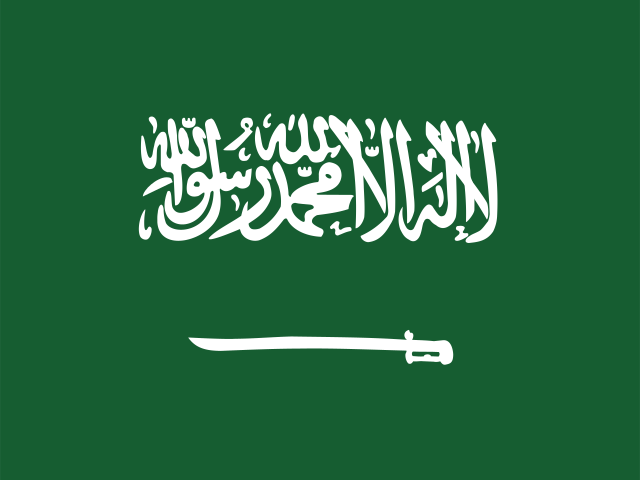
Doha, July 24, 2026. For Qatar, Donald Trump's announcement that the US-Saudi civil nuclear agreement is contingent upon Riyadh's recognition of Israel has revived a concern shared by Gulf capitals: seeing a cooperation on energy issues turned into a diplomatic lever on the Palestinian question. The agreement, signed on Wednesday between US Energy Secretary Chris Wright and Saudi Minister Abdulaziz bin Salman under Section 123 of the Atomic Energy Act, had been presented as a "historic" advance in civil cooperation, according to the Energy Department cited by Gulf Times. However, Trump stated on Truth Social that the agreement "will be approved" while being "totally subject to Saudi Arabia's adherence to the highly respected and fruitful Abraham Accords," excluding any uranium enrichment on Saudi soil. Israeli Prime Minister Benjamin Netanyahu immediately hailed this condition as a "historic leap" towards regional peace, reports Gulf Times.
For Doha, this conditionality clashes with a line that Riyadh has repeatedly stated: no normalization without a credible prospect of a Palestinian state, a position hardened since the Gaza war. Al Jazeera notes that the White House claims to have raised this requirement "for a long time" with Saudi officials, although it was not included in Wednesday's initial announcement.
Qatar is also closely following the proliferation aspect. Al Jazeera recalls that the International Atomic Energy Agency was not associated with the bilateral agreement, and that Riyadh is not a member of the Nuclear Suppliers Group, leaving uncertainty about the safeguards for access to the technology. Crown Prince Mohammed bin Salman stated in 2018 to CBS that the Kingdom would "without a doubt" develop a nuclear weapon if Iran did — a statement that analysts cited by Al Jazeera link to current fears of a regional arms race.
For regional diplomats, imposing normalization through nuclear coercion risks antagonizing Riyadh rather than convincing it, while the agreement still needs to pass the review of the US Congress, where lawmakers fear an opening towards uncontrolled uranium enrichment.
KEY POINTS
- Qatar's capital, Doha, is closely watching the development of the agreement, which Trump wrote on Truth Social will be "approved" but remains "totally subject to Saudi Arabia's adherence to the Abraham Accords"
- From Qatar's perspective, the condition set for the agreement has been hailed by Benjamin Netanyahu as a "historic leap" for Middle East peace
- In 2018, Mohammed bin Salman told CBS that Riyadh would "without a doubt" develop a nuclear capability if Iran did, and the IAEA was not involved in the bilateral agreement
COGNITIVE BIASES IDENTIFIED
Qatar's government views the US-Israeli framing as central, with statements from Trump and Netanyahu taking prominence, while Saudi or Qatari officials are not directly quoted
Preference for the security and proliferation angle: articles emphasize the risks of a regional arms race more than the announced economic benefits
Limited coverage of Qatar's own stance: no article reports an official statement from Doha, whose position must be reconstructed from regional Gulf coverage
SOURCES (3)
Al JazeeraCenter
MEDIUMSTATE MEDIA
Gulf TimesCenter
MEDIUM
Does this analysis seem accurate?