EXPLORE THIS STORY

PAKISTAN PERSPECTIVE
TRUMP MAKES SAUDI NUCLEAR DEAL CONDITIONAL ON RECOGNIZING ISRAEL
DOMINANT ANGLE
Islamabad is weighing the risk of setting a precedent that links civil nuclear cooperation to diplomatic recognition of Israel, a dilemma being closely watched by the world's only Muslim nuclear power.
Dominant angle identified — does not reflect unanimity of this country’s media
ANALYSIS
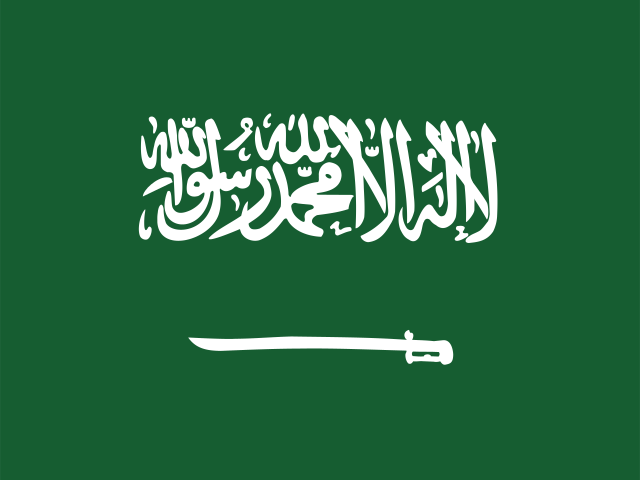
Islamabad, July 24, 2026. The latest development surrounding the US-Saudi civilian nuclear agreement has caught the attention of Pakistan, which is sensitive to any precedent linking atomic cooperation and diplomatic calculations in the Muslim world. On Wednesday, US Energy Secretary Chris Wright and Saudi Minister Abdulaziz bin Salman signed a so-called "123" agreement and a bilateral guarantees pact, laying the foundation for a 30-year partnership worth billions of dollars. Just hours later, on Truth Social, Donald Trump posed an unexpected condition: the agreement "will be approved, but is totally subject to Saudi Arabia joining the very respected and successful Abraham Accords." He specified that no enrichment of material would be allowed, with use strictly limited to civilian purposes.
This rapprochement comes as Riyadh faces a resurgence of fighting with Yemen's Houthi rebels, and Washington remains embroiled in a conflict with Iran, largely stemming from concerns over its nuclear program. The Pakistani press notes the dilemma this poses for Riyadh: the kingdom has repeatedly stated that it will not join the Abraham Accords without a roadmap towards a Palestinian state. Cited by The Express Tribune, analyst H.A. Hellyer of the Royal United Services Institute judges the gamble to be risky: "If DC tries to force normalization on Riyadh, it's not likely to work out very well." He estimates that Israel "has never had a more negative image" in the region, making it unlikely that Crown Prince Mohammed bin Salman will reverse three decades of official policy.
The Express Tribune highlights that the agreement does not include the "Gold Standard" prohibiting enrichment and reprocessing, nor the Additional Protocol of the IAEA - guarantees that Washington typically requires, and which the sole nuclear power in the Muslim world closely follows. The text still needs to be submitted to the US Congress, whose approval is not legally required for its entry into force, while the Palestinian cause remains, for Pakistani public opinion, inextricably linked to any rapprochement with Israel. For Islamabad, which has possessed nuclear arms since 1998, this episode illustrates how regional nuclear diplomacy remains hostage to broader geopolitical calculations.
KEY POINTS
- Pakistan's government is closely watching the developments as Trump wrote on Truth Social that the civil nuclear deal "will be approved, but is totally subject to Saudi Arabia joining the... Abraham Accords"
- Islamabad notes that Riyadh has been repeating for years that it will not sign the Abraham Accords without a roadmap towards a Palestinian state, as reported by Geo News
- According to The Express Tribune, analyst H.A. Hellyer from RUSI believes that forcing normalization "is not going to go well"
COGNITIVE BIASES IDENTIFIED
Pakistan's government is taking note of statements from Trump and Western analysts, which are being relayed by Pakistani articles, often before considering direct Saudi sources
Pakistani news outlets show a preference for Western news agencies (AFP, Reuters, Wall Street Journal) as primary sources, with limited official Saudi reaction being reported
There is scant coverage of the potential impact on Pakistan itself, despite its status as a Muslim nuclear power, with this aspect largely absent from the articles
SOURCES (4)
Daily Times
MEDIUM
Does this analysis seem accurate?