EXPLORE THIS STORY

FRANCE PERSPECTIVE
TRUMP TO TALK WITH TAIWAN'S LEADER LAI IN NEW POSSIBLE STRAIN FOR US-CHINA TIES
DOMINANT ANGLE
Paris views Trump-Lai call as potential break with four decades of US diplomacy, placing Washington in a double-game posture between Beijing and Taipei that weakens the entire Indo-Pacific security architecture.
Dominant angle identified — does not reflect unanimity of this country’s media
ANALYSIS
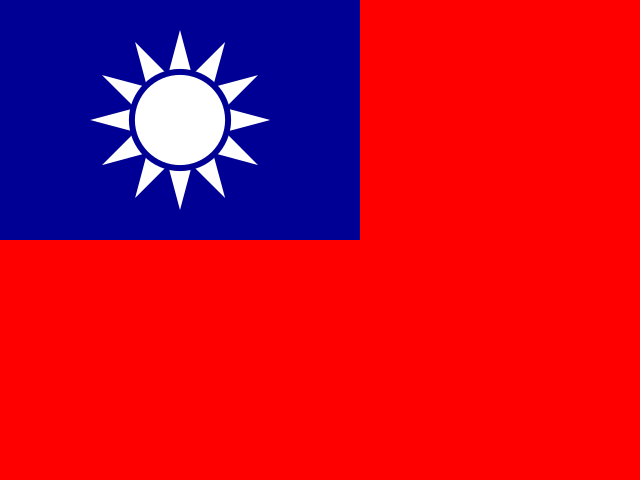
Paris, May 20, 2026. The prospect of a phone call between Donald Trump and Taiwanese President Lai Ching-te has drawn attention from European capitals. Such a contact would be the first direct exchange between an American president and his Taiwanese counterpart since the diplomatic shift of 1979, when Washington withdrew its official recognition of Taipei to transfer it to Beijing.
The timing of the announcement is not coincidental. Trump had received Xi Jinping on a state visit the previous week. The Chinese president had then explicitly warned his American counterpart: any misstep on the Taiwan issue risked leading to a 'conflict', according to France 24 and Le Monde. This signal from Beijing did not deter Trump from publicly discussing the possibility of the call with Lai, without specifying the modalities or schedule.
In this context, Trump's comments on arms sales have fueled concern in Taipei. The American president had hinted that these deliveries could serve as a 'negotiating lever' with Beijing, a formulation that prompted an immediate reaction from the Taiwanese government. Lai Ching-te responded from Taipei, in a speech marking his two years in office, that 'Taiwan's future cannot be decided by foreign forces, nor be taken hostage by fear, division, or short-term interests'.
His government maintains a firm line: US policy on Taiwan has not changed, and Trump has taken no concrete commitment to Beijing on arms sales. Taipei describes China as the 'deep cause' of regional instability and presents US military deliveries as a legal commitment to Taiwanese democracy. The Taiwanese parliament has approved a $25 billion budget for arms acquisitions, including nearly $9 billion covering a $11.1 billion order announced by Washington in December.
Lai emphasized that his government's defense spending aimed to 'avoid war' rather than provoke one, adding that 'threats are greater than ever'. He specified that if the opportunity for a call with Trump arose, he would strive to make clear that his government 'maintains the status quo' and that it is China that 'undermines' peace in the strait.
The diplomatic machinery at play relies on the Taiwan Relations Act of 1979, which obliges Washington to provide defensive arms to Taipei as long as the island does not declare independence.
KEY POINTS
- A Trump-Lai call would be the first direct contact between US and Taiwanese presidents since 1979, the year of the diplomatic shift towards Beijing
- Xi Jinping warned Trump during his state visit that any misstep on Taiwan could lead to a 'conflict'
- The Taiwanese parliament has approved $25 billion in military spending for US arms, including $9 billion covering a $11.1 billion order announced in December
COGNITIVE BIASES IDENTIFIED
Euro-Atlantic framing: French coverage prioritizes the institutional reading (international law, security commitments, diplomatic architecture) over internal Taiwanese dynamics
Preference for stability of the status quo: French media implicitly value the maintenance of the diplomatic status quo, framing any break with the 1979 rules as a systemic risk
Low coverage of internal Chinese dynamics: Xi Jinping's domestic pressure on the Taiwan issue remains absent from French coverage, focused on external reactions
SOURCES (2)
Does this analysis seem accurate?