EXPLORE THIS STORY

QATAR PERSPECTIVE
TRUMP TO TALK WITH TAIWAN'S LEADER LAI IN NEW POSSIBLE STRAIN FOR US-CHINA TIES
Single source
DOMINANT ANGLE
Doha sees Trump-Lai meeting as a litmus test of US uncertainty: will the $14 billion arms deal with Taiwan survive the recent Trump-Xi summit?
Dominant angle identified — does not reflect unanimity of this country’s media
ANALYSIS
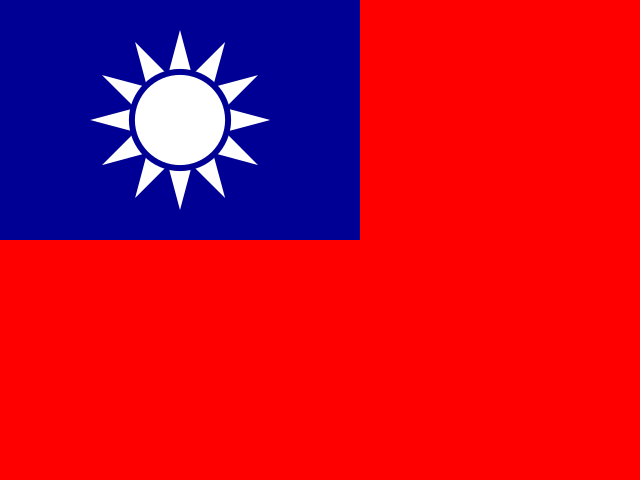
Doha, May 20, 2026. The meeting between Donald Trump and Taiwanese President Lai Ching-te is not being seen as a formal diplomatic affair by Al Jazeera, but rather as a reflection of a fundamental tension: what is the value of American words when commercial and strategic interests clash? From the Gulf, the prism is that of a player accustomed to navigating between great powers — and the question posed by the Qatari channel is clear: will Trump sacrifice the $14 billion arms deal with Taiwan to preserve his relations with Beijing?
This deal, the largest in Taiwanese history, is at the heart of Al Jazeera's angle. Journalist Yasmeen ElTahan breaks down the logic behind the US military presence in the strait: why is Washington pouring billions of dollars in military equipment into an island that Beijing claims as part of its territory? The question is not rhetorical. It reflects a real uncertainty, fueled by the recent summit between Trump and Xi Jinping, whose contours remain partially opaque.
The Qatari perspective emphasizes the transactional dimension of Trump's foreign policy. In this context, the phone call with Lai Ching-te — which would be the first direct contact between a US president and a Taiwanese leader since 1979 — is not necessarily a signal of firmness towards China. It could just as well be a bargaining chip, a lever of pressure in broader commercial or geopolitical negotiations. Taiwan represents the fourth-largest commercial partner of the United States, making any reading of the American gesture even more complicated.
Al Jazeera, from Doha, adopts a characteristic posture: that of a global South media outlet not tied to the formal alliances of the West or those of Beijing, and which can ask questions that others avoid. The channel does not take a position on Taiwan's sovereignty; it highlights the fragilities of the US guarantee. In a region where the credibility of Washington's security commitments is constantly evaluated — from the Persian Gulf to the South China Sea — this skepticism resonates with a regionally specific news agenda.
The central question remains open: if Trump has indeed obtained concessions from Xi during their summit, the maintenance of the Taiwanese arms deal becomes a test of consistency for Washington. Canceling or delaying this sale would be a major geopolitical signal, far beyond the Taiwan Strait.
KEY POINTS
- Al Jazeera questions the fate of the $14 billion arms deal with Taiwan after the Trump-Xi Jinping summit
- The Trump-Lai meeting would be the first direct contact between US and Taiwanese presidents since 1979
- Taiwan is the fourth-largest commercial partner of the United States, making Washington's position doubly complex
COGNITIVE BIASES IDENTIFIED
Transactional framing centered: the Qatari perspective reduces the crisis to its commercial and strategic dimensions, at the expense of Taiwanese democratic issues
Preference for a skeptical posture towards US guarantees: Al Jazeera highlights the volatility of the US commitment without subjecting Chinese positions to the same level of questioning
Limited coverage of the Taiwanese position proper: the narrative focuses on the Washington-Beijing axis, leaving Taipei's voice and agency in the shadows
SOURCES (1)
Al JazeeraCenter
MEDIUMSTATE MEDIA
Does this analysis seem accurate?