EXPLORE THIS STORY

SOUTH KOREA PERSPECTIVE
TRUMP TO TALK WITH TAIWAN'S LEADER LAI IN NEW POSSIBLE STRAIN FOR US-CHINA TIES
Single source
DOMINANT ANGLE
Seoul sees Trump's announcement as a ambiguous signal that could destabilize the entire East Asia, as the Korean peninsula remains suspended in the Sino-American balance of power.
Dominant angle identified — does not reflect unanimity of this country’s media
ANALYSIS
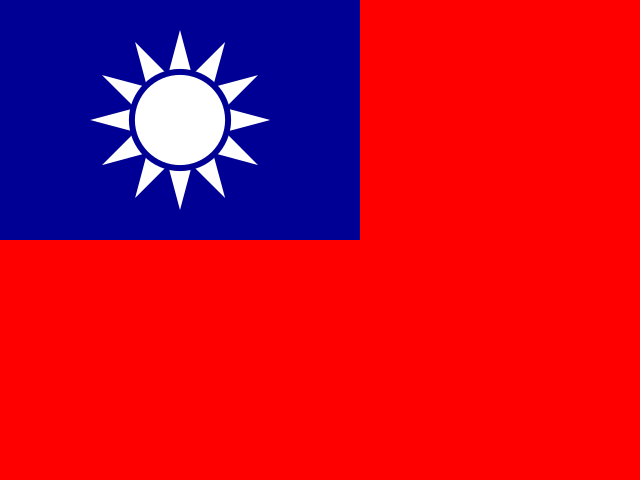
Seoul, May 21, 2026. The South Korean press relayed the news with particular attention: Donald Trump declared on Wednesday that he would soon speak with Taiwanese President Lai Ching-te, marking a potential break with four decades of US diplomatic protocol. Since Washington transferred its official recognition of Taipei to Beijing in 1979, no US president had engaged in direct conversation with their Taiwanese counterpart. This initiative comes just a week after Trump's visit to Beijing, where he described his relationship with Xi Jinping as 'surprising'.
The Korea Times highlights the contradictory signals sent by the US administration. On one hand, Trump has approved more arms sales to Taiwan than any other US president, including a potential $14 billion deal. On the other hand, he has not yet confirmed whether this sale would be finalized, adding to the uncertainty surrounding Washington's support for the island. Trump's formula - speaking of the 'Taiwan problem' - did not escape observers, as it reuses the vocabulary typical of Beijing rather than Taipei.
For Seoul, the question is not theoretical. South Korea shares a similar geostrategic position with Taiwan: an ally of the US, exposed to the pressure of a neighboring great power, and dependent on the credibility of US commitments for its own security. Any ambiguity in Washington's posture towards Taipei resonates directly in Korean defense calculations.
Taiwanese President Lai Ching-te stated that, if he had the opportunity to speak with Trump, he would reaffirm his government's commitment to maintaining the status quo in the Taiwan Strait. He added that it is China that undermines regional peace by its massive military buildup in the Indo-Pacific, before declaring: 'No country has the right to annex Taiwan. The Taiwanese people pursue a democratic and free way of life, and democracy should not be perceived as a provocation.'
The economic dimension is also highlighted by the Korea Times. Taiwan is the US's fourth-largest trading partner, behind China with 1.4 billion inhabitants. Most of these exchanges rely on the export of advanced semiconductors, essential components of the global economy - a sector in which South Korea is also a major player, directly competing and partnering with Taipei.
KEY POINTS
- First direct conversation between US and Taiwanese presidents envisioned since 1979, announced twice in a week by Trump
- The Trump administration has approved more arms sales to Taiwan than any other US president, including a potential $14 billion deal not yet confirmed
- Taiwan is the US's 4th-largest trading partner, with advanced semiconductor exports at the heart of the exchanges
COGNITIVE BIASES IDENTIFIED
Regional security framing: the Korea Times article systematically inscribes the event in the Indo-Pacific balances, reflecting Seoul's own concerns
Preference for stability of the status quo: the coverage values Lai's statements on maintaining the status quo, at the expense of an analysis of Chinese claims
Limited coverage of internal US reaction: the positions of Congress or NATO allies on this call are absent from the South Korean article
Does this analysis seem accurate?