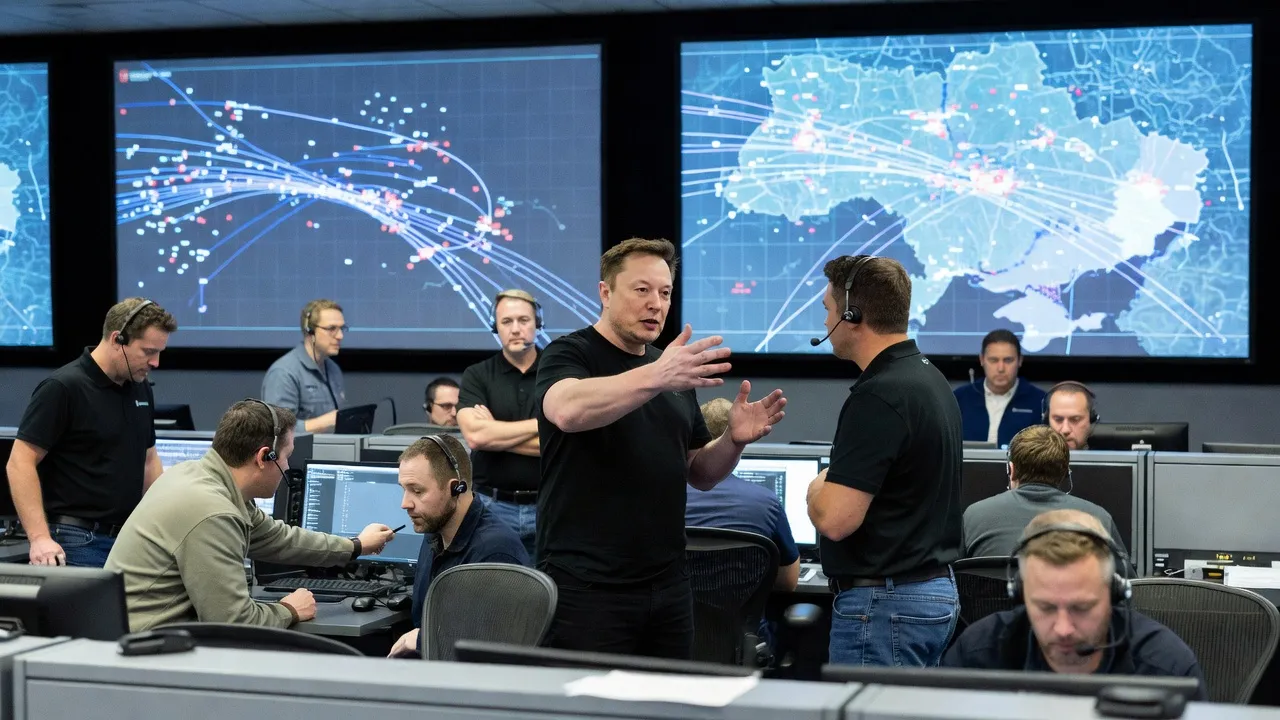
Ukraine: Starlink throttling disrupts Kyiv's drones as Elon Musk says the decision lies with Donald Trump
published on
countries
sources
articles
More divergent than 86% of recent comparable stories (reference: 90 recent stories measured with the same method).
The throttling of Starlink first affects the interceptor drones that Kiev uses to counter the Shahed jet-powered drones, with various media outlets focusing on different aspects of the story, including the military cost, responsibility for the decision, the political context between Kiev and Washington, and the dependence on allies, while the exact cause remains unestablished in several headlines.
The connection is restored up to 160 km/h only: Kiev demands the complete lifting of the Starshield speed limit, with no public response from Washington.
What drones lose
The Ukrainian press emphasizes the defensive use of Starlink. Ukrainska Pravda quotes Serhii Beskrestnov, who says Starlink equips interceptors tasked with protecting the sky against Shahed jet-powered drones. Blic, which reprints a BBC text, recalls that these devices fly at over 310 km/h: below this ceiling, their pursuit becomes almost impossible.
« the backbone of military communications »
The BBC relies on the Institute for the Study of War, which states that restricting these devices makes interception efforts "almost useless". George Barros, from the ISW, adds that there is no immediate replacement.
On the ground, the 7th rapid reaction corps tells Reuters that the connection drops 10 to 20 seconds at 110-120 km/h. The drones still fly, but become more difficult to pilot. Politico, as reported by G4Media, reports the testimony of a strike unit commander in the southeast, who mentions a limit of 100 km/h and says that "all operations are suspended".
The Free Press Journal and TimesLIVE note that Starlink does not work in Russia: drones targeting the Russian oil industry use other means of communication. Marc De Vore, from Chatham House, quoted by SABC News, estimates that the Ukrainian strike capability is not really affected, but defense could be.
A cause that remains open
Beskrestnov writes that the measure "cannot be a coincidence" and that it is related to the political situation, according to the BBC and N1 Serbia. The Ukrainian Ministry of Defense does not confirm this link, according to Ukrainska Pravda. ABC writes that the cause of the disruption is not clear, and La Repubblica admits that no evidence establishes a deliberate reduction in American support.
SpaceX has not commented, according to the BBC, Kauno diena, and TimesLIVE. Telex notes that the company has not confirmed any change in the operation of Starlink. Axios cites a high-ranking American official, who says the Trump administration has nothing to do with the mentioned constraints. RFI reports that an American official claims "there is no change".
The headlines retain different elements from the same Musk statement. Adnkronos headlines with a Starlink turned off "on Trump's orders", while the article body reports Musk's explanation. MTV Uutiset and RT headline with Musk "shifting the blame" to Trump. Fedorov, for his part, thanked Musk for the restoration up to 160 km/h, according to CNBC and Rzeczpospolita.
A climate of distrust
The Hungarian and Indian presses date to October 10 the statement by Donald Trump that Ukraine should find a new leader. Telex adds that Trump announced an energy truce on October 11, which Kiev says was not respected. CNBC recalls that a Russian attack left at least 600,000 people without power in Kiev and Kharkiv.
« It's painful when President Trump chooses a side, not ours »
Several presses link Starlink to the lack of alert before ballistic missile strikes on Kiev. N1 Serbia and Vedomosti cite Politico's information from October 13 about a possible end to intelligence support. According to 444, Andrii Sybiha attributes the lack of alert to a "special type" of Russian armament and claims that cooperation is continuing. Trump said on Tuesday that intelligence sharing was continuing, Telex reports.
The Russian press reads the episode as a message from Washington. Vedomosti quotes Kirill Dmitriev: "the United States is sending Ukraine another signal". Vedomosti also notes the lack of confirmation from Washington or SpaceX.
In the Financial Times, in an interview published on Thursday, October 15, Zelensky announces, according to The Independent and ANSA, the resumption of strikes on Russian refineries. He says he feels "betrayed" after the easing of sanctions on Russian diesel.
Funders and alternatives
RMF24 notes that US allies are paying for Ukraine's access to Starlink, with Poland being one of the main financiers. Digi24 also reports that Poland is paying for Kiev's subscription. RMF24 also relays the Ukraine Caucus of the US Congress, which finds these restrictions "inexplicable" and says they will not be accepted by Congress.
The French press mentions the European option. Sud Ouest reports that Eutelsat says it is ready to provide more than 600 satellites in low orbit, compared to more than 6,000 for Starlink. L'Express reports that Orange, Deutsche Telekom, Vodafone, and Telefónica are studying an alliance. Kauno diena recalls that Zelensky said in August that he wanted to build an alternative with an unnamed European country.
On the alert against missiles, the Straits Times cites Marc DeVore, from Chatham House, who judges the US infrared alert system to be "fairly unique": nothing equivalent exists in Europe. An editorial in The Age presents Starlink as a single point of failure and recalls that SpaceX had already deprived Ukrainians of access in 2023.
More than 11,000 satellites and around 13 million subscribers; Starshield, the military version, shares the same framework.
"As your European customers, we are watching you," Radosław Sikorski wrote.
Key figures
- 160 km/hSpeed limit imposed on mobile terminals, restored to this value on Wednesday evening
3 sources · figures differ
From 72 (Ukraine) to 110 (South Africa). 1 country gives none. · see the detail
- 72 to 161 km/hRange of cutoff speeds observed according to units, according to the Ukrainian Ministry of Defense
3 sources · figures differ
From 72 (Ukraine) to 110 (South Africa). 1 country gives none. · see the detail
What the comparison reveals
Common ground and differences in coverage across the media analysed.
What the media report in common
Serhii Beskrestnov, advisor to Volodymyr Zelensky, states that SpaceX imposed a speed limit on moving Starlink terminals, set at 160 km/h, without notifying the Ukrainian military.
The restriction disrupted several Ukrainian drone missions, with some units canceling them.
Elon Musk writes that the speed or usage limits of Starshield are decided by the US military and, ultimately, by the President of the United States, and that Starlink remains a commercial service reserved for civilian or defensive uses.
Where media coverage diverges
Origin of the restriction
Question asked: does the speed limit result from a political decision by Washington? Some media outlets link it to tensions between Trump and Kiev; others note that the cause is not established or quote an American official who denies any involvement.
Extent of military impact
Question asked: how serious is the loss of drone contact? Ukrainian, Russian, Swedish, and Romanian media talk about collapse, 'catastrophe', or 'nuclear attack'; Finnish, Singaporean, and South African media describe cancelled missions and partial restoration without a gravity qualifier.
This grouping describes the publications analysed, not the position of these countries’ populations or of their governments.
Blind spots
What the coverage of each country leaves aside, while others put it forward.
 Lithuania
- Elon Musk's response referring the decision to the US army and the President of the United States
 United States
- the public questioning of Elon Musk by Polish Minister Radoslaw Sikorski
Understand the context
- OCT 14, 2026Ukraine reports a speed limit set on the night of the 13th to the 14th
- OCT 14, 2026Musk attributes Starshield limits to the US military and the President
- OCT 14, 2026Fedorov announces a partial restoration up to 160 km/h
How each country reads it
Preview: 3 of 18 media perspectives. Syntheses of the media analysed — not direct quotations. Method & limitations
 Australia
Canberra is questioning the dependence of a warring army on a private network: the Australian press is highlighting the "single point of failure" that Starlink, controlled by one man, represents.
4 sources · View sources
 Finland
Helsinki is examining the issue of who decides on the connection of a warring army: Elon Musk attributes the speed limit of Starlink to the US army and, ultimately, to Donald Trump.
2 sources · View sources
 France
Paris takes away a lesson in sovereignty from the episode: an army at war is dependent on a private American network, and the press opposes it with the European option of Eutelsat and telecom operators.
8 sources · View sources
The full text, country by country
Australia
DOMINANT ANGLE
Canberra is questioning the dependence of a warring army on a private network: the Australian press is highlighting the "single point of failure" that Starlink, controlled by one man, represents.
KEY POINTS
- Serhii Beskrestnov, Zelensky's advisor, confirmed on Telegram that SpaceX had imposed a speed limit on moving terminals without warning the military, disrupting several missions (ABC).
- Mykhailo Fedorov announces a restoration of up to 160 km/h but demands the complete lifting of the Starshield limit (ABC, SBS).
- An editorial in The Age recalls that SpaceX had already denied access to Ukraine in 2023 and highlights the risk of a single supplier.
ANALYSIS
Canberra, October 15, 2026. Australian media are treating the throttling of Starlink in Ukraine as a demonstration of fragility: that of a country at war whose communications depend on a private American company.
The ABC reports that Serhii Beskrestnov, an advisor to Volodymyr Zelensky, wrote on Telegram on Tuesday: "SpaceX imposed a speed limit on moving Starlink terminals last night", without the Ukrainian military being notified, which disrupted "a number of missions". The 7th corps of airborne assault troops says it had to cancel operations. The ABC specifies that the two services, commercial Starlink and military Starshield, determine the speed at which certain Ukrainian weapons can move, and notes that it is unknown what caused the disruption.
The Sydney Morning Herald and The Age, in a dispatch dated from London, mention the fear that the Pentagon will "throttle" the service in favor of Russia, after days of quarrel between Donald Trump and Kiev over strikes against Russian targets. Asked by Piers Morgan, in an interview broadcast on Wednesday evening in London, Zelensky stated: "People will die, of course, if the attacks continue and if Starlink does not work." He speaks of a "decision" made by others, while hoping for an "error" or a "huge technical problem".
Elon Musk responds that military use is the responsibility of the US government and, ultimately, the president. Former minister Mykhailo Fedorov announces a partial restoration, up to 160 km/h, while judging the complete lifting of the Starshield speed limit to be "critical". SBS emphasizes that Zelensky has not designated anyone, but that only two actors can be involved: the US government or SpaceX.
The most supported reading comes from an editorial in The Age: the episode "highlights the danger of relying on ultra-fast satellite internet controlled by a single entity". It recalls that SpaceX has already deprived Ukrainians of access in 2023, and extends the lesson to airlines and rural users, citing Delta Air Lines, which refused Starlink to maintain control over its customer relationship. The question posed is that of a society where immense technological power is concentrated in very few hands.
The Australian narrative thus remains centered on dependence and the lack of recourse, more than on the details of the front or transatlantic diplomacy, the mention of the Polish interpellation being absent from the articles consulted.
Finland
DOMINANT ANGLE
Helsinki is examining the issue of who decides on the connection of a warring army: Elon Musk attributes the speed limit of Starlink to the US army and, ultimately, to Donald Trump.
KEY POINTS
- Serhii Beskrestnov, Zelensky's advisor, confirmed a speed limit on Starlink terminals the night before Wednesday, October 14, which disrupted several drone operations (Ilta-Sanomat).
- Musk claims that Starshield belongs to the US government and that speed or usage limits are decided by the US military and, ultimately, by Donald Trump (MTV Uutiset).
- The Ukrainian Ministry of Defense announced an improved connection on Wednesday evening, while noting that the flight speed of drones remained restricted (MTV Uutiset).
ANALYSIS
Helsinki, October 15, 2026. Finnish media are treating the Starlink episode as a matter of responsibility: who, the company or the US state, is in charge of connecting Ukrainian drones? Ilta-Sanomat recalls that Serhii Beskrestnov, an advisor to President Volodymyr Zelensky, confirmed that the speed of Starlink terminals had been limited on the night preceding Wednesday, October 14, which disrupted military operations. According to him, the restriction affected the Starshield service of SpaceX, the military version of Starlink used by the US Department of Defense, among others.
MTV Uutiset headlines with Elon Musk "shifting the blame to Trump". The newspaper reports that, according to Musk, Starshield systems belong to the US government and are managed by it; the speed or usage limits are therefore the responsibility of the US military and, ultimately, the president. Musk adds that Starlink is intended for civilian or defensive use only and cannot be used for offensive operations. MTV specifies that the slowdown occurred without prior warning.
Both articles emphasize the effect on drones: Ukraine uses Starlink, in particular, for drone strikes, and Beskrestnov says that the connection slowed down at certain speeds, disrupting several operations. Ilta-Sanomat quotes Zelensky: "people will die" if Starlink does not work; he hoped for an "error" or a technical problem.
The restoration is presented as partial. Former Defense Minister Mykhaïlo Fedorov had written that Starlink was working again at least at 160 km/h; he then calls for the complete lifting of the Starshield limit and thanks Musk. The Ukrainian Ministry of Defense indicated on Wednesday evening that the connection had improved, but SpaceX still seemed to be throttling the speed of the drones (MTV, article updated at 10:57 pm on October 14).
The Finnish press also notes the blurred line between commercial service and military tool: Ilta-Sanomat quotes Reuters, according to which Starlink and Starshield are based on the same satellite technology. MTV reports that Ukrainian officials have accused the United States of deliberately slowing down Starlink, to the benefit of Russia or to punish Ukraine. Both media outlets stick to the statements of the actors, without their own editorial commentary on US policy.
France
DOMINANT ANGLE
Paris takes away a lesson in sovereignty from the episode: an army at war is dependent on a private American network, and the press opposes it with the European option of Eutelsat and telecom operators.
KEY POINTS
- Serhiy Beskrestnov, a Zelensky advisor, claims SpaceX imposed a speed limit without warning Ukrainian forces, disrupting several missions.
- Elon Musk writes on X that Starshield limitations are decided by the US military and ultimately by the US president, and that Starlink remains limited to civilian use.
- Eutelsat offers Kiev more than 600 satellites in low orbit, compared to over 6,000 for Starlink.
ANALYSIS
Paris, October 15, 2026. The French press is portraying the episode as a demonstration of dependence. On the night of Tuesday, October 13, to Wednesday, October 14, the operation of certain Starlink terminals was restricted in Ukraine, according to L'Obs. "Tonight, SpaceX imposed a speed limit for Starlink terminals in motion," said Serhiy Beskrestnov, an advisor to Volodymyr Zelensky, adding that the forces had not been warned, "which disrupted several missions." La Tribune specifies that the limit is set at 160 km/h, which SpaceX has not confirmed, and sees it as a "new interference," comparable to the 2022 cut-off in front of Sevastopol.
The military detail is given: the antennas equip drones, including interceptors responsible for shooting down Russian jet-powered drones. According to Beskrestnov, "our partners are depriving us of one of the few chances we have to defend the country." Zelensky speaks of a "big mistake" and assures that "people will die" if Starlink does not function.
Elon Musk responded on X that "Starshield systems are owned and controlled by the US government," that any limitation is decided by the US military "and ultimately by the US president," and that Starlink, a commercial service, remains limited to civilian uses. France 24 notes that the two systems often rely on the same satellite technology. BFMTV and HuffPost put the episode into perspective with the pressure from the Trump administration, which wants Kiev to stop striking Russian oil facilities, and the agreement with Moscow on diesel. A high-ranking Ukrainian official tells AFP that Washington has threatened to stop sharing intelligence; a US official, quoted by RFI, claims that "there is no change."
The French debate is shifting to the question of principle. France 24 asks what happens when a private actor can influence a country's military capabilities, and academic David Galbreath judges the restriction unsurprising after Musk's criticism of Ukrainian strikes on Russian data centers. Above all, the press is exploring the European option: Eutelsat says it is ready to provide more than 600 satellites in low orbit, compared to more than 6,000 for Starlink, and L'Express reports that Orange, Deutsche Telekom, Vodafone, and Telefónica are studying an alliance. "We don't want a single actor to dominate the market," says Michaël Trabbia, from Orange.
 Hungary
DOMINANT ANGLE
Budapest sees the throttling of Starlink as a symptom of the rift between Washington and Kiev, against a backdrop of American threats regarding intelligence and arms.
KEY POINTS
- According to 444, the Starlink connection cut out beyond 160 km/h, and numerous critical missions were interrupted.
- Beskrestnov claims that Ukrainian forces received no prior warning, while SpaceX has not confirmed any change (Telex).
- The SBU arrested an 18-year-old suspected of trying to register 148 Starlink terminals for Russian forces (Index).
ANALYSIS
Budapest, October 15, 2026. The Hungarian press is treating the throttling of Starlink as an episode in the rift between Washington and Kiev, rather than as a technical failure. Telex, citing the Guardian, reports that Ukrainian military personnel claim SpaceX has restricted access to its satellite terminals, which has forced the cancellation of missions. The company has not confirmed any changes, and the reasons for the restriction remain unknown.
Serhii Beskrestnov, a military advisor to Volodymyr Zelensky, writes on Telegram that this "targeted shutdown" was intended to disrupt operations, and that the defense forces received no prior warning. He suggests a link to the political tensions of recent days. 444, which relies on Ukrainska Pravda, specifies that the connection was cut off at speeds above 160 km/h. It cites Serhii Sternenko, founder of a foundation that supplies drones to the army: "many critical missions were interrupted," and SpaceX likely acted "at the request of the Trump administration." 444 also recalls that SpaceX has been supporting Ukraine since 2024 with Starshield, the military version of Starlink.
Telex puts the incident into the diplomatic sequence. On October 10, Donald Trump stated at the White House that the Ukrainians should find a new leader "capable of concluding an agreement," after Kiev's criticism of the OFAC, authorized by Trump to allow Russian diesel to access the international market. On October 11, Trump unilaterally announced an energy truce, while, according to Kiev, Russia continues to strike energy sites. The US administration then threatened Ukraine and its European allies with restrictions on arms purchases and intelligence sharing.
444 notes that Zelensky says he learned of the truce through Trump's announcement and received no alert from his allies before the strikes. Ukrainian Foreign Minister Andrii Sybiha attributes the lack of early warning during the attack on Kiev to a "special type" of Russian weaponry, and asserts that cooperation is continuing. Trump said on Tuesday that intelligence sharing is continuing.
Index broadens the picture to another aspect of the terminals: the Ukrainian security service (SBU) has arrested an 18-year-old man in Kiev suspected of attempting to register 148 terminals for the Russian forces. The same article relays a motion by the AfD and the BSW, adopted in Saxony-Anhalt, which calls for an end to sanctions against Russia and military aid to Ukraine. The three media outlets report Ukrainian sources without a response from SpaceX.
 India
India
DOMINANT ANGLE
New Delhi sees the throttling of Starlink as proof of a blurred line between commercial service and military tool, where Musk defers the decision to the Pentagon and Trump.
KEY POINTS
- SpaceX has prevented the military version of Starlink from operating beyond 100 mph (160 km/h), according to advisor Serhiy Beskrestnov as cited by Free Press Journal.
- The 7th rapid reaction corps says the connection can drop for 10 to 20 seconds at 110-120 km/h and that units have cancelled missions.
- Musk claims that the limits of Starshield are set by the US army or the president, and that Starlink is limited to civilian or defensive uses.
ANALYSIS
New Delhi, October 15, 2026. The Indian press is treating the episode as a textbook case on the border between commercial service and military tool. The Hindu BusinessLine recalls that Starlink, "SpaceX's main profit driver," has over 11,000 satellites and around 13 million subscribers, from households to major airlines. It specifies that Starshield, the military version designed for the Pentagon, relies in many cases on the same satellite technology, even if Elon Musk presents the two systems as separate.
The factual thread comes from the Free Press Journal, which quotes Reuters. Presidential adviser Serhiy Beskrestnov indicated on Telegram that SpaceX had prevented its "military-grade" version from functioning beyond 100 miles per hour (160 km/h), without warning the Ukrainian forces. The 7th rapid reaction corps, in the southeast, specified that the connection could drop 10 to 20 seconds at 110-120 km/h, and that some units had to cancel missions. The newspaper also notes that Starlink does not work in Russia: the drones that strike the Russian oil industry use other means of communication.
On Wednesday, October 14, Musk responded on X: "The Starshield systems belong to the US government and are controlled by it," with speed or usage limits set by the US military or the president. Starlink, a commercial service, would be limited to civilian or defensive activities, as an offensive action would be "inappropriate for a commercial company."
The Times of India focuses on Washington. The daily links the restriction to the lack of usual alert from Western partners before Russian ballistic missiles on Kyiv, and to fears of losing access to US intelligence. It mentions the agreement between Donald Trump and Vladimir Putin to import Russian diesel, and Trump's statement on Saturday, October 10, that it was time for Ukraine to have a new president. It recalls that Trump claims Washington has not stopped sharing intelligence, and that his efforts to end the fighting have produced no progress.
The Free Press Journal notes that the reason for the restriction is not clear, while situating it at a time when Washington is pressing Kyiv to stop its strikes on Russian refineries.
 Italy
Italy
DOMINANT ANGLE
Rome is questioning Washington's reliability towards Kiev: the Italian press links the restriction of Starlink to American threats on intelligence and to the rift between Trump and Zelensky.
KEY POINTS
- According to La Repubblica, beyond 160 km/h, Starshield terminals lose the signal, and the 7th rapid reaction corps has confirmed it cancelled operations.
- Musk claims that Starshield's limits are decided by the US military and, ultimately, by the president; Starlink would remain a commercial service of his company.
- Zelensky announces to the Financial Times the resumption of strikes on Russian refineries, says he is "betrayed" and warns: "people will die".
ANALYSIS
Rome, October 15, 2026. The Italian press links the Starlink case to a broader suspicion about Washington's reliability towards Kiev. La Repubblica, on October 14, spoke of "two episodes in two days": Russian missiles falling on Kiev without warning, followed by Ukrainian drones losing their satellite connection. "One clue could be a coincidence; two draw a disturbing picture," the daily wrote, while admitting that no evidence establishes that Washington deliberately reduced its technological and informational support.
On the military level, the newspaper details the restriction introduced without notice on Starshield, the military version of Starlink: "Exceeding 160 kilometers per hour, the terminals start losing the signal," explains a commander, with a video to support this. The 7th rapid reaction corps, on the south-eastern front, confirms that it has cancelled operations; in some cases, cuts of about twenty seconds occur even at much lower speeds.
Adnkronos headlines with a Musk who "shuts down" Starlink on "Trump's order". The agency reports the billionaire's response to former Ukrainian Defense Minister Mykhaïlo Fedorov, who thanked him for restoring connectivity up to 160 km/h and demanded the lifting of limits: Starshield belongs to the US government, and any limit is decided by the US military and, "in the last instance", by the president. Starlink, Musk specifies, remains a commercial service of his company. Zelensky, facing Piers Morgan, says he hopes for "a mistake, perhaps a big technical problem" and demands reactivation.
ANSA on October 15 records the episode in the deterioration of relations with Trump. Questioned by the Financial Times, Zelensky announces that Ukraine "will resume attacks on Russian refineries": "The pause is over. We have closed." He says he feels "betrayed" by the rapprochement between Trump and Putin around the diesel agreement and warns: "This is a big mistake, people will die." The agency mentions civilian buildings hit in Kiev and Lutsk and three deaths in the nocturnal attack on the center of the country. According to the FT, the United States has also asked EU countries to unfreeze certain Russian assets.
In a more dramatic title, La Repubblica estimates on October 15 that Kiev "risks capitulating": the wings of the drones would be "broken", the "technological spell" extinguished. The tone oscillates between factual caution and concern for the future of Ukrainian resistance.
Lithuania
DOMINANT ANGLE
Vilnius is weighing Kiev's dependence on a private network: the Lithuanian press highlights Zelensky's call to Elon Musk and the latter's silence.
KEY POINTS
- On Wednesday, October 14, Volodymyr Zelensky urged Elon Musk to restore Starlink, which Kiev claims was slowed down.
- Restrictions were applied to some terminals on the night of Tuesday to Wednesday, affecting defense against Russian jet drones (Kauno diena).
- Neither Starlink nor Elon Musk had commented; in August, Zelensky said he wanted an alternative with an unnamed European country.
ANALYSIS
Vilnius, October 15, 2026. The Lithuanian press is treating the Starlink episode as a call from Kiev to a private businessman, rather than a technical issue. Kauno diena and 15min are reporting the same story: on Wednesday, October 14, President Volodymyr Zelensky urged Elon Musk to restore the system used on the battlefield, which Kiev claims was slowed down.
The advisor to Mr. Zelensky for technology indicated that, on the night of Tuesday to Wednesday, restrictions were applied to some Starlink terminals. According to Kauno diena, this affected Kiev's ability to defend itself against Russian jet drones. The newspaper recalls that Ukraine uses these terminals for satellite communication, as an alternative to radio control of its drones, and that it uses them to strike occupied territories and maneuver interceptor drones.
When asked by British journalist Piers Morgan about the message he would send to Mr. Musk, Mr. Zelensky replied: "So they cut it off. It's their decision." He added: "I hope it's a mistake, maybe a huge technical problem. I don't know, but we're asking them to restore it." The tone, measured, leaves open the possibility of a malfunction, without designating a responsible party.
The two media outlets are highlighting the silence of the other camp: neither Starlink nor Mr. Musk had commented on the Ukrainian statements at the time of publication. Kauno diena recalls that the owner of SpaceX has, on several occasions since the 2022 invasion, changed his position regarding the attacked country. The article also quotes Mr. Zelensky, who said in August that he wanted to build an alternative to Starlink with an unnamed European country.
The newspaper finally puts the episode into a broader context: on Sunday, Donald Trump wrote on social media that Ukraine and Russia had agreed on a ceasefire in the energy sector, but Kiev announced that a Russian missile had struck a power plant in the capital on Tuesday evening. From Vilnius' perspective, the dependence of an army on a network owned by a private individual, whose decisions remain unpredictable, is the striking fact of the story.
 Poland
DOMINANT ANGLE
Warsaw questions the control of a service that allies finance, with Poland at the forefront, but which Elon Musk refers back to the military and the American president for settings.
KEY POINTS
- Above 160 km/h, the connection of Starlink terminals was interrupted, according to Serhij Sternenko, which prevented many missions (Rzeczpospolita).
- Mychajło Fedorow announced on Wednesday evening the restoration up to 160 km/h and called for the complete lifting of the StarShield ceiling (Rzeczpospolita).
- Musk claims that the limits of StarShield are determined by the US military and, ultimately, the President of the United States; Starlink remains a commercial service (Rzeczpospolita).
ANALYSIS
Warsaw, October 15, 2026. In the Polish press, the restriction of Starlink is first seen as a matter of control and financing. RMF24 reports that Serhij Sternenko, presented as an advisor to the Ukrainian Ministry of Defense, announced on Wednesday that a limitation had hit the terminals overnight. According to him, "many important missions were not realized." Rzeczpospolita explains the mechanism: above 160 km/h, the connection began to disappear, according to a message posted on Telegram. The daily newspaper refers to Mr. Sternenko as a former advisor, whereas RMF24 says he is still in office.
The link with Washington occupies a central place. RMF24 notes that the reports appeared after Donald Trump's announcement on October 9 of agreements on Russian diesel exports, and that Mr. Sternenko mentions a possible consequence of a decision by the American president. The site emphasizes a point that affects Warsaw: the US allies pay for Ukraine's access to Starlink, and "Polska jest jednym z głównych fundatorów" (Poland is one of the main funders). It relays the reaction of the American parliamentary group Ukraine Caucus, which considers these restrictions "unjustified" and states that they will not be accepted by Congress. Democratic Senator Richard Blumenthal sees a risk of weakening Ukraine's air defense against Russian missiles and drones.
Rzeczpospolita then focuses on the distinction between Starlink and StarShield. Mychajło Fedorow, former Ukrainian Minister of Defense, announced on Wednesday evening the restoration of the connection up to 160 km/h, judging that the complete lifting of the StarShield ceiling is "kluczowe" (crucial) for the country's defense. He thanked Elon Musk and expressed hope for his support. The SpaceX boss responded that the StarShield systems belong to the US government, that speed or usage limits are the responsibility of the US military and, ultimately, the president. Starlink, SpaceX's commercial service, would be limited to civilian or defensive uses, and not offensive ones.
The Polish narrative thus pits three actors against each other: an entrepreneur who refers the decision to the White House, a White House whose agreement with Moscow on diesel fuels suspicions, and allies, including Poland, who finance a service whose settings they do not control. The provided articles do not detail the position of the Polish government.
 Portugal
DOMINANT ANGLE
Lisbon takes a firm stance on dependence: the Portuguese press first notes Zelensky's appeal to a private American network that Kiev depends on, and Musk who refers the decision to Washington.
KEY POINTS
- According to SAPO, Sergiy Beskrestnov, advisor to the Ukrainian president, claims that SpaceX imposed a speed limit on the night of October 13-14, without warning the defense forces.
- Zelensky to Piers Morgan: "People will die" if the attacks continue and Starlink does not work; he calls for the service to be restored.
- Tuesday's ballistic missile and drone strikes killed at least five people and injured 36, according to the Ukrainian police.
ANALYSIS
Lisbon, October 15, 2026. The Portuguese media are treating the Starlink episode as an admission of dependence: that of a country at war on a network owned by an American billionaire.
SAPO Notícias reports that an advisor to the Ukrainian president, Sergiy Beskrestnov, revealed that SpaceX had introduced restrictions on Tuesday night to Wednesday (October 13-14). According to him, the speed limit affects military missions, without prior notice to the defense forces. The text emphasizes that Starlink is also used for defense against Shahed drones and that the restriction compromises the effectiveness of Ukrainian operations and logistics.
Observador and Jornal Económico then give the floor to Volodymyr Zelensky. On Wednesday, October 14, during an interview with Piers Morgan, excerpts of which were broadcast online, he stated: "People will die, of course, if the attacks continue and Starlink doesn't work." He says he hopes for "a serious technical problem" and demands the restoration of the service, calling it "a big mistake." In London, upon his arrival at Downing Street, he mentioned difficulties with Starlink and the sharing of information by the United States, before discussing it with British Prime Minister Andy Burnham. He said he was frustrated by "many surprises" incompatible with "a true partnership".
The military context is recalled: the missile and drone strikes on Tuesday killed at least five people and injured 36, according to the Ukrainian police. Kiev complains of a lack of information about Russian attacks and limitations on the use of Starlink to launch its own drones.
Observador notes that Elon Musk, the boss of SpaceX, rejects the idea that the restrictions are the responsibility of the company and suggests that they are the responsibility of the American government. Jornal Económico adds that Zelensky says he is counting on the partnership with the United States while feeling betrayed by recent announcements by Donald Trump.
The Portuguese account remains focused on the statements from Kiev and Musk. It is based on largely common dispatches and gives little space to the reaction from Washington or the technical details of the limitation.
 Romania
DOMINANT ANGLE
Bucharest first assesses the military cost of disrupting Starlink: cancelled missions, drones exposed to Russian weaponry, officers speaking of a "nuclear attack", before addressing Musk's responsibility.
KEY POINTS
- According to Digi24 (citing The Times), Ukrainian drone units cancelled missions after speed restrictions were imposed on Starlink.
- Musk wrote that the limits of Starshield are decided by the US military and, "ultimately", by the US president (Digi24, G4Media).
- The Ukrainian Ministry of Defense announced on Wednesday evening an improved connection up to 160 km/h, with SpaceX maintaining a limit of 161 km/h (Digi24).
ANALYSIS
Bucharest, October 15, 2026. The Romanian press (Digi24, G4Media, Mediafax) initially treats the Starlink episode as an operational shock for the Ukrainian army. According to Digi24, which cites The Times, drone units had to cancel missions and others were left "practically defenseless" against Russian jet-powered drones, after speed restrictions were imposed on the night of Tuesday to Wednesday, October 14.
G4Media picks up the testimony, collected by Politico, of a commanding officer of a strike unit in the southeast: "It's as if we were the target of a nuclear attack. All operations are suspended." He mentions a limit of 100 km/h, while Serhii Beskrestnov, an advisor to Volodymyr Zelensky, talks about Starshield terminals throttled around 160 km/h, without any warning to Ukrainian forces. Mediafax specifies that the 7th rapid reaction corps noted cuts of 10 to 20 seconds at 110-120 km/h: the drones can still fly, but become more difficult to pilot.
Romanian media also provide explanations on the context. Digi24 details what Starshield is, a network that SpaceX describes as "specifically designed for government customers", and Mediafax relays, according to the BBC, George Barros' (ISW) formula: Starlink is "the backbone of Ukrainian military communications". G4Media summarizes the question that Ukrainian commanders have been asking themselves for years: how far can battlefield communications rely on a service controlled by an American company.
As for responsibilities, Digi24 reports Elon Musk's response on Wednesday: Starshield systems are "owned and controlled by the US government", and the limits are decided by the US military and, "ultimately, by the president". He distinguishes Starshield from Starlink, limited to civilian use. The same evening, the Ukrainian Ministry of Defense announced an improvement up to 160 km/h, while indicating that SpaceX maintained a limit of 161 km/h.
The reaction of Polish Minister Radosław Sikorski is widely quoted: "Hei, @elonmusk, big man, are you playing politics with your products again? As your European customers, we are watching you." Digi24 notes that Poland pays for Kiev's Starlink subscription. Finally, Digi24 reports the comment of Dmitri Peskov, who says it would be better if Starlink were never used for military purposes.
Volodymyr Zelensky, interviewed by Piers Morgan, stated that "people will die" if Starlink does not work, hoping for a simple technical error.
 Serbia
DOMINANT ANGLE
Belgrade is breaking down the Ukrainian army's dependence on an American network: the Serbian press is holding onto Musk's phrase that the decision ultimately falls to the President of the United States.
KEY POINTS
- According to Beskrestnov, SpaceX has limited the speed of Starlink terminals at night to 160 km/h without notifying Ukrainian officials (Blic, N1).
- Musk: Starshield systems belong to the US government, limits are decided by the US military and, ultimately, by the President of the United States (Politika, N1).
- Shahed jet drones fly at over 310 km/h, making their pursuit almost impossible under the ceiling, according to the Institute for the Study of War (Blic).
ANALYSIS
Belgrade, October 15, 2026. The Serbian press is treating the Starlink episode as a demonstration of dependence: that of a warring army on a network owned by an American entrepreneur, and beyond that, on Washington.
N1 Serbia reports that Ukrainian drones have lost some of their combat capability after the sudden introduction of restrictions on Starlink terminals, according to officials in Kiev, who had just suffered another night of missile strikes. Sergey Beskrestnov, an advisor to President Volodymyr Zelensky, indicated that SpaceX had capped the speed of terminals mounted on drones during the night. The slower attack drones become easier targets for Russian defense. Beskrestnov added: "Obviously, this gesture cannot be a coincidence and it is related to the current political situation," without elaborating. N1 notes that neither SpaceX nor the White House initially commented, and recalls that Politico had published on October 13 that Donald Trump could suspend intelligence support to Kiev or pressure Musk to cut off Starlink.
Blic, quoting a BBC text, explains why the issue is vital. The 160 km/h speed cap, which officials had not been informed about, makes it almost impossible to pursue Shahed jet drones, which fly at over 310 km/h. According to George Barros, from the Institute for the Study of War, Starlink is the "backbone of military communications in Ukraine" and there is no ready-made substitute.
Politika focuses on Musk's response on X: Starshield systems belong to the US government, speed or usage limits are set by the US military, and the final decision rests with the president. Starlink, a commercial service, would be reserved for civilian and defensive activities, not offensive operations. The daily quotes, via the Tanjug and Ukrinform agencies, connection losses at speeds ranging from 72 to 161 km/h depending on the units, which hinders interceptor drones, logistics, and reconnaissance.
The overall tone remains factual and centered on the statements of the protagonists: Kiev's sovereignty over its own communications is implicitly raised by Musk's admission that the final word belongs to the White House. The articles do not provide any specific Serbian interpretation nor mention European reactions.
 Russia
DOMINANT ANGLE
Moscow sees the crippling of Starlink as a blow to Ukraine's combat capability and as a signal from Washington to Kiev, at a time when Donald Trump is pressing Ukraine to spare Russian refineries.
KEY POINTS
- Beskrestnov, Zelensky's advisor, confirmed a speed limit of around 160 km/h on the Starshield military package, which has "disrupted several missions" (TASS).
- Musk: "Any limits on speed or usage are decided by the US military and ultimately POTUS"; Starlink remains limited to civilian or defensive uses (TASS, RT).
- According to the Telegraph as reported by Vedomosti, operators of the 7th corps suffered link losses of 10 to 20 seconds and operations were cancelled.
ANALYSIS
Moscow, October 15, 2026. Russian media, from TASS to Vedomosti, including Sputnik and RT, initially treat the Starlink episode as a disruption of the Ukrainian army. TASS reports the confirmation of Serhii Beskrestnov, advisor to Volodymyr Zelensky: SpaceX has limited the speed of the "military package" Starshield terminals to around 160 km/h, which has "disrupted several missions". Sputnik and Vedomosti relay The Telegraph: military personnel from the 7th corps of airborne assault troops describe losses of connection of 10 to 20 seconds during fast flights, more vulnerable drones, and cancelled operations.
Sputnik gives the floor to Viktor Litovkin, a retired colonel, who believes Starlink is the "backbone" of the Ukrainian command: the restriction would be "a catastrophe" for kamikaze and reconnaissance drones. The same article mentions a "200% dependence" denounced by Ukrainian deputies. Meduza, an independent media outlet, reports that some Ukrainians have compared the damage to a nuclear strike.
The second line of reading is political. Vedomosti and Sputnik recall that Beskrestnov considers the decision "not fortuitous" and linked to the political situation, and that former advisor Sergueï Sternenko suspects a request from the Trump administration. Kirill Dmitriev, head of the RFPI fund, writes that "the United States is sending Ukraine another signal". The articles link the measure to information from Politico on October 13 about a possible end to American intelligence and the lack of alert before Russian ballistic missile strikes.
Elon Musk's response is quoted almost everywhere: Starshield belongs to the US government, the limits are set by the US military "and ultimately by the president", and Starlink, a commercial service, remains reserved for civilian or defensive uses. RT titles that Musk "shifts the blame" to Trump and adds that a high-ranking American official told Axios that the administration had nothing to do with it. Vedomosti notes the lack of confirmation from Washington or SpaceX.
The partial restoration is reported by Meduza: Mykhaïlo Fedorov announces that Starlink is restarting up to 160 km/h and demands the complete lifting of the limit for Starshield, while the Ukrainian Ministry of Defense talks about a ceiling maintained at 161 km/h. TASS adds that Sternenko mentioned restrictions lowered to 60-70 km/h. All of this is set against the backdrop of the crisis between Trump and Zelensky, and the peak of the war, with Ukrainian strikes on Sber and Yandex data centers.
 Sweden
DOMINANT ANGLE
Stockholm is questioning Kiev's dependence on Washington: between SpaceX, Elon Musk, and the White House, the Swedish press is looking into who controls the connection of a warring army.
KEY POINTS
- According to Svenska Dagbladet, SpaceX introduced without warning limitations that cause Ukrainian drones to lose their connection at a certain speed.
- Zelensky says he "feels betrayed by the United States", according to Sveriges Radio, which links the failure to difficulties in intercepting Russian missiles and drones.
- Elon Musk claims that the US government owns and controls the military version of the system, reports Sveriges Radio.
ANALYSIS
Stockholm, October 15, 2026. The Swedish press is covering the Starlink episode from the angle of Ukraine's dependence on American actors, both public and private. Svenska Dagbladet reports that, according to Ukrainian officials, SpaceX introduced "without warning" limitations in Starlink, the satellite internet service. These restrictions mean that Ukrainian drones risk losing their connection when they reach a certain speed, making them more difficult to pilot. The daily newspaper cites Ukrainian presidential advisor Serhij Beskrestnov, who writes on Telegram: "Our defense forces were not informed of this limitation, and it has caused disruptions in a number of missions." The newspaper's headline, "Trump pekas ut: Ingen slump", refers to voices that point to the American president and rule out chance.
Sveriges Radio highlights the political reaction. President Volodymyr Zelensky says he "feels betrayed by the United States" after the last few days, during which Starlink has functioned less well. According to the public radio, Ukraine has struggled over the last 24 hours to shoot down the large quantities of missiles and attack drones launched by Russia, particularly against Ukrainian energy facilities. Elon Musk, owner of SpaceX, claims that it is the American government that owns and controls the military version of the system.
Aftonbladet gives the floor to a Swedish military expert. Lieutenant Colonel Joakim Paasikivi warns that Musk's decision may have catastrophic consequences for the country's defense, and the tabloid headlines the fact that SpaceX has "tripped up" Ukraine. The newspaper also reports an irritated Polish reaction, without detailing it, as well as an "alternative explanation" for the slowdown.
Overall, the Swedish narrative raises a question of control: who decides on the connection of a warring army, a private company or the American executive? The three media outlets link the restriction to Washington, either by designating Donald Trump, or by Musk's statement on the military version, or by the feeling of betrayal expressed by Kiev. The operational consequences are described in general terms, without figures on cancelled missions.
 Singapore
DOMINANT ANGLE
Singapore is examining the boundary between Starlink, a commercial service, and Starshield, the Pentagon's military version, to understand who can curb the Ukrainian drones.
KEY POINTS
- Musk: "Starshield systems are owned and controlled by the US government. Any limits on speed or usage are decided by the US military and ultimately POTUS" (October 14).
- Starlink has over 11,000 satellites and around 13 million subscribers; Starshield, the Pentagon's military version, uses the same satellite framework.
- Fedorov announces the restoration of Starlink up to 160 km/h but deems the complete lifting of the Starshield limit "critical"; Kiev received no alerts before ballistic strikes two nights in a row.
ANALYSIS
Singapour, 15 October 2026. The Straits Times and Channel News Asia, which largely reproduce agency dispatches, approach the matter through the mechanics of the service rather than the dramaturgy of the front. On Wednesday, 14 October, according to their texts, Ukraine claimed that SpaceX had restricted the "military-grade" Starlink services, hindering drone strike missions and air defense.
The explanatory thread is that of the "explainer": Starlink is SpaceX's civilian network, with over 11,000 satellites and around 13 million subscribers, the company's main profit driver. Starshield is its military version, designed for the Pentagon, featuring secure communications, enhanced encryption, and distinct terminals, but relying on the same satellite infrastructure. Elon Musk maintains that the two systems are separate.
The central quote is from Musk on X: "The Starshield systems belong to the US government and are controlled by it. Any speed or usage limit is decided by the US military and, ultimately, by POTUS." He adds that Starlink, a commercial service, is limited to civilian or defensive activities and cannot be used for offensive military action.
The two titles relay the response from Mykhaïlo Fedorov, Ukraine's former Defense Minister: Starlink connectivity up to 160 km/h is being restored, but completely lifting the Starshield limit is "now critical" for the country's defense. Fedorov then thanked Musk for his "continued support". Ukrainian officials suggest that Washington is behind the slowdown, and American Democrats denounce the White House.
A second article in The Straits Times expands to Europe: Kiev says it received no alerts from its partners before a Russian ballistic missile attack for the second consecutive night, and Europeans have no quick solution. Marc DeVore, from Chatham House, judges the US infrared alert system to be "quite unique": "There's nothing equivalent in Europe."
The tone remains that of an agency: little editorializing, attention to the dependence of allies on American infrastructure, and a distancing from the conflict actors.
 Ukraine
DOMINANT ANGLE
Kyiv gauges the throttling of Starlink by the front line: interceptor drones slowed, missions cancelled, Shahed jet drones more difficult to counter, and a hint of a political decision from Washington.
KEY POINTS
- According to the Defense Ministry, SpaceX limited Starshield terminals to 160 km/h without notice on the night of October 13-14, with outages occurring between 72 and 161 km/h depending on the units.
- Elon Musk claims that the speed or usage limits for Starshield are set by the US Department of Defense and, in his words, "ultimately" by the President of the United States.
- Mykhaïlo Fedorov announced Wednesday evening the restoration of Starlink up to 160 km/h and called for the complete removal of the limit for Starshield.
ANALYSIS
Kyiv, October 15, 2026. Ukraine's press is treating the throttling of Starlink as a battlefield emergency. According to sources from the Ministry of Defense cited by Kyiv Post and Ukrinform, SpaceX imposed a limit on Starshield terminals, the "military package" of the service, in the night of October 13-14, without warning the Defense Forces. The connection drops above 160 km/h; according to units, the cutoff occurs between 72 and 161 km/h. The ministry says that missions of interceptor drones and medium-range drones are hindered, as well as logistics, reconnaissance, and communication relays.
Serhii "Flash" Beskrestnov, presidential advisor, emphasizes that Starlink equips "the most effective solution" against reaction Shahed. His reasoning: by throttling the connection, "our partners" are depriving Ukraine of one of its few defense options. The 7th rapid reaction corps told Reuters that connections were dropping 10 to 20 seconds at 110-120 km/h; drones were still flying, but became more difficult to pilot, and missions were canceled. The link established by Beskrestnov with the political climate between Kyiv and Washington is not confirmed by the ministry.
The context weighs in the story: Russia launched 269 drones in one day, including 124 at night, and six people died in Lutsk according to Kyiv Post. Volodymyr Zelensky claims that Moscow is trying to take advantage of Starlink's problems. On Piers Morgan's show, Wednesday, October 14, he said that "they knew what they were doing" since the cutoff occurred at 1 am, and warned that the decision will cause "many human losses," while hoping for an error or technical issue.
Elon Musk's response, according to TSN, shifts the responsibility to Washington: Starshield belongs to the US government, and any limit is set by the Pentagon and "ultimately" by the president. Mykhailo Fedorov, former Minister of Defense, announced on Wednesday evening that the connection is back up to 160 km/h and that the limit must now be entirely removed. TSN also reports that the Trump administration denies any involvement, according to Axios.
The media is relaying the appeal of Radosław Sikorski, who writes to Musk: "As your European customers, we are watching you." They recall his dispute from March 2025: Poland pays for Ukrainian terminals and would seek another supplier if SpaceX proves unreliable.
 United Kingdom
DOMINANT ANGLE
London first measures the military cost of the disruption to Starlink: slowed drones, disrupted missions, weakened interception of Russian drones, before reading it as a symptom of the tensions between Kyiv and Washington.
KEY POINTS
- SpaceX imposed a 160 km/h limit on Starlink terminals Tuesday night, which disrupted "a certain number of missions" according to advisor Serhiy Beskrestnov.
- Elon Musk claims Starshield is controlled by the American government and that limits are decided by the American army and, ultimately, by the president.
- Polish Minister Radoslaw Sikorski wrote to Musk: "As your European customers, we are watching you".
ANALYSIS
London, 15 October 2026. The British press initially treated the episode as a military capability breakdown. The BBC reports that on Tuesday night, SpaceX capped the speed of devices connected to Starlink at 160 km/h without informing Kyiv. Serhiy Beskrestnov, an advisor to Volodymyr Zelensky, wrote on Telegram that the measure had caused "the disruption of several missions" and that "it cannot be a coincidence". SpaceX has not commented.
The BBC details the stakes. Starlink allows Ukrainian drones to remain in contact with their operators over long distances, with less exposure to jamming than classic radio networks. According to the Institute for the Study of War, limiting these devices makes Russian intercept drone efforts "almost useless". George Barros, from the ISW, describes Starlink as the "backbone of Ukrainian military communications" and notes that there is no immediate replacement.
Elon Musk responded on X that Starshield, the military version of Starlink, is controlled by the US government and that any speed or usage limit is decided by the US military and, ultimately, by the president. On Wednesday evening, former Defense Minister Mykhailo Fedorov reported a partial restoration and called for the complete lifting of the speed limit. Zelensky told British media that he hopes for "a mistake" or "a huge technical problem".
The Independent puts the cut in the political sequence. Polish Minister Radoslaw Sikorski called out Musk on X: "We are watching you." The newspaper notes that Ukraine suffered ballistic missiles without American warning for a second night, despite the "energy ceasefire" claimed by Donald Trump. In a direct quote, Zelensky, who says he feels "betrayed" after the easing of sanctions on Russian diesel, tells Piers Morgan: "It's painful when President Trump chooses a side, not ours", and announces to the Financial Times, in an interview published on Thursday, the resumption of strikes on Russian refineries: "The blockade is lifted."
United States
DOMINANT ANGLE
The United States government deciphers the throttling of Starlink as a symptom of the rift between Trump and Zelensky, beyond the technical glitch, while Musk shifts the responsibility to the president.
KEY POINTS
- The system would cut out when a drone exceeded 160 km/h, sometimes as low as 80 km/h, according to Ukrainian officials cited by Axios.
- Musk: Starshield's limits are decided by the US military and "ultimately POTUS" (CNBC).
- Mykhailo Fedorov confirmed a restoration up to 160 km/h and called for the total lifting of Starshield's limit (CNBC).
ANALYSIS
Washington, October 15, 2026. The American press is treating the throttling of Starlink less as a technical incident than as a new chapter in the rift between Donald Trump and Volodymyr Zelensky.
According to NBC News, Serhii Beskrestnov, Zelensky's advisor for defense technologies, indicates that SpaceX imposed a speed limit on moving terminals overnight. "Our defense forces received no warning, which led to the failure of several missions," he writes on Telegram. A unit in the Zaporijjia region had to cancel operations. Axios specifies that the system would shut down when a drone exceeded 160 km/h, and sometimes as low as 80 km/h.
The political context dominates. Axios links the episode to Trump's deal on Russian oil, which Zelensky criticized before the American president called on Ukraine to elect a new leader. NBC reports that the usual alert was missing before two Russian ballistic missile strikes on Kiev. American officials cite a technical glitch, but Kiev sees it as a possible warning from the administration. A high-ranking American official assures that the administration had nothing to do with the restrictions.
On Wednesday, Elon Musk responded on X that "Starshield systems are owned and controlled by the U.S. government" and that any speed or usage limit is decided by the American military and, "ultimately," by the president. Starlink, he adds, is only used for civilian or defensive activities. CNBC notes that some of the restrictions have been lifted: former Ukrainian Defense Minister Mykhailo Fedorov thanked Musk for a reestablished connection up to 160 km/h, while judging the complete lifting of the Starshield limit "critical".
Vox pushes the political reading: Trump would be taking it out on Ukraine in anger over energy prices before the midterm elections. The site notes that Ukrainian strikes on refineries have less of an impact on prices than the disruptions in the Strait of Ormuz related to the war against Iran. CNBC recalls that a Russian attack on the power grid left at least 600,000 people without electricity in Kiev and Kharkiv, despite the "energy ceasefire" announced by Trump.
 South Africa
DOMINANT ANGLE
Pretoria is primarily focused on the rift between Kiev and Washington: the restriction of Starlink is presented as a revelation of a deteriorating American partnership, at a time when London is showing its support for Zelensky.
KEY POINTS
- SpaceX has stopped the military version of Starlink from operating beyond 160 km/h, without warning Ukrainian forces, according to advisor Serhiy Beskrestnov.
- The 7th Ukrainian rapid reaction corps cancelled missions: the connection dropped 10 to 20 seconds at 110 to 120 km/h.
- Zelensky regretted in London the "surprises" regarding Starlink and intelligence, as Washington presses Kiev to stop its strikes on Russian refineries.
ANALYSIS
Pretoria, October 15, 2026. The South African press, which largely reproduces Reuters and AFP dispatches, reports that SpaceX has introduced a limit on certain Starlink services in Ukraine, disrupting combat drone missions for which this technology is crucial. According to TimesLIVE and Business Day, the terminals guide long-range strikes in occupied Ukraine, in the south and east, which have "wreaked havoc" on Russian logistics.
Presidential adviser Serhiy Beskrestnov wrote on Telegram: "Our defense forces received no warning about this limitation, which disrupted several missions." He specifies that SpaceX stopped the military version from functioning above 160 km/h. The 7th rapid reaction corps, deployed in the southeast, indicates that it had to cancel certain missions: the connection could drop 10 to 20 seconds from 110 to 120 km/h, making the drones more difficult to control.
The Citizen, via AFP, emphasizes the defensive aspect: the restriction would deprive Kiev of "one of the few chances" to counter Russian Shahed reaction drones, which are faster and more difficult to intercept. A high-ranking Ukrainian official claims that the restriction coincides with the Russian ballistic attack that morning and that the United States "is helping Russia." The title also recalls that Elon Musk has changed his position on the country several times since 2022.
The political dimension is evident in the coverage by SABC News. Volodymyr Zelensky, in London alongside British Prime Minister Andy Burnham, regretted "some difficulties" with Starlink and intelligence, "surprises" that cannot be accepted "when you have a true partnership." The United Kingdom is seeking to show its support as Kiev's relationship with Washington deteriorates. Chatham House analyst Marc De Vore estimates that this does not really affect Ukraine's strike capability but hinders its defense, and that American intelligence capabilities remain difficult to replace.
TimesLIVE notes that the reason for the restriction is not established, but the measure comes as Washington pressures Kiev to stop its strikes on Russian refineries. Starlink does not function in Russia, and drones targeting the oil industry use other means of communication. SpaceX had not responded to the request for comment.
Explore every perspective on this subject across 18 countries.
Compare viewpoints and see where they diverge.