
DOMINANT ANGLE
Paris takes away a lesson in sovereignty from the episode: an army at war is dependent on a private American network, and the press opposes it with the European option of Eutelsat and telecom operators.
Dominant angle identified — does not reflect unanimity of this country’s media
KEY POINTS
- 01
Serhiy Beskrestnov, a Zelensky advisor, claims SpaceX imposed a speed limit without warning Ukrainian forces, disrupting several missions.
- 02
Elon Musk writes on X that Starshield limitations are decided by the US military and ultimately by the US president, and that Starlink remains limited to civilian use.
- 03
Eutelsat offers Kiev more than 600 satellites in low orbit, compared to over 6,000 for Starlink.
ANALYSIS
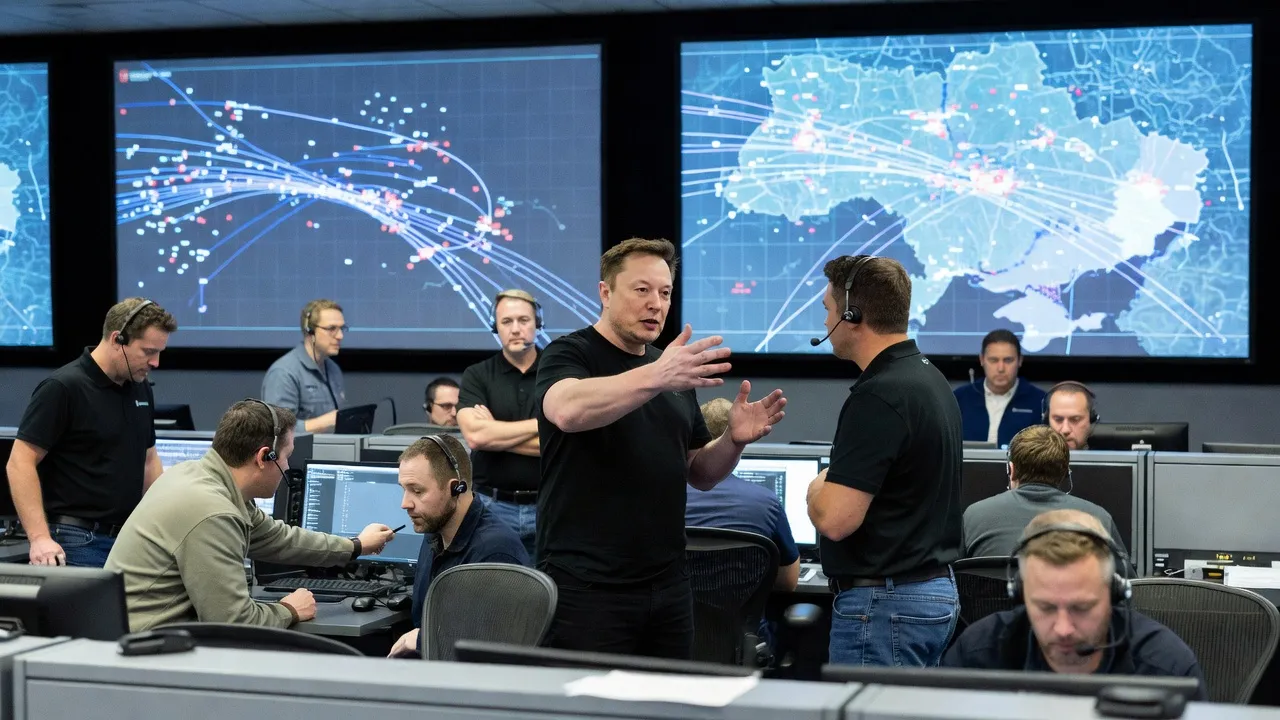
Paris, October 15, 2026. The French press is portraying the episode as a demonstration of dependence. On the night of Tuesday, October 13, to Wednesday, October 14, the operation of certain Starlink terminals was restricted in Ukraine, according to L'Obs. "Tonight, SpaceX imposed a speed limit for Starlink terminals in motion," said Serhiy Beskrestnov, an advisor to Volodymyr Zelensky, adding that the forces had not been warned, "which disrupted several missions." La Tribune specifies that the limit is set at 160 km/h, which SpaceX has not confirmed, and sees it as a "new interference," comparable to the 2022 cut-off in front of Sevastopol.
The military detail is given: the antennas equip drones, including interceptors responsible for shooting down Russian jet-powered drones. According to Beskrestnov, "our partners are depriving us of one of the few chances we have to defend the country." Zelensky speaks of a "big mistake" and assures that "people will die" if Starlink does not function.
Elon Musk responded on X that "Starshield systems are owned and controlled by the US government," that any limitation is decided by the US military "and ultimately by the US president," and that Starlink, a commercial service, remains limited to civilian uses. France 24 notes that the two systems often rely on the same satellite technology. BFMTV and HuffPost put the episode into perspective with the pressure from the Trump administration, which wants Kiev to stop striking Russian oil facilities, and the agreement with Moscow on diesel. A high-ranking Ukrainian official tells AFP that Washington has threatened to stop sharing intelligence; a US official, quoted by RFI, claims that "there is no change."
The French debate is shifting to the question of principle. France 24 asks what happens when a private actor can influence a country's military capabilities, and academic David Galbreath judges the restriction unsurprising after Musk's criticism of Ukrainian strikes on Russian data centers. Above all, the press is exploring the European option: Eutelsat says it is ready to provide more than 600 satellites in low orbit, compared to more than 6,000 for Starlink, and L'Express reports that Orange, Deutsche Telekom, Vodafone, and Telefónica are studying an alliance. "We don't want a single actor to dominate the market," says Michaël Trabbia, from Orange.
SOURCES (8)
- Sud OuestMEDIUM
- HuffPost FranceMEDIUM
- L'ObsMEDIUM
- L'ExpressMEDIUM
- BFMTV InternationalMEDIUM
- La TribuneMEDIUM